I well remember when spectacular Clifton, on Cape Town’s Atlantic coast, served a very different residential community. Among their number were artists, writers and poets. Accompanying them were a few remittance men with a well-developed game of beach bats. Best played on a late summer evening. They lived modestly on land leased cheaply from the municipality. Upon which comfortable wooden bungalows, as we called them, were perched on the steep inclines. Life indeed was a beach for those who somewhat mysteriously had acquired valuable residential rights and easy access to brilliant sunsets.
And then the City did something very sensible. It offered the established residents the opportunity to convert their land leases into freehold at a very attractive rate. And rents and the value of renovated homes then began an upward spiral that continues to this day. And the locals mostly sold up and cashed in their windfalls to be replaced by the rich and not so famous.
The originals preferred not to sacrifice the rental income they would have done owner-occupying, or to delay realising their capital gains. They moved on to other less valuable locations and lower rentals. They traded off consuming what had become less expensive accommodation for more of the other necessities of life. Consistently so given their limited incomes and overweight real estate. And the renovators, demolishers and builders moved in to satisfy those who could afford and consume more valuable homes on Clifton beach. Homes that have proved to be good investments that offset higher rentals and higher real estate taxes levied on the market value of the homes. And also providing a growing flow of revenue from rates levied on the market value of the Clifton Villas for the City.
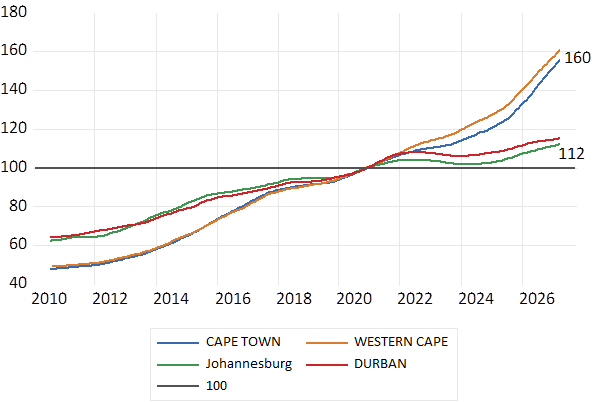
A Clifton type story is now evolving widely in Cape Town and environs. Where rents and property values have been rising and are expected to increase further. High rise real estate developments are well under way to meet the demand for space at rentals high enough to encourage developers and owners to speculate on increases in rentals to come. Providing jobs and incomes way up the supply chain that includes the supply of labour. The average price of a home in Cape Town and the Western Cape has increased by 60% since 2020. In Durban or Johannesburg house prices on average have increased by only 12% since 2020.
Average House Prices in Cape Town, the Western Cape, Johannesburg and Durban. Monthly Data 2020=100
Source; Stats SA, Investec Wealth & Investment
There are however well recognised downsides to a successful City. More congestion for the established residents and visitors. And more strain to deliver water and electricity, refuse collection, roads and flyovers and to fight the fires. The other downside for those who do not own is more expensive accommodation for those who rent for cash. You could live a lot cheaper, rent at much lower rates per sq. metre, in Johannesburg and Durban. Or in the less expensive suburbs of Cape Town.
The answer to the growing scarcity of any good or service, including accommodation, is to increase supply. Build Baby Build. All who travel to inner Cape Town from the North or the South will notice that there is an abundance of undeveloped land close to the City. Turning that low or zero yield land into many more homes is surely possible. The City, by adding at its own expense, the infrastructure to connect vacant land to essential services, would help deliver increased supplies of land for building on. Lower costs attached to land translates into lower prices for the buildings erected on them, given competition. The extra income collected every year from the rates to be charged on the additional housing stock would help re-cover such costs. Investing in infrastructure can provide good long term returns in kind and in cash for a growing City.
Property developments can be made more viable when higher permitted bulk is exchanged for additional so-called social housing as appears to be under way in Cape Town. Accommodation supplied at a subsidised rental for those fortunate enough to win such a lottery. But a number questions need to be answered by social housing. The poor will not be able to afford even heavily subsidised rentals in high rise buildings that have to be well and expensively maintained. The essentially middle-income, or soon to become middle income teachers, health workers and administrators could qualify. But how will they be selected? And will they be permitted to do a Clifton? Rent out or sell up because it makes sense for them to spend less on what becomes expensive accommodation and more on the other essentials.
A successful City armed with a growing stock of taxable real estate can exercise choices with a budget that provides for improved amenities. That in turn add to property values. The tax revenue helps maintain the municipal capital stock and fund additional capacity to meet growing demands. Which supports and reinforces property values that then further improve flows of revenue. A virtuous circle made possible in Cape Town because it avoided being captured by its own officials. A fate suffered by many other SA municipalities.
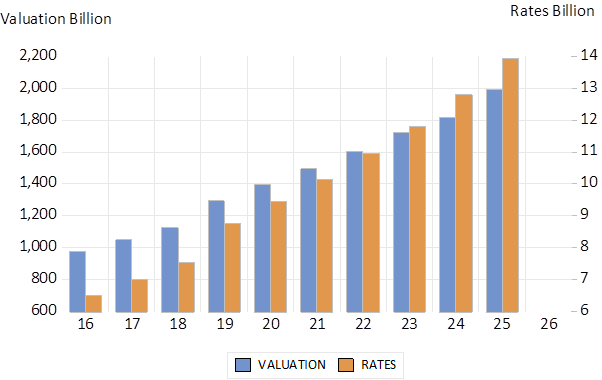
The value of taxed real estate in CT has been rising at an about seven per cent p.a. rate over the past ten years, more than doubling from about 1 trillion rand in 2016 to nearly 2.2 trillion rands in 2025. The average rate of the wealth tax on this property has been a consistently average (0.07%) per month-about 1.33% of property values per annum. Taxes collected on Property have been rising at about the same rate. Also more than doubling from R6.5 billion in 2015-2016 to R13.92 billion in 25-26. The City Budget expects R15.8 of income from rates in the 26-27 fiscal year an increase of 13.7%.
Cape Town- Property Values (Left Scale) and Income from Rates (Right Scale) Annual Data R billions
Source; City of Cape Town Financial Statements and Investec Wealth & Investment
Cape Town can however be charged with spending and funding too conservatively. It should be encouraged to do more with its very strong balance sheet (minimal debt) and rising revenue streams and flows of cash. It could raise debt to add further to its infrastructure- in ways that would further reinforce property values and revenues. More boldness is called for.