The CEO of gold mining company DRD, Mr. Niel Pretorious, made the following commitment when reporting good recent results.
“For the foreseeable future, the company will stick firmly to its preference for funding growth without leaning on debt. DRD Gold has also promised not to lock in elevated gold prices through hedging. The one undertaking that I do give is that for as long as we can, we will remain unhedged, and we will give you full exposure to movements in the gold price…..”
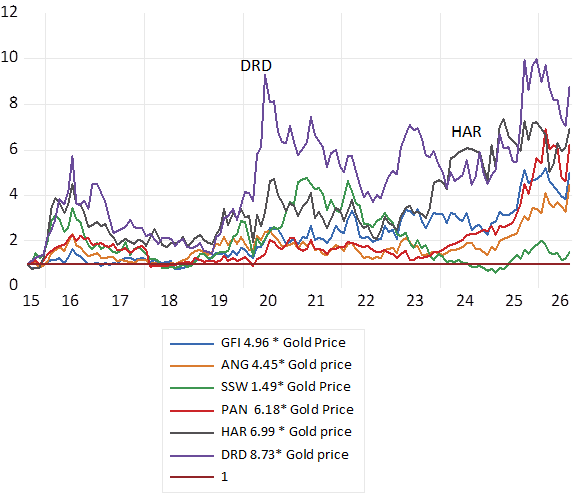
Shareholders in DRD no doubt approve of their exposure to the gold price. They typically hold shares in gold mining companies as a small part of diversified portfolios. They are well hedged generally and appreciate the extra upside gold shares can offer to the gold price. As DRD has succeeded in doing. Since 2015 the value of a DRD share has increased by nearly nine times faster than the gold price itself. Providing more gearing to the moves in the gold price for DRD shareholders than have any of the other gold miners listed on the JSE. At August 2026, the ratio of the DRD share price to the price of gold in ZAR was 8.73 times (2015=1) Since August 2015 this gearing ratio for Harmony (HAR) was 6.99, 6.18 times for PanAfrican (PAN) 4.96 for Gold Fields (GFI) 4.45 for Anglogold( ANG) and 1.49 for Sibanya (SSW)
Ratio of Share Price to Gold Price ZAR; August 2015=1
Source; Bloomberg and Investec Wealth & Investment
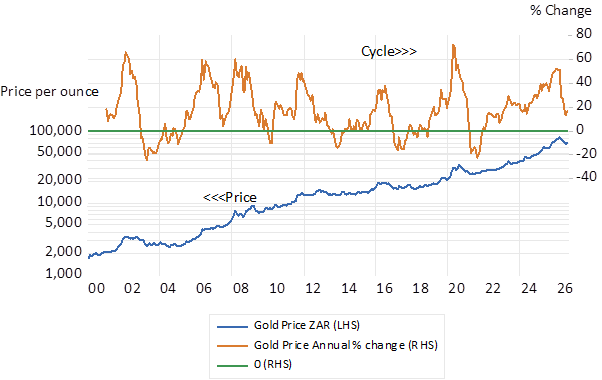
The annual average increase in the rand gold price since 2015 has been an impressive 17.6% p.a. average. There are peaks and troughs in this cycle – though the gold price itself has been on an almost continuous long tear higher since 2000. The annual average increase in the rand price of gold has been 16.9% p.a. since 2000 with few and limited declines. Why do gold mines ever hedge gold price risks? Other than perhaps to secure less risky finance for new ventures – perhaps to diversify – acquiring a copper mine or two – as has Harmony.
The answer is surely because the senior professional managers of any business are mostly much less diversified than their shareholders. The present value of their expected benefits from continued employment will likely far exceed the value of any company shares they may own. Hence their observed reluctance to retain shares awarded to them as a part of their packages. They may be encouraged to join the ranks of shareholders to act like them. But they prefer not to do so because they have a very concentrated interest in the companies they work for. They accordingly are likely to be more risk averse than the average shareholder and so more likely to hedge to help secure their futures. Which is why knowledge of the skin in the game of directors, the value of their shares, may indicate where hedging activities may take the company. There is however one sure lesson in hedging strategy. Keep your shareholders well informed about your hedging strategies, as DRD has done so that shareholders can knowingly choose to share in the risks or not.
Every company will have its own risks to cope with or take advantage of. For example, should South African domiciled businesses hedge their exposure to SA specific risks? Knowing also that their SA shareholders have full opportunity to diversify SA risks, holding a diversified portfolio of shares with foreign jurisdictions. Similarly, their foreign shareholders will also be well diversified and expose themselves to SA risks for the potential upside. Foreign investing in SA is not typically a safety-first decision. As with the miners the interest of shareholders and managers may not be fully reconciled as may be the case with the miners. SA managers may have better reasons investing shareholders capital offshore than their shareholders.
The Gold Price Cycle (% Change p.a.) and the Gold Price ZAR per ounce 2000- 2026; Log scale – LHS
Source; Bloomberg and Investec Wealth & Investment
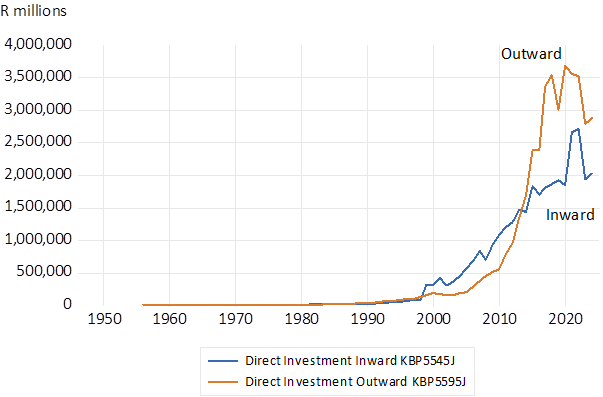
The value of such direct investments inward and outward has grown strongly over recent years from very limited beginnings. Direct Investments by SA businesses have grown to a value of over R3000 billion in 2024- first exceeding inward direct investment of about R2000 billion – in 2013.
South Africa; Foreign Direct Investment by Private Business Enterprises – outward and inward 2000- 2026.
Source; SA Reserve Bank and Investec Wealth and Investment
Direct investment is defined as those made by a controlling foreign investor, one owning more than 10% of the shares in issue. Clearly not all these investments by SA companies abroad have succeeded for shareholders. There have been many conspicuous failures yet also several successes, including recent investments abroad made by the originally SA mining companies.
Perhaps the lessons are well demonstrated by the performance of foreign direct investors in SA. They invest here for its expected return on capital, doing so for the same reasons they invest globally. It is not to diversify exposure to their domestic economies, but much better to profitably scale up the application of their Intellectual Property in the SA market.
SA businesses when investing abroad should not be doing so to diversify SA risk. Shareholders are perfectly capable of doing so for themselves. The understandable interest managers will have in diversifying their SA employment risks, should not be the compelling purpose. The confidence of the managers in their ability to scale up their own Intellectual Property should be the primary motivation – a goal not easily satisfied it should be stressed. Investment decisions should rely on business properties powerful enough to enable them to compete successfully with well-established and capable and well capitalised domestic operators. Without this essential capability the case for investing abroad will be a weak one- that potential and actual shareholders will recognise and resist and value their shares accordingly.