Wealth effects were much larger than income effects in SA in South Africa in 2025. A welcome reality

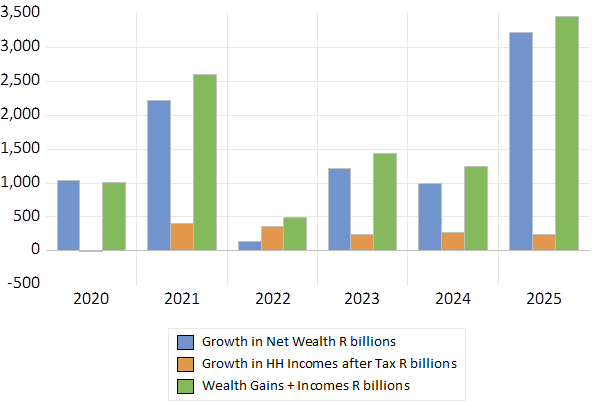
South Africans grew their wealth at a much faster rate than their incomes in 2025. Household assets, less household debt, was 15% larger than the year before. Up by a very tidy R3,200b. The disposable incomes of households grew at a much more pedestrian rate of 4.7% or by R230 billion in 2025. Household spending on consumption goods was 5.7% up on a year before.  A respectable real increase given consumer goods inflation of only 2.2% in 2025, so helping the economy along. Nominal GDP grew by 3.9% in 2025 that lost only 2.8% of its purchasing power delivering real growth of only 1% in 2025

Household Net Wealth and Disposable Incomes (R billion)
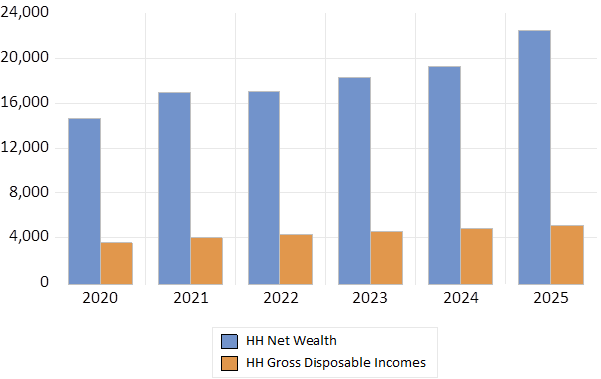
Source; SA Reserve Bank. Quarterly Bulletin and Tables December 2025. Investec Wealth and Investment

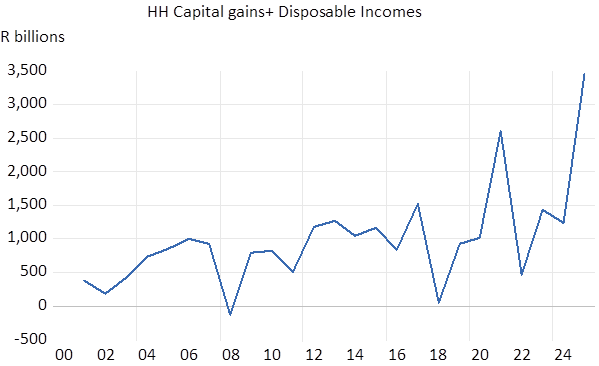
If we regarded the increase in net wealth as income and added it to the disposable incomes of households, the increase in household income, including unrealised capital gains, was close to an imposing 3.5 trillion rand and more than 10 times the increase in disposable incomes last year. The household wealth to disposable income ratio in 2025 was nearly five times- close to the long term ratio.

Growth in SA Household Incomes- including capital gains
Source; SA Reserve Bank. Quarterly Bulletin and Tables December 2025. Investec Wealth and Investment
Source; SA Reserve Bank. Quarterly Bulletin and Tables December 2025. Investec Wealth and Investment

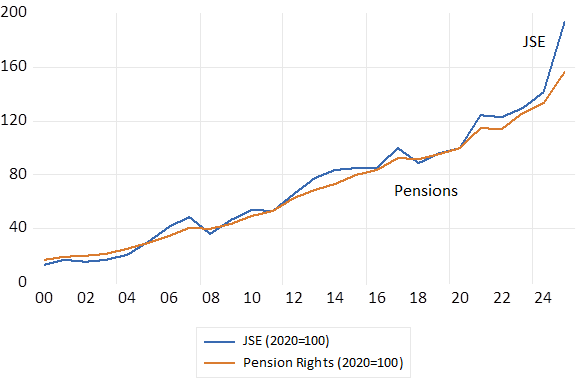
The largest contribution to this impressive increase in the wealth of SA households was the increase in the value of the assets held for retirement. The claims of Households on the pension and retirement funds managed for them amounted to over 9 trillion rand in 2025, having added as much as 1.36 trillion rand to net HH wealth in 2025. Pension fund rights account for about 40% of the net wealth of SA of households and homes about 35% worth about 7.7 trillion in 2025. The value of pension rights closely follows the JSE All Share Index and 2025 was a banner year for the JSE, buoyed as it was by dramatic increases in the prices of precious metals that play a significant role in SA exports and income tax. The JSE returned about 30% in 2025.

Pension and Retirement Fund Assets of Households compared to the JSE (2020=100)
Source; SA Reserve Bank. Quarterly Bulletin and Tables December 2025. Investec Wealth and Investment

The formally employed in SA are mostly required to contribute a proportion of their incomes to retirement and medical aid funds to which their employers often add a contribution which should be understood as a salary sacrifice, not as charity. The share market has served the many employees, who are the owners of SA companies, very well over many years. The shareholders of SA companies, through their pension rights are many and a highly diverse, representative of the work force. They incorrectly do not register as BEE qualifying.

Clearly changes in household incomes that include capital gains are not only much larger than disposable incomes. They are also much more variable,  given exposure to financial market forces. Retirement funds moreover are less immediately accessible than income from work or from dividends or interest income that compounds most usefully when reinvested in retirement funds, rather than when paid out and consumed. Banks will lend when secured by incomes. They are apparently much more reluctant to regard pension fund assets as security for their credit. Is this appropriate, to encourage saving up rather than down? By households many of whom live from paycheck to paycheck and incur expensive debt doing so. Cheaper credit would be very valuable to them.

Though households are drawing increasingly, in as far as they are allowed to by the two-pot system, to cash in their pension fund gains. The number of such drawdowns, repeated drawdowns, have been increasing. Though the amounts drawn down to fund current expenditure given the growth in the market value of pension fund assets has not had a significant negative influence on the funds managed. Favourable wealth effects will have helped to stimulate household spending in SA in 2025 and compensated for a general reluctance or inability to commit funds to capex. For want of business confidence to do so and for want of capacity of SOE’s to do so.

Despite the ubiquity of pension funds for the formally employed the distribution of SA’s wealth has surely been less equal than the distribution of incomes. Especially given that so many South Africans, earn or report no incomes at all and rely on the taxpayers to fund their consumption of private and public goods. So reducing significantly differences in actual consumption if not in earned incomes.

But an inevitably unequal distribution of wealth and of the savings of net income, including capital gains, undertaken mostly by the better off has a major upside. It means more capital for the economy  to fund productive real capital, plant equipment, infrastructure and also R&D. The higher the ratio of capital- that is wealth to the labour force – the higher will be incomes from work. The rich make their contribution not only by producing and earning more (when earned in the old-fashioned honest way not corruptly)  But also by saving more to help fund capex.

Expenditure on consuming goods and services by rich and poor has an opportunity cost. It means fewer goods and services left over to be consumed by others, in the wider community. But saving, accumulating wealth and not spending it all, postponing spending, provides a public benefit. It enables and funds the growth in the real stock of capital. It should be encouraged. As should the incentives to allocate capital domestically rather than abroad.
The best laid plans of mice and men (and women)

March 2026.

Mike Tyson famously remarked that a plan was all very useful until you were smacked in the mouth. The SA economy has taken a snot-klap in the form of an oil price shock accompanied by a further shock in the form of a weaker ZAR. An unexpectedly disappointing development but by no means unprecedented. Oil price and currency shocks have been a regular feature of recent global and economic history. Any helpfully realistic plan for the SA economy should include a credible plan to deal with an oil price or currency shock. Do we have one?

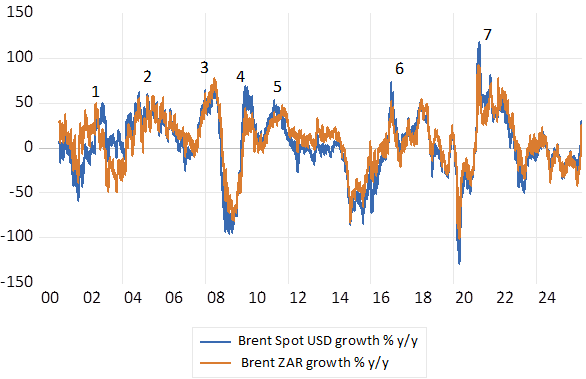
We have often been here before as the oil price cycle in ZAR and USD reveals- though it also reveals that the oil price cycle when measured in USD or ZAR looks very much the same. One can identify at least seven such shocks – in both directions – since 2000. And the stock market reacts in the same direction- share price volatility rises and falls with the oil price. An oil price shock is bad news for SA facing businesses -understandably so – and for their shareholders in pension and retirement funds – because of its negative implications for generating sales and earnings.

Recognising the Oil Price Cycle. USD and ZAR. Daily Data to March 2026

Source; Bloomberg Investec Wealth & Investment

What is our economic plan and how has it been disrupted? The plan is to realise consistently lower inflation ( for all the benefits lower inflation delivers for the long-term growth outlook- easily exaggerated I would add) Yet To achieve lower inflation a helpfully stronger ZAR and stable oil price is essential to the purpose. But both are not at all influenced by SA interest rate settings. The supply side of our economy (the cost of imports) as we painfully observe, is not under our control. Yet the demand side of the economy and its impact on prices can be managed to a degree with interest rate settings.

Policy determined interest rates and the cost of credit for an extended period have therefore been set high enough for an extended period to effectively restrain the strength of the demand side of the economy (to a fault –I would  argue). A mixture of demand repression and very welcome supply side support- stable oil prices and a stronger rand with support from much higher precious metal prices and a weaker USD – has helped bring down inflation in 2025. And led us to an inflation target of 3% p.a.

Though despite the severe monetary policy setting there were some encouraging preliminary signs of a cyclical pick up in credit and money supplies and in household consumption spending. By year end 2025 household spending was ticking higher – by about 1.2% more than the quarter before as were the growth rates in money and credit supplies. And perhaps even more important for a sustained upswing, precious metal prices provided good support for the ZAR, the Treasury and the value of pension and retirement funds of the working and retired South Africans in 2025

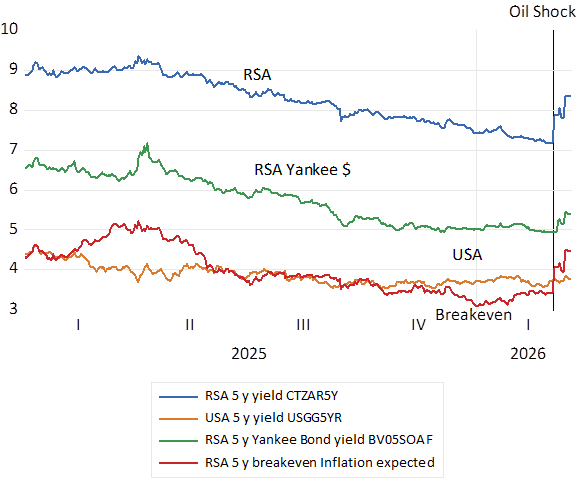
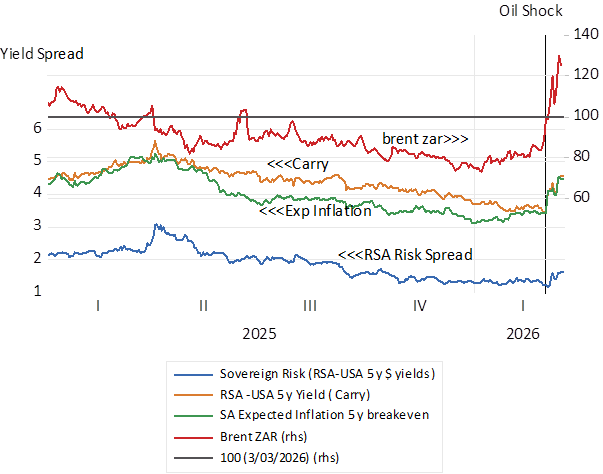
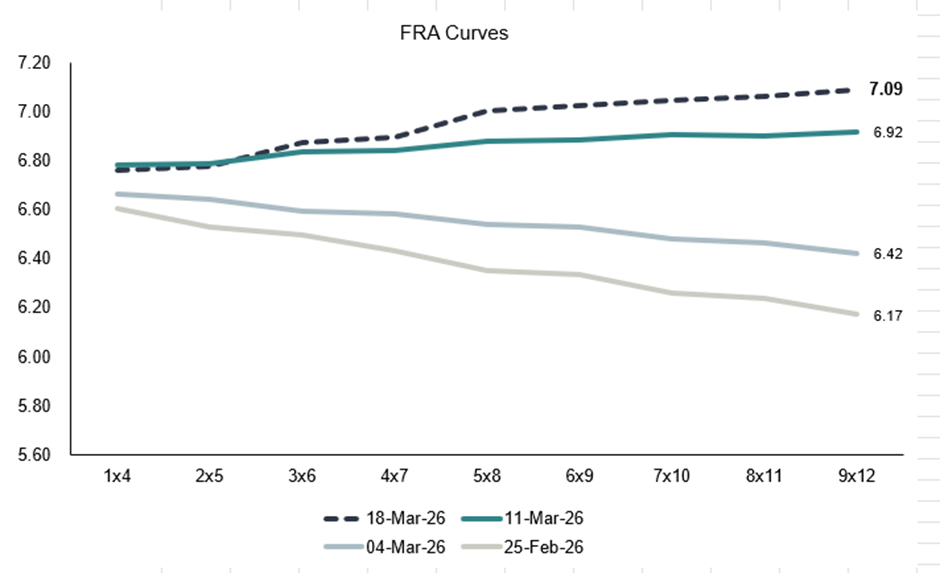
The chance of a cyclical recovery have now receded sharply- on the assumption that inflation will rise and the Reserve Bank will increase rather than cut interest rates over the next twelve months- as was the market expectation until two weeks ago. The money market is now pricing in about 50 bp higher short-term rates in twelve months. The broader bond market view is also anything but sanguine with interest rates rising similarly- though still below levels of a year ago.

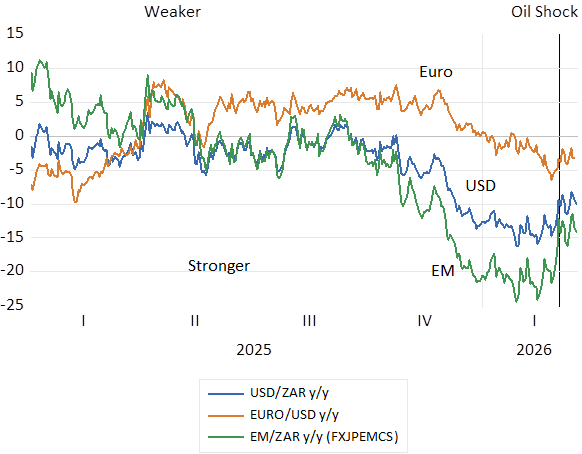
Perhaps realistic expectations but, if they are imposed on a stagnant economy, would surely mean a serious and avoidable policy error. The ZAR, while helpfully little changed over a twelve-month period, has unhelpfully also weakened marginally against the major currencies and other emerging markets.

Forward Rate Agreements in the Money Market

Source; Bloomberg Investec Wealth & Investment

Long dated bonds – five-year RSA and USA Bond Yields and Inflation Expected; Daily Data 2025-March 17th, 2026

Source; Bloomberg Investec Wealth & Investment

Interest rate trends and the rand oil price (March 2026=100) daily data

Source; Bloomberg Investec Wealth & Investment

The Exchange Rate Cycle. The annual per cent movement in the ZAR vs the USD, the Euro and the EM basket. Daily Data to March 17th, 2026.

Source; Bloomberg Investec Wealth & Investment

It is not good sense to raise interest rates when a price shock is already damaging disposable incomes and undermining the willingness and ability of households or firms to spend. Adding higher interest rates to the debilitating impact of higher prices- an oil price tax- on spending – adds to the misery. And can have no impact on inflation expected. Inflation and inflation expected will take its cue from the oil price and the ZAR. And judged by past performance- neither the oil price nor the ZAR can be expected to continue in the same direction into an indefinite future. The rational expectation is that these trends must reverse and inflation trends will reverse in the same direction. Wisdom is for monetary policy to stand aside and let it all work out. The broader plan should include a plan to deal with a supply side shock to prices. A plan that ignores supply side shocks to help the economy ride through impact of a temporary increase in prices. By not raising interest rates and expected to do so.

There is some consolation for dependents on the SA economy in current circumstances. We are not dependent on imported oil or gas to generate electricity, as is Europe for example. Domestic coal is the feed stuff for our energy that also provides a domestic source of chemicals and refined petroleum. And renewables will play a more important role in the future. As will electric vehicles. We should have planned for a reserve of refining capacity but appear not to have done so. Should we now optimistically plan for a more stable oil market, one much less disrupted by choke points in the Middle East?