The highly influential tribe of central bankers gathered in Sintra Portugal last week at the invitation of Madame Legarde, President of the ECB. Some of their leaders, Legarde, Governor Baily of the Bank of England, Maklem of the Bank of Canada and Kevin Warsh, only four weeks into his tenure as Chairman of the Board of Governors of the Fed, agreed to take part in an unrehearsed panel discussion expertly led by Sarah Eisen of CNBC. The Q&A can be found on Youtube [1].
The Mantra strongly shared and proclaimed by the panellists was NO FORWARD GUIDANCE. That is no insights at all were offered on how the central bankers saw their economies evolving over the next twelve months and more. And all attempts to extract such information about the expected direction of interest rates or the size of their balance sheets guidance were firmly rejected with Walsh leading the resistance. Predictably given his already widely shared objections to the public prognostications of his FED colleagues.
And despite his obvious acknowledgment that monetary policy works with “long and variable lags” for which some reliable sense of where the economy might be heading would surely be required when setting interest rates today, to work their magic tomorrow. But if they have such forecasts the central bankers were determined not to have to share them.
The ECB and the BOE have in fact refused to offer forward guidance. For fear that in an unruly world their forecasts might prove embarrassingly wide of the mark and might have to be defended despite their errors. Legarde spoke of the necessity for framework guidance, that is to inform the financial markets of the process of reasoning that informs the ECB. That is to foster a better understanding of what is the “reaction function” of the central bank. Upon which market participants would draw when predicting the direction of interest rates. Something they will continue to do to avoid losses or to make profits when central banks decide to move their key interest rates higher or lower as they are bound to do. Which participants in financial markets will continue to make every effort to anticipate- using all the information they collect to do so.
But Warsh’s resistance to forward guidance- sharing his forecasts- is not based on the chances that the forecast might prove inaccurate. His objection is one of deeper principle. He thinks that the central bank should not look forward. And only observe as accurately as it can the actual current state of the economy to which it reacts with changes in short term interest rates. Which he regards as the most important instrument of monetary policy.
He does not wish the Fed to feed the market with news – to add grist to the hedge fund mill that leads the market – and thrives on uncertainty and accompanying volatility. He would rather have the well-informed marketplace feed him with better and more timeous information about the current state of the economy, to which he could then react appropriately. Removing or spiking up the punch bowl as we used to say. Thus he would wish the Fed to become more, not less data dependent, but with superior data drawn from the current state of the economy rather than to act on unreliable forecasts.
Which is indeed the actual state of monetary policy. In an essentially unruly world monetary policy is in fact very largely data dependent. It reacts to the observed state of the economy as best it can. Though the financial markets will always be driven by expectations of the future and the developments on the financial markets- on share and debt markets – that profoundly influence the real economy through wealth effects – will be forecast dependent. Hopefully such financial market behaviour will be highly rational, rational also when interpreting the reactions of central banks and not blindly momentum driven. Momentum that can easily reverse.
The panel referred to significant changes in the government debt markets. And as seasoned central bankers who survived the GFC are well aware of the risks, the unknowns that might abruptly change the course of financial markets. To which they may be forced to react – having to act outside of their normal lanes – as the phrase goes -in ways that they would prefer not to do. And be correctly blamed for having to do. But such grave potential dangers that might soon call upon all the skills and resolve of central bankers were not top of mind of the panel.
What was top of mind of Kevin Warsh’s mind was clearly AI and its huge promise for the US and other economies. He is aware that the demand side of the US economy is being greatly stimulated by the extraordinary investments being made in rolling out AI. He refers favourably to these impressive real forces rather than financial engineering that is driving the stock markets rather than financial engineering. And he is optimistic about how the supply of goods and services will increase in response over time. He mentioned of this being the most consequential time to be a central banker. I would suggest that having to wait and see these supply side responses makes higher interest rates in the US less not more likely this year.
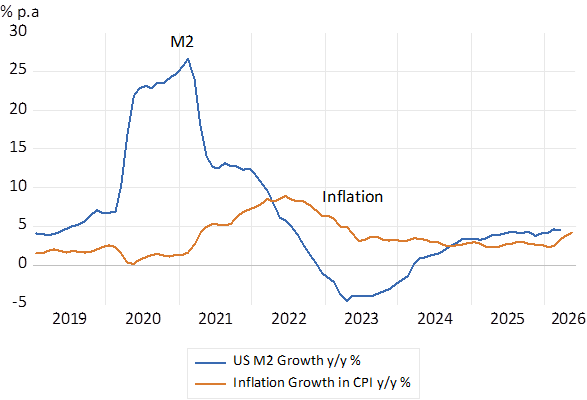
Warsh hopes his six task forces of the best and brightest will help him do a superior job managing inflation and the labour market. Perhaps point the way to superior sources of data about the economy. And hopefully also point to better ways of managing supply side shocks and understanding inflationary expectations that are not simple mindedly extrapolations of past inflation. I was struck by one lacunae in the panel discussion. When asked about the key indicators the central bankers watch or ignore none mentioned the money supply or financial conditions more generally. Perhaps the task force can explain again in an old-fashioned way, why the money supply and bank credit can go a long way in explaining and containing inflation.
US Money Supply (M2) and Inflation Annual y/y % Change