We discuss government plans to encourage beneficiation of minerals. We argue that unwillingness to beneficiate is a market outcome rather than a market failure. We explain that is may well become a government failure as the price of the essential input for industry- electricity- is priced well above its true full cost. We argue against setting the price of electricity in South Africa to protect the balance sheet of Eskom rather than the promote the competitiveness of the economy. Click for full report
Electricity prices
Category: SA Economy
The Rand this Q4 2011
This report discusses the recent behaviour of the ZAR- that is weaker than expected. According to our emerging equity market model of the ZAR. the ZAR is about 9% weaker than predicted by the model- indicaing recent SA specific influences on the ZAR.
For the full report click below
SA Operation Reverse Twist
Bond markets: Operation twist in reverse, or just bowling a wrong ‘un?
The US Federal Reserve System has been conducting operations to reduce the interest yield on long dated US Treasury Bonds, and by so doing attempting to twist the yield curve, that is buying longer dated bonds in order to reduce long term interest rates.
Meanwhile in SA, we are seeing something of a twist in reverse. We will discuss this topic further in this piece, but first some explanation of the US version.
The Fed has been borrowing short from its member banks to buy long dated US government debt. It has committed some US$400bn to the scheme. The Fed owns about US$1.675 trillion of US government debt or over 10% of all US debt in issue. It also holds US$841bn of mortgage backed securities issued by Fannie Mae and Freddie Mac, the government sponsored enterprises that support the mortgage market in the US. The Fed has been buying these securities in the market and the sums paid out have mostly ended up as excess cash reserves (deposits) held by banks with the Fed itself. What the Fed pays out has ended up with the Fed.
Mortgage loans in the US are typically long dated loans for up to 30 years, at fixed rates of interest linked to the yield on long dated Treasuries. The intention of the Fed is to reduce mortgage rates to encourage demand for homes and house prices. By so doing it would encourage a recovery in home building activity. Higher house prices would also help US households recover some of the equity they have lost in their homes.
According to US Flows of Funds Accounts published bty the Fed, the average US home is worth 30% less than it was in 2006. In 2005 homeowners’ equity in their homes (the difference between the market value of their homes and their mortgage liabilities) was worth over $13 trillion. The value of this equity had shrunk to $6.2 trillion by September 2011 and the share of owners’ equity in their homes from 59.8% to 38.6%. The net worth of US households has held up much better than their equity in homes over this period, having declined marginally from over $59 trillion in 2005 to $58.7 trillion in 2011. This represents 5.1 times the disposable incomes of households, which is a very high wealth to income ratio by international standards.
Without a recovery in the housing market, the prospects for US economic growth cannot be regarded as promising: hence Operation Twist. Long term interest and mortgage rates have remained exceptionally low, presumably mostly attributable to the safe haven status of US government debt in a highly risk averse world, rather than to Operation Twist itself or the quantitative easing (purchases of bonds and other securities) already conducted by the Fed.
And so to the reverse
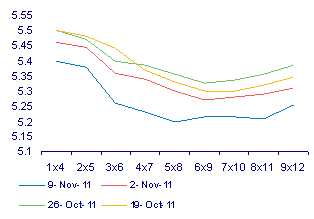
The SA Treasury has also been conducting its own intervention in the market for SA government debt. This may be described as the reverse of operation twist. The Treasury has been very busy extending the maturity profile of RSA government debt, actively buying up short dated government securities before due date and issuing much long dated securities of both the conventional and inflation linked variety. With the yield curve in SA upward sloping and getting more so (see below) this means that for now, or until the yield curve turns flat or negative, the SA taxpayer is paying up to 2% per annum more for its longer term borrowing. This additional expense of servicing interest bearing domestic rand denominated debt of the order of R800bn might well be better incurred helping the poor or giving tax relief to businesses to employ them. Why then the rush to roll over RSA debt before it matures and especially to convert lower interest short term debt to higher longer dated debt, before it is required to do so?
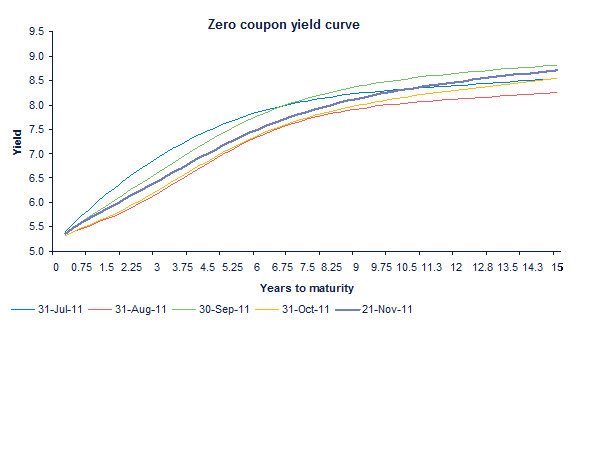
Source: Investec Securities and Investec Wealth and Investment
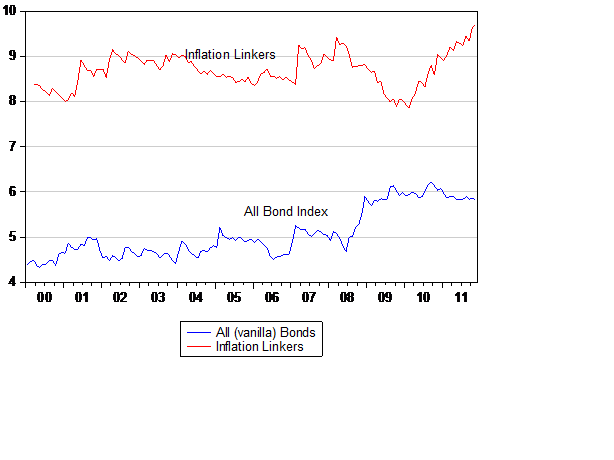
The average duration of SA debt, that is the time it takes for investors to recover their capital through a mixture of coupon payments and principal repayment, has risen significantly over recent years as we show below. Zero coupon bonds issued at a discount have a duration equal to the time to maturity. For debt with a predetermined coupon, the higher the nominal coupon payment, the shorter the duration. The average duration of US government debt is shorter than RSA debt – somewhere between four and five years.
Were these refinancing operations of the SA Treasury being conducted in the vanilla bonds alone, one might conclude that the Treasury, in preferring long to short, had a negative view on the inflation outlook for SA. Borrowing long is a good idea when inflation turns out to be unexpectedly high – borrowing short makes sense when the market overestimates the inflation rate incorporated into long term interest rates.
However the opposite is true when issuing inflation linkers and the Treasury has been especially aggressive converting its short dated inflation linkers into much longer dated inflation linkers. If inflation was expected to rise above expectations, an issuer would much prefer issuing short dated inflation linked securities, rather than the longer dated maturities. These long dated linkers would bring ever higher interest payments and receipts as inflation rose.
At recent auctions the Treasury has been issuing inflation linkers with 20 years to maturity (for example the R202) at real yields of 2.6% to redeem the once dominant R189 that is due to mature in 2013. The R189 is currently priced to offer a negative real yield of -0.07%. Or in other words, the Treasury is now paying out something like 240bps extra to roll over this inflation linked debt, rather than waiting for this shorter term debt to mature in two years time.
Average duration of RSA Inflation and Vanilla Bonds
Why Europe is not a good example
Why then would the Treasury be pursuing such aggressively expensive debt management? Hopefully it is not in response to the difficulties European governments and their debt managers have been seen to have in rolling over their debt with highly bunched maturity schedules. These refinancing difficulties arise because the Greek, Portuguese, Italian and Spanish governments cannot call upon the services of their own central banks to convert, without limit, interest bearing into non-interest bearing government debt- that is to say cash. Their central bank sits in Frankfurt and appears very reluctant to convert longer dated Euro debt into cash. This is not a problem for the US. If faced by any temporary reluctance to bid for longer dated Treasuries, the Fed could come to the rescue with extra cash.
So could the SA Reserve Bank, if called upon, issue rands in exchange to overcome any refinancing emergency that might show up. Rolling over debt can only become a solvency or liquidity problem when the borrowing is undertaken in a foreign currency. Rolling over debt cannot be an issue when the debt is issued in an inconvertible currency that can be created without limit by a central bank should this be forced upon a government with its independent central bank. And most important, the knowledge that in last resort, government debt issued in the inconvertible currency of the land can always be converted in to cash, would surely be enough to fully overcome fears that government debt could not be rolled over. By exchanging cash for government securities (if conducted without limits), a central bank could invoke an inflation problem. However it could also overcome any refinancing problems (as the Italians and Greeks, now without such a fallback position, are fully aware).
There is presumably a case for smoothing what may be bunched repayment schedules for maturing government debt. But there is also a case for anticipating them in advance when scheduling debt, to avoid bunched repayments making such smoothing operations unnecessary in the first place. Paying a large interest premium to do so does not make good sense; nor is long dated debt issued by the RSA necessarily superior to issuing shorter dated debt.
Long term interest rates are the geometric average of expected short rates over the same period. To think otherwise is to second guess the market in fixed interest and there is little reason to believe the issuers of debt have superior insight about the direction of interest rates than lenders have. There are however some unintended consequences of longer duration: the longer the duration the more responsive the All Bond Index will be to unexpected changes in interest rates. Adding risks to fixed interest rate bonds in general discourages demand for them.
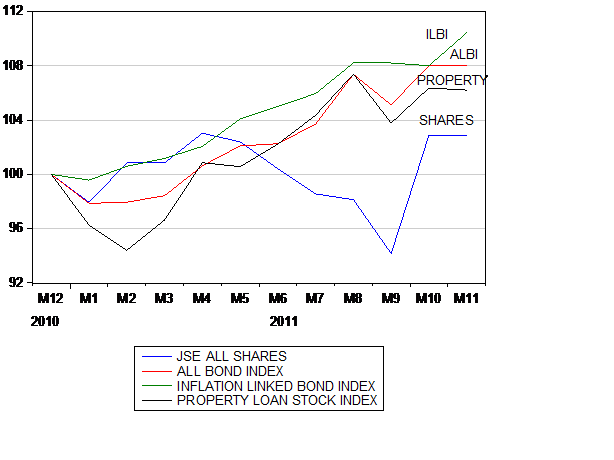
Furthermore the recent debt management operations in the inflation linkers (which have meant additional demand for them) have made this class of bonds an outperformer over the past year. Is the SA Treasury, in its urgency to substitute long dated for short dated RSA securities (to avoid what it regards as potential embarrassments in the debt market), misreading the nature of the Euro debt problems – at the expense of the SA taxpayer? Brian Kantor
Asset Class Performance 2011 to November 18th
Earnings are growing strongly in Europe – despite slow growth
Alexis Xydias and Adria Cimino report for Bloomberg today that
“Net income for companies in the Stoxx Europe 600 Index will rise by 10.5 percent in 2012 after increasing 11 percent this year, led by carmakers such as Porsche SE and retailers including Burberry Group Plc, according to more than 12,000 analyst estimates compiled by Bloomberg. The gauge is headed for four straight years of income growth exceeding 10 percent, the longest streak since 1998, data show”, and that European profit growth
“….. will exceed the 10.1 percent estimated for U.S. companies, even though the economy in the 17-nation euro zone is expanding at one-third the pace….”
The reason that profits are growing much faster than nominal GDP in Europe and the US is that the dominant European and US companies increasingly depend on revenues and profits generated globally. Emerging market economies are doing much better and growing much faster than developed economies. They are playing catch up adopting proven technologies and through the absorption of labour from low productivity employment in agriculture to much more productive engagements in factories that fully participate in global supply chains without push back from trade unions protecting established workers. Yet wages are rising rapidly as competition for workers builds up. And these fast growing economies have not yet made promises of welfare benefits funded by taxpayers that are now proving impossible to fulfil. The cloud on their economic horizons is a meltdown in demands from Europe and perhaps the US- where the economic outlook now looks a lot more promising than a few months ago. The opportunity these rapidly emerging economies have is to rely much more on domestic rather than foreign consumers.
It is these same consumers in the emerging economies that are already proving so helpful to the profits of companies listed in Europe and the US. The willingness of these profitable global companies to add productive capacity and to employment in their home economies would be greatly assisted by a sense that their own governments are coming to grips with the necessity to spend less so as to grow faster and in this way overcome their debt problems
SA economy: Moody’s can do some good
The mood may have changed even if the SA economic facts have not. But the Moody’s negative watch can do SA good without doing any harm.
Moody’s has raised legitimate concerns about the risks facing economic policy makers in SA that will resonate strongly with observers not only outside but also inside government circles. The question one would have to ask is what is especially new about these threats to SA political and economic stability. Perhaps the Moody’s decision to put SA’s credit rating on negative watch tells us more about the changing world of credit and especially for credit rating agencies than it is does about the direction of SA economic policy. What is clearly especially galling to the Treasury is that Moody’s appears to have been unimpressed by the strong affirmation of the conservative fiscal policy settings outlined by Finance Minister Gordhan in his speech to Parliament in October backed up in his recently issued Medium Term Budget Policy Statement. The government has planned to maintain the ratios of government revenue and government expenditure to GDP, to reduce debt to GDP ratios and to give greater impetus to capital formation rather than improved benefits for those who work for or depend on government.
The populist threats to the conservative setting of fiscal policy or the all-important role played in the economy by privately owned businesses, both domestic and foreign, are not new and will remain an ever present in SA, as they will almost everywhere else (Switzerland perhaps excepted and Wall Street Masters of the Universe not excluded) . The greatest risk to stability in SA is slow rates of economic growth that frustrate ambitions of individuals and firms and the financial capacity of the public and private sectors. This can lead to attempts at quick fixes by politicians.
The rating agencies have long been very well aware of these dangers to the impressive conservative fiscal and monetary policy directions taken by the new SA. Aware enough, that is, to have made SA’s ascent to an investment grade credit status a long hard ride. It is this status that has now been put on negative watch by Moody’s (though not by Standard and Poor’s). But Moody’s was not entirely negative in its judgment. It did not derate RSA credit, for the following reasons as we quote below from its statement:
“To date, South Africa’s fiscal picture and economic policy parameters have remained generally in line with Moody’s expectations, hence the continued A3 rating. The South African authorities’ economic stewardship has been effective for more than a decade, during which time they brought public finances and inflation under control and significantly bolstered the country’s external liquidity position. In addition, meaningful progress has been made in raising living standards, expanding social services and physical infrastructure, and putting in place a financial support mechanism for the most underprivileged. Finally, the outlook for South Africa’s public finances has not diverged significantly from Moody’s projections when the country entered into recession in 2009, roughly the time of Moody’s last sovereign rating action, despite the rather sluggish economic recovery over the past two years….”
The Moody’s rationale for a negative watch on RSA credit went as follows and is highly deserving of serious attention especially by those in the tripartite alliance inclined to believe in quick fixes or the magic wands that are meant to provide well paid jobs for all (that current policies applied to regulate the SA labour market have so singularly And conspicuously failed to do), a fact of SA economic life well recognized incidentally by Minister Gordhan in his policy review.
To quote the rationale:
“The primary driver behind Moody’s decision to change the outlook on South Africa’s government ratings to negative is the rising pressure from society at large, as well as from within the ANC and its political partners, to ease fiscal policy in order to address South Africa’s high levels of poverty and unemployment. In Moody’s view, spending beyond the substantial amounts already budgeted in response to such demands could push debt to levels more commensurate with lower-rated sovereigns. South Africa’s direct debt and guarantees for state-owned companies’ obligations currently approach or exceed 50% of GDP. Moreover, a substantial proportion of the government budget is already absorbed by wages, social support and debt service, limiting the room for new growth-supportive spending.
“Secondly, Moody’s is concerned that economic growth will be somewhat slower than previously expected in the years ahead due to a weaker global economy, depressing any rebound in South African employment levels over the coming years. This would in turn aggravate existing frustrations over the lack of economic opportunities. Moreover, job creation in this environment would not be enough to absorb new entrants to the labour force nor reduce the already high levels of unemployment. In Moody’s opinion, this situation poses risks to political stability over the longer term. Thirdly, Moody’s believes that the political leadership’s unwillingness to definitively reject demands from certain segments of the political spectrum for more activist policy interventions is harmful to South Africa’s economic prospects, in particular private investment. The agency also says that nationalisation of the mines and/or other sectors — however unlikely to happen — would not achieve the stated aim of accelerating progress on black economic transformation. Instead, such moves are more likely to do the opposite, reducing the country’s attractiveness to both local and foreign investors, and encouraging the outward migration of citizens and businesses. Such actions would in turn raise the risk premium on government debt, further inflating the already-rising costs of debt service. Overall, Moody’s believes that the next two years will be especially challenging for South Africa’s political system, with the potential for further pressures emerging for the established economic policy framework during this period.”
The most important factor restraining growth in SA over the next 12 months are not the structural weaknesses of the SA economy or the populist threat to property rights and fiscal policy settings. It is the European government debt crisis and the threat it poses to global growth and sothe demand for SA goods and services, including services supplied to tourists. The behaviour of the rand and so the outlook for inflation and its impact on interest rates paid on debt issued by the RSA is completely dominated by these global forces. RSA specific political or monetary policy influences on these important influences on the growth outlook and the willingness of SA firms and households to invest or spend are conspicuously absent. It is not the Moody’s watch that moved the rand yesterday but higher yields on Italian government debt.
Hopefully these facts of economic life have been well appreciated at the Reserve Bank sitting today to decide on the repo rate. As the Monetary Policy Committee (MPC) of the Bank pointed out in its latest statement, the SA economy is being held back by a lack of foreign and domestic demand. The short term outlook for the global economy has deteriorated. The outlook for the domestic economy is not conspicuously improved, at least according to Moody’s. The Reserve Bank can only hope to stimulate domestic demand by lowering interest rates. It cannot expect to have any predictable influence on foreign demand or the value of the rand (and so on the outlook for inflation) with its interest rate settings.
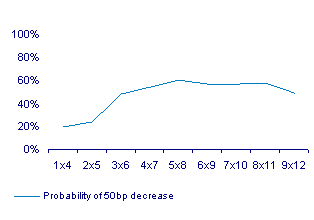
That lowering interest rates might do some good in promoting essential economic growth and so reducing SA risks (without doing any harm in the form of more inflation) should make a decision to cut interest rates an obvious one. If it was not altogether obvious at its last September meeting, it should be obvious today. And the Moody report would, it may be hoped, have made it even more obvious: the risks to the SA economy are not inflation (over which the Reserve Bank has no influence in the short term) but to growth, over which interest rate settings may have some influence. However the market place yesterday was not expecting a 50bps cut. This is despite the short term Forward Rate Agreements having shifted significantly lower over the past week, raising the probability of a 50bps cut to over 50% within three months. The probability of a cut today was still only about 20%.
We can hope the Reserve Bank will get it right and that the market has misread its better intentions. Brian Kantor
Hard Number Index: Noteworthy change
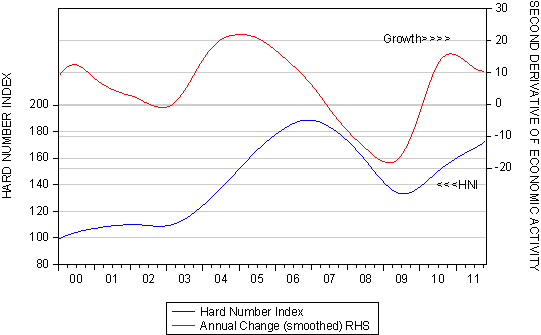
The economic signs from the Hard Numbers in October (vehicle sales and the note issue) provide some encouraging confirmation of the improving state of the SA economy.
The Hard Number Index of Economic Activity in South Africa (HNI) continued its upward trajectory in October. This indicates that the economy – based on two hard numbers for October, unit vehicle sales and notes in circulation – maintained a positive rate of growth in October. The direction of the economy (forwards or backwards) is shown by the HNI: when it moves higher the economy is moving ahead; when lower it is going in reverse. The economy, according to these up to date and hard numbers, is clearly moving ahead. The speed at which the economy moved ahead in October may however have slowed down, as we show below.
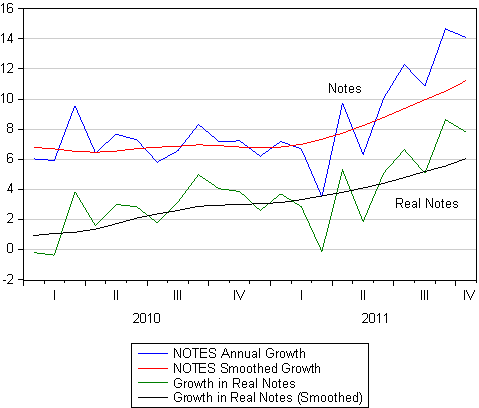
The changing speed at which it moves forward is indicated by the growth in the HNI. The speed of the economy slowed because vehicle sales in October 2011, while very strong compared to a year before, were down on September sales that were extraordinarily strong that month. However the other half of the HNI is made up of the notes issued by the Reserve Bank. These are issued in response to the demand for notes by banks and the public adjusted for the CPI. These growth rates have picked up very strongly in recent months. (See Below)
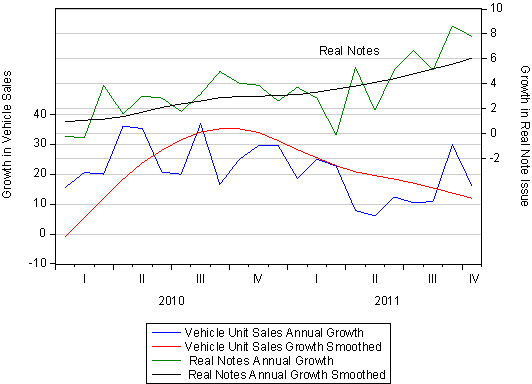
It may be seen below that the demand for and supply of notes has picked up significant momentum this year and that the pace at which notes are being issued is accelerating. Notes are held by banks in their branches and ATM machines and by the public in their wallets and purses to facilitate their spending intentions. It would therefore appear that at month end October, spending was gaining momentum. These trends will have to be confirmed but only much later by official estimates of retail activity. The most recent statistic of this kind for the retail sector is only for August 2011. These latest indicators confirm for us that the economy, after a slower patch in the second quarter, has picked up momentum.
The Reserve Bank however has never seemed to regard the narrow or broader definitions of the money supply and its growth as an objective of policy or of interest rate settings. Its decisions to lower short term interest rates at its meeting this week not are unlikely to be influenced by the accelerating growth in the note issue. Furthermore the growth in broader money (to September 2011) remained rather modest when viewed on a year on year basis. This may be so, but if interest rates are cut this week, this may add some pro-cyclical impetus to monetary policy. Brian Kantor
Money supply and credit growth: Confirming a more positive picture
Money supply and bank credit numbers have been updated to September 2011. The year on year growth rates have recovered from their cyclical lows of late 2009 but appear to have stabilised in the 6% range. Broadly defined money supply covers almost all of the liabilities side of the balance sheets of the banks; while credit extended to the private sector accounts for almost all of the assets held by banks and so the growth rates are bound to be almost identical.
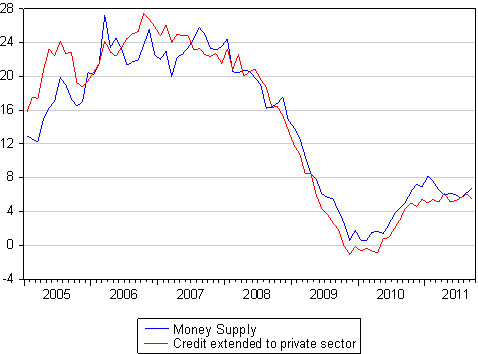
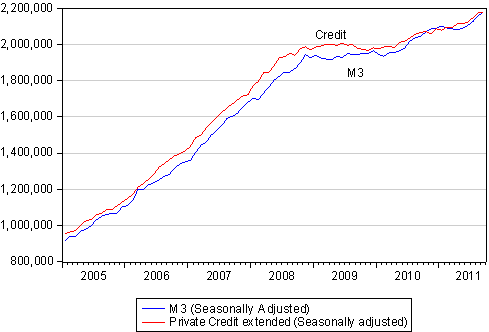
A closer look at the bank statistics over the past three months reveals a somewhat more encouraging picture. On a seasonally adjusted basis both money supply (M3) and bank credit have picked up momentum.
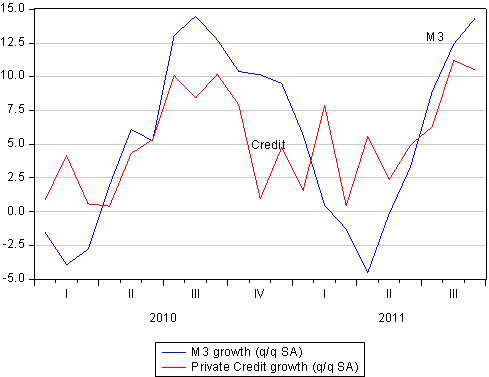
When these statistics are converted into a rolling quarter to quarter annualised rate of growth we observe a strong recovery to growth rates of +10% from the slower rates of growth realised earlier in the year.
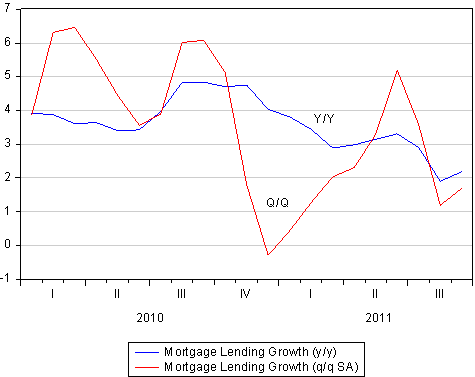
Mortgage credit demanded and supplied (accounting for about half all bank lending) however remains highly subdued, with growth rates tending lower rather than higher. House price inflation leads mortgage credit supplied and it would appear that the housing market remains in the doldrums.
The money supply and credit trends confirm our impression from vehicle sales, activity at retail level and the growth in the narrowly defined money supply (notes in circulation) that the SA economy has rather more life in it than is perhaps generally recognised. We await data on the note issue and vehicle sales in October, due to be released this week to give us a more up to date impression of the current state of the economy.
Retail sales: Share prices may be telling us more than retail sales
The volume of retail sales in August 2011, reported yesterday, was over 7% ahead of August a year before. This would seem to represent quite robust real growth in the top lines of SA retailers. However a year is a long time in economic life and especially in the retail business for making sales comparisons. Even a week and especially a week around Easter or more so Christmas when sales are highly concentrated may prove to be a very anxious and long period to wait for reports from the tills.
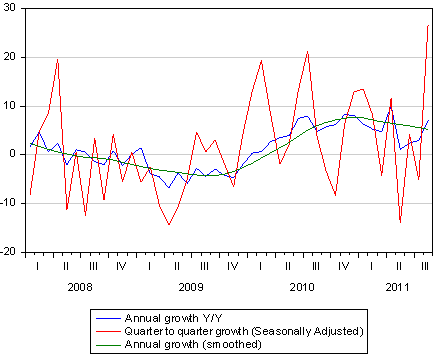
In the figure below we show annual and smoothed annual growth in retail sales volumes. As may be seen, these trends appear to be pointing lower. However when we seasonally adjust sales on a moving three month period these quarterly growth rates spiked significantly higher in August – providing a much more encouraging signal about sales growth.
This growth in sales may well have been assisted by a low rate of retail inflation. Retail prices are 3.25% higher than a year before while on a seasonally adjusted basis retail prices have risen by only 1.33% over the past three months. The annual rate of retail price inflation has ticked up while the quarter to quarter rate has slowed down.
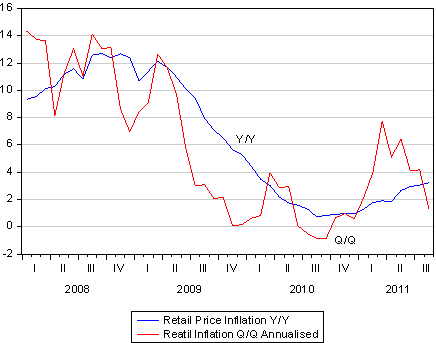
We show below that retail prices have been rising at a significantly slower rate than prices in general, the inflation of which has been much augmented by higher administered prices, that are taxes on consumers by another name. In a real sense these price trends have made retailers more competitive for the household budgets strained by higher charges for electricity and petrol.
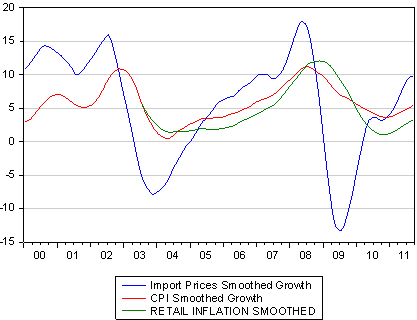
However as we also show prices in general, including at retail level, follow the trends in the prices of imported goods. Imported goods represent the cutting edge of competition in SA and so the prices of imports lead prices lower and higher as the exchange rate strengthens or weakens. The state of global supply and demand is also reflected in the US dollar prices paid for imported goods. Lately the rand has weakened as have commodity prices on expectations of slower global growth.
The net effect has been a rising trend in the prices of imported goods that may not reverse until the rand recovers some of its lost ground. The outlook for inflation in SA has deteriorated accordingly but it is not an inflation rate that the SA Reserve Bank or higher interest rates can have any influence over. The case for higher interest rates can only be made when the upward pressure on prices emanates from excess domestic spending rather than temporarily higher prices driven by a weaker rand.
Despite a satisfactory state of demand at retail level, the SA economy deserves encouragement rather than discouragement from monetary policy settings. It would appear that the Reserve Bank remains of this mind, despite the usual genuflection to the inflationary dangers of inflationary expectations (for which there is simply no SA evidence).
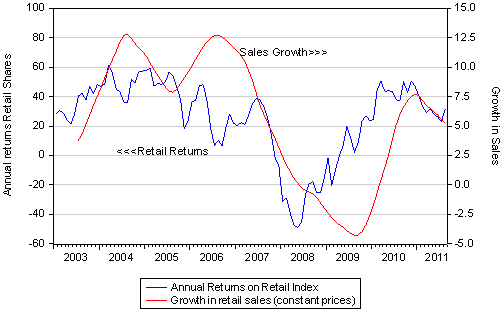
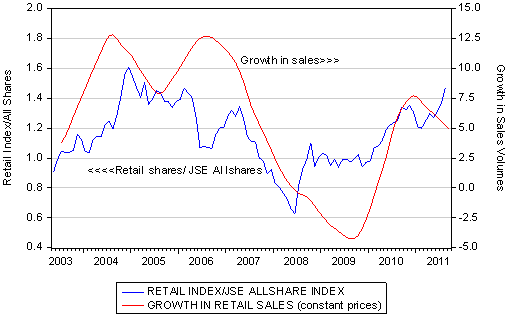
A further source of encouragement for the view that retail sales are growing consistently well is the performance of the SA retailers on the JSE. As we show below the returns on the JSE General Retail Index have provided a very good leading indicator of retail sales volumes. Returns have picked up recently, as may be seen below. As may also be seen, such positive signals of retail sales volumes and the earnings to follow are provided by the outperformance of retail shares. Retailers have been doing significantly better than the JSE as a whole. Thus the prices attached to the shares of retailers (especially relative to share prices in general) may tell us more about the state of retailing in South Africa, and in a much more up to date way, than the retail sales statistics themselves.
The Hard Number Index: Better than might have been expected
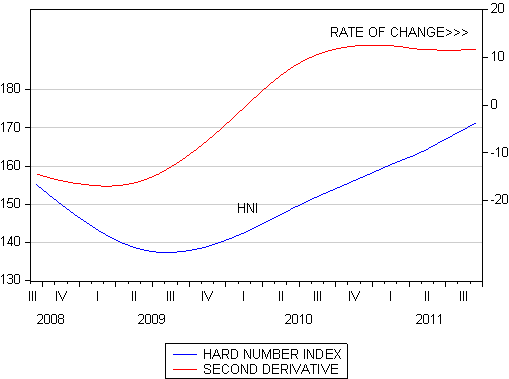
The official numbers for notes in circulation at 30 September, as well as new vehicle sales for September 2011 have been reported, allowing us to update our Hard Number Index (HNI) of the state of the SA economy. According to the HNI, economic activity in SA maintained its faster momentum in last month, at more or less a satisfactory constant speed as we show below. Given that many commentators had been expecting decelerating growth, this outcome must be regarded as good and encouraging economic news. The SA economy has, according to our HNI, headed in the direction of faster rather than slower growth in the third quarter.
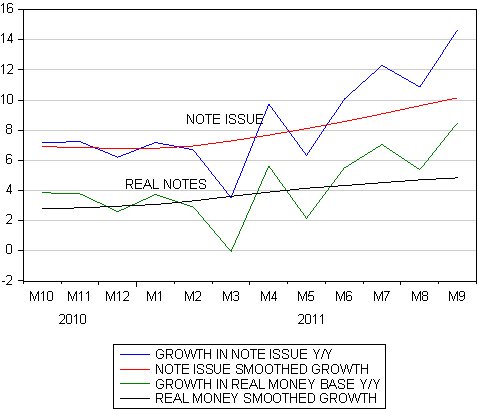
We had noted in our previous report that the supply of and demand for notes had picked up momentum in August. The note issue is a very good indicator of spending intentions by consumers and one that is particularly useful as an economic indicator because it is so up to date. The growth in demand for notes continued to increase in September with actual growth rates now well above 10% p.a with the growth trend accelerating rather than decelerating. These growth numbers, when adjusted for inflation, are also revealing a marked upward bias. SA households would appear to be willing to increase rather than rein in their spending.
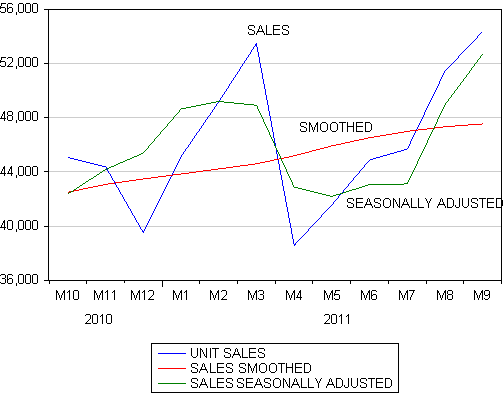
New vehicle sales in September also revealed a robust growth trend. The growth trend in new unit sales, which had weakened in the second quarter, has reversed course very decisively. On both an actual and seasonally adjusted basis, new vehicle sales have headed higher. Also encouraging is that export sales have remained very strong at nearly 26 000 units sold while the demand for commercial vehicles, particularly heavy vehicles, is showing especially strong growth. This indicates a willingness of SA business to add to its capacity to produce goods and services. Brian Kantor
Hard Number Index: Has the gloom been overdone?
With the release of unit vehicle sales and the size of the note issue for August 2011 we are able to update our hard Number Index (HNI) of the state of the SA economy. As we show below the HNI confirms the SA economy is maintaining its growth momentum. The HNI for July and August 2011 show very little change. The economy appears to moving ahead at a constant speed.
The HNI is an equally weighted mix of vehicle sales and the notes in circulation, adjusted for inflation. The vehicle sale cycle has turned lower – while still indicating good growth. As we reported previously vehicle sales in August recovered well from July 2011 levels – however this pickup in sales was not enough to reverse the declining growth trend.
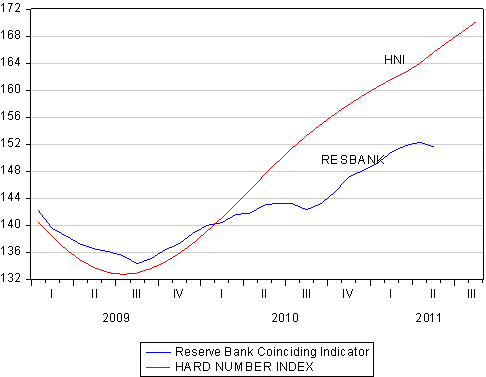
As we also show, the HNI provides a much more up to date measure of the current state of the SA economy than the Business Cycle indicator, released by the Reserve Bank (which is only updated to May). As may be seen the HNI and the Reserve Bank Indicator tuned up in the same quarter of 2009. It may also be seen that the Reserve Bank indicator turned lower in May 20011; though the subsequent progress of the HNI strongly suggests that this economic activity indicator will have followed the HNI higher since then.
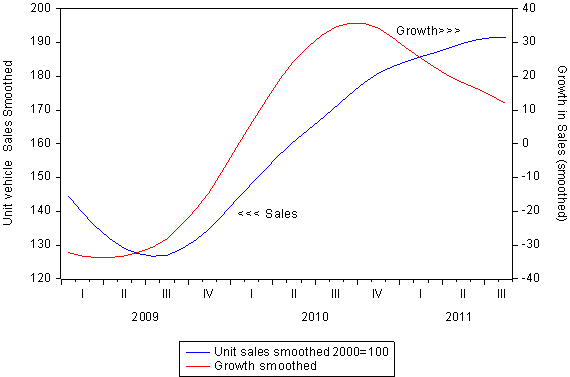
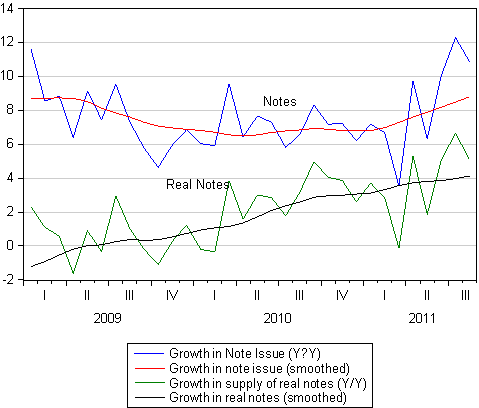
However what was negative for the HNI on the vehicle front was made up almost completely by the strength in demand for extra notes by the public and the banks. Adjusted for inflation, this growth in the note issue has picked up good momentum as we show below. This trend must be regarded as a very helpful one for the SA economy. Growth in the demand for and supply of notes indicates an improved willingness of the public to spend more. It has proved to be a very good indicator of the state of the SA economy. It suggests that the gloom about the prospects for the domestic economy may be overdone.
New vehicle sales: Business boost
The producers and distributors of new vehicles enjoyed significantly improved trading results in August 2011. Domestic sales were up to 51 436 from 45 686 units sold in July 2011. On a seasonally adjusted basis this represented an impressive increase of 5 471 units in the latest month after flat to declining sales on a seasonally adjusted recorded after March 2011. This recovery, if sustained, would see monthly sales of between 46 000 and 48 000 units to August 2012. This would be regarded as a very satisfactory outcome for the largest contributor to manufacturing output in SA.
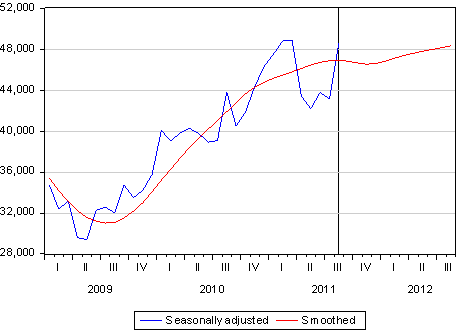
The recovery in August 2011 sales arrested but did not reverse the declining growth trend that became apparent earlier this year.
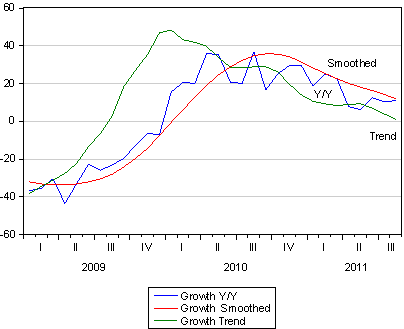
Sales to businesses, including passenger car sales to rental car companies, new light commercial vehicles, bakkies and minibuses, were particularly strong, while sales of medium and heavy trucks were especially buoyant in August. Export sales of 24 835 units were recorded in August which must also be regarded as satisfactory given uncertainties about the sate of the global economy.
Vehicle sales thus continue to be one of the SA economy’s brighter spots. That growth in demand seems now to be coming more from the investment decisions made by businesses is very welcome given the weakness to date in the willingness of the private sector to add capacity.
Vehicle sales, house prices and credit: Operating below potential
New vehicle sales in South Africa in July rose from 44 880 in June to 45 703 units sold. On a seasonally adjusted basis this represents a marginal increase of about 70 units. As we also show below, the new vehicle cycle has clearly peaked and if present trends continue the level of new vehicle sales will remain more or less at current levels and growth will turn marginally negative (off its higher 2011 base) by early 2012.
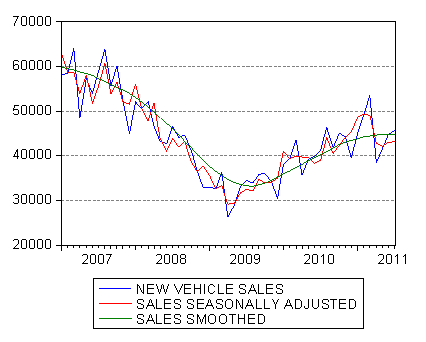
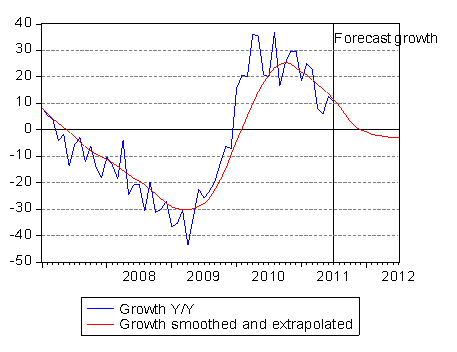
In 2010 SA Households increased their spending on durable consumer goods by 24% off a very depressed base. This growth in the first quarter of 2011 was maintained at a very robust 21.5% annual rate helped by particularly buoyant sales of new vehicles in March 2011. The impetus provided to the SA economy by increased sales of new vehicles and perhaps also sales of other durable consumer goods, is losing momentum.
Such lack of momentum is also revealed by very tepid growth in the supply of bank credit and money to June 2011, a trend confirmed by the results reported by the retail banks this week. The revenue line of the SA banks is growing very slowly because house prices and so demands for additional mortgage loans have increased at a very modest rate and growth in the supply of money and credit may be slowing down rather than picking up.
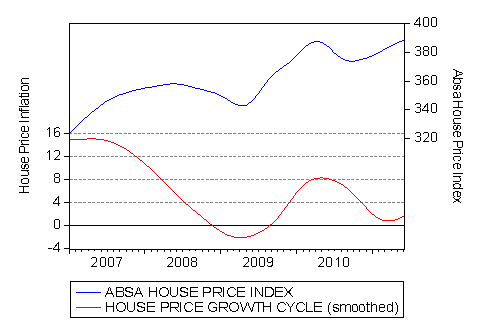
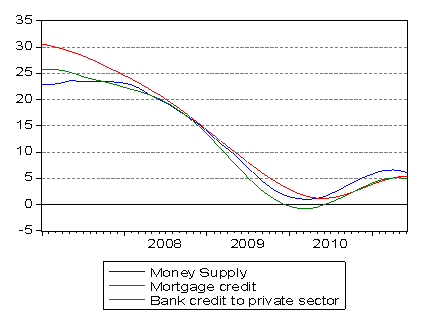
These trends in vehicle sales, house prices and credit and money supply suggest that the SA economy will operate below its potential for some time to come. The potential stimulus to growth from the global economy and exports now also seems less likely to provide additional strength to incomes and employment. The MPC after its July meeting told us that it had not even considered lowering interest rates only raising them- a temptation that was strongly resisted as we were also told. Given these updates on the SA economy it should have considered lowering interest rates
US earnings: The benefits of going global
A Wall Street Journal Report today by Kate Linebaugh and James Hagerty, Business Abroad Drives U.S. Profits, points to way foreign operations of leading US corporations have contributed to the very satisfactory second quarter earnings season now well under way in New York. One third through the earnings reporting season for the S&P 500 companies, earnings are the highest they have been in four years.
These S&P 500 earnings per share may well exceed $100 for the 2011 calendar year. The drivers for this earnings growth however, as the report points out, is not the struggling US economy, but the off shore operations of these companies.
About three quarters of the companies that have reported so far have done better than analysts expected. As the WSJ report states, “…Many of them – ranging from manufacturers Honeywell International Inc. and Caterpillar Inc. to drug maker Abbott Laboratories – raised their earnings forecasts for later in the year.
The report refers to the bellwether industrial giant GE that reported a 21% increase in earnings to $3.8bn for the second quarter. Yet US revenues in GE’s core industrial businesses shrank about 3.4% while international industrial revenue soared 23% to $13.4bn, accounting for about 59% of the company’s total industrial revenue. This translates into growth in capital expenditure and employment offshore rather than on US shores making the US economic recovery less likely to benefit from the financial strength of US corporations, many of whom have a strong global footprint.
We have been firmly of the view that the most compelling way to gain exposure to the global economy is via the companies listed on the S&P 500. The valuations of these companies appeared very undemanding of earnings growth, trading as they do well below their average price to trailing earnings multiples (which averaged as much as 21 times between 1980 and 2011). The current trailing S&P 500 earnings per share, calculated before higher second quarter earnings have been reported, is US$81.31. This puts the S&P on a trailing 16.5x earnings and a prospective forward PE of under 14 times earnings to be reported in the first quarter of 2012.
This advice has proven apposite as we show below. Since 1 January 2011, the S&P 500 has gained almost 7% (to 23 July) while the MSCI EM is flat and the JSE in US dollars is 2.5% weaker than on 1 January 2011.
However as we also show, S&P earnings year to date have significantly outpaced the share market index, adding to the case for investing in the S&P 500. We remain firmly of the view that the S&P 500 is still very undemanding of future earnings growth and even less demanding than it was. And the unsatisfactory state of the US economy can be expected to continue to keep down interest rates in the US (and so the competition for equities from fixed interest income)
To view the graphs and tables referred to in the article, see Daily Ideas in the Daily View: Daily View 25 July
Employment: The annual strike (that is the loss of jobs) season is well under way
The annual strike season is well under way. The usual well above inflation increases are being demanded accompanied by the usual marches, highly rhythmical toi-toing and some violent intimidation of workers, less inclined to put their jobs at risk. And after losses of production and presumably also of wages, management and unions settle on still significant increases above recent inflation rates.
The season might well be called the season of further loss of permanent jobs in the formal sector of the economy. Wages and benefits improve for those who keep their jobs, while management are strongly encouraged to proceed with operating strategies that rely less and less on unskilled labour and more on capital equipment employed.
The outcomes are plain to see in the ever widening gap between output growth and formal employment growth. This has become ever more conspicuous after 1995, due to more onerous regulation of the SA labour market (for management).
The labour saving logic practised by management is sensible enough – including their willingness to concede well above inflation increases. The logic driving union action is less obvious to those outside the ranks of union leaders and presumably their generally supportive rank and file who seem to appreciate a good fight with their bosses. One might be inclined to think, given the long established employment trends, that the leaders would rather wish to encourage employment (perhaps of their sons and daughters) and so union membership and the dues they collect with less militancy and less aggressive demands for more. Clearly there is something else at work that makes union militancy, rather than co-operation, the action that keeps the union leadership in their jobs. And so the history repeats itself: higher real employment benefits, fewer formal sector jobs and productivity gains to compensate for more expensive labour.
Shareholders by contrast have no reason to be immediately concerned about these trends, unless they fear, as they may well, the instability threatened by the growing divide between those in good jobs and those increasingly excluded from gaining access to them. But this is an issue that the management of any one firm cannot address. The reality is that management teams have adopted labour saving or especially unskilled labour saving policies that have proved to be consistently profitable and can be expected to continue to be profitable.
Over recent years the share of operating surpluses in the gross value added by the SA corporate sector has if anything tended to rise while that of employees (including managers) in the form of wages in cash and kind has tended to fall. In other words operating profits have been improving despite higher wages for those who hold on to their jobs.
The share of the operating surplus in the value added by non-financial corporations in SA and their gross cash savings is shown below. As may be seen it is a much improved picture, especially in the form of cash flow generated by these firms that has no doubt added to balance sheet strength and added value for shareholders.
The issue confronting the firms, the unions and SA generally, is how these cash flows and profits should best be employed – in reducing debt, paying dividends, making acquisitions or (much more helpfully) for economic growth adding to capital equipment or workers employed.
The answer for SA is obvious enough to all – more jobs. The uncomfortable truth is that management has no good reason to alter its ways. They are reacting to the fact of economic life in SA that the real cost of capital, in the form of a lower risk premium paid by SA firms, has come down materially, given a most helpful political transformation. Over the same period their real cost of hiring labour has increased materially.
It would seem obvious to all but those who find it convenient to deny the relationship between employment levels and employment benefits. That is to say. in the interest of more formal jobs, it is the unions that need to become less militant and more co-operative with management. The unions need to promote employment by encouraging the adoption of policies that would make for a more flexible labour market and a much more mobile labour force that could adapt appropriately to the state of the economy. Maybe only an economic policy Codesa will lead to this.
To view the graphs and tables referred to in the article, see Daily Ideas in the Daily View:
Daily View 21 July
Gold is for the risk averse, gold shares for the risk loving
The gold price in US dollars and in rands has moved ever higher while JSE listed gold shares have moved mostly sideways over recent years. The explanation seems obvious enough. The cost of mining gold in SA has risen every bit as rapidly as the price of gold while the volume of gold mined in SA has declined consistently with these higher costs and the lower grade of ore being crushed. In 1970, before the price of gold escaped the constraints of the gold standard that set the price at $35 or approximately R27 per troy ounce, SA mines produced over 600 metric tonnes of gold a year.
SA gold mines now produce fewer than 200 tonnes of gold a year and this output is falling. The only consolation in this sad tale of events is that presumably the US dollar and rand price of gold would be a lot lower had SA continued to produce as much as it did before.
But the hope that the gold mines will be able to take advantage of the higher gold price in the form of profits and dividends seems to rest eternal. Investors have consistently paid up more for the dividends actually paid by the gold mines. Currently the mines are selling at 122 times their trailing dividends or at a dividend yield of less than a third of one per cent. Gold mining accounting earnings follow no consistent pattern and have often been negative in recent years. For the record , the JSE Gold index reported earnings per share have been positive over the past 12 months and the share prices are on average 315 times their trailing earnings.
The hope clearly implicit in these extraordinary market ratings is that gold mining companies will some day, maybe soon, be able to get more valuable gold out of the ground at greatly improved margins. This makes gold shares the ones with the longest odds in the equity markets. This taste for risk may well continue to provide support for gold shares for some time to come. Presumably the risk lovers assign only a small proportion of their portfolios to this gamble.
Accordingly the relationship between the gold price (much higher) and gold shares (sideways) is therefore a very weak one and may remain so until the mines actually deliver much improved dividends. Since January 2008, for every one per cent daily move in the rand gold price, the JSE Gold Mining Index has moved on average by only 0.42% (the so called gold price beta). However the gold price explains only about 7% of the daily move in gold shares over this period. There is clearly much more than the influence of the gold price at work on gold shares. The gold price expressed in US dollars does only a marginally better job explaining the JSE Gold index (in rands) with a beta close to 0.75 but still with very low R squared or explanatory power of 0.16%.
Gold shares are clearly only for the risk lovers. Gold itself however would have served the risk averse very well over this period. This is because, on average, when the market was down the gold price was up and vice versa. The correlation between daily moves in the JSE All share and the rand gold price was a negative (-0.16). Negative correlations of this order of magnitude provide outstandingly good risk reducing diversification benefits for portfolio managers. The correlation between daily changes in the rand gold price and the S&P 500 in US dollars has been even more negative (-0.44). Thus for South Africans with exposure to developed equity markets, gold would have provided especially good insurance. For the offshore investor the correlation of daily changes in the dollar price of gold and the S&P 500 was close to zero (0.04) over the period indicating that gold would also have provided very good insurance for the US dollar investor.
Past performance may not be a guide to future performance. But if the past is anything to go by the case for investing in gold, especially for South Africans, has been greatly strengthened while the case for investing in gold shares remains at best unproven.
To view the graphs and tables referred to in the article, see Daily Ideas in the Daily View:
Daily View 20 July
The Hard Number Index: Satisfactory but not improving
Economic activity in SA expanded in June, but according to our Hard Number Index of Economic Activity (HNI) the pace of growth may well have slowed marginally rather than picked up momentum.
Our HNI attaches equal weights to two very up to date hard numbers, namely new vehicle sales for June, as released by NAAMSA, and the size of the note issue as at the end of June. The HNI may be compared to the Coinciding Indicator of the SA Business Cycle calculated by the SA Reserve Bank. This indicator, with a very similar lower turning point for the current cycle, is however only updated to March 2011, leaving it well behind current economic events.
Vehicle sales began a very strong recovery in late 2009. Sales of all new vehicles were particularly strong in March 2011. Actual sales that month were 53 478 units, which, since March is usually a very good month for vehicle sales, translated into a seasonally adjusted 50 101 units. Since March 2011 vehicle sales have fallen back significantly from these levels, though sales in June were modestly up on those of May. On a seasonally adjusted basis sales had fallen from the over 50 000 units sold in March to 43 108 units sold in May and recovered to 44 359 units sold in June 2011. The vehicle sales growth cycle appears to have declined significantly with the current annual growth trend around the 10% annual rate, perhaps to recede further.
We have mentioned before that the Combined Motor Holdings (CMH) share price has consistently provided a very good, even leading, indicator of the state of the new vehicle market. This relationship appears to be holding up with the CMH share price having peaked late last year, consistent with the peak in the new vehicle cycle.
While the news about vehicle sales may be regarded as somewhat less encouraging about the current state of the SA economy, the demand for and supply of notes in June is somewhat more encouraging. The Reserve Bank, when it issues notes, satisfies the extra demands of the public for notes, presumably to spend, and from the banks for cash reserves, presumably so that they are able to lend more. Banks in SA do not hold excess cash reserves of any magnitude and so the supply of notes, adjusted for cash reserve requirements, is equivalent to the money base of the system, adjusted for cash reserve requirements, or what is also described as high powered money. This makes the note issue a reliable coinciding indicator of economic activity, with the great advantage of being a highly up to date indicator.
The growth in supply of notes to the economy slowed down consistently between early 2009 and early 2011. This growth cycle appears to have picked up momentum recently. The slower growth in the supply of notes, until recently, was however offset by lower inflation, providing scope for acceleration in the growth in the real supply of notes. This growth was necessary to sustain the economic recovery under way. Now a mixture of slightly higher inflation and slightly faster growth in the note issue has helped stabilise the real money base cycle at about a four per cent rate.
If the economy is to sustain a growth rate that is still below its potential or sustainable rate, a further increase in the rate of growth in the demands for cash, well ahead of inflation is called for. No help in this regard can be expected from lower interest rates. SA does not (alas) engage in money supply targeting or quantitative easing. However it may be hoped that any increase in short term interest rates will be postponed until the demands for and supply of bank credit and the demands for the banks and the public for more cash indicate a clear case for tightening. The case for tightening based on the most recent money supply and credit numbers remains, a very week one. Faster growth in the supply of narrow money, broad money and bank credit deserves encouragement.
To view the graphs and tables referred to in the article, see Daily Ideas in the Daily View:Daily View 13 July
The economy: Steady as it goes
The Reserve Bank Quarterly Bulletin published yesterday has provided further detail on the highly satisfactory performance of the SA economy in the first quarter. Household spending growth has led the economic recovery and was sustained in the quarter at an above 5% rate. Government consumption spending also grew strongly.
The weakest spot in the economy remained the reluctance of the private sector to add to its plant and equipment. However the consistent run down in inventories had come to a natural end in the fourth quarter of 2010 and a sharp buildup in inventories, from highly depressed levels relative to output saw Gross Domestic Expenditure (GDE) rise by over 8% at an annual rate, much faster than Gross Domestic Output (GDP) that as was previously announced grew by 4.8% in the quarter.
If one is to draw a bottom line on the update provided by the Reserve Bank, it is that the economy is growing satisfactorily enough led by household and government spending. However if these growth rates are to be sustained and improved, as must be the objective of policy, the economy needs a stronger commitment by business to additional capital expenditure and to the provision of more employment. More formal employment would help the housing market and highly depressed construction of housing activity that is labour intensive. A business friendly approach by government and its agencies seems to be an essential and urgent requirement for economic and employment growth.
The almost stagnant money and credit numbers indicate very clearly the lack of demand for plant and equipment and for new homes. They also confirm that the economy is not yet operating at what might be regarded as its growth potential. The balance of trade, including the weakness in demand for imports, also confirms that the economy could be growing faster (given easy access to foreign capital on favourable terms). There is moreover little indication that the economy is picking up momentum.
The concern rather, given recent trends, must be that the economy could easily lose momentum (depending in part on the uncertain state of the global economy and demands for exports). The fragility of business confidence could be another negative influence. The best monetary policy could do in the circumstances, would be leave interest rates well alone and unchanged.
To view the graphs and tables referred to in the article, see Daily Ideas in the Daily View:Daily View: The economy: Steady as it goes
Industrial and employment policy: A new dawn or a false dawn?
The long awaited subsidy for Job Creation has become a reality. The Jobs Fund will make available R9bn over the next three
years as a subsidy for jobs to be created and encouraged with R2bn available this financial year. The fund will be administered by
the Development Bank (DBSA). It will be “…targeted at established companies with a good track record and plans to expand
existing programmes or pilot innovative approaches to employment creation, with a special focus on opportunities for young
people..” (Q&A, Media Briefing, Houses of Parliament, 7 June 2011).
The four areas of focus are Enterprise Development, Infrastructure Investment, Support for Work Seekers and Institutional
Capacity Building, including internship and mentorship programmes. The focus seems broad enough to cover almost any aspect
of business activity.
The approved programmes will be “..cost and risk shared by participants..to ensure real ownership..” In other words, private sector
participants will have to provide matching funds on a 1 to 1 ratio. A reduced own contribution is intended for “non-private sector
applicants” These would include municipalities and public enterprises. It may presumably include NGOs and their like. Applications
must be made by 31 July for funding this year.
The scheme will clearly be employment creating among the ranks of the consultants. It should prove particularly welcome to firms
with well established training programmes. “Support for Work Seekers; assistance with job search, mobilisation and enhancement
of training activities, support for career guidance and placement services” (Media briefing) will surely prove a boon to the well
established and much maligned labour brokers. The statement above reads like an accurate description of their business model.
The SA government is trading off a significant proportion of its corporate tax base for new industrial projects and subsidies for
employment. In addition to the R9bn Jobs Fund the newly defined s12i Tax incentives are backed by a 2011-12 Budget allocation
of R20bn. These are by no means trivial amounts in absolute terms, or relative to all the tax collected from SA companies. It would
be of interest to know the proportion of company taxes paid by manufacturers. Would it be as much as R20bn allocated in the
2011-2012 Budget?
In the 2010-11 Budget estimated revenue from companies was R150bn or 24% of all estimated tax revenues of R643bn. The SA
government’s dependence on income from companies is unusually large. In many other tax regimes the corporate tax rate may be
comparable to the rates levied on company profits in South Africa. But when taxes actually paid are reduced by investment and
many other allowances provided by government to stimulate investment and job creation, the effective (economic) tax rate
becomes much lower than the nominal company tax rate.
SA is following this route. More subsidy and allowances provided for companies, in one way and another, tax concessions and job
subsidies included, that lead to less tax paid and a lower effective tax on business profits. No doubt these lower taxes paid will be
very welcome to businesses that are able to engage skilfully with the system.
If however the path of government spending is to remain unaffected, as would appear likely, the taxes saved or the subsidies
provided to the companies that benefit, would have to be made up by taxes collected from other taxpayers. This must mean
increased taxes on consumption expenditure or on individual incomes; or companies outside the sectors favoured by industrial
policy will be forced to pay up for the benefits provided to industry.
The SA government clearly thinks, as do governments almost everywhere, that it can do better than simply providing an
encouraging tax and regulation environment for business in general. It clearly believes it can pick the winners in the industrial
space rather than leaving the investment and employment decisions to participants in the market place on a field levelled by
equally generous tax treatment, irrespective of the designated activity and location in which it takes place.
It would promote economic growth in SA if more generous investment or depreciation allowances were offered to business in
general rather than those judged particularly worthy by the bureaucrats involved. This would encourage companies to save and
invest more of their after tax earnings or cash flow. Investment allowances reduce the taxable income of companies, leading to
less tax paid and more cash retained and invested. This would lead in turn to more output and employment. But this is an
argument for lower business taxes in general rather than for particular benefits or subsidies.
One has to question the ability of the government through the Department of Trade and Industry (DTI) or any other of its agencies,
the Development Bank or the IDC, to pick the winners, without fear or favour, among the many proposals that are bound to be
made to it. As indicated there will be a great deal of taxpayer’s money at stake.
The government has proved itself much more capable of raising tax revenues than spending them effectively. The subsidies or tax
concessions will surely add to industrial output and employment. But we will never know how much better the economy might have
done and the employment created had much less discretion been exercised over tax concessions or subsidies. As the saying goes if you want more of something subsidise it, if you want less tax it. SA is doing both – extracting more tax from some
employers, employees and consumers, while subsidising other businesses and their employment decisions more generously.
The government through the DTI (and organs like the competition authorities) seems to show a marked and regrettable lack of
respect for the creative powers of private businesses. The simple recipe for economic growth is one that relies on businesses
directed by their owners and senior managers, to pursue their self interest, constrained essentially by the competition provided by
other businesses for their customers, workers and providers of capital. Economic history has surely proved that the recipe works.
But governing best by governing least does not serve the interest of ambitious policy makers. There is a constant flow of new
regulations and intrusions that SA business has to manage which adds to their costs and reduces their competitiveness with
imported goods. There moreover appears no popular ground swell of support for activist economic policies. The impetus seems to
come directly from officials and their consultants.
The poor protest about the lack of delivery of basic services by government not about the lack of delivery of basic goods and
services by businesses. SA Business, unlike the SA government, delivers very effectively. It would deliver more jobs if the labour
market were less heavily regulated to encourage them to do so.
Industrial policy and the Job Fund have become an expensive and counterproductive alternative to sensible, employment growth
encouraging, de-regulation of the labour market. The intervention by the competition authorities in the employment and
procurement decisions to be made by Massmart and Wal-Mart provide an obvious case in point and a further example of
government officials thinking they know better how business should be run in the interest of more employment. The goods and
services market has been made less competitive to make up for the lack of competition in the labour market. The employment
problem is one of the government’s own making, acting as it has done to entrench the rights of established workers, at the
expense of potential entrants to the ranks of the formally employed.
The government and its officials will no doubt point to the jobs gained through subsidy and perhaps also compulsion to employ
more labour demanded of the government departments themselves and publicly owned enterprises. The jobs lost because of
higher taxes and job destroying regulation will be much less obvious and ignored to the great disadvantage of the poor in SA who
need jobs – not handouts to lift them out of poverty.
The solution to the failures of the SA economy, or rather its formal businesses to provide jobs would seem obvious to all but those
with an interest in the status quo – the trade unions and the officials who write and implement interventions in the labour and other
markets of the economy. This is to rely less on government and its regulatory, taxing and subsidy powers and more on private
business to deliver more of the essential goods and services demanded in a modern economy.
To view the graphs and tables referred to in the article, see Daily Ideas in the Daily View: Daily View 8 June: Industrial and employment policy: A new dawn or a false dawn?
Global markets and the rand: Not all bad news
The flow of disappointing US economic data continued with the Payroll report of Friday that reported a gain of 54 000 in May, well below the monthly average gain in 2011 of 182 000, and an increase in the unemployment rate from 9% to 9.1%. The unemployment rate was not all bad news as, according to the US Survey of households, an extra 272 000 workers joined the labour force only partly offset by a 105 000 increase in household employment.
More people entered the labour force, presumably because they thought they could realistically find work, but not all did so. Hourly earnings in the US are rising very slowly, by 0.1% in April and 0.3% in May. With little growth in wages, any perceived inflationary threat from the labour market has dissipated, providing further reason for postponing higher interest rates and hence the weaker US dollar.
Not all the recent news about the US economy was bad, The ISM non-manufacturing index that covers 90% of the US economy rose from 52.8 to 54.6, marginally ahead of consensus. Numbers above 50 indicate growth. More encouraging was that the employment component of this Index rose from 51.9 to 54, consistent with payroll growth of 175 000, and faster than that indicated by the official payroll report.
The weaker numbers and their implications for low interest rates for longer weakened the dollar and strengthened the euro and emerging market currencies, including the rand. This made the week a better one for US dollar investors on the JSE and emerging markets generally than it was for investors in the S&P 500, that after an extended period of outperformance lost ground to emerging markets last week.
The rand during the week had turned out to be a particularly strong emerging market currency. The rand made gains not only against the US dollar, the euro and the Aussie dollar but also gained about 3% against our basket of other emerging market currencies.
It would appear that the rand had gained from the approval of the Competition Tribunal of the Wal-Mart / Massmart deal after having weakened relative to the Aussie dollar and other emerging markets in the weeks leading up to the decision. SA specific risks, that is policies more or less friendly to foreign investment, would appear to have a modest influence on the exchange value of the rand in recent weeks. The more important influence on the rand will remain those emanating from global markets in the form of commodity prices and flows into emerging market bonds and equities.
The news from the commodity markets was not unsatisfactory as prices held up, helped by the weaker US dollar. The oil price in US dollars was largely unchanged.
The stronger rand and the more uncertain outlook for the US and global economy weakens further the case for higher interest rates in SA. This has been partly recognised in the bond market with a downward shift of the term structure of interest rates. The probability of an increase in the repo rate this year receded the week before last but remained largely unaffected by the news last week.
The US equity markets are undemandingly valued relative to earnings and interest rates and have become less so this past week. The weaker data disturbs the outlook for future earnings as the performance of the S&P 500 this past week made perfectly clear. The key to the outlook for the US economy and the equity markets will be the willingness of US business to put their strong balance sheets to work hiring workers and buying equipment.
The confidence of US business would be greatly assisted by the belief that Washington will deal effectively with the US Budget and US government debt. Any sense that China is loosening rather than tightening its monetary stance will be very helpful too.
To view the graphs and tables referred to in the article, see Daily Ideas in the Daily View: Daily View – June 6: Global markets and the rand: Not all bad news
Vehicle sales: Not much vroom
Naamsa released its new units sold statistics for May 2011 yesterday. The numbers are not encouraging. April 2011 was a poor month for sales, especially when compared to sales in March 2011, and the fall off in monthly sales, when seasonally adjusted, continued in May as we show below.
The sales quarter to quarter and seasonally adjusted have fallen sharply from a very strong March 2011 as we also show. The growth in sales is now barely positive, compared to a year ago, which is a long time in the motor dealing business, and in fact negative on a three month moving quarterly basis as may also be seen.
Making the seasonal adjustment for two months with an unusual number of public holidays, including the Easter holidays that fell in April, has no doubt complicated the analysis of the underlying cyclical trend. Holidays are good for shopping malls but not vehicle show rooms. Also adding complexity are disruptions in the supply chains that start North of Tokyo. Is it a relative lack of demand or an inability to supply that is holding back sales? The Naamsa explanation quoted below appears to attach some (though not major) importance to negative supply side forces.
“..During May, 2011 – constraints on the availability of components from Japan impacted on the production of certain product lines in South Africa and, together with shortages of various models sourced from Japan, this would have contributed to the slow down in the rate of growth in the new car and light commercial vehicle sales cycle for the month. These factors would also have contributed to lower aggregate industry exports. It was anticipated that the supply position would normalize over the medium term..”
Our own interpretation is that the peak of the vehicle cycle has been reached and the growth trend is now a significantly lower one. The market for new vehicles seems to be stabilising at a monthly pace of approximately 47 000 new units sold, well below the heady pace of 60 000 units sold at the peak of the previous motor vehicle cycle of early 2007. That is to say, year on year growth in December 2011 on December 2010 will be about 5%.
The current and projected level of vehicle sales help confirm our impression of an SA economy that is growing satisfactorily, but that the growth is not accelerating. There would appear to be no danger of excess demand materialising any time soon.
The economy, on the basis of these May vehicle sales and the April credit, money supply and house price data, appears to be taking longer to reach its growth potential than previously thought. Moreover the risks have increased recently that the global economy will not support export volumes and prices strongly enough to help take up the slack in domestic demand over potential supply. The danger of a global slowdown has risen in response to signs of slowing rather than accelerating growth in the US. The case for higher interest rates in SA, in the light of domestic vehicle sales and exports of vehicles, has weakened further.
To view the graphs and tables referred to in the article, see Daily Ideas in todays Daily View: Daily View 3 June: Vehicle sales: Not much vroom