Banks and shadow banking: Out of the shadows

Should we be frightened of our banks and their shadows or should we rather learn how to deal with banking failure?

Shadow banks rather than non-bank financial intermediaries

A new description – shadow banks – has entered the financial lexicon. The term is, as we may infer, is not used in a positive context. Rather it is to alert the public to the potential dangers in shadow banks, as opposed to the presumably better regulated banks proper.

This is a use of language consistent with one of the dictionary definitions of the word:

A dominant or pervasive threat, influence, or atmosphere, especially one causing gloom, fear, doubt, or the like: They lived under the shadow of war.

Or perhaps alluding to shadowy, defined as:

1. full of shadows; dark; shady
2. resembling a shadow in faintness; vague
3. illusory or imaginary
4. mysterious or secretive: a shadowy underworld figure

 Source:  www.Dictionary.com

An older, less pejorative description of this class of financial institution or lender would have been non-bank financial intermediary or perhaps near-bank financial intermediary to describe those firms that closely resembled banks in their lending activities. Examples are mortgage lenders (once called building societies), insurance companies, pension funds, money market funds and unit trusts, all of which would have fall under the modern description, shadow banks.


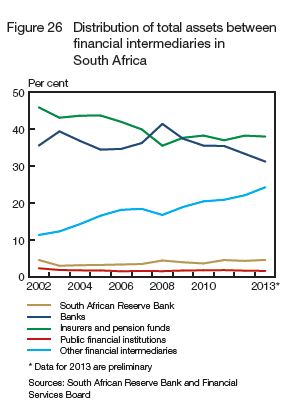
As we show below, drawing on the March 2014 Financial Stability Report of the SA Reserve Bank, the share of SA banks in the total business of Financial Intermediation in SA has declined over the past few years while the share of other financial intermediaries (including money market funds and unit trusts) has risen consistently, also in part at the expense of pension and retirement funds


Source; SA Reserve Bank Financial Stability Report, March 2014

The role of financial intermediaries is to facilitate the capital providing and raising activities of economic actors, domestic and foreign. They stand between (intermediate) the providers of capital in the economic system, be they households or firms, and those raising funds, to cover (temporary) financial deficits, that is, other households and firms and government agencies needing finance. They also compete for financial custom with those providers and users of finance who might bypass the financial intermediaries completely and deal directly with each other.

Such activities may be described as disintermediation when, for example, a firm previously dependent on bank finance bypasses the banks and issues its own debt or equity in the financial markets. The subscribers to such issues may however well be other financial intermediaries, for example pension funds, in which case  it is the banks that will have been disintermediated.


Why banks are different from all other financial intermediaries

What then makes banks different in principle from other financial intermediaries? It may be in the detailed manner in which they are regulated, as we indicate above. But pension and retirement funds are also subject to particular regulations and regulators designed to protect providers of capital to them as are the managers of money market funds or unit trusts.

Banks are different not because they borrow and lend (or, more generally, raise and provide capital); they are different fundamentally because an important part of their function is to provide, via some of the deposit liabilities they raise, an alternative to the cash provided by the central bank that can be used for transactions, in the older terminology, as a much more convenient medium of exchange . In so doing, they provide an essential service to the economy, providing a payment system without which the modern economy would founder.


The danger with banks, narrowly confined to those few institutions that provide the payments mechanism, is that a large bank failure would bring down the payments mechanism with it. This is a danger to the broader economy almost too ghastly to contemplate. It is a danger that makes a large transaction clearing bank, on which all other financial institutions depend, not only to hold their cash, but more importantly, to help make payments, too big to fail. If such a bank were in danger of failing and unable to recapitalise itself in the market place, it would be obliged to call on the taxpayer for additional capital and the central bank for cash as a lender of last resort. A call that the central bank and the government could not, in good sense, resist. Shareholders given such a rescue should then lose all they have invested in the bank while depositors might be saved while bank creditors generally may or may not be obliged to accept a haircut. A possible haircut would help bank creditors exercise essential disciplines over banks as borrowers. The moral hazard of too big to fail and therefore too big to have to worry about default could be overcome without jeopardising the payments system with a predictable well recognised set of bankruptcy procedures for banks.


Clearly, facilitating payments by transferring deposits on demand of their depositors, is not all that banks do. Not all their funding is by way of deposits that may be transferred or withdrawn on demand. Term deposits as well as ordinary debt may be more important on their balance sheets than current accounts or transaction balances.


Banks, narrowly defined as the providers of a payments system, largely originated by offering an alternative medium of exchange to that of transferring gold or silver and the notes issued by a central banks to settle obligations. The owners of banks came to realise that they did not have to maintain anything like a 100% backing in gold or notes or deposits with the central banks for the deposits that could be withdrawn without notice, to survive profitably.


Fractional reserve banking was seen to be possible and profitable. In other words, the interest spread between the cost of raising deposits, with demand deposits paying the lowest interest or no interest at all, helped the banks make profits on the spread between their borrowing costs and interest income and so helped pay for the costs of maintaining the payments mechanism – a form of cross subsidy. It may be surmised that had the banks had to levy fees to cover all the costs, including a return on capital, of providing the payments mechanism, bank deposits might have proved less attractive and the growth of retail banks accordingly more inhibited than it was.


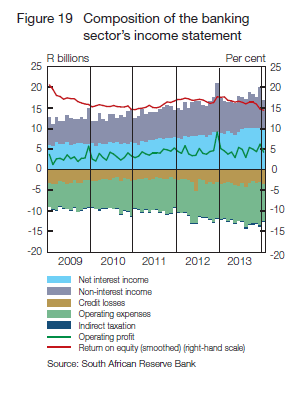
Banks in SA have become more dependent on net interest income in recent years, rising from about 5% to 10% of net income, while operating expenses have grown by about the same percentage. Return on equity has declined but remains a respectable 15% p.a.

Source; SA Reserve Bank Financial Stability Report, March 2014


The inevitable risks in fractional reserve banking and leveraged banks

Such fractional reserves however do pose a risk to the shareholders of banks as well as to their depositors. There might be a run on the bank that could cause the bank to fail, making the shares they owned in the bank valueless. Clearly, the interest earning assets it typically held could not be cashed in as easily as its deposit liabilities. Banking failures led to responses by regulators – firstly in the form of a compulsory cash to deposit ratio demanded of banks and in the form of deposit insurance designed to protect the smaller depositor. This was introduced in the US in the 1930s in response to the Great Depression and the banking failures associated with it.

Compared to most other financial institutions, including the so-called shadow banks, banks proper have always been among the most highly leveraged of business enterprises.. Their debts include all deposits, current and time deposits, equivalent to 90% or more of their assets, leaving little room for errors in the loans made.

The protection provided to depositors in the form of required cash or liquid asset reserves could not insure any bank or financial institution against the bad loans that could wipe out shareholders equity and cause a bank to go out of business.  Hence the regulatory focus in recent years, not so much on cash adequacy, but on equity capital adequacy. The Basel rules promoted by the central bankers’ central bank, the Bank for International Settlements located in Basel, Switzerland, have imposed higher equity capital ratios of banks.

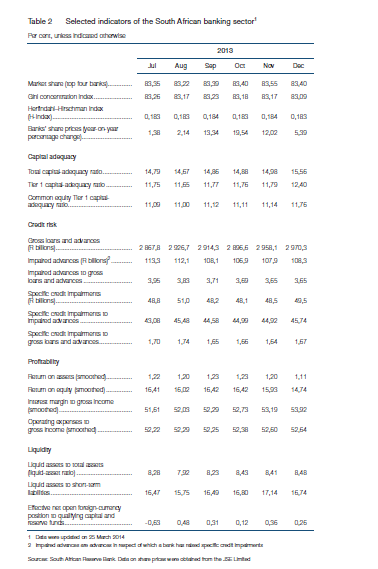
Understandably, the SA Reserve Bank as the regulator of the SA banks has given attention in its Financial Stability Report to the capital adequacy as well as the operating character of the banks under their supervision. The results of this analysis indicate that by international standards, the four large SA banks are well capitalised and well managed. As the table below shows, a capital to asset ratio of nearly 15% provides a return on banking shareholders’ equity of close to 15%, even though the return on total assets held by the banks is only 1.1%. Without high degrees of leverage SA banks might not be profitable enough to be willing to cross-subsidise the payments mechanism. If so other providers of a payments mechanism would then have to be found.

Funding such alternative providers with fees charged might not seem an attractive alternative to the current banking system that facilitates payments, partly through the interest spread, but with the danger than banks can fail. Dealing with the possibility of failure may well prove a better approach than imposing capital and cash requirements of banks that make them unable to easily stay in business.

There are no guarantees against banking failure


There is no guarantee that regulated bank capital, adequate for normal times and not so demanding as to threaten the profitability of banks and their survival as business enterprises, would be sufficient to support the banks in abnormal times. The global financial crisis of 2008 took place in most unusual circumstances, that is when the an average house price in the US declined by as much as 30% from peak to trough. Such declines meant that much of the mortgage lending of US banks had to be written off. Even a capital adequacy ratio of 15% might not protect a banking system, with a typically large dependence on mortgage lending, against failure, should the security in house prices collapse as they did in the US. SA banks have held up to 50% of all their assets in the form of nominally secure mortgage loans. They too would not have survived a collapse in house prices of similar magnitude.


Is it possible to insulate the payments mechanism from other banking activity? And what would it cost the holders of transaction balances?


It may be possible, given modern technology, to separate the payments system from  bank lending and borrowing. The payments system could be conceivably managed by the specialised equivalents of a credit card company that would compete for non interest bearing transactions balances on a fee only basis. The transfer mechanism could well be a smart phone or some equivalent device.


The proviso would have to be 100% reserve backing for these balances held for clients to transfer. These reserves that would fully cover the liability would have to take the form of a cash deposit with the central bank or notes held in the ATMs.  A deposit with a private bank would not be sufficient to the purpose- the other private bank, unlike a central bank can also fail and so bring down the payments system. If such a separation of banking from payments was enforced by regulation, large banks might not then be too big to fail any more than any other financial intermediary or indeed any other business enterprise might be regarded as too big to fail. But the unsubsidised transaction fees that would have to be levied to cover the costs of such an independent  payments system, fully protected against failure, that would include an appropriate return on shareholders capital invested in such payment companies, might prove more onerous than the costs of maintaining transaction balances with the banks today that provide a bundle of services, including facilitating transactions.


It is striking how expensive it is to transfer cash through the specialised agencies that provide a pure money transfer service. A fee of 5% or more of the value of such a transaction is not unusual. The case for bundling banking services, even should banks need to be recapitalised should they fail in unusual circumstances, may well be a price worth paying. In other words what is required for financial stability and a low cost payments service is a predictable rescue service for the few large banks that manage the payments system.


Avoiding the mind games

The MPC voted to keep interest rates on hold. Without a recovery in growth rates, interest rates will stay on hold – absent the dangerous mind games of January 2014 that led to an ill-timed rise in the repo rate.

The Monetary Policy Committee (MPC) of the Reserve Bank yesterday indicated that its outlook for SA inflation over the next few years has improved marginally. To quote the statement:

“The Bank’s forecast of headline inflation changed marginally since the previous meeting. Inflation is expected to average 6,2 per cent in 2014, compared with 6,3 per cent previously, with the peak of 6,5 per cent (previously 6,6 per cent) expected in the fourth quarter. The forecast average inflation for 2015 remained unchanged at 5,8 per cent. The forecast horizon has been extended and inflation is expected to average 5,5 per cent in 2016, and 5,4 per cent in the final quarter of that year. Inflation is still expected to remain outside the target band from the second quarter of 2014 until the second quarter of 2015.”

It also reported that inflation expectations are unchanged:

“The Reuters survey of inflation expectations of economic analysts conducted in May is more or less unchanged since the previous survey. Inflation is expected to average 6,3 per cent in the second quarter, and 6,2 per cent in the final two quarters of this year, before returning to within the target at an average of 5,8 per cent in the first quarter of 2015. Annual inflation is expected to average 6,2 per cent in 2014, and 5,6 per cent and 5,4 per cent in the subsequent two years respectively, somewhat lower than the Bank’s forecast.”

The growth outlook for the economy, according to the MPC by strong contrast has “deteriorated markedly” :

“The domestic economic growth outlook has deteriorated markedly, with the reversal of a number of the tentative positive signs observed at the beginning of the year. The Bank’s forecast for economic growth for 2014 has been revised down from 2,6 per cent at the previous meeting to 2,1 per cent, implying a further widening of the negative output gap. The forecast for 2015 remains unchanged at 3,1 per cent, and growth in 2016 is expected to average 3,4 per cent. However, the risks to these forecasts are increasingly to the downside against the renewed possibility of electricity load-shedding, among other factors.”

With this backdrop one might have thought that the decision not to raise short term interest rates would have been a formality. But not so for two members of the MPC – compared to the three at the meeting before – who actually voted for a further increase in rates. What can be on their minds?

It can’t be a belief that higher interest rates can do much to slow down inflation. The Investec Securities simulation for the Reserve Bank model of inflation and growth indicates that an increase of 25bps in the repo rate will only reduce its expected inflation by roughly 8bps and this would take seven quarters to take full effect. In other words, not much help on the inflation front at considerable further risk to the state of the economy – and moreover in the knowledge that an unpredictable exchange rate (that the model treats as an independent influence, about which assumptions rather than predictions are made when running the model).

The hard pressed SA economy had some good luck in the form of a stronger rand and a bumper maize harvest, which will help to hold down inflation in the months ahead. One gains an impression that had the rains not come when they did, the case for raising rates might have had more support.

That monetary policy is hostage to such obvious supply side shocks as drought and global risk aversion is not a comfortable thought. The reality is that inflation n SA has very little to do with the demand side of the economy (as the Reserve Bank acknowledges fully) and everything to do with factors over which interest rates have little influence: exchange rates and the harvest as well as the pace of administered price increases, which is the province of the regulators and the tax collectors.

At least this time round, at the media briefing and Q&A, the Governor was asked some leading questions about supply side effects and the influence of interest rates. She was even asked if the hike in rates in January (with hindsight surely a mistake) did any harm to the economy. There was little mea culpa in the response and a resort in the response to the non-testable theory that had the Bank not raised rates then second round effects – higher inflationary expectations – would have taken inflation higher. In fact there is no evidence that inflation expectations lead inflation rather than the other way round. And, as the MPC indicated, inflation expectations remain unchanged and the great constant in the economic environment.

This Q&A unfortunately indicates the danger in monetary policy: that members of the MPC come to believe that in order to preserve their inflation fighting credentials, and because the markets may expect them to raise interest rates, then that is what they have to do. This is regardless of the predicted outcomes for inflation and, more importantly, for growth.

The trouble with such monetary policy reactions is that they can never be tested or refuted. The economic caravan always moves on even as the dogs bark. Who can say with certainy what might have happened if the Bank had acted differently? Such mind games do not serve the SA economy well. Interest rates in SA should have been lower, not higher, given the state of the economy over the past 12 months The time for a cyclical upswing in interest rates is when the economy can justify it – not before. And there is clearly no justification for higher interest rates given the growth outlook.

Bernanke’s legacy: The great (and ongoing) monetary experiment

Ben Bernanke has now retired as Fed chairman, having rewritten the book on central banking.

He has done this not so much by what he and his fellow governors (including his successor Janet Yellen) did to address the Global Financial Crisis (GFC) that erupted in 2008, but by the enormous scale to which he supplied cash to the US and global financial system as well as in injecting new capital to shore up financial institutions whose failure would pose a risk to the financial system.

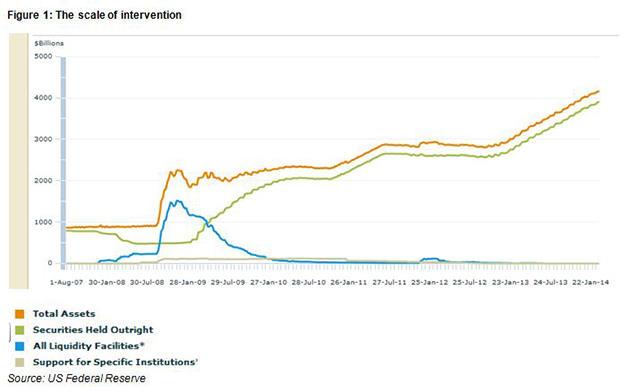
The scale of Fed interventions in the financial markets is indicated in the figure below which highlights the explosive growth in the asset side of its balance sheet. The initial actions taken after the collapse of Lehman Brothers in September 2008, what may be regarded as classical central bank assistance for a financial system in a crisis of liquidity, was superseded by further massive injections of cash into the US and global financial system as the figure makes clear. The cash made available by the central bank in exchange for securities supplied (discounted) by hard pressed banks, when only cash would satisfy depositors and other lenders to banks, alleviated the panic and allowed normally sound financial institutions to escape the run for cash. But Quantitiative Easing (QE) thereafter became much more than a temporary help to the financial system.

Chairman Bernanke recently took the opportunity to explain his actions and the reasoning behind them in a valedictory address to his own tribe (that of professional economists) gathered at the annual meeting of the American Economic Association (AEA) in early January 20141. On the role of a central bank in a financial crisis, he said:

“For the U.S. and global economies, the most important event of the past eight years was, of course, the global financial crisis and the deep recession that it triggered. As I have observed on other occasions, the crisis bore a strong family resemblance to a classic financial panic, except that it took place in the complex environment of the 21st century global financial system. Likewise, the tools used to fight the panic, though adapted to the modern context, were analogous to those that would have been used a century ago, including liquidity provision by the central bank, liability guarantees, recapitalization, and the provision of assurances and information to the public.”

Furthermore:

“The Federal Reserve responded forcefully to the liquidity pressures during the crisis in a manner consistent with the lessons that central banks had learned from financial panics over more than 150 years and summarized in the writings of the 19th century British journalist Walter Bagehot: Lend early and freely to solvent institutions. However, the institutional context had changed substantially since Bagehot wrote. The panics of the 19th and early 20th centuries typically involved runs on commercial banks and other depository institutions. Prior to the recent crisis, in contrast, credit extension …….. Accordingly, to help calm the panic, the Federal Reserve provided liquidity not only to commercial banks, but also to other types of financial institutions such as investment banks and money market funds, as well as to key financial markets such as those for commercial paper and asset-backed securities. .Because funding markets are global in scope and U.S. borrowers depend importantly on foreign lenders, the Federal Reserve also approved currency swap agreements with 14 foreign central banks.

“Providing liquidity represented only the first step in stabilizing the financial system. Subsequent efforts focused on rebuilding the public’s confidence, notably including public guarantees of bank debt by the Federal Deposit Insurance Corporation and of money market funds by the Treasury Department, as well as the injection of public capital into banking institutions. The bank stress test that the Federal Reserve led in the spring of 2009, which included detailed public disclosure of information regarding the solvency of our largest banks, further buttressed confidence in the banking system.”

In the accompanying notes to his speech, the following explanations of shadow banking as well as the special arrangements made to boost liquidity were specified as follows:

“Shadow banking, as usually defined, comprises a diverse set of institutions and markets that, collectively, carry out traditional banking functions–but do so outside, or in ways only loosely linked to, the traditional system of regulated depository institutions. Examples of important components of the shadow banking system include securitization vehicles, asset-backed commercial paper conduits, money market funds, markets for repurchase agreements, investment banks, and nonbank mortgage companies.

“ Liquidity tools employed by the Federal Reserve that were closely tied to the central bank’s traditional role as lender of last resort involved the provision of short-term liquidity to depository and other financial institutions and included the traditional discount window, the Term Auction Facility (TAF), the Primary Dealer Credit Facility (PDCF), and the Term Securities Lending Facility (TSLF). A second set of tools involved the provision of liquidity directly to borrowers and investors in those credit markets key to households and businesses where the expanding crisis threatened to materially impede the availability of financing. The Asset-Backed Commercial Paper Money Market Mutual Fund Liquidity Facility (AMLF), the Commercial Paper Funding Facility (CPFF), the Money Market Investor Funding Facility (MMIFF), and the Term Asset-Backed Securities Loan Facility (TALF) fall into this category.”

The initial injections of liquidity by the Fed to deal with the crisis was followed by actions that did write a further new page to the central bankers’ play book. That is, in the form of very large and regular additional injections of additional cash into the financial system, made on the Fed’s own initiative, in the form of a massive bond and security buying programme, which accelerated in late 2011 and early 2013 (QE2 and QE3) that was undertaken not so much to shore up the financial system that had stabilized, but undertaken as conventional monetary policy to influence the state of the economy by managing key interest rates and especially mortgage rates.

Usually, monetary policy focuses on changes in short term interest rates, leaving long term interest rates and the slope of the yield curve to the market place. But in the US, the mortgage rate, so important for the US housing market, is a long term fixed rate of interest linked to long term interest rates and US Treasury Bond Yields. These long term fixed mortgage rates (30 year loans) available to homeowners are made possible only with the aid of government, in the form of the government sponsored mortgage lending bodies Fannie Mae and Freddy Mac, whose lending practices did so much to precipitate the housing boom and bust and were particularly in need of rescuing by the US Treasury. Their roles in the crisis do not feature in the Bernanke speech made to the AEA.

The state of the US housing market is a crucial ingredient for improving the state of US household balance sheets that are so necessary if households are to spend more in order that  that the US economy can recover from recession. Households account for over 70% of all final demands in the US and only when households lead can firms be expected to follow with their own spending plans. These household balance sheets had been devastated by the collapse in house prices, by 30% on average from the peak in 2006 to the trough in average house prices in 2011. It was this boom in house prices followed by a collapse in them that was the proximate cause of the financial crisis itself.

This bubble and bust, after all, happened on Bernanke’s watch as a governor and then as chairman of the Fed, for which the Fed does not take responsibility. A fuller explanation of the deeper causes of the GFC was offered by Bernanke in his speech to the AEA:

“The immediate trigger of the crisis, as you know, was a sharp decline in house prices, which reversed a previous run-up that had been fueled by irresponsible mortgage lending and securitization practices. Policymakers at the time, including myself, certainly appreciated that house prices might decline, although we disagreed about how much decline was likely; indeed, prices were already moving down when I took office in 2006. However, to a significant extent, our expectations about the possible macroeconomic effects of house price declines were shaped by the apparent analogy to the bursting of the dot-com bubble a few years earlier. That earlier bust also involved a large reduction in paper wealth but was followed by only a mild recession. In the event, of course, the bursting of the housing bubble helped trigger the most severe financial crisis since the Great Depression. It did so because, unlike the earlier decline in equity prices, it interacted with critical vulnerabilities in the financial system and in government regulation that allowed what were initially moderate aggregate losses to subprime mortgage holders to cascade through the financial system. In the private sector, key vulnerabilities included high levels of leverage, excessive dependence on unstable short-term funding, deficiencies in risk measurement and management, and the use of exotic financial instruments that redistributed risk in nontransparent ways. In the public sector, vulnerabilities included gaps in the regulatory structure that allowed some systemically important firms and markets to escape comprehensive supervision, failures of supervisors to effectively use their existing powers, and insufficient attention to threats to the stability of the system as a whole.”

The obvious question for critics of Bernanke is why the Fed itself did not do more to slow down the increases in the supply of credit from banks and the so called shadow banks? Perhaps the Fed could not do more, given its lack of adherence to money and credit supply targets and its heavy reliance on interest rates as its principal instrument of policy.

Given what happened in the housing price boom, it seems clear that policy determined interest rates should have been much higher to slow down the growth in credit. But it may also be argued that interest rates themselves are insufficient to moderate a credit cycle. This is an essentially monetarist point not addressed by Bernanke. In other words, to say there is more to monetary policy than interest rates. The supply of money and bank credit is deserving of control according to the monetarist critique. The Bernanke remedy for protecting the system against the prospect of a future financial crisis is predictably familiar: better regulation and more equity on the books of banks and other lenders. It may be argued that there will always be enough capital, regulated or not, in normal times, and too little in any financial crisis regardless of generally well funded financial institutions. Prevention of a financial crisis may prove impossible and the attempt to do so may be costly in terms of too little, rather than too much, lending and leverage in normal conditions (when lenders are appropriately default risk-conscious and do not make bad loans on a scale that makes for a credit and asset price bubble that ends in tears). The cure for a crisis should always be on hand and the Bernanke recipe will hopefully not be forgotten in the good times.

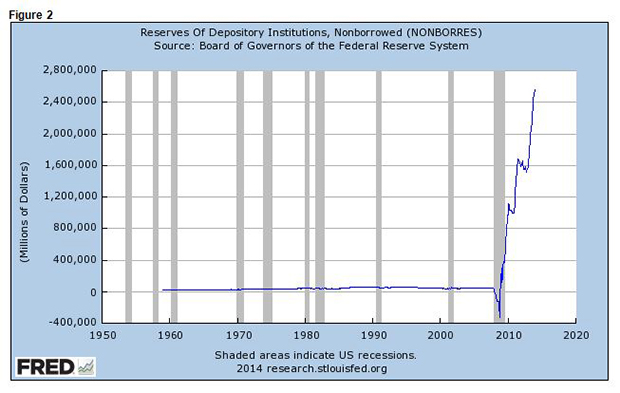
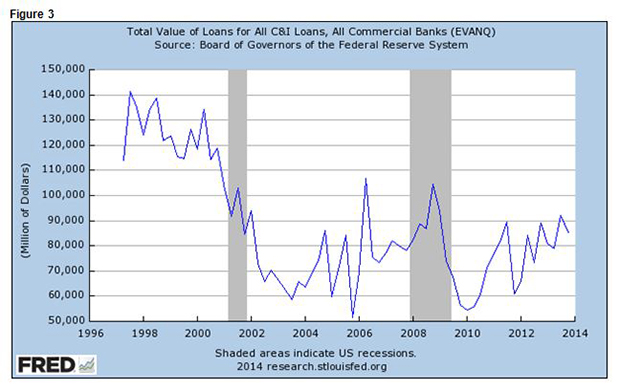
Any current concern about monetary aggregates would have to be on the liabilities side of the Fed balance sheet, conspicuous not so much for the volume of deposits held by the member commercial banks with the Fed, but with the historically unprecedented volume or ratio of deposits (cash) held by these banks with the Fed, in excess of their regulated cash reserve requirements. Also conspicuous is the lack of growth in bank lending to businesses – despite the abundance of cash on hand (see figures 2 and 3).
 

As Bernanke explained:

“To provide additional monetary policy accommodation despite the constraint imposed by the effective lower bound on interest rates, the Federal Reserve turned to two alternative tools: enhanced forward guidance regarding the likely path of the federal funds rate and large-scale purchases of longer-term securities for the Federal Reserve’s portfolio. Other major central banks have responded to developments since 2008 in roughly similar ways. For example, the Bank of England and the Bank of Japan have employed detailed forward guidance and conducted large-scale asset purchases, while the European Central Bank has moved to reduce the perceived risk of sovereign debt, provided banks with substantial liquidity, and offered qualitative guidance regarding the future path of interest rates.”

The use of forward guidance to help the market place forecast the path of interest rates more accurately, so reducing uncertainties in the market place leading hopefully to better financial decisions, predates the Bernanke chairmanship of the Fed. However, he should be credited with taking the Fed to new levels of transparency and much improved communication with both the marketplace and the politicians. In Bernanke’s words:

“The crisis and its aftermath, however, raised the need for communication and explanation by the Federal Reserve to a new level. We took extraordinary measures to meet extraordinary economic challenges, and we had to explain those measures to earn the public’s support and confidence. Talking only to the Congress and to market participants would not have been enough. The effort to inform the public engaged the whole institution, including both Board members and the staff. As Chairman, I did my part, by appearing on television programs, holding town halls, taking student questions at universities, and visiting a military base to talk to soldiers and their families. The Federal Reserve Banks also played key roles in providing public information in their Districts, through programs, publications, speeches, and other media.

The crisis has passed, but I think the Fed’s need to educate and explain will only grow.”

Historically US banks held minimum excess cash reserves, meeting any demand for cash by borrowing reserves in the Federal Funds market (the interbank market for cash), so making the Fed Funds rate the key money market rate and the instrument of Fed monetary policy. Holding idle cash is not usually profitable banking – but it has become so to an extraordinary degree. Furthermore, the large volume of excess reserves means that short term interest rates fall to zero from which they cannot fall any further. The reason they have remained above zero is that the Fed has been willing to reward the banks for their excess reserves by offering 0.25% p.a on their deposits with the Fed.

Every purchase of bonds or mortgage backed securities made by the Fed in its asset purchase programme must end up on the books of a bank as a deposit with the Fed. But before the extra phases of QE, the banks would make every effort to put their cash to work earning interest rather than holding them largely idle (as they are now doing). But it would appear that the Fed expects the demand for excess cash to remain a permanent feature of the financial landscape and can cope accordingly.

According to Bernanke:

“Large-scale asset purchases have increased the size of our balance sheet and created substantial excess reserves in the banking system. Under the operating procedures used prior to the crisis, the presence of large quantities of excess reserves likely would have impeded the FOMC’s ability to raise short-term nominal interest rates when appropriate. However, the Federal Reserve now has effective tools to normalize the stance of policy when conditions warrant, without reliance on asset sales. The interest rate on excess reserves can be raised, which will put upward pressure on short-term rates; in addition, the Federal Reserve will be able to employ other tools, such as fixed-rate overnight reverse repurchase agreements, term deposits, or term repurchase agreements, to drain bank reserves and tighten its control over money market rates if this proves necessary. As a result, at the appropriate time, the FOMC will be able to return to conducting monetary policy primarily through adjustments in the short-term policy rate. It is possible, however, that some specific aspects of the Federal Reserve’s operating framework will change; the Committee will be considering this question in the future, taking into account what it learned from its experience with an expanded balance sheet and new tools for managing interest rates.”

It seems clear that the market is not frightened by the prospect that abundant supplies of cash will in turn lead to more inflation as the cash is lent and spent, as monetary history foretells. The market clearly believes in the capacity of the Fed to remove the proverbial punchbowl before the party gets going. Judged by the difference between yields on vanilla Treasury bonds and their inflation protected alternatives, inflation of no more than 2% a year is expected in the US over the next 20 years. According to Bernanke, who is much more concerned with the dangers of deflation, arguing that inflation of less than 2% should be regarded as deflation (given the hard to measure improvements in the quality of goods and services). Therefore if inflation is less than 2% this becomes an argument for more, rather than less, accommodative monetary policy by the Fed.

The market clearly finds the Bernanke arguments and guidance highly convincing. These expectations are a measure of Bernanke’s success as a central banker. He has surely helped save the financial system from a potential disaster and has done so without adding to fears of inflation.

The US economy has not however enjoyed the strong recovery that usually follows a recession. Bernanke has some explanation for this tepid growth:

“In retrospect, at least, many of the factors that held back the recovery can be identified. Some of these factors were difficult or impossible to anticipate, such as the resurgence in financial volatility associated with the European sovereign debt and banking crisis and the economic effects of natural disasters in Japan and elsewhere. Other factors were more predictable; in particular, we appreciated early on, though perhaps to a lesser extent than we might have, that the boom and bust left severe imbalances that would take time to work off. As Carmen Reinhart and Ken Rogoff noted in their prescient research, economic activity following financial crises tends to be anemic, especially when the preceding economic expansion was accompanied by rapid growth in credit and real estate prices.16 Weak recoveries from financial crises reflect, in part, the process of deleveraging and balance sheet repair: Households pull back on spending to recoup lost wealth and reduce debt burdens, while financial institutions restrict credit to restore capital ratios and reduce the riskiness of their portfolios. In addition to these financial factors, the weakness of the recovery reflects the overbuilding of housing (and, to some extent, commercial real estate) prior to the crisis, together with tight mortgage credit; indeed, recent activity in these areas is especially tepid in comparison to the rapid gains in construction more typically seen in recoveries.”

He also blames the slow recovery on the unintended consequence of unplanned government fiscal austerity:

“To this list of reasons for the slow recovery–the effects of the financial crisis, problems in the housing and mortgage markets, weaker-than-expected productivity growth, and events in Europe and elsewhere–I would add one more significant factor– – 18 – Since that time, however, federal fiscal policy has turned quite restrictive; according to the Congressional Budget Office, tax increases and spending cuts likely lowered output growth in 2013 by as much as 1-1/2 percentage points. In addition, throughout much of the recovery, state and local government budgets have been highly contractionary, reflecting their adjustment to sharply declining tax revenues. To illustrate the extent of fiscal tightness, at the current point in the recovery from the 2001 recession, employment at all levels of government had increased by nearly 600,000 workers; in contrast, in the current recovery, government employment has declined by more than 700,000 jobs, a net difference of more than 1.3 million jobs. There have been corresponding cuts in government investment, in infrastructure for example, as well as increases in taxes and reductions in transfers.

“Although long-term fiscal sustainability is a critical objective, excessively tight near-term fiscal policies have likely been counterproductive. Most importantly, with fiscal and monetary policy working in opposite directions, the recovery is weaker than it otherwise would be. But the current policy mix is particularly problematic when interest rates are very low, as is the case today. Monetary policy has less room to maneuver when interest rates are close to zero, while expansionary fiscal policy is likely both more effective and less costly in terms of increased debt burden when interest rates are pinned at low levels. A more balanced policy mix might also avoid some of the costs of very low interest rates, such as potential risks to financial stability, without sacrificing jobs and growth.”

Bernanke then went on to paint an optimistic picture of the US economy:

“I have discussed the factors that have held back the recovery, not only to better understand the recent past but also to think about the economy’s prospects. The encouraging news is that the headwinds I have mentioned may now be abating. Near-term fiscal policy at the federal level remains restrictive, but the degree of restraint on economic growth seems likely to lessen somewhat in 2014 and even more so in 2015; meanwhile, the budgetary situations of state and local governments have improved, reducing the need for further sharp cuts. The aftereffects of the housing bust also appear to have waned. For example, notwithstanding the effects of somewhat higher mortgage rates, house prices have rebounded, with one consequence being that the number of homeowners with “underwater” mortgages has dropped significantly, as have foreclosures and mortgage delinquencies. Household balance sheets have strengthened considerably, with wealth and income rising and the household debt-service burden at its lowest level in decades. Partly as a result of households’ improved finances, lending standards to households are showing signs of easing, though potential mortgage borrowers still face impediments. Businesses, especially larger ones, are also in good financial shape. The combination of financial healing, greater balance in the housing market, less fiscal restraint, and, of course, continued monetary policy accommodation bodes well for U.S. economic growth in coming quarters. But, of course, if the experience of the past few years teaches us anything, it is that we should be cautious in our forecasts.”

It can be argued by his critics that the Bernanke innovations have been part of the problem rather than the solution. It would be very hard to argue that injecting liquidity and capital into the financial system to avert an incipient financial crisis in 2008-09 was the wrong thing to do. But it may yet be asked, then, if QE2 and QE3 were also necessary? Would not a sooner return to monetary normality have been confidence boosting, rather than undermining, business confidence, which is essential to any sustained recovery? Further bouts of QE have led to large additions to the excess cash held by banks, rather than additional lending undertaken by them that would have helped the economy along. Would the banks and the US corporations have put more of their strong balance sheets to work to help the economy along had monetary policy been less innovative, or at least had QE not been advanced as strongly as it was? Growth in bank credit and money supply (M2) has slowed down rather than picked up in recent years, despite the creation of so much more base money (see the figure on bank lending). That the banks have been able to earn 0.25% on their vast cash balances has surely encouraged them to hold rather than lend out their cash.

Furthermore, while fiscal policy could have been less restrictive in the short run, would any political failure to implement a modest degree of austerity at Federal and State level, not have made households even more anxious about their economic futures and the tax burdens accompanying them, leading to still less private spending?

The performance of the US economy over the next few years will be the test of the Bernanke years. If the US economy regains momentum without inflation, the Bernanke innovations will have proved their worth. They would then provide the concrete evidence that it is possible to create money, à outrance, and then take away the juice when that becomes necessary. Tapering of QE, the initial thought of which that so disturbed the markets in May 2013, is but a first tentative step to the actual withdrawal of cash from the system and the shrinking of the Fed balance sheet. The monetary experiment, conducted with deep knowledge of monetary history and theory that fortunately characterised the Bernanke years, remains an experiment. We must hope for the sake of continued economic progress both in the US and elsewhere that it proves a highly successful experiment.

1The Federal Reserve: Looking Back, Looking Forward, Remarks by Ben S. Bernanke, Chairman Board of Governors of the Federal Reserve System at
Annual Meeting of the American Economic Association
Philadelphia, Pennsylvania
3 January 2014
Source: Federal Reserve System of the United States, Speeches of Governors. All quotations referred to are taken from the published version of this speech.

Economic reality and the MPC – coming together?

The first and second meetings of the Monetary Policy Committee (MPC) of the Reserve Bank in 2014 have come and gone and been accompanied by very different reactions in the money market.

The first meeting on 29 January produced a significant interest rate surprise on the upside when the MPC decided to raise its key repo rate by 50bps. The second meeting on 27 March produced a much smaller surprise in the other direction. Note in the chart below that the first upside interest rate surprise in January 2014 was associated with a significantly weaker rand while the surprising downside move in short term interest rates in March was accompanied by a stronger rand. Short term rates are represented in the figure by the Johannesburg interbank rate (Jibar) expected in three months – that is the forward rate of interest implicit in the relationship between the three month and six month JIBAR rate. Changes in this rate indicate interest rate surprises. Hence the inflation outlook deteriorated as interest rates moved higher and improved as interest rates were kept on hold.

This inconsistent and essentially unpredictable relationship between movements in SA interest rates and the rand is clearly coincidental – it is not a causal relationship because the value of the rand is determined by global or (more particularly) emerging market economic forces rather than domestic policy decisions. As we show below, where emerging market equities go, the rand follows. And emerging equity and bond markets are led by global risk appetite. The more inclined global investors are to take on more risk, the better emerging market equities and bonds perform, including those listed on the JSE. The behaviour of SA stocks and bonds and the exchange value of the rand is highly consistent with that of emerging markets genrally as we show in the chart below. The rand follows the Emerging Market Equity Index (MSCI EM) as does the JSE All Share Index (both in US dollars) while both the rand and the JSE respond to the spread between RSA and US Treasury 10 year bond yields that can be regarded as a measure of SA specific exchange rate risk. The wider the spread the more exchange rate weakness expected.

But what does this all mean for monetary policy in SA and for the direction of short term interest rates? As we are all well aware Reserve Bank interest rate settings are meant to hold inflation within its target band of three to six per cent per annum. But inflation takes its cue mostly from the direction of the rand, which is beyond any predictable influence of interest rates – as has been demonstrated once more.

And so the Reserve Bank remains essentially powerless to manage inflation in the face of exchange rate shocks (over which it has no obvious or predictable influence). Interest rates can influence spending in SA, causing the economy to grow faster or slower without necessarily influencing the direction of prices. In other words inflation can rise, as it has done recently, even though the economy has operated well below its potential and will continue to do so. Therefore higher interest rates can  slow the economy down further without causing inflation to fall. This is a painful dilemma of which the MPC seems only too well aware. To quote its statement of 27 March:

“The Monetary Policy Committee is acutely aware of the policy dilemma of rising inflation pressures in a subdued economic growth environment.

“The main upside risk to the forecast continues to come from the exchange rate, which, despite the recent relative stability, remains vulnerable to global rebalancing. The expected normalisation of monetary policy in advanced economies is unlikely to be linear or smooth, and the timing and pace is uncertain.

“The rand is also vulnerable to domestic idiosyncratic factors, including protracted work stoppages, electricity supply constraints, and the slow adjustment of the current account deficit. Pass-through from the exchange rate to prices has been relatively muted to date but there is some evidence that it is accelerating. However, the forecast already incorporates a higher pass-through than has been experienced up to now.

“At the same time, the domestic economic outlook remains fragile, with the risks assessed to be on the downside. Demand pressures remain benign as consumption expenditure continues to slow amid weakening credit extension to households and high levels of household indebtedness. The upward trend in the core inflation forecast is assessed to reflect exchange rate pressures rather than underlying demand pressures.”

So then how should the MPC respond to exchange rate-driven price increases? The obvious answer would appear to be to accept the limitations of inflation targeting in the absence of any predictable reaction of exchange rates to interest rate settings. That is to ignore completely the exchange rate shock effect on inflation and focus on domestic forces that influence the inflation rate: lowering rates when the economy is operating below potential and raising them when spending (led by money and credit growth) is growing so rapidly as to add to inflationary pressures. And to explain very clearly why it would be acting this way.

But this unfortunately is not the way the MPC is still inclined to think. It worries about the inflationary effect of inflationary expectations. To quote its recent statement again:

“Given the lags with which monetary policy operates, the MPC will continue to focus on the medium term inflation trajectory. The committee is aware that too slow a pace of tightening could undermine inflation expectations and may require more aggressive tightening in the future. Consistent with our mandate, a fine balance is required to ensure that inflation is contained while minimising the cost to output”.

The MPC would be well advised to accept another bit of SA economic reality, which is that not only does the exchange rate lead inflation, but inflation itself leads inflation expectations – not the other other way round. There is no evidence that inflationary expectations lead inflation higher or lower. More SA inflation leads to more inflation expected though, as the MPC is well aware, inflation expected has remained remarkably constant over the years: around six per cent per annum that is the upper end of the inflation target band.

The MPC did the right thing this time round not to raise its repo rate. It made a mistake to raise its repo rate at the January meeting. The money market made the mistake of immediately anticipating a further 200bp increase in interest rates by January 2015. The Governor has done very good work guiding the market away from such interest rate expectations that, if realised, would be even more costly to the economy. The money market now expects only a 100bp increase in short term rates by early next year. The market may again be very wrong about this, dependent as the direction of inflation and interest rates are on the behaviour of the rand over the next 12 months. But even good news for the exchange rate will still leave monetary policy in SA on a fundamentally wrong tack. The interest rate cycle in SA, as in any normal economic state of affairs, should be led by the state of the domestic economy, not by the direction of unpredictable global capital.

Monetary policy: The limits to inflation targeting

Is SA monetary policy accommodative? It all depends on whose inflation and whose interest rates you have in mind

We are told by the Reserve Bank that monetary policy in SA is “accommodative” because interest rates are below the rate of inflation. That is because real interest rates are negative. But whose interest rates and whose inflation rates can the Reserve Bank be referring to? From the perspective of lenders the interest paid on savings accounts in the banks are not keeping up with inflation – and more so if tax has to be paid on interest income. Low real interest rates are tough on savers, but, for a good reason, borrowers may be unable to pay any more for the use of their savings.

But from the perspective of business borrowers, especially small businesses still able to borrow from their banks at prime plus something over 9%, finance may in reality be very expensive. The presumption of negative real interest rates is that businesses will be able to increase the prices they charge their customers at more than the 9% per annum they pay in interest. If this were the case, simply financing a warehouse of non-perishable goods that increase in value by more than the costs of finance (after taxes) becomes a no-brainer of a profitable business decision. This would presumably make monetary policy accommodative and encourage business.

But is this currently the case for many businesses serving the domestic market? Do they currently have the power to price their goods or services ahead of the rate of inflation that was 5.4% in December 2013?

The weakened state of demand for goods and services may prevent this as the more detailed inflation statistics bear out. The headline inflation rate is the weighted average of the prices of goods and services consumed by the mythical average SA household, some of which have risen by much more than the average and others by much less. It is administered prices, those charged by municipalities for water and electricity etc and those subject to additional excise duties, for example alcoholic beverages (up 7.2% on average with beer up 9.2% on December a year before), that have been making the inflation running . Administered prices were up nearly 8% on a year before in December 2013.

By contrast, the price of clothing and footwear is estimated to have increased by a mere 3.6% and 3% respectively. The food basket itself was also only 3% up, believe it or not. The farmers, food retailers and manufacturers will know all about their pricing power and the pressure on their sales volumes and profit margins.

It is clear that rising prices in SA have very little to do with any strong demands being registered by consumers. As is well recognized, SA households are under increasing budget pressures from higher prices and taxes imposed upon them. And, most relevant, they are suffering from a lack of pricing power in the most important market for their services, in the market for their labour services.

By recent accounts from Adcorp the rate of dismissal from private sector jobs is accelerating and workers are much less mobile than usual. They are therefore presumably somewhat fearfully holding onto the jobs they have, rather than moving to better paid ones. This is not an environment likely to encourage growth in spending, despite interest rates in the money market being below the headline inflation rate.

In fact monetary policy is doing very little to encourage domestic spending and, indeed, with the recent increase in benchmark short rates, has become less so. Even less demand side pressure on spending can be expected as prices continue to rise, driven especially by a weaker rand over which domestic interest rates have little or no influence.

The fact that the SA economy is as weak as it is, indicates quite clearly that interest rates should have been significantly lower than they have been, and that they should be falling, rather than rising, given the deteriorating state of the economy. Furthermore, targeting inflation when prices are rising for supply side (exchange rate shocks, drought and taxes) rather than demand side reasons makes little economic sense. Inflation targeting in SA can only makes good sense when the exchange rate itself responds predictably to interests rate settings. The rand over much of the past 12 years or so has not behaved anything like this.

Aiming for low inflation is good monetary policy. Trying to meet inflation targets is proving again to mean very poor monetary policy in S.A.

The Hard Number Index: Foot off the accelerator

Hard numbers for January 2014 in the form of vehicle sales and notes in circulation are now available. We combine them to form our Hard Number Index (HNI) – a useful indicator of the state of the SA economy because it is so up to date.

The indication from the HNI is that while the economy is maintaining its forward momentum (numbers above 100 indicate growth) the pace of growth is slowing down and is forecast to slow further in the months ahead. This lower absolute number for the HNI in January 2014 is the first decline in the HNI registered since the economy escaped from the recession of 2008-09, when the HNI as may be seen turned briefly below the 100 level.

The turning points in the HNI anticipate those of the Reserve Bank Coinciding Business Cycle Indicator consistently well, as we also show. However this business cycle indicator has only been updated to October 2013 which is a long time ago in the business of economic analysis and forecasting. It will not come as much of a surprise to observers that the pace of domestic spending in SA slowed down in January. Higher short term interest rates imposed by the Reserve Bank in late January 2014 will do nothing to encourage spending growth that at best was stalling in the final quarter of 2013.


It was the slowdown in the growth in the supply and demand for cash (adjusted for inflation) in January 2014 that dragged the HNI lower. The real money base growth cycle peaked in 2011 and has been on a more or less consistently lower trajectory since then. The forecast is for a further decline in this growth rate.


By contrast, unit vehicle sales in January 2014 held up well. On a seasonally adjusted basis unit sales in January 2014 were about 1000 units higher than in December 2013, that in turn, on a seasonally adjusted basis, were well up on November 2013 sales.

For the motor dealers, December and January are both usually below average months for selling new vehicles. The current level of sales would translate into an annual rate of sales of about 650 000 units this time next year, which would be little changed from the pace of sales in 2013. However some preemptive buying ahead of exchange rate forced increases in list prices may well have provided a temporary boost to new unit sales in December and January. A combination of a weaker rand and higher financing costs does not bode well for the new vehicle market in SA.

For motor and component manufacturers, the profit opportunity must be in export markets where prices are set presumably in foreign currencies – trade unions permitting. The opportunity for SA to lift growth rates from the currently unsatisfactory pace, must lie with increases in export volumes. The weak real rand/US dollar rate, currently about 17% below its purchasing power equivalent value compared to its 1995 value, offers the opportunity for SA producers to take full advantage of higher operating profit margins to increase export volumes and rand revenues significantly. It is up to SA management and workers to seize the opportunity to share in the operating surpluses that a weak real rand makes possible.

Monetary policy: The Aussies win the exchange rate toss – again

The Monetary Policy Committee (MPC) of the SARB met on Tuesday 28 January with the rand down about 30% against the US dollar on a year before. Predictably, given the openness of the SA economy to exports and imports, the SA inflation rate had picked up and was forecast to exceed its inflation target range of 3- 6% later in 2014.

The next day the MPC decided to raise its key repo rate by 50bp from 5% to 5.5%. The rand in response weakened further, by about 3% by the close of trading on the Wednesday 29 January.

The Reserve Bank of Australia (RBA) decided on 3 February to leave its cash rate unchanged at 2.5%. The Aussie dollar (which had also lost a significant amount over the last year, approximately 17% against the US dollar) responded favourably to the decision, gaining about 1.6% against the US dollar on the day.


These market reactions help prove a point we have made repeatedly: higher interest rates may not necessarily support a currency; thus leaving interest rates alone, or even reducing them, may support a currency, especially in times of exchange rate volatility.


Higher short term interest rates may imply a deteriorating growth outlook, meaning lower rather than higher expected returns on flows of risk capital to and from an economy. As a result, the net outflows of foreign exchange may exceed the inflows, leading to a weaker domestic currency and more rather than less subsequent pressure on consumer and producer prices. Lower or unchanged interest rates, by contrast, may improve the economic outlook and prospective returns and attract more rather than less net foreign capital. It is growth prospects rather than nominal interest rates that drive capital flows to businesses and economies.


Australian cricket prowess may wax and wane. But Australian monetary policy has proved consistently adept at ignoring large movements in the Aussie dollar exchange rate, even welcoming the opportunity provided for more balanced growth. In the words of RBA governor, Glenn Stevens, from its media release of 4 February:


“The exchange rate has declined further, which, if sustained, will assist in achieving balanced growth in the economy.”


The picture presented of the Australian economy is not however without its challenges for policy. As shown by further extracts from the media release, there are threats to Australian growth, employment and prices – enough to keep interest rates at their currently low accommodative level in expectation of an improving outlook over the long term:


“In Australia, information becoming available over the summer suggests slightly firmer consumer demand and foreshadows a solid expansion in housing construction. Some indicators of business conditions and confidence have shown improvement. At the same time, with resources sector investment spending set to decline significantly, considerable structural change occurring and lingering uncertainty in some areas of the business community, near-term prospects for business investment remain subdued. The demand for labour has remained weak and, as a result, the rate of unemployment has continued to edge higher. Growth in wages has declined noticeably.


“Inflation in the December quarter was higher than expected. This may be explained in part by faster than anticipated pass-through of the lower exchange rate, though domestic prices also continued to rise at a solid pace, despite slower growth in labour costs. If domestic costs remain contained, some moderation in the growth of prices for non-traded goods could be expected over time.


“Monetary policy remains accommodative. Interest rates are very low and savers continue to look for higher returns in response to low rates on safe instruments. Credit growth remains low overall but is picking up gradually for households. Dwelling prices have increased further over the past several months. The exchange rate has declined further, which, if sustained, will assist in achieving balanced growth in the economy.


“Looking ahead, the Bank expects growth to remain below trend for a time yet and unemployment to rise further before it peaks. Beyond the short term, growth is expected to strengthen, helped by continued low interest rates and the lower exchange rate. Inflation is expected to be somewhat higher than forecast three months ago, but still consistent with the 2–3 per cent target over the next two years.”


By sad contrast the outlook for the SA economy has deteriorated, with no sign that domestic spending (linked inevitably to deteriorating conditions in the labour market) can lead the economy out of its doldrums. Still higher prices for goods with high import and export content will depress spending further and higher interest rates will further discourage very slow growing demands for and supplies of credit.  The remarks made by governor Stevens about the poor outlook for investment in the Australian resource sector are also not encouraging for the SA resource sector. The hope must be that the weak rand and the much improved operating margins in the export sector and for firms competing with imports can lead the economy onto a faster growth path –labour unions permitting.


The problem for the SA economy and its interest rate sensitive sectors is that not only did short term interest rates rise last week, but they were immediately expected to rise significantly further by as much as an extra 2% over the next few months by the money market.

Such increases would be most unwelcome to a hard pressed economy – even unthinkable had they been imposed last week. These higher interest rates would be unlikely to help the rand in the near future and the inflation outlook any more than they have helped to date, for the reasons we have indicated.

In our response to the MPC decision we cautioned against the danger of such an interest rate spiral heralded by the 50bp increase in the repo rate. We noted that a spirited defence of the case for not raising rates will be as imperative the next time the MPC meets, should the rand not have gained strength by then and the inflation outlook remains as unsatisfactory as it is now.

We noted further that without such an argument, the economy may well set off on a 1998 like spiral of higher interest rates in response to a weaker currency and the more inflation that follows that leads to still slower economic growth.

Monetary policy needs to be not only data dependent, but also accompanied by good and appropriate guidance for the market about monetary policy that makes good economic sense.

We are therefore much encouraged by the guidance offered by governor Gill Marcus this week when, in an interview with Reuters, she remarked: “Money market expectations of a 200 basis point rate increase this year were exaggerated.”

In response to these remarks, interest rates along the RSA yield curve moved lower and the rand has held up well against most currencies, excluding the Aussie dollar. This provides further evidence of how to manage exchange rate volatility the Australian wa

Interest rates: Falling into the trap

The Reserve Bank raises rates modestly and falls into the trap set by other central banks. Too little by half to impress the markets – more than enough to damage the economy.

The Reserve Bank fell into the trap set for it by its central bank peers in Turkey and India (and Brazil and Indonesia which are already in a tightening mode) who raised short rates to defend their weaker exchange rates.

That this strong armed defence (including direct intervention in the foreign exchange markets) has failed to support the likes of the Turkish lira or the Brazilian real, might have given  pause to the Monetary Policy Committee (MPC). A minority of members voted against the increase, presumably because they know that higher interest rates have an unpredictable influence on exchange rates – particularly when global capital markets are under strain – while having a predictably negative influence on already weak domestic spending and therefore economic growth.

The Governor or the members of the MPC cannot explain how higher interest rates will reduce inflation rates, unless the exchange rate strengthens in response to higher rates, which it may or may not do. The immediate response to the 50bps increase has been a weaker rather than stronger rand. It may however be argued that the market expected a more hawkish response of at least a 100bp increase and sold the rand accordingly. In other words, so the argument goes, the MPC surprised the market not because it raised rates but because it did not raise them much further.

What the SA economy needed and did not get from the Reserve Bank was a vigorous analysis of the uselessness in current circumstances of capital market volatility of raising short term interest rates. A full explanation should have been provided, and would have explained why a 50bp increase would be irrelevant for the exchange rate and harmful to the economy and why any larger hike in interest rates, perhaps expected in the market place, was unthinkable given the weak domestic economy. Nor, it might have been pointed out, would an even larger increase in short rates have helped the rand anymore than it has helped the Turkish lira.

Such an argument will be as imperative the next time the MPC meets, should the rand not have gained strength by then and should the inflation outlook remain as unsatisfactory as it is now and the economy become even less well placed to tolerate a further increase in rates. Without such an argument the economy may well set off on a 1998 Chris Stals-like spiral of higher interest rates in response to a weaker currency and the more inflation that follows that leads to still slower economic growth.

We have been here before and we should remember how much better the Australians coped at that time with Aussie dollar weakness – by sitting on their interest rate hands and not reacting to the essentially temporary inflation danger presented by a (temporarily?) weaker exchange rate. The comparison between the success the Aussies had by doing nothing and the pain suffered for example by the SA, New Zealand and Chilean economies in the late nineties, where interest rates were increased aggressively in response to emerging and commodity market crisis-driven exchange rate weakness, makes  a most instructive case study.

The right response to a weaker exchange rate driven by forces beyond the control of the Reserve Bank is not to react at all. It should ride out the exchange rate weakness as best it can and focus on the requirements of the domestic economy. The MPC did not have the wisdom to do this and unfortunately made a modest concession, a mere 50bp concession, to poorly considered market expectations and poorly executed monetary policy reactions in other emerging markets.

We can only hope it does a much better job before and during the next MPC meeting of defending the SA economy against ill considered and unhelpful interest rate increases. Monetary policy needs to be not only data dependent, as the Governor has indicated following the Fed mantra, but accompanied by appropriate guidance for the market that makes good economic sense. That is why we will not be embarking on an interest rate spiral unless the domestic economy can justify it – which it is very unlikely to do anytime soon.


Inflation targets are proving to be a very unhelpful guide to monetary policy settings

With the SA inflation rate above the upper band of the target it was inevitable that the Reserve Bank’s Monetary Policy Committee (MPC)  at its latest meeting and Press Conference, would focus on inflation and the risks to it rather than the unpromising growth outlook and the prospect of even slower growth to come. The question that should have been asked of the Governor and the members of the MPC is why they appear to believe that higher short term interest rates would help to reduce inflation in SA. The connection is by no means as obvious as traditional monetary theory might suggest- that higher interest rates lead to less inflation and vice-versa.

The answer, following conventional theory, might have been that higher rates would slow down spending and so further inhibit pricing power at a retail and manufacturing level. It might well do that- slow down spending further and harm the economy accordingly. But by slowing down the economy it would discourage foreign investors from investing in South Africa. This could mean a weaker rand and so more rather than less inflation. Slower growth with more inflation is not something the Reserve Bank should wish to inflict on South Africans. The evidence is however very strong that interest rate changes in SA do not have any predictable impact on the exchange rate and therefore on inflation.

The reality is that the exchange value of the rand is highly unpredictable and volatile, highly independently of SA short term interest rates, for both global and SA reasons that encourage or discourage the demand for risky rand denominated assets. This means that inflation is beyond the immediate control of the Reserve Bank. Therefore while low inflation is a highly desirable objective for economic policy – inflation targeting –becomes a very bad idea when domestic demand is growing too slowly rather too rapidly for economic comfort. Higher interest rates in these circumstances are a bad idea because higher interest rates leads to still slower growth in the economy and because growth determines capital flows and so the exchange value of the rand, higher short rates imposed by the Reserve Bank may in fact lead to more rather than less inflation.

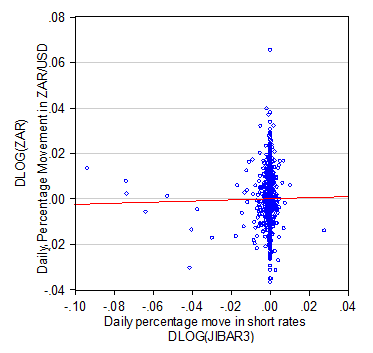
In the figure below this point is made. It is a scatter plot of daily percentage moves in the ZAR/USD exchange rate and short term interest rates, represented by the 3 month Johannesburg Inter bank rate (JIBAR). As may be seen there has been about the same chance of an interest rate move leading to a more or a less valuable rand since January 2008. The correlation statistic for this relationship is very close to zero, in fact 0.000006 to be exact.

A scatter plot- daily percentage moves in short rates and the ZAR ( daily data January 2009- September 2013)

Source I-net Bridge Investec Wealth and Investment

The theory behind inflation targeting is that exchange rates follow rather than lead domestic inflation. The theory does not hold for an economy that depends, for want of domestic savings, on a highly variable flow of foreign capital. This leads in turn to a highly variable and unpredictable exchange rate. The best monetary policy can do in the circumstances is to accept this reality. That is to allow the exchange rate to act as the shock absorber of variable capital flows and to accept the consequential short term price trends – while using interest rates as far as they can be used – to moderate the domestic spending and credit cycles.

In practice this is how the Reserve Bank has reacted to recent exchange rate weakness that was so clearly not of its monetary policy making. Doing nothing by way of interest rate changes or intervention in the forex markets was the right thing to do. It remains the right thing to do until the global capital markets calm down. It is just as well that in the past week the rand has strengthened, improving the inflation outlook and so helping to keep the Reserve Bank on the interest rate fence, where it should stay.

If the rand stabilizes – better still strengthens further in response to global forces or SA reasons – for example better labour relations – one may hope for lower interest rates. The weakness of domestic spending calls for lower not higher interest rates. Lower rates would will help stimulate faster growth. And so doing would add expected value to SA companies, especially to those heavily exposed to the SA economy and the domestic spender. This would add to the incentives for foreign investors to buy JSE listed shares. It would also encourage foreign controlled businesses in South Africa to add to their plant and equipment and retain cash rather than pay out dividends to foreign shareholders. Such a more favourable outlook for the SA economy and the capital that flows in response may well strengthen the rand and improve the inflation outlook.

A focus on inflation targets, beyond Reserve Bank control via interest rate determination, prevents the Bank from doing the right thing for what interest rates do influence in a consistent way and that is domestic spending. Lower interest rates and the demands for credit that accompany them can stimulate demand and higher interest rates can be used to discourage demand when it becomes excessive. When domestic spending growth is adding significantly to domestically driven pressures on prices higher interest rates are called for. This is clearly, and by the Reserve Bank’s admission, not the case now. The opposite is true, domestic demand is more than weak enough to deny local price setters much pricing power. And in these circumstances higher wages conceded to Union pressure lead to fewer jobs and on balance less rather than more spending. Prices are set by what the market will bear rather than operating costs. Operating margins rise and fall with operating costs- – in the absence of support form customers- and prices do not necessarily follow.

A target for what is judged to be sustainable growth in domestic spending might be a useful adjunct to monetary policy that regards low inflation as helpful to economic growth. A target for inflation, without a predictable exchange rate, just gets in the way of interest rate settings that should be helpful for growth.

Inflation targets are proving to be a very unhelpful guide to monetary policy settings

With the SA inflation rate above the upper band of the target it was inevitable that the MPC at its latest meeting and Press Conference would focus on inflation and the risks to it rather than the unpromising growth outlook and the risks of even slower growth to come. The question that should have been asked of the Governor and the MPC is why they appear to believe that higher short term interest rates would help to reduce inflation in SA. The connection is by no means as obvious as traditional monetary theory might suggest.

The answer following conventional theory might have been that it would slow down spending – even more than it has slowed down to date – and so further inhibit pricing power at a retail and manufacturing level. It might well do that- slow down spending further and so harm the economy accordingly. But by slowing down the economy it would discourage foreign investors from investing in South Africa. This could mean a weaker rand and so more rather than less inflation. Slower growth with more inflation is not something the Reserve Bank should wish to inflict on South Africans, as it might well do. The evidence is very strong that interest rate changes in SA have had no predictable impact on the exchange rate and therefore on inflation.

The reality is that the exchange value of the rand is highly unpredictable and volatile for both global and SA reasons that encourage or discourage the demand for risky rand denominated assets. This means that inflation is beyond the immediate control of the Reserve Bank. Therefore while low inflation is a highly desirable objective for economic policy – inflation targeting –becomes a very bad idea in these circumstances. A bad idea because it may well lead to higher interest rates, slower growth and because growth determines capital flows, may mean more rather than less inflation.

The theory behind inflation targeting is that exchange rates follow rather than lead domestic inflation. The theory does not hold for an economy like the SA economy that is dependent for its growth on a highly variable flow of foreign capital that leads to a highly variable and unpredictable exchange rate. The best monetary policy can do in the circumstances is to accept this reality. That is to allow the exchange rate to act as the shock absorber of variable capital flows and to accept the consequential short term price trends while using interest rates as far as they can be used to moderate the domestic spending and credit cycles.

In practice this is how the Reserve Bank has reacted to recent exchange rate weakness that was so clearly not of its monetary policy making. Doing nothing by way of interest rate changes or intervention in the forex markets was the right thing to do. It remains the right thing to do. It is just as well that in the past day the rand has strengthened improving the inflation outlook and so helping to keep the Reserve Bank on the fence where it should stay. If the rand stabilizes – better still strengthens further in response to global forces or SA reasons – for example better labour relations – one may hope for lower interest rates. These will help growth and by improving the incentives for foreign investors to buy South Africa may well strengthen the rand and improve the inflation outlook.

Talking about the strong Rand today it was highly instructive that the stronger rand was accompanied by higher Rand values attached to almost all financial assets. Almost all equities appreciated – global plays for example NPN or BTI or SAB became more valuable in rands – despite the stronger rand – as did the SA plays – banks and retailers – as did almost all Resource companies, especially the gold miners that might ordinarily be expected to suffer from rand strength and benefit from rand weakness. In other words there were no rand hedges on the JSE on the 18th September (.i.e. companies that benefit in rand terms from rand weakness or are harmed in rand terms by rand strength).

There is in fact very little recent evidence of rand hedge qualities in JSE listed companies. This is because rand strength reflects good news about the global and the SA economy – for example lower interest rates in the US – absent tapering – that is good economic news. The good news effect on the dollar value of JSE stocks outweighs the effect of translating higher dollar values into stronger rands. Hence no rand hedge characteristics are consistently to be observed. The opposite is mostly true when the rand weakens on bad news. A weaker rand does not usually compensate for the lower dollar prices of globally traded shares when the outlook for the global and or SA economy deteriorates. Therefore investors should hope for a strong rather than a weak rand. But is remains true that the SA economy plays- businesses that benefit from lower interest rates that may well follow a stronger rand and the lower inflation that follows-  stand to benefit even more than the global companies listed on the JSE that generate a much smaller proportion of their revenues and profits from the SA economy.

Global interest rates: Ben Bernanke did not get what he wanted from the bond markets

By Brian Kantor

Fed chairman Ben Bernanke spoke of a surprisingly promising outlook for the US economy, of 3% to 3.5% growth in 2014 that, if it all materialises as predicted, would allow the Fed to taper off its securities purchase programme from September this year and to close down the purchases by late 2014 (currently of the order of $85bn a month).

The market listened and reacted in ways that were consistent with the prospect of faster growth in the US but they would not have pleased Bernanke. He was at pains to emphasise in his statements how conditional would be the direction of quantitative easing (QE), ie conditional on the actual improvement in the US economy (and the labour market in particular) to keep the market at ease. The severe bond market reactions were not welcome because higher interest rates (especially higher mortgage rates) may threaten the recovery itself.

Longer term interest rates moved sharply higher in reaction to Bernanke and the Fed. By the weekend the 10 year Treasury Bond yielded over 2.5%, compared to about 2% a week before. More economically significant was the move in inflation linked bonds (TIPS). These real yields moved even than did the yields on the vanilla Treasury bonds, from close to zero on 16 June to over half a per cent by the weekend. Higher real rates are consistent with an improving growth outlook, leading to increased demands for capital to invest in real assets. And so the gap between the vanilla yields and the inflation protected variety narrowed to less than 2%.

Bernanke indicated in his press conference that his target for inflation is 2% per annum – anything less in his view represents a deflationary danger for the economy. The market now expects inflation to be dangerously low – implying more, rather than less, monetary easing to come.
The negative reactions of the equity markets to the more promising outlook for the US economy were not as easily explained. The S&P 500 was down by just over 2% in the past week, having been very firm before the Fed statement. Stronger, more normal US growth of the kind the Fed is expecting drives earnings as well as interest rates higher – possibly enough to add rather than detract from the value of equities that remain (in our judgment) still undemandingly valued by the standards of history and the prospects for earnings.

These interest rate developments in the US had severe repercussions for emerging bond markets and emerging currencies, that until recently have been beneficiaries of a search for yield in a world of generally very low yields. Not-so-low yields in the US reversed these flows, leading to pressure on emerging market currencies and yields of all kinds. SA was not spared these withdrawals of cash from high yielding assets, though the rand and the rand bond market did less poorly than many other emerging market currencies and bond markets, subject as they have been, for example in Brazil and Turkey, to violent demonstrations on their streets.

The rand actually gained by a per cent or two against the basket of EM currencies and the Australian dollar in the week ending 21 June. The yields on both long dated conventional RSA bonds and the inflation-linked equivalents rose, though this yield gap widened slightly, offering more compensation for bearing SA inflation risk by the weekend.

The yield gap between RSA rand bond yields and US Treasury bond yields can be regarded as compensation for bearing the risk of the rand depreciating. This yield gap can also be described as break even rand depreciation. If the rand depreciates over time at a faster rate than implied by the difference in interest rates, it would be better to buy US bonds (and vice versa if the rand does better, that is depreciates on average by less than the difference in yields). This yield remained largely unchanged through the past week. While the rand has weakened against the US dollar it is not priced to weaken at a faster rate.

Expectations about the direction of short term interest rates in SA have been revised sharply higher to the disadvantage of all the interest rate sensitive stocks listed on the JSE, the retailers, property companies and banks etc. With a more sharply inclined yield curve the one year RSA rate expected in a year’s time was 5.13% on 30 April. It is now 7.6% (see below):

The state of the SA economy does not justify higher short term rates. The Reserve Bank is predicted to raise them notwithstanding. Our view is that the Reserve Bank will correctly resist raising rates until the SA economy has picked up momentum, rather than slowing down, as it appears to be doing.

The immediate future of the longer term interest rates in SA will take their cue largely from the direction of long term rates in the US. Better economic news emanating from emerging market economies (and China in particular), would also help the rand and the RSA bond market. There would appear to be some chance that the US bond market has over reacted to good news about the US economy – expectations that have still to be fully vindicated. Higher rates will also encourage the Fed to maintain, rather than slow down, the pace of its bond purchases. If so, the past week may well prove a temporary high water market for interest rates in the US and elsewhere.

Inflation and the rand: Why doing nothing is the best SA monetary policy can do

By Brian Kantor

An unfortunate history of exchange volatility

The SA economy is once more challenged by an exchange rate shock. As we show below, such exchange rate weakness – of the order of a 15% or more move lower in the trade weighted exchange rate, compared to a year before is hardly unknown. In fact the latest shock is the fourth since 2000. As we also show below, the rand had lost as much as 26% of its foreign trading value by May 2002. By early 2007 the rand was down by about 15% on its value a year before and then 20 months later had lost 19% of its value.

The rand on 31 May 2013 was about 14% weaker than 12 months ago on a trade weighted basis. It will also be appreciated that while the long term trend in the value of the rand since 2000 has been one of rand weakness, the direction is by no means one way. Weakness can be followed by strength of similar magnitude. These unpredictable shocks, in the form of large sustained movements in the value of the rand in both directions, can be of similar magnitude and can complicate business decision making and monetary policy. They are a most undesirable feature of the SA economic landscape.

The sources of exchange rate volatility have very little to do with monetary policy

These large exchange rate movements are a response to interruptions or disruptions in the flow of capital to and from South Africa. Increased demands for rands push the rand higher and less demand moves the price of the rand higher or lower when valued in other currencies. It is very much a market-determined and flexible – very flexible in both directions – rate of exchange. The SA Reserve Bank does not typically use its own stock of foreign exchange to intervene in the market for rands.

This market, a deep one at that, regularly transacts over US$15bn worth of rands every trading day, according to the Reserve Bank on the basis of information provided by the trading banks. Three quarters of the trade is conducted between third parties without a direct connection to SA trade or finance. They presumably trade and hedge the rand so actively as a proxy for currencies that are less liquid. As we show below there is no obvious relationship between the trade weighted value of the rand and turnover in the currency market.

The one highly predictable impact of an exchange rate shock- more or less inflation

The one highly predictable influence of an exchange rate shock is that more or less inflation will follow in the opposite direction. More inflation when the rand weakens – less when it strengthens. It is most important to recognise that for SA the exchange rate leads and the inflation rate follows. In conventional monetary theory it is faster domestic inflation (caused by easy monetary policy) that leads to a weaker exchange rate. The weaker exchange rate then should help to maintain the international competitiveness of exporters and firms that compete with more expensive imports priced in the weaker domestic currency. In the figure below we identify the timing of the shocks that have sent the rand weaker and show how the trend in the inflation rate has followed these shocks consistently.

In the figure below we show the results of a very simple model. The trend in inflation is very simply explained in a single regression equation by the annual movement in the trade weighted exchange rate, lagged by six months. The model does well in predicting the direction of inflation in SA and also its level. The explanatory power of the model is rather good – explaining over 60% of the inflation trend. As the chart also shows, there is somewhat more to inflation than the exchange value of the rand. The model significantly underestimated inflation in 2008-09 and has less significantly underestimated it recently.

Among other forces moving SA prices and inflation are trends in global prices, particularly in the prices of grains and other soft commodities in US dollars that influence the domestic price of food when translated at import price parity into rands. The global price of oil is also very important in this regard. Clearly independent of the value of the rand, global inflation or deflation (including oil price increases or decreases) will influence prices in SA and their rate of change. The pace of administered prices increases in SA (taxes by another name) will also have an influence on the CPI. So will the strength or otherwise of domestic spending, supported more or less by the growth in money supply and credit and interest rates, that is by monetary policy.

Monetary policy is largely impotent in the face of exchange rate shocks of this order of magnitude

It should be very obvious from the recent history of inflation in SA that there is little the Reserve Bank or monetary policy can do about inflation because it cannot influence the variable exchange value of the rand in any predictable way. The same monetary history tells us that raising or lowering interest rates have simply no predictable impact on the exchange rate. Monetary policy is largely impotent in the circumstances of exchange rate shocks of the order of magnitude suffered by SA. Inflation targeting, to which SA subscribed in the early 2000s with all the sincerity of the newly converted, had as its justification the conventional wisdom of monetary policy of that period. The presumption of inflation targeting was that a politically independent central bank would target inflation with its interest rate settings in a sound way and inflation and the exchange rate would behave itself in a predictable way.

The unpredictable nature of exchange rate shocks – global or domestic in origin

That presumption has proved to be a false one. The exchange rate has not behaved itself and so measured inflation has remained largely outside the influence of monetary policy. Monetary policy and interest rate settings can clearly influence domestic spending. But maintaining the balance of domestic demand and potential supply does not at all necessarily secure exchange rate stability as we observe.

The exchange rate can have an unhealthy life all of its own, responding as it does to global forces, as it did during the Global Financial Crisis of 2008-09. This crisis increased the global demands for safe havens and reduced the demand for riskier emerging market assets and their currencies, including the weaker rand, and led to more inflation in SA.

The other shocks to the rand we have identified are much more SA specific in their origins. We can identify such SA specific risks driving the rand by comparing the behaviour of the rand to other emerging market or commodity currencies over a period of rand weakness or strength. The forces driving the rand in 2001-02 and in 2006-7 were largely SA specific in their origins. The rand has weakened by significantly more than its peers over these periods of weakness.

The only time the Reserve Bank may be held responsible for rand weakness was in 2006-7. Then the bank adopted interest rate settings that were too severe, that threatened the growth prospects for the SA economy and frightened capital away. The 2001-2002 weakness was an unintended consequence of partial exchange control reform – that led to panic demands for foreign currency by local wealth owners and fund managers. The latest burst of rand weakness that began in August 2012 is associated clearly with labour relations on the mines and elsewhere that threaten mining output and exports that are so important to the trade balance of the rand. Foreign and local investors have been discouraged by the political responses to this crisis.

Nothing for the Reserve Bank to do but watch the economy ride out the storm

As clear as are the political origins of the latest exchange rate shock is that the Reserve Bank and its interest rate settings can do nothing now to meaningfully assist the rand. It is out of their hands. Raising interest rates would further weaken domestic spending, that cannot be regarded as excessive. Still slower growth in domestic spending following any imposition of higher interest rates would if anything further undermine the case for investing in SA and could lead to a still weaker rand. Indeed, were it not for rand weakness, interest rates would have been reduced to encourage domestic demand. But such action might well be regarded as less than responsible in the circumstances.

The best the Reserve Bank can do in these difficult circumstances is to do very little. The economy must be left to rise out the exchange rate shock and the temporary increase in inflation that is likely to follow. The weaker rand will encourage production for export and for the domestic market as prices and profit margins for exporters and those competing with imports have improved. Hopefully the mining sector will be allowed to benefit from these price and profit trends. Hopefully too, the politicians can help the industry. Higher prices, especially for goods or services with high import content, will discourage consumption. There is nothing the Reserve Bank can usefully do to slow these inflation and relative price effects down. Raising interest rates would damage the economy further. The best monetary policy can do in response to an exchange rate shock (that is not of its making) is to do nothing at all – but also to explain why doing nothing is the best policy.

Monetary policy: A movable feast

Easter is the bane of those who attempt to measure the temperature of an economy. Without a good fix on current activity it is very difficult to forecast the future. The trouble with the Easter festivals is that unlike Christmas celebrations, they come at different times of the year. An early Easter for the average retailer will add to sales in March and reduce them in April and vice versa when Easter falls in April.

For motor dealers the opposite is true. For some reason, obscure to us, probably due to the regulation of their hours of trading, they stay closed on public holidays and Sundays. In other words, unlike your ordinary retailers who stay open on holidays for the convenience of customers and to the advantage of their part time employees, the motor dealers lose trading days over Easter.

This makes the essential seasonal adjustment more difficult to estimate. For retail sales in South Africa, the Christmas influence on spending at retail level, combined as it with the summer holiday effect on spending is very large. For the average South African retailer December month sales on average account for 35% more than the average month. To get a good idea of how good or bad retailers have done in December compared to past Decembers or to November, sales revenues of the average retailer have to be reduced (divided by) a factor of 1.35. For the motor dealer new vehicle unit sales have to be scaled up by 0.85 (ie divided by a factor of 0.85).

Over the longer run March and April on average have proved to be a slightly below sales months for the average retailer: the scaling factor is 0.98 or 0.97. But life is more complicated for the motor dealer. March is usually an above average month, with a scaling factor of 1.08, and presumably March becomes an even stronger month when Easter does not reduce showroom hours as they did this year. Meanwhile April, presumably because Easter usually but not always falls in April, is a below average month with a scaling up factor of 0.87.

This year, with Easter in March, will be a more difficult year to interpret sales trends for the motor dealers and perhaps also for retailers generally. To get at the underlying trend in sales and sales volumes we would have to scale up for the motor dealers and scale down for the orinary retailers by more than usual, but just how much would be a matter of some guess work. We will have to wait for sales in April to be confident in our measures.

Estimates of retail sales provided by Stats SA are only up to date to February. As we show below, the estimate of sales volumes in February were encouraging, suggesting that , on a seasonally adjusted basis, it was a better month for retailers than January 2013. On a seasonally adjusted basis retail volumes declined by 1.75% in January compared to December 2012 and grew by 2.7% in February compared to January. February volumes, compared to February 2012, were up 7.4%.

However despite this pick up in February sales volumes, extrapolating recent trends, appropriately seasonally adjusted and smoothed, suggests that the growth in retail volumes will continue to slow down marginally over the next 12 months. However this forecast growth in retail sales volumes can still be regarded as satisfactory. Real growth is predicted to be 4% in February 2014. With retail inflation currently running at a 4.6% year on year rate and predicted to rise to 5.2% in February 2014, this suggests that retail sales in current prices may be running at a close to 10% rate this time next year.

What the hard numbers say

We do however have actual vehicle sales volumes for March from the National Association of Automobile Manufacturers (Naamsa). These must be interpreted with caution. We also know from the Reserve Bank the value of its notes in circulation at March month end. We use these hard numbers to compile our up to date Hard Number Index (HNI) of economic activity which is an equally weighted combination of the real note issue and new unit vehicle sales. As we show below, this Index compares very well in its turning points with the delayed Business Cycle Indicator provided by the Reserve Bank. The Index, updated to March, indicates that the economy continued to grow faster in March but that the rate of forward momentum was more or less constant and maybe slowing down.

Values above 100 indicate economic growth. The Index was helped by strong growth in the note issue. This growth too was influenced by the early Easter and the spending intentions associated with it. The demand for cash is itself a coinciding rather than a leading indicator of economic activity. Households hold more cash when they intend to spend more on goods and services. However the advantage of measuring the note issue is that it provides a much more up to date indicator of spending intentions than spending itself. Spending, for example at retail level, is an estimate made from a sample survey, not a hard number, and moreover is only available with a lag. It will only be well into May before we can update our estimate of retail spending.

The close statistical relationship between growth in the note issue and growth in retail sales at current prices is shown below. Both series are on a slower growth trend and are predicted to remain so.

Should such negative trends in domestic spending materialise, more aggressive monetary policy would surely be justified. High rates of inflation that threaten the inflation targets have inhibited such monetary policy responses to date and may continue to do so. However, high rates of inflation cannot be ascribed to excessive domestic demand for goods and services. The trends moreover suggest that the growth in demand will be slowing down, rather than speeding up. The recent inflation in SA have had little to do with excess demand and much more to do with weakness in the rate of exchange and so the costs of imports that reflect also global commodity price trends. These trends, for example in the US dollar price of petroleum, suggest less rather than more inflation to come from this source (independent of exchange rates).

The problem for an inflation concerned Reserve Bank is that there is little predictable connection between interest rates and the exchange value of the rand and therefore very little direct influence the Bank can exert on inflation rates. Higher interest rates, if they implied slower economic growth, might well discourage capital inflows and encourage capital outflows, so weakening the rand and thus add to inflation, even as higher interest rates and a weaker rand discourage domestic spending.

Lower interest rates, where they boost economic growth, might in turn attract portfolio flows to the JSE and lead to a stronger not weaker rand. Faster growth with less inflation then becomes a highly desirable possibility.

Inflation targeting, without being able to predict the direction of the rate of exchange when policy action is undertaken, makes little sense. It may come to pass that the Reserve Bank accepts that the most it can hope to do with its monetary policy is to stabilise domestic spending, without regard to the outcomes for inflation. Recent policy actions by the Reserve Bank strongly indicate that in practice the Bank is following a dual mandate – targeting growth as well as inflation.

If only the rand would behave itself in the months ahead (implying no upward pressure on inflation rates) this dual mandate could lead it to lower interest rates. Recent movements in short and long term interest rates indicate that the money and bond markets are according a higher probability to a reduction in the repo rate over the next 12 months. Brian Kantor

Global monetary policy: Ben signals his intentions and the markets like what they are told

Ben Bernanke fired his Bazooka yesterday. He pledged the Fed to further purchases of securities in the market without effective limit and for as long as it takes. The Federal Open Market Committee (FOMC) indicated net injections of cash of the order of US$85bn a month for as long as it takes. The indication from the FOMC is that

“…exceptionally low levels for the federal funds rate are likely to be warranted at least through mid-2015”.

The asset markets were pleasantly surprised by the scale of the intended interventions in the asset market as well as their unlimited nature.

The key paragraph of the OMC statement read as follows:

To support a stronger economic recovery and to help ensure that inflation, over time, is at the rate most consistent with its dual mandate, the Committee agreed today to increase policy accommodation by purchasing additional agency mortgage-backed securities at a pace of $40 billion per month. The Committee also will continue through the end of the year its program to extend the average maturity of its holdings of securities as announced in June, and it is maintaining its existing policy of reinvesting principal payments from its holdings of agency debt and agency mortgage-backed securities in agency mortgage-backed securities. These actions, which together will increase the Committee’s holdings of longer-term securities by about $85 billion each month through the end of the year, should put downward pressure on longer-term interest rates, support mortgage markets, and help to make broader financial conditions more accommodative. The Committee will closely monitor incoming information on economic and financial developments in coming months. If the outlook for the labor market does not improve substantially, the Committee will continue its purchases of agency mortgage-backed securities, undertake additional asset purchases, and employ its other policy tools as appropriate until such improvement is achieved in a context of price stability.

Will these additional actions (QE3) work to revive the US economy and reduce the unemployment rate to a natural 5% or so within the next few years? The answer must be not necessarily so, given that highly accommodative monetary policies to date have not worked very obviously to reduce the unemployment rate below a stubborn 8%, with many more potential workers discouraged from looking for jobs (though how poorly the US economy would have looked without the accommodative actions to date can only be speculated about).

Persistently low interest rates and continuous injections of cash into the securities markets cannot do any harm to employment prospects. Nor can very low interest rates (as far as the eye can see) do anything but support the property market generally and related construction activity (unless these exceptional monetary measures were considered dangerous to the long term health of the economy and so undermine business and household confidence. This does not seem to be the present danger at all).

QE3 is likely to be very positively received by US business. However the boost to confidence necessary to strongly revive the spending plans of US business will have to be taken by the politicians after the elections. Better economic news from Europe and Asia would also be confidence boosting, but clarity on the outlook for Europe and China may not be imminent.

Monetary stimulus is helpful to asset markets. Higher asset prices support pension plans and encourage households to spend more. Low interest rates )that are expected to stay low) add to the argument for equities – especially those that come with dividend yield.

What sectors benefit?

The further question then is what sectors of the equity markets stand to benefit most in a still more friendly monetary policy environment? The case for the defensive stocks, that is those that pay dividends and have the balance sheets to maintain dividends, is most obviously improved.

The cyclical stocks, while not prejudiced at all by easy monetary policy and low interest rates would benefit most from a cyclical recovery itself. This, as we have suggested, is not a certainty in the short term: until a cyclical recovery clearly manifests itself, the outlook for commodity prices appears uncertain.

For undemandingly valued JSE listed cyclicals that would ordinarily benefit from of higher operating margins from SA specific rand weakness, this takes some of the wind out of their sails. The stronger rand in a world of persistently low interest rates (likely to extend to SA) is helpful for the interest rate sensitive stocks on the JSE.

The conclusion one comes to is that Bernanke, while helping equity markets, has in our opinion not yet improved the case for cyclical over defensives. The time for the cyclicals will come when the outllook for a global cyclical recovery appears more certain. Brian Kantor

The Eurozone: A declaration of monetary independence

Mario Draghi asserted the independence of the European Central Bank (ECB) to act as the independent central bank of Europe and to be the responsible guardian of the “irreversible” euro. This declaration of independence was supported by all but one of the governors of the ECB.

The bank’s government bond buying campaign is to be concentrated on maturities of less than three years to maturity. These purchases, now called the Outright Monetary Transactions (OMTs) will be conducted without any limit other than constrained by the judgment of Draghi and his colleagues. These purchases of all government bonds linked to the euro will not be inhibited by inferior credit ratings, nor would the ECB claim any seniority of its claims against borrowing governments ahead of private lenders. This is an important principle designed to draw private sector support for the bond market. ECB support for the market in distressed government bonds is conditional, that is on the condition that those governments seeking aid from Europe, the ECB and the IMF abide by the conditions set for such support. The “conditionality’ of ECB was strongly emphasised, no doubt to address likely criticism that the programme represented a soft option for hard pressed European states unable (so far) to convince the market place that they can continue to meet their obligations to creditors.

Predictably, the plan did draw criticism from the Bundesbank as representing fiscal assistance to governments and therefore was not within the mandate of the ECB. No doubt it was this German viewpoint that has so delayed the assertion of ECB independence and its ability to do, in practice, what it takes to protect a financial system in times of crisis. What it takes to solve a financial and banking crisis, as the Fed has proved recently, is quite simply the exercise of a central bank’s power to print money without limits, other than those set by its own judgment as to how much extra cash it will takes to solve a crisis. Once the crisis is resolved (hopefully, with excellent timing), it will then take back the cash from the banking system that could otherwise become inflationary (as excess supplies of money over the demand to hold money, inevitably become).

Sterilisation

Draghi did say that the automatic money supply effects of its bond purchases – crediting the banks with extra deposits at the central bank – would be “sterilised”. In other words, they would be countered by simultaneous ECB bond sales. Presumably, if the banks choose to hold excess cash reserves(as they have been doing to a very large extent in the US and Europe) sterilisation would not be called for.

Draghi was firm and forthright that his plan fully confirmed to the mandate of the ECB that charges the Bank with achieving monetary stability for Europe. Monetary stability, according to Draghi, demands the survival of the euro and the integration of the currently “fragmented” European monetary system. These are essential components of monetary stability and his ability to enter the bond markets without restraint is essential to this purpose, according to Draghi.

An integrated Eurpean monetary system would mean similar interest rates and costs and availability of credit in all the European centres of finance. It would also have to mean well co-ordinated fiscal policies and banking regulations and a unified European banking system. Europe will work towards this – monetary stability and the irreversibility of the euro to which the ECB is committed allows time for the European project – the European Union – to be completed.

It will take time, maybe lots of time, to be realised, but Draghi has acted to reduce what he described as “tail risk”, that is to reduce the perhaps small but catastrophic possibility of a banking and financial collapse in Europe.

It has taken a long time for the ECB to assert itself as a fully independent central bank. The almost immediate reactions to the Draghi plan were highly favourable. Risks came off, to the advantage of the bond, equity and currency markets, including the rand. If the market is convinced that the ECB could do what it would have to do in a time of crisis then maybe the markets in euro debt and interbank loans will calm down enough to avoid the ECB from actually exercising its powers. The bazooka is loaded: it may not have to be fired.

Fired or not, the markets can return to the still difficult task of forecasting the state of the global economy (Europe included) without the same fear about the tail risk of a European financial break down that the ECB has addressed. Brian Kantor

Interest Rates: The Marcus Put

Headline CPI inflation declined to 4.9% for the 12 months to July. This welcome lower rate of inflation does not tell the full story of the direction of prices. A year can be a long time in economic life and what happens to prices in between can be much more revealing about inflation trends. Over the past three months prices have increased very slowly – more slowly than they did a year ago, as we show below. Prices rose by 0.08% in May, 0.24% in June and 0.32% in July.

These relatively small monthly increases compared to a year before have brought down the three month rate of inflation, seasonally adjusted and annualised, sharply lower to well below 4%. ( See below)

If current trends in the CPI persist, the outlook is for an inflation rate of no more than 3.5% this time next year, as we show in the chart below. It should be noticed that monthly increases in the CPI were particularly rapid early this year, thus offering the possibility of seeing year on year inflation come down further in early 2013 (that is, if monthly increases then turn out to be below the rather high monthly increases of early 2012).

These trends could be damaged by a combination of a weaker rand and supply side disruption (drought and war) which might drive global grain and oil prices higher. If global growth gathered enough momentum to drive up metal and commodity prices generally, for demand side reasons, the rand might well strengthen to moderate such influences on the prices of imported and exported goods. Faster growth in export markets would be very helpful to the SA economy. It could bring faster growth without more inflation, because the rand will strengthen.

Slower global growth would be very likely to weaken the rand and cause the inflation numbers and outlook to deteriorate. The domestic economy will also be harmed by such trends. It would mean slower growth and higher inflation. The case for raising interest rates under such adverse circumstances is a poor one. It would mean still slower growth without any predictable impact on the inflation rate.

The Reserve Bank, under present leadership, seems unlikely to raise rates should this adverse scenario materialise. If the economy stays its present course (less inflation and growth that remains below potential growth), the case for lowering rates improves. The more hopeful scenario – the SA economy to benefit from a reviving global economy and higher commodity prices and a more valuable rand meaning no more inflation – the case for lower interest rates also improves.

And so in the light of currently lower inflation, the case for lower interest rates has improved. Furthermore it is hard to contemplate more favourable or less favourable economic circumstances that would drive short rates higher. We might describe the outlook for (lower) interest rates in SA as the Marcus Put. Brian Kantor

Keynesian economics and Quantitative Easing: Can they restore economic health?

The economic problem is usually one of unlimited wants and highly limited means to satisfy them. It is a supply side problem that only improved productivity and improved access to capital or natural resources can ameliorate.

Economic growth sustained over the past 200 years or so has helped many to overcome the economic problem, at least to a degree. When obesity rather than starvation becomes the major danger to individual well being in the developed economies considerable economic progress has been made.

But sometimes the economic problem becomes one of too little spending rather than of dismal constraints on spending. Too little demand is now the major problem in many of the developed economies and also for us in SA. Given the current availability of labour, plant and equipment in the US, Europe and SA, more goods and services would be produced and more income would be earned in the process of expanded production, if only economic agents would spend more. More spending is thus possible without the usual trade-offs and choices having to be made between one kind of spending or another. There is no opportunity cost to employing more resources when they are standing idle.

It was a severe lack of demand that severely afflicted the US economy and other economies in the 1930s. The US economy nearly halved its size between 1929 and 1933 and economic activity had not recovered 1929 levels by 1939. These catastrophic economic events gave rise to what has come to be known as Keynesian economics, named after the famous English economist John Maynard Keynes. Keynes in the late 1930s had persuaded much of the economics profession to agree that in the absence of sufficient demand from the private sector (firms and households) governments should fill the gap between potential and actual supply of goods and services by spending and borrowing more. In other words, he argued for expanded fiscal deficits to stimulate demand when aggregate demand was painfully lacking.

Keynesianism today

Such arguments are being made today, most prominently by Nobel Prize winning economists Paul Krugman and Joseph Stiglitz. They argue against the austerity apparently being practised by the US and European governments or recommended for them. In fact the fiscal deficits of the US and UK have widened enormously, and more or less automatically, as government revenues declined with the recession and as government spending, including spending on bailing out banks and other financial institutions, increased. But whether the larger deficits or higher levels of government spending helped to stabilise their economies, as the Keynesians predict, is not at all obvious. Arthur Laffer, in a recent Wall Street Journal article, argued that the opposite has in fact happened: that the stronger the growth in government spending, the slower the growth in GDP. He presented the following table linking changes in government spending to declines in GDP growth as evidence for this:

The UK, US, Germany and Japan, despite increased spending and larger deficits and borrowing requirements, have enjoyed one great advantage not available to Greece, Portugal, Ireland, Spain and Italy. The cost of borrowing, even of issuing very long term loans in the US, UK and Germany, has come down dramatically while the interest rates charged to Spain and Italy have risen enough to threaten their fiscal viability.

In contradiction to the Laffer evidence, it may be argued that growth would have been even slower without these increases in government spending. In the case of the Krugman-Stiglitz arguments for less, rather than more UK austerity, there is no way of knowing with any confidence what might have happened to interest rates in the UK in the absence of intended austerity. Higher interest rates would have severely further limited spending by the private and public sectors in the UK, had borrowing costs been forced higher by nervous investors in UK gilts.

The limits to government spending

The essential criticism of the Keynesian approach to recessions is that governments can only ever account for a portion of total spending. Increased spending by the public sector may well be offset by lower levels of spending by households and firms fearful of the impact of extra government spending and borrowing on their own financial welfare.

Higher interest rates associated with more government borrowing may crowd out private spending Higher taxes that will be expected to levied in the future to cover interest to be paid on a much enlarged volume of government debt may induce more private savings. Households and firms may seek to protect their own balance sheets and wealth that they believe may be subject to higher levels of taxation.

The potential limits to the ability of governments to increase total spending and the danger that firms and households and other government agencies may spend less, can be illustrated by reference to the US GDP statistics and Budget.

Of the US GDP of nearly US$14 trillion in 2011, spending by all government agencies, Federal, state and municipal governments on consumption and investment amounted to $3 trillion or 21% of GDP. Of this spending the Federal government accounted for but $1.14 trillion or about 38%.

Even when government spending is a large proportion of GDP, a high percentage of this is in the form of transfers to households and firms. So spending decisions are in the hands of these households and firms, who might feel constrained for the reasons outlined above.

Normal times would have meant no need for QE 1, 2 or 3 or for the very low interest rates that have accompanied QE (quantitative easing). The collapse of Lehman Brothers in September 2008 threatened to bring down the US banking and financial system. Flooding the system with liquidity (cash created by the Fed) is the time honoured method of preventing a financial implosion. The great free marketer and anti-Keynesian, Milton Friedman, with Anna Schwartz in their monumental work Monetary History of the US, had accused the Fed failing to respond in this way in 1930 and by so failing in its mission, allowed a preventable financial crisis to become an economic crisis of disastrous proportions. This was not a mistake Ben Bernanke (well versed as he was in monetary history), was going to make as head of the Fed.

What about the liquidity trap?

But the Bernanke-led Fed, having avoided a financial implosion, is faced with a problem that both Keynes and Friedman were very conscious of. Keynesians wrote of the dangers of a liquidity trap: that cash could be made freely available to the banking system at very low interest rates by the central banks; but if the banks were reluctant to lend and its customers reluctant to borrow or spend, the cash would get stuck with the banks or the public. The system could fall into the liquidity trap and so lower interest rates or increases in the supply of cash would do little to stimulate economic activity.

Keynesians then call for government spending. Friedman and Bernanke in their writing called upon a hypothetical helicopter to by-pass reluctant banks to spread cash around, which would be spent to help the economy recover. Bernanke came to be known disparagingly as helicopter Ben for this idea. The trouble with helicopter-induced money creation is that it would have to be sanctioned by Congress – it would have to be included in the Budget as fiscal policy. This makes it a highly impractical response.

Given an inability to force co-operation from banks to inject cash and spending into the system, the Fed and the European Central Bank have to rely on monetary policy. They would thus continue to make cash available to the banking system and to engage in QE, so keeping the financial system afloat, and to hold interest rates as close to zero for as long as it takes, until confidence and entrepreneurial spirits revive. Moreover, Bernanke has been lecturing politicians on the need to exercise fiscal propriety to help restore business and household confidence. Brian Kantor

Interest rates: MPC stays in the hole it has dug for itself

(From 20 January 2012)
The Monetary Policy Committee (MPC) kept rates unchanged, as expected. We would suggest that this reveals a more dovish, growth sensitive tone with a further strong emphasis on the cost push nature of inflation (to which the Reserve Bank should not be expected to react).

Click here for the full report:
Interest rates MPC stays in the hole 20 Jan 2012

Talking Point: A New Year wish – with encouragement from the ECB

(From 23 December 2011)
The ECB has finally acted as a lender of last resort (without limit) to the European banks, who had been threatened by the weakness in the European Government bonds they hold. These bonds are now being used as collateral by the banks for three year money from the ECB at 1% per annum.

Click here for the full report:
Talking Point A New Year Wish

Currencies: A structurally weaker euro?

(From 14 December 2011)
The big new story in the currency markets is not the weakness of the rand or the strength of the dollar – but the weakness of the euro. The euro, which was worth as much as 1.417 US dollars on 27 October, is now trading at close to 1.30

Click here for the full report:
Currencies Structurally weaker euro