The rand: A welcome question of specifics

Is the recovery of the rand for global or SA reasons? Whatever the explanation, it is surely very welcome.

A recovery of the SA economy needs a stronger rand. A stronger rand will mean less inflation to come and lower interest rates. Unfortunately a weaker rand leads interest rates in the opposite direction making it just about impossible for the business cycle to turn higher. A combination of higher prices on the shelves and the petrol station forecourts following rand weakness, depresses household spending. And the higher interest rates that follow add to the inability of households to spend more – and to borrow more. Household spending, which accounts for over 60% of all spending, leads the economy in both directions. Without a recovery in the propensity of households to spend more, the best the SA economy can hope to do over the next 24 months would be to avoid recession.

The foreign exchange value of the rand responds to both global forces – that is global risk appetites that drive emerging markets and currencies lower or higher (including the rand) – and SA-specific risks that encourage capital flows to and from SA.

An obvious example of SA-specific risks driving the rand weaker and interest rates higher was provided by President Jacob Zuma in December. The week of Zuma interventions in the Treasury saw the rand sharply weaken and sent long term interest sharply higher. These interventions added about R2 to the cost of a US dollar – according to our model of the rand – and about 100bps or more to the cost of raising long-dated government debt.

Our model of “fair value” for the USD/ZAR relies on two forces, the USD/AUD and the emerging market risk spread. Had Zuma not acted as he did, the US dollar might well have cost no more than R14 in early December 2015. With the recent recovery in the USD/AUD and emerging market bonds, the current fair value for the rand would be closer to R13 than R14. This suggests that the Zuma danger to the rand has not left the currency or bond markets. And that the welcome recovery of the rand is mostly attributable to global rather than SA forces. We attempt below to isolate the impact of global from SA-specific risks on the exchange value of the rand and show that the recovery of the rand is mostly global rather than SA specific.

If indeed the recovery of the rand is mostly attributable to global rather than SA forces, there is the possibility that a revived respect for SA’s fiscal conservatism – demonstrated in the Pravin Gordhan Budget for 2016-17 – can still prove more helpful to the SA bond market and the rand, global forces permitting.

In the figure below we compare the performance of the rand to other currencies including a basket of emerging market currencies. The rand weakened against all currencies in 2015 – including other emerging market currencies. Furthermore the significant recovery of the rand in 2016 is in line with that of other commodity and emerging market currencies. This suggests again that global rather than SA forces explain the recent rand recovery.

A similar impression of predominant global forces is provided by the bond market. The spread between RSA 10 year bond yields and US Treasury Bond Yields of similar duration have stabilised at more than 7% p.a. having widened dramatically in December 2015. These spreads are significantly wider than they were in early 2015. This spread may be regarded as a measure of SA specific risk, or more particularly as a measure of expected rand weakness. The rand has weakened – and is expected to weaken further. An alternative measure of SA specific risk is provided by the CDS spread paid to insure SA US dollar denominated debt against default. This spread has moved very much in in line with the interest rate spread.

The recent narrowing of this insurance premium has however also been accompanied by a narrowing of the more general emerging market CDS spread, reflecting global forces at work. The gap between the higher emerging market CDS spread and the lower RSA spread narrowed sharply in December 2015, indicating a deterioration in SA’s relative credit standing. This relative standing has not improved much in 2016, as may be seen by a difference in spreads of only about 120bps. Note that the wider this spread, the better SA’s relative standing in the global credit markets.

The spread between RSA rand yields and their US Treasury yields of similar duration are by definition also the average rate at which the rand is expected to depreciate over the next 10 years. The fact is that the rand has weakened and is expected to weaken further – despite the wider interest carry in favour of the rand.

Given these expectations of rand weakness it is not surprising and entirely consistent that inflation compensation provided by the RSA bond market being the difference between an inflation linked yield and a nominal yield. This is a very good measure of inflation expected and has also risen and remains above 7% p.a.

The Reserve Bank pays particular attention to inflationary expectations, believing that these expectations can drive inflation higher. But without an improvement in the outlook for the rand, it is hard to imagine any decline in inflation expected. It is also very hard to imagine how higher short term interest rates can have any predictable influence on the spot or expected value of the rand and therefore on inflation to come. As we have emphasised the risks that drive the rand are global events or SA political developments, for which short term interest rates in SA are largely irrelevant.

The only predictable influence of higher short term interest rates in SA is still slower growth in household spending. Less growth without any predictably less inflation is not a trade off the Reserve Bank should be imposing on the SA economy, even though but may well continue to do so. The only hope for a cyclical recovery is a stronger rand – whatever its cause, global or South African.

Real exchange rates: All about capital flows

Explaining the rand – don’t look to Purchasing Power Parity (PPP), but to capital flows to explain the value of the rand

When exchange rates conform to Purchasing Power Parity (PPP), that is the exchange rate moves to compensate for differences in inflation between two trading countries, the exchange will not have any real effects on the economy. Given PPP, what is lost, say, for an exporter or gained by an importer in the form of faster or slower inflation, is fully offset by what is gained or lost by compensating movements in the exchange rate. This would leave importers or exporters no more or less competitive in their home or offshore markets. PPP exchange rates are however at best a very long run equilibrium rate to which exchange rates may trend but seldom conform.

The SA experience with exchange rates is one where large deviations from PPP exchange rates are the rule rather than the exception. The starting point for any calculation of PPP equivalent exchange rates is of crucial importance. The date should be be one when the exchange rate appears very close to its long term PPP value.

This was the case for the rand/US dollar in 1995. Before 1995 the value of the commercial rand (this was used to pay for imports, dividends and interest and dividend payments abroad and received for exports) was protected by exchange controls on both foreign and domestic investors. Flows of capital to and from SA were conducted through the transfer of a more or less fixed pool of so called financial rands. These financial rand movements, usually expressed as a discount to the commercial rand, left the value of the commercial rand largely unaffected by capital flows and insulated against changes in investor sentiment. Hence foreign trade driven commercial rand exchange rates stayed very close to their PPP values, as was the case in 1995.

The capital controls applied to foreign investors in the form of the financial rand were abandoned in 1995. Ever since then, flows of foreign capital to or from SA – driven by levels of SA or global risk tolerance – came to influence the value of the unified rand. The rand became less a trading and more a capital driven currency in the short run.

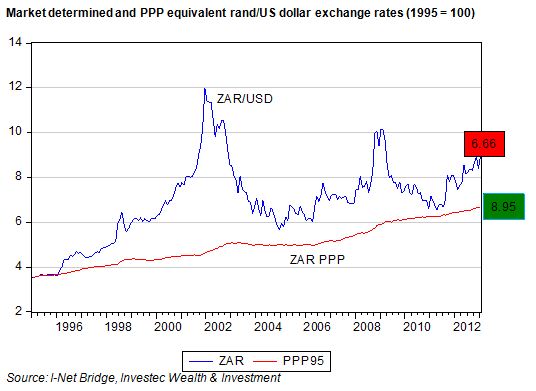
We show below (starting our calculation of the PPP equivalent rand/US dollar exchange in 1995) that the rand had become deeply undervalued by 2000. If PPP had held between 1995 and 2013, the US dollar that cost R3.35 in January 1995 would have cost a mere R6.66 in January 2013, leaving the rand about 28% undervalued compared to its PPP value.

If we start the same calculation in January 2000, when the US dollar fetched R6.31 and had PPP equivalent exchange rates been maintained, the US dollar would now cost R9.68, making the rand appear 10.5% overvalued. However, as we have shown, the PPP equivalent value of the rand in January 2000, using January 1995 as the starting point, was as little as R4.36, not the R6.31 it cost. The rand, as a result of freed up capital movements after 1995, was already deeply undervalued by 2000. It was to become much more deeply undervalued in 2001, but thereafter began to recover with improved investor sentiment.

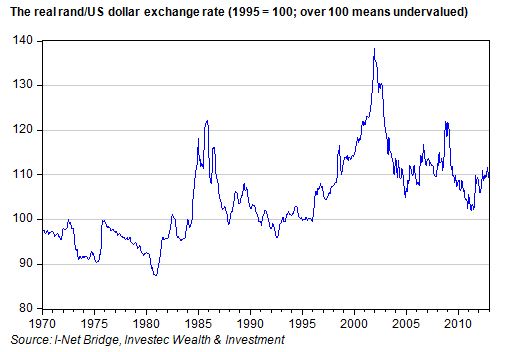
In the figure below we show the real rand/US dollar exchange rate, that is the deviation in the value of the rand from PPP, taking 1995 as the starting point. The real commercial (then unified) rand has fluctuated wildly over the years. It was slightly overvalued during the gold boom seventies. It weakened significantly when SA failed to cross its political Rubicon in 1986. The largest burst of weakness came in 2001 for SA specific reasons – largely related to the panic demands for asset swaps when they first became available – and the real rand lost as much as 40% of its value. Thereafter it began a more or less consistent recovery, helped by large foreign flows into the JSE (though it was interrupted by the Global Financial Crisis in 2008 that weakened all riskier emerging market currencies). The strength of the rand and the JSE after 2003 was not at all coincidental. The recent weakness of the rand, very much SA specific, has moved the real rand from near parity with the US dollar to about 10% undervalued.

Clearly it is investor sentiment that has come to drive movements in the exchange value of the rand. Sometimes these perceptions are SA specific and at other times much more generally explained by global attitudes to risk taking.

The reality for SA exporters and importers post 1995 is that they have had to cope with a highly variable real exchange rate. It is instructive to note that the extreme moves between 1983 and 1986 can also be explained by capital flows: the financial rand was temporarily abolished in 1983 and then reinstated in 1986.

It is these exchange rate fluctuations that greatly complicate the business of importing and exporting. Ideally, given consistency of economic policies, the real exchange rate would stabilise. Unfortunately fiscal and monetary policy in SA has been far more consistent than expectations of them. It is these expectations of policy that drive capital flows more than the policies themselves. Until SA can convince investors of the permanence of investor friendly policies, such real exchange rate volatility will continue.

The advice for SA policy makers is to maintain investor friendly policies, including the freedom to move capital in and out of the SA economy. The depth of the SA capital markets and the consequent liquidity it offers has been a major attraction for foreign investors, upon which the SA economy remains highly dependent for its growth, given the lack of domestic savings. The economy will have to trade off exchange rate instability against easy access to foreign capital.

Resorting to capital controls would drive capital away over any long term view. Moreover improved labour relations would be highly investor friendly. It would lead to a stronger real rand and a sronger economy supported by larger capital inflows. Brian Kantor

Interest rates: MPC stays in the hole it has dug for itself

(From 20 January 2012)
The Monetary Policy Committee (MPC) kept rates unchanged, as expected. We would suggest that this reveals a more dovish, growth sensitive tone with a further strong emphasis on the cost push nature of inflation (to which the Reserve Bank should not be expected to react).

Click here for the full report:
Interest rates MPC stays in the hole 20 Jan 2012

The rand and emerging markets: It all makes consistently good sense

(From 6 February 2012)
The rand has strengthened in recent weeks in response to global equity markets and in particular to the recovery in emerging market (EM) equity markets. Such responses are entirely consistent with the patterns of the exchange value of the rand since 2008. As we have often pointed out, the rand is an emerging equity market currency: where emerging equity markets go, so too goes the rand and this year is no exception.
Click here for the full report: The rand and emerging markets

Global markets and the rand: Not all bad news

The flow of disappointing US economic data continued with the Payroll report of Friday that reported a gain of 54 000 in May, well below the monthly average gain in 2011 of 182 000, and an increase in the unemployment rate from 9% to 9.1%. The unemployment rate was not all bad news as, according to the US Survey of households, an extra 272 000 workers joined the labour force only partly offset by a 105 000 increase in household employment.

More people entered the labour force, presumably because they thought they could realistically find work, but not all did so. Hourly earnings in the US are rising very slowly, by 0.1% in April and 0.3% in May. With little growth in wages, any perceived inflationary threat from the labour market has dissipated, providing further reason for postponing higher interest rates and hence the weaker US dollar.

Not all the recent news about the US economy was bad, The ISM non-manufacturing index that covers 90% of the US economy rose from 52.8 to 54.6, marginally ahead of consensus. Numbers above 50 indicate growth. More encouraging was that the employment component of this Index rose from 51.9 to 54, consistent with payroll growth of 175 000, and faster than that indicated by the official payroll report.

The weaker numbers and their implications for low interest rates for longer weakened the dollar and strengthened the euro and emerging market currencies, including the rand. This made the week a better one for US dollar investors on the JSE and emerging markets generally than it was for investors in the S&P 500, that after an extended period of outperformance lost ground to emerging markets last week.

The rand during the week had turned out to be a particularly strong emerging market currency. The rand made gains not only against the US dollar, the euro and the Aussie dollar but also gained about 3% against our basket of other emerging market currencies.

It would appear that the rand had gained from the approval of the Competition Tribunal of the Wal-Mart / Massmart deal after having weakened relative to the Aussie dollar and other emerging markets in the weeks leading up to the decision. SA specific risks, that is policies more or less friendly to foreign investment, would appear to have a modest influence on the exchange value of the rand in recent weeks. The more important influence on the rand will remain those emanating from global markets in the form of commodity prices and flows into emerging market bonds and equities.

The news from the commodity markets was not unsatisfactory as prices held up, helped by the weaker US dollar. The oil price in US dollars was largely unchanged.

The stronger rand and the more uncertain outlook for the US and global economy weakens further the case for higher interest rates in SA. This has been partly recognised in the bond market with a downward shift of the term structure of interest rates. The probability of an increase in the repo rate this year receded the week before last but remained largely unaffected by the news last week.

The US equity markets are undemandingly valued relative to earnings and interest rates and have become less so this past week. The weaker data disturbs the outlook for future earnings as the performance of the S&P 500 this past week made perfectly clear. The key to the outlook for the US economy and the equity markets will be the willingness of US business to put their strong balance sheets to work hiring workers and buying equipment.

The confidence of US business would be greatly assisted by the belief that Washington will deal effectively with the US Budget and US government debt. Any sense that China is loosening rather than tightening its monetary stance will be very helpful too.

To view the graphs and tables referred to in the article, see Daily Ideas in the Daily View: Daily View – June 6: Global markets and the rand: Not all bad news

Currency markets: Explaining the weak US dollar and the strong rand

Recent trends in the currency markets following the spike in the oil price raise two questions: why has the US dollar weakened and why has the rand strengthened? It should be recognised that the rand has gained not only against the weaker US dollar but also against the crosses, including the Aussie dollar. In the figure below we show the trade weighted value of the rand and the oil price in US dollars based to 1 February 1 2011. The oil price is up about 13% while the trade weighted rand had gained nearly 3% since the oil price spiked in mid month.

The full version of this article can be found in the Daily View here: Currency markets: Explaining the weak US dollar and the strong rand