How important is mining to the SA Economy. It depends on how you measure it.

A crisis of poor returns on capital invested and declining employment opportunities

SA mining is in crisis. And the travails of SA mining, more particularly those of gold and platinum mining are having a very negative impact on GDP and expected GDP growth and on the value of the rand. To survive as viable businesses able to cover their costs of capital the mines have to plan for lower costs of operations and that means to plan for lower levels of production and employment, that is plan the closing rather than the opening of mining shafts. Investors in the industry and in the South African economy are not at all sanguine about the prospects for the industry and this lack of confidence is well reflected in the market value of the mining companies and in the exchange value of the ZAR.

The market fears further disruption of mining output by uncooperative trade unions. Union leaders do not appear to share the same sense as have shareholders and potential investors have of an industry in crisis. The Unions are expected to further resist retrenchment of their members and to continue to demand what shareholders and also the government regard as hopelessly unrealistic demands for improved employment benefits.

The future of deep level mining in South Africa may well lie in much higher levels of automation. This is a course of action not suited to an economy with so many unemployed or employed on far inferior terms outside the mining sector.

The mining sector contributes much to exports and to the outlook for the rand and interest rates

Lower levels of mining production, particularly if they are the result of strike action, threaten the trade account of the balance of payments and justify a weaker rand. The weaker rand then implies more inflation that makes it harder for the Reserve Bank to offer relief to the economy in the form of lower interest rates, relief, absent a widening trade deficit, that would make every economic sense.

Growth in Domestic Expenditure (GDE) has held up significantly better than growth in domestic output (GDP) meaning stronger growth in imports than in exports. The failures of the mining sector to produce more and to take advantage of what has been until recently, highly favourable price trends ( as we will show below) are a large part of the explanation of current rand weakness and slow economic growth generally.

The share market doesn’t expect growth in output or even growth in earnings and dividends from the mining houses and their subsidiaries. It is rather demanding that the mining houses pay much closer attention to cost control and operational excellence. These low market expectations should act as a warning to managers, workers and the government responsible for mining policy. The lower profits and reduced growth expected is not in synch with demands for higher wages, electricity prices and government interference with mining rights and the taxation of mining profits.  The potential upside for shareholders is that if these low expectations can be countered by sober management and better relations with labour and government then these mining companies stand a stronger chance of recovering their status with investors. Merely sustaining the output of gold, platinum even at lower planned levels, would be surprisingly good news and likely to be well received in the share and currency markets.

How dependent then is the SA economy on the mining sector? It all depends on how the share is measured

The SA economy remains highly dependent on the export of minerals and metals. Directly exported minerals and metals account for as much as 60% of all export revenue. Hence the sensitivity of the foreign exchange value of the rand to mineral and metal prices and their production.

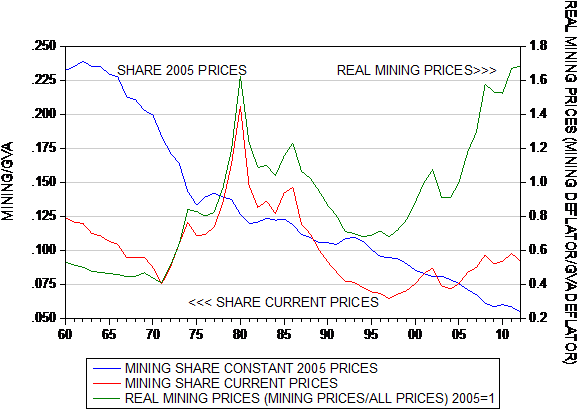
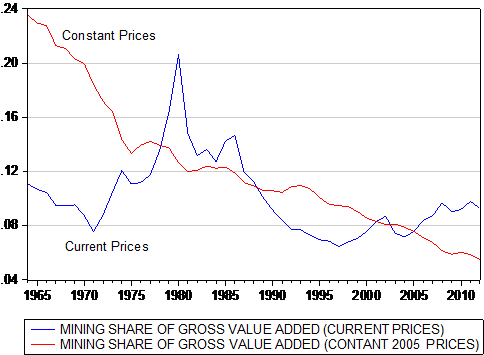
Mining’s share of the Gross Value Added (GVA) by all sectors of the SA economy in 2012 was no more than 5.5% when measured in constant 2005 prices. When both mining output and GVA, including mining output, is measured in current prices, mining’s share rises to 9.3% of GVA. As we show below, when measured in constant 2005 prices, the contribution of mining to GVA and GDP has been steadily declining over many years from a large 23% share in 1960 to the current less than 6% share , regardless of the direction of global metal and mineral prices and so mining revenues.

As we also show that when the share of mining is measured in current money of the day prices the share of mining in the economy takes on a very different complexion. The share of mining in the SA economy, so measured as a ratio in current money of the day prices, was less than 12% in 1960, compared to over 23% in constant price terms that year. In 1970 the share of mining in GVA was 8.8% if measured in current prices, or a much higher share, 20% of the economy,  if measured in constant 2005 prices. Thereafter the mining share measured in current prices rises significantly rises in response to the very significant increases in the gold price in the seventies. When the gold price peaked in 1980 the share of mining in GVA in current price terms was as much as 21%- but then only about 12% if recorded in constant 2005 prices. Thereafter, as the gold price fell away and the prices of mining output were subject to a long period of deflation and a further decline in the output of gold, the share of mining in current price terms fell further to a much less important 7% by the year 2000. Thereafter when measured in current prices Mining gained a marginally larger share of the economy to the 9% share measured in 2012. The increased output of and higher prices coal and iron ore were significant contributors to thei increase in economy share. The share of mining in the economy in constant price terms by strong contrast declines continuously after 1960 and appears completely unaffected by relative prices or industry trends as we show below.

The share of Mining in Gross Value Added using constant 2005 prices or current prices
Source; SA Reserve Bank Data Bank, Investec Wealth and Investment.

Real prices matter a great deal to producers

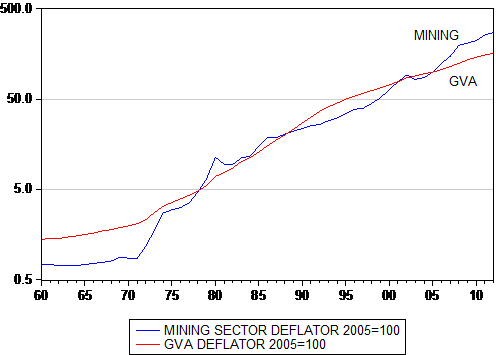
A key to the role of any sector of the economy, with an improving or deteriorating share of the economy, is surely relative price trends. When a sector enjoys what may be called pricing power, that is to say the sector can price increases ahead of the average rate of inflation , then one would expect improved profit margins to follow and extra output to be encouraged. In the figure below we show how the SA Mining Sector Price Index, that is the mining sector deflator, has compared over the years with all prices, including the prices of metals and minerals, as reflected by the Gross Value Added Deflator.

As may be seen between 1960 and 1970 Mining Sector selling prices lagged well behind the selling prices of all SA production or value Added.   In the seventies, helped especially by a rising gold price, prices realised by the SA mines, rose significantly faster than prices in general. A long period of metal and mineral price deflation then followed until approximately 1999 when commodity prices picked up strongly in absolute and relative terms. These favourable trends or terms of mining trade were then disrupted by the Global Financial Crisis of 2008-09

The Mining Sector Deflator compared to the Gross value Added Deflator (2005=100) Logarithmic Scale
Source; SA Reserve Bank Data Bank, Investec Wealth and Investment.

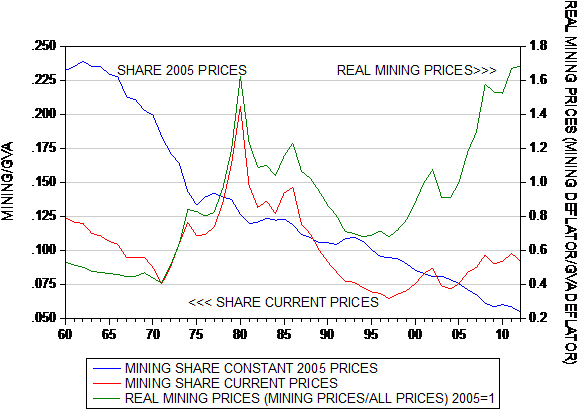
 If we divide the Mining Sector deflator by the GVA deflator we get the relative price of mining output. For producers in any sector the higher the relative price the better and the more encouragement offered to increase otput.[1] In the figure below we compare these relative prices with the share of Mining in GVA, measured in current prices. As may be seen the share of mining grows and declines very consistently with improvements in or a deterioration of the relative prices of mining output. Such responses make every economic sense. That the share of mining, when measured in constant price terms, declines consistently and independently of these relative prices makes very little intuitive sense. Relative prices appear to make no positive impact on the mining sector at all when the mining share is measured in constant prices. The share of mining in the economy, when measured in constant prices, simply declines continuously as may be seen.

The reason for this highly counterintuitive result is simply in the arithmetic of National Income Accounting conventions. If sector prices – for example mining sector prices – rise faster than prices in general then the share of that sector in the economy, when measured in constant prices, automatically declines and vice versa when sector prices rise more slowly than prices in general the share of that sector will rise automatically. [i]

The presumption of such a result is that it is the supply side of the economy, rather than demand forces that drive relative prices and so relative shares in national income methods of calculation. That is it is an increase in supply that results in a lower relative price and so a larger share of the economy. Rather, that as in the case of mining output, where prices are set globally and the mines are price takers, to presume that it is an increase in global demand that leads to higher prices and in turn to more profitable production and so increases in output and in the share of the economy realized by a sector.

Applying the standard convention to the share of Mining and also Exports in SA subject to similar price trends becomes seriously misleading. Measuring sectoral shares using current prices makes much more economic sense.

It should be noticed in the figure below that SA miners benefitted from an extraordinary increases in the prices for their output compared to prices in general in the seventies and after 2000. Relative prices have moved further to the advantage of the mining sector over the past twelve years as may also be seen. That Mining’s share of the economy did not rise anything like as significantly in the past decade and more reflects the wasted opportunity to benefit from the commodity super cycle. The mining boom in terms of volume of output produced regrettably largely passed South African production by. The costs of mining gold and platinum rise as rapidly as did prices. Uncertainties about government policies towards mining and the failure to invest in additional transport infrastructure to export more coal and iron ore also contributed significantly to the modest supply side responses to much more favourable relative price trends.

Mining share of GVA and Relative Mining Prices

Source; SA Reserve Bank Data Bank, Investec Wealth and Investment.

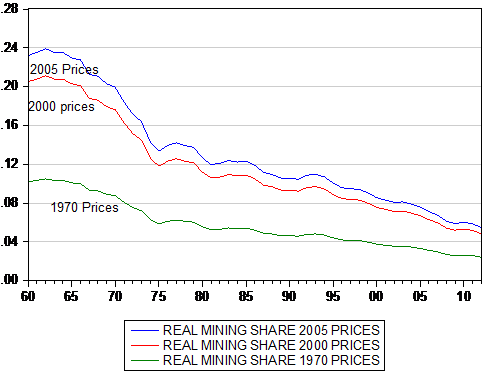
Another very good reason to question the use of constant prices to calculate sectoral shares of the economy  is that these shares can change meaningfully with changes in the base year used to measure constant prices. Using exactly the same price series, the same deflators, measured in constant 2005 prices or constant 2000 or constant 1970 prices can make a large difference to the share of a sector measured in constant prices as we show below. Using a deflator with 1970 prices =100 for both Mining and GVA, to one using much lower 2000 prices or 2005 prices as the base equal to 100 shifts the share of mining in constant prices in 2012 from 2.4% using 1970 prices to 4.8% using 2000 prices to 5.5% using 2005 prices. [ii]

Share of Mining In the SA economy using different base years

Source; SA Reserve Bank Data Bank, Investec Wealth and Investment.


That changing the base year can have such a meaningful effect on the sector share makes the use of constant prices as the basis for calculating the share of different sectors in the economy highly unsatisfactory. While the trends in the sector share, measured in constant prices using different base years, remains exactly the same the numerical values can turn out to be very different. Every change in the base year results in once and all constant shift in the trend giving a different impression of the importance of the sector to the economy. This is why in our judgment the most consistent measure of mining’s contribution is the ratio of mining output to Gross Value Added ( GVA)when both mining output and that of all sectors including mining GVA, is measured in money of the day prices. By this calculation the share of mining in the SA economy peaked in 1980 at over 20% and currently contributes about 9% of all value added as we show above.

The contribution of manufacturing to the SA economy is exaggerated using constant price calculations


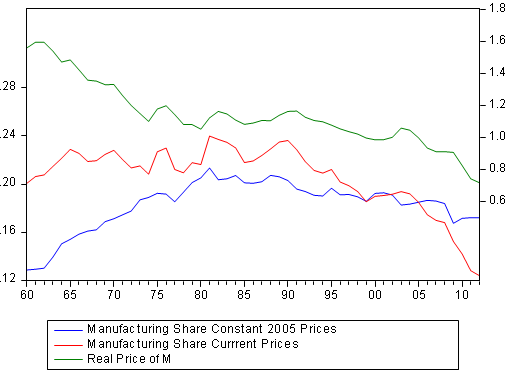
The same approach to measuring the share of Manufacturing in  SA production can  be taken. In the figure below we show Manufacturing’s share in GVA as well as the relative price of manufacturing Output. As may be seen the share of Manufacturing measured in current prices was approximately 24% in the eighties. It has since declined markedly to a 12.4% share in 2012. This declining share has been accompanied consistently by an almost continuous decline in relative prices. This downward price pressure has clearly accelerated in recent years. Manufacturing in SA has become increasingly exposed to competition, especially from abroad. Consumers and retailers and their employees have benefited from the competition.

Manufacturing Sector; Share of Output and Relative Prices
Source;  SA Reserve Bank Data Bank, Investec Wealth and Investment.

Conclusion

Economic statistics should accurately reflect economic realities and hopefully lead to appropriate economic policy and policy changes. Measuring sector shares in SA in constant price terms as is the National Income Accounting Convention is very misleading about the role of mining in South Africa and therefore also about the role of other sectors, including Manufacturing as we have argued. A irony is that if shares in the economy were measured in current rather than constant price terms this past quarter the disappointing and currency moving Q1 GDP numbers would have looked rather different. Manufacturing, with a lower share of the economy when measured in current prices, 12.3% share in current prices in 2012 compared to 17.2% in constant prices, with a close to 8% decline in output on a seasonally adjusted and annualized basis, would have been less of a drag on economic growth. And mining output that increased in Q1 given a larger share of GVA (5.6% in constant prices, 9.3% in current prices) would have added more to the growth rate.


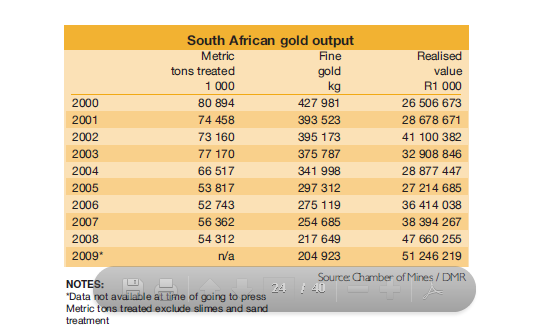
[1] The case of Gold Mining in South Africa is somewhat different to the norm. In the seventies and eighties the higher gold price offered a choice to the mines. They could choose to mine shafts with lower grade, that is ore with lower gold content and in this way extend the life of the mines by extracting more gold bearing ore so leaving less gold behind. They typically elected, where possible, to extract more gold bearing ore from underground with lower average gold content. As a result the output of gold fell from 1000 metric tons in 1970 to 670 tons in 1985 while the tones of ore extracted and milled by the mines grew by about 30% from 75m tons in 1970 to 105m tons over this period 1970 – 1985. Capital expenditure by the gold mines was R106m in 1970 and R1911m in 1985. Working profit per ton of ore milled was a marginal R3.9 in 1970 and a hugely profitable R70.46 in 1985.  416,846 workers were employed by the gold mines in 1970 and 513,832 in 1985. If productivity was measured as output of gold per worker employed then it declined sharply over this period, from 2.3 kg of gold per worker in 1970 to 1.3kg in 1985. If productivity was however more realistically measured as tones of ore extracted per worker, then it would have improved from 178 tonnes of ore milled d per worker in 1970 to 203.5 tonnes in 1985. These tradeoffs of lower grade for a longer mining life seem no longer available to the gold mining industry. The better grades of ore appear as largely exhausted and the industry is forced to mine lower grade ore at ever deeper more costly levels. The volume of ore extracted has declined consistently over the past ten years while the annual output of gold from SA mines is now below 200 tonnes. (See Table Below)  Source; Annual Reports of Chamber of Mines of South Africa.


[i] The mathematical proof of this and other propositions made here are to be found in a paper written in 1987 with Iraj Abedian, Relative Price Changes and their Effects on Sectoral Contributions to National Income , that can be found in my blog www.zaeconomist.com

[ii] Reducing or increasing the absolute value attached to the price series reduces or increases the sectoral share by a constant value. The 1970 deflator rises from a very low absolute base of 100 in 1970 to a level of close to 50000 in 2012- a 500 times increase in average prices over the 42 years. The deflator for 1970 using 2005 prices as the basis would have an absolute value of 0.869 compared to the value of 100 if 1970 was chosen as the base year. Clearly such absolute numbers with excatly the same underlying trend should not have a real effect.


Why a great variety of new cars on the road is good economic policy

A lead article in BD by Alexander Parker, (Friday 5 April) was introduced with the headline State-Aided car exports ‘almost 40% of trade gap’.

The article quoted Roger Pitot of the National Association of Automotive Components and Allied Manufacturers, that the motor industry’s trade deficit was R49bn “or more than 40% of the national trade deficit … by far the highest we’ve ever had”. Presumably this trade deficit is the difference between the imports of motor vehicles (fully built) and also of components of motor vehicles (to be assembled in SA) and the exports of motor vehicles and components from SA.

Fair enough – but then the article goes on to quote Gavin Maile from KPMG “… local production of vehicles for export also contributed to the trade deficit …” an observation given prominence in the headline.

(This last statement is a non sequitur. Any exports of motor vehicles from SA would reduce the trade deficit provided, which seems reasonable enough to assume, that the prices received for the the exported vehicles covered at least some of the labour, transport and rental cost etc incurred in SA assembling and/or shipping out the vehicles. This would be true even if all the components of the vehicles exported were imported. Indeed, if the fully built up vehicles were shipped to SA and then re-shipped to neighbouring countries, outside the customs union, provided there were extra rands to be earned in these operations, the SA trade deficit would decline.) Imports might go up in rand terms importing the vehicles and or their components, but if some of the imports were then re-exported exports measured in rands would go up by more than the rand cost of the imported vehicles or the components previously imported.

But these logical quibbles aside, the more important point is that there is no logical reason to expect or plan for a balance of imports and and exports in any one sector of the economy as perhaps the component producers are suggesting and would prefer. There will always be sectors of the economy that profitably export far more than they import: for example mining or farming and other sectors, such as the motor industry where the opposite applies.

We and the firms we own and work for strive to profitably produce a surplus of the services or goods that we specialise in to supply the world of consumers and users, both domestic and foreign. We then turn these sales into money for salaries and wages and rents and taxes and profits for owners who then exchange this income for all the other goods and services that are cheaper to buy in than produce ourselves. As Adam Smith explained many years ago, division of labour and the productivity gained through specilaisation is limited by the extent of the market. These benefits of trade are widened by opportunities to sell to and buy from foreign firms and households.
An economy protected against foreign competition will not only import less but also export less because it denies itself the advantages of specialisation in goods and services in which it has comparative advantages (in both the domestic and foreign markets). The notion that trading partners will willingly buy from SA firms without an equal opportunity for their firms to also sell to SA customers is clearly false. Trade is a two-way street where the traffic is best kept flowing freely in both directions.

It is possibly a moot point whether SA would have much of a domestic motor assembly, let alone a domestic motor manufacturing industry, were it not for a long history of protection offered to the domestic manufacturer and component producer. The effective protection against imports may have declined to a degree – hence the greater volume of imported vehicles. The one great advantage of the current system of incentivising exports by giving license to import, is an SA market with a great variety of vehicles (though how well prices paid on the local showroom floors compare with prices abroad is a subject of much debate).

This variety of new vehicles on offer in the domestic market – from luxury to utility – not only encourages demand for vehicles but also employment in the distribution and maintenance of these vehicles. One wonders how the numbers employed in distributing and servicing the vehicle stock compare with those employed in manufacturing vehicles and components. Less variety on offer would mean reduced demand for new vehicles and a smaller slower growing vehicle park to service and trade.

But aside from employment gains made in distributing and servicing an enhanced vehicle park, there is another very valuable benefit from having a great variety of new motor vehicles for customers to choose from. The quality of motoring experiences for many highly paid and highly skilled participants in our economy – the indispensable rain makers so to speak – ranks for them (in lifestyle) not far behind, in importance and relevance, to the quality of their homes, children’s education and medical services. Force them all to drive the equivalent of the East German Trabant or a limited selection of cars that might be produced cheaply in relatively large numbers in SA, would mean a less attractive life style for them and so effectively a still higher tax rate imposed on their incomes.

With all taxes or exactions on their standard of living, these key personnel with artificially diminished choices in vehicles or in any other goods and services they wished to spend their own incomes on, would have to be compensated with higher pre- tax incomes to help keep them in SA. Being able to exercise consumer sovereignty not only makes you free: it also makes your economy more competitive in the market for skills and so in all markets for goods and services that domestic suppliers enter.

Freedom to enjoy the full variety of goods and services on offer in the global village, especially educational, medical and motoring services (at competitive prices that only openness to imports can bring), helps hold down the cost of attracting essential skills without which no industry or economy can hope to be competitive. Adopting free trade helps supply a better quality of life, including importantly a better quality of motoring. This is sensible economic policy that pays off for all sectors of the economy, especially for those that have a comparative advantage in exporting their surplus production. Protecting the market against imported goods or services inevitably will bring lower levels of exports and a lower standard of living for all- rich and poor.

Brian Kantor

Platinum mining in SA: Anchored in the False Bay

By David Holland and Brian Kantor

Behavioural studies have shown that humans exhibit a strong anchoring tendency. When the world changes, they remain anchored to the one they know instead of adapting to the new order. Evidence for this behaviour is ubiquitous when parsing through government and labour comments about the ability of mining companies to pay more or hire increased numbers of workers. This is undoubtedly a reason for delay and lack of resolution in discussions between government, organised labour and Anglo American Platinum about the company’s need to reduce costs and investment.

We would like to take a step back and assess how profitable platinum miners are, and calculate the expectations embedded in their market prices. Once we understand those expectations, we can focus on the best way forward for the businesses and their stakeholders.

The platinum industry has been one of great hope and now disillusionment. We aggregated the historical financial statements of the five largest South African platinum miners (Anglo American Platinum, Impala, Lonmin, Northam and Royal Bafokeng) and calculated the inflation-adjusted cash flow return on operating assets, CFROI, which is the real return on capital for the industry. From 1992 to 1997, platinum miners were generating an unattractive return on capital, which slumbered below the cost of capital. The years 1999 to 2002 provided the first wave of extraordinary fortune for platinum miners. The real return on capital exceeded 20%, making it one of the most profitable industries in the world at that time (the average CFROI for global industrial and service companies is 6%). The rush to mine platinum and build company strategies around this effort was on, e.g., Lonmin bet its future on platinum.

The second wave of fortune occurred during the global commodities “super cycle” from 2006 to 2008. Again, platinum mining became one of the most profitable businesses in the world. The good times ended abruptly with the onset of the Great Recession in 2009, and platinum miners saw their real return on capital drop to 1% – well below the cost of capital, i.e., the return required to justify committing further capital to the industry.

Unfortunately, operating returns have not improved much and have remained below the cost of capital throughout the global slowdown due to increasing labour, electricity and excavation costs, and lower platinum prices. By cost of capital, we mean the minimum return required of an investment in an industry with proper regard to the risks involved in its operations and financial constraints. The greater the risks, the greater the return required to sustain or expand the industry. Firms or sectors of the economy that prove unable to satisfy their cost of capital decline while firms that beat their cost of capital are strongly encouraged by shareholders and other capital providers to expand and to raise the finances necessary to do so.

The 2012 CFROI in the platinum sector of the SA economy was a miserable minus 0.6%, which is the lowest return on capital since 1992 when our calculations on realised returns in the sector begin. Suffice to say, platinum miners aren’t producing sufficient returns to satisfy shareholders or the market place to support their operations. This has resulted in unavoidable cost-cutting, lay-offs and deep cuts to capital expenditure plans. These are natural economic consequences when a business is destroying economic value by not meeting its cost of capital.

And what does the future hold? We’ve taken analyst expectations for 2013 and 2014 and estimated the real return on capital. It remains very poor at a value destructive level of 0% for 2013 and a depressed 3.4% until 2017. There is no hint of a return to superior profitability in the share prices of platinum miners. The market has them valued to continue to realise a real return on capital of less than 6%, which is the average real return on capital for industrial and service firms throughout the world.

In a nutshell, South African platinum miners are destroying value and are expected to continue to do so. They are in a very dire economic state. To survive they have to reduce costs. Demands for wage increases that far exceed inflation are now totally unrealistic and cannot be fulfilled. These demands are anchored to a past that no longer exists. The tragedy is that for the workers who are bound to lose their jobs mining platinum, there are no forms of alternative employment that will provide them with anything like the same rewards.

All parties should focus on what is realistically possible and economically feasible. A wage freeze, reduced hours or some form of deferred pay are called for to minimise the pain. The workers and the unions already subject to retrenchment and very poor job prospects would surely be wise to focus on job retention rather than further gains in real employment benefits. Deferred pay offers the potential for an inventive compromise where pay is exchanged for share options. It would be in all parties’ best interest for productivity to improve and for the shares to appreciate.

Unless the industry can come to deliver a cost of capital beating return, its value to all stakeholders will surely decline further and its prospects deteriorate, perhaps even to the point where nationalising the industry with full compensation might seem a realistic proposition. It may cost relatively little to take over a failed industry. Nationalisation however will not solve the problem of poor labour relations and the decline in the productivity of both labour and capital in the industry. It would simply mean that taxpayers, rather than shareholders who will have lost so much, carry the can for the failures of management and unions that must share the blame. The government and its agencies have many alternative and much better uses for tax revenues than to subsidise the already well-paid workers in a difficult, capital-intensive industry that is likely to realise poor returns.

The unions might think (correctly) that management subject to the discipline of taxpayers rather than shareholders would be a softer touch. Government and its taxpayers should be very wary of signing a blank cheque. All parties need to focus on what is realistically possible and economically feasible. By taking stock of the poor economic performance of the platinum mining industry and its depressed expectations, all parties can negotiate from a shared set of financial and economic facts. These are difficult times and creative approaches are needed. All parties need to be anchored in the right bay, signaled by today’s reality and expectations.

David Holland is an independent consultant and senior advisor to Credit Suisse. Brian Kantor is Chief Strategist and Economist with Investec Wealth and Investment.

Vehicle sales: Combined impact

April proved to be a good month for SA motor plants and showrooms. 50 920 units were sold with all sales categories – from new cars sold to households to very expensive heavy vehicles sold to business (and exports too) – well up on March and on sales recorded a year before. The early Easter holidays had reduced trading days in March compared to a year before, increasing trading opportunities in April.

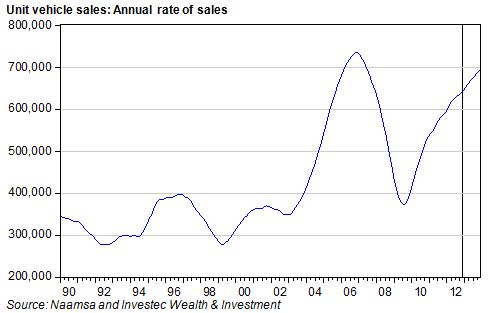
On a seasonally adjusted basis, unit sales were up by a solid 7 644 units in April compared to March and were nearly 20% up on April sales a year before. If we combine March and April sales, sales this year of 105 866 units were 6.7% higher than the equivalent two months in 2012. This growth in domestic sales will surely be very encouraging to the industry, especially to its manufacturing and assembly arm, accompanied as it was by very good export volumes of 22 907 units – equal to a solid 45% of domestic sales volumes.

When sales are smoothed and extrapolated using a time series forecast, sales appear to be on track for close to 700 000 units on an annual basis by this time next year. This would leave unit sales close to their record pace of late 2007.

As we show below, the industry marked time between 1990 and 2003. Sales then took off very strongly only to be much depressed in the aftermath of the global financial crisis.

This financial crisis was accompanied by a much weaker rand and significantly higher interest rates. Money market rates were over 12% in mid 2008, with overdraft and mortgage rates of the order of 15% p.a. They have come down steadily and significantly since then. As we show below, vehicle sales in SA appear highly sensitive to the level of interest rates and the associated finance costs. The money market is expecting interest rates at worst to remain at current levels for an extended period of time. Our own view is that the next move in SA interest rates will be down, not up, due to sub-par growth rates. These vehicle sales do however confirm that the economy is performing somewhat better on the demand side than the supply side.

The recent strength in the rand and the lower inflation rate this implies improves the chance of an interest rate cut. The sensitivity of vehicle sales to interest rates makes the argument for lower interest rates a still stronger one. The motor manufacturers are the the largest contributors to manufacturing activity generally. They and the economy deserve all the predictable help they can get form lower interest rates. Brian Kantor

The cash conundrum

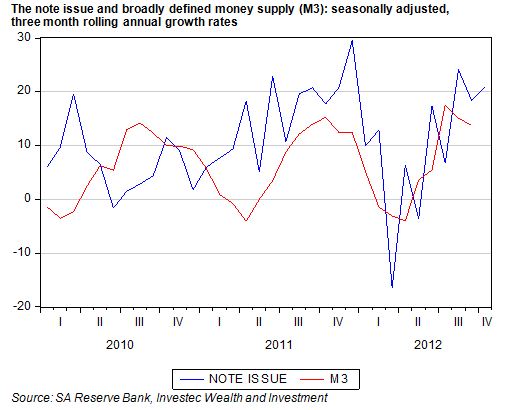
There is far more cash out there than can be explained by National Income Estimates of Expenditure and Output. This is as true of the US as it is of SA.

A modern economy laden with old fashioned cash

A peculiar feature of the modern economy is just how much cash lies around. The demand for cash appears largely unaffected by the growing use of highly convenient alternatives to cash to pay a bill, or check out of a hotel restaurant or shop. The value of transactions processed by the banks has grown very significantly with the use of credit and debit cards. A still more important development is the use of an online transaction that transfers ownership of a bank deposit from one party to another with a few clicks on a computer.

The extraordinary demand for dollars circulating outside the US banking system has attracted renewed interest following a revised estimate of the greenbacks held outside the US. (See James Surowieki, “The Underground Recovery” in the New Yorker, 25 April and referred to by John Mauldin in his free weekly investment and economic newsletter, “Thoughts from the Frontline”, 27 April, John Mauldin. The revised estimates of off shore holdings came from Edgar Feige of the University of Wisconsin, a pioneer in the analysis of the demand for cash.)

After allowing for the 27% held offshore, this leaves about US$750bn of cash in US wallets, purses, under mattresses and in safety vaults. This is equivalent to over $2000 cash stored by every person in the US. The average American family that is hard pressed for cash at the end of every month will be surprised to know how cash flush they are presumed to be. But as with many other metrics, such averages tell us very little about the financial condition of the average family. The distribution of these extraordinary cash holdings is no doubt highly skewed to the right, with relatively few holders holding the bulk of the cash for their own good reasons.

The demand for cash and other transactions in SA

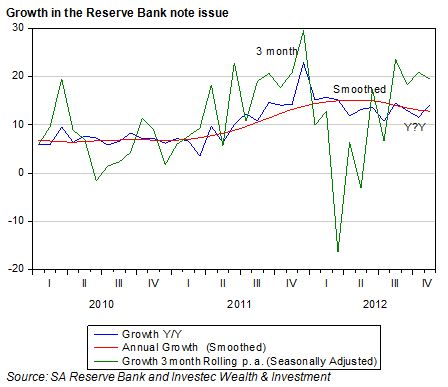
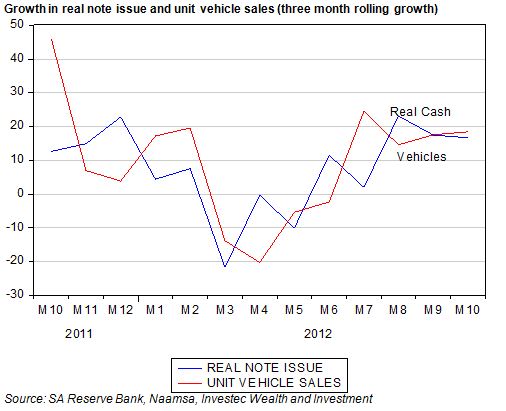
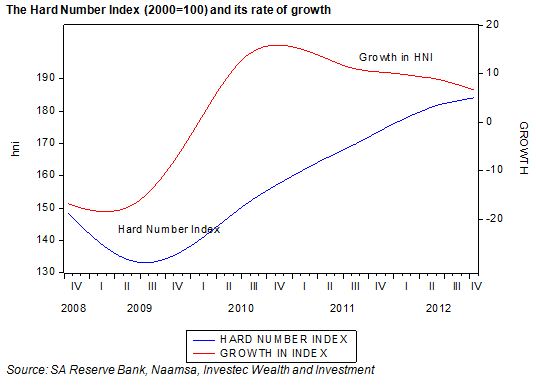
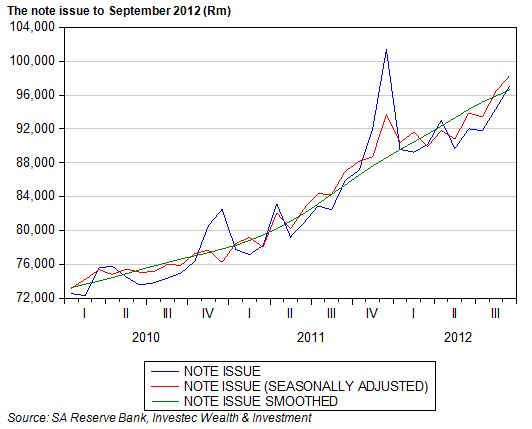
In SA a similarly extraordinary growth in the demand for cash outside the banking system has been recorded. The rapid growth in demands for cash has taken place despite the impressive advances made in the availability and use of alternatives to cash in SA, as in the US and elsewhere, with the adoption by banks of new technologies. The notes in circulation outside the banking system grew from nearly R23bn at the end of 1999 to over R81b by the end of 2012. That is at an average compound growth rate of 11.3% p.a. Adjusted for inflation the average compound rate of growth was 4.4% p.a. (See below)


According to the 2011 census there are some 15 milion households in SA. Dividing R8.1bn of cash in circulation by these 15 million households would mean that the average household in SA held on average as much as R5 400 in cash at the end of 2012. A small, fairly constant proportion of this cash will be held in neighbouring countries, especially Zimbabwe, but these demands are unlikely to account for more than 4% of the rand notes and coin currently in circulation.

In the figures below we show the strong growth in the value of electronic transactions effected by the SA Banks. Not surprisingly, given their convenience, the use of electronic fund transfers (EFTs) has grown significantly while the use of cheques has fallen away. The use of credit cards, while still relatively small, has more or less kept pace with the other forms of exchange since 2002, as we show below.

The value of purely electronic transactions facilitated by the banks grew from R155.2bn in January 2003 to R603.5bn in December 2012, that is at an average compound growth rate of approximately 13.6% p.a. This growth, while impressive, is only about 2% p.a faster than the growth in cash, despite the switch from cheques to EFTs. The average EFT processed by the banks is now about R8 583 per transaction and the average credit card transaction is of the order of R545. These average sized transactions are lower than they were in 2003 when adjusted for inflation.

The average low income SA household is too poor to hold this much cash at the expense of the inadequate food, clothes, energy or educational services they consume. And so we should conclude that the heavy lifting of cash in SA is probably not being done by the road side hawker or marginal retailer, but by more significant business enterprises and their owners.

How can we explain the demand for cash? Using cash escapes surveillance.

The question then is what is all this cash on hand being used for? Cash very obviously serves the interests of those who wish to hide their income from the tax authorities or the officials responsible for means testing welfare benefits. Using cash helps escape surveillance by government and the financial system generally. Honestly declaring extra income earned that takes welfare recipients beyond the income thresholds or tax payers into higher tax brackets can make for what are effectively very high rates of taxation of income at the margin. An extra $100 or rands of extra income earned and declared may well mean more than a hundred of sacrificed benefits or as much in taxes levied.

The currency approach to measuring informal activity

Clearly there is a lot more cash out there in use in SA and the US and in many other economies than can be explained by officially estimated incomes or expenditure, especially given the growth in the use of the alternatives to cash. The question then is just how much income and economic activity goes unrecorded when cash is exchanged for labour and goods and services? Just how much income or expenditure is going unrecorded because the transactions and the value they add are made in cash and are not reported in any reliable consistent way?

An estimate of how much activity is not recorded can be found by observation of the demand for cash itself. The essence of the approach is to attempt to explain and predict the demand for cash using incomes, prices and improvements in payments technology, measured as the value of electronic transactions processed by the banks, as explanations of the demand for cash. The observed higher demands for cash, the demands for cash that cannot be explained in this economically sensible way, then becomes a proxy for estimating the unrecorded levels of economic activity.

How much economic activity is not recorded?

The New Yorker article suggested that as much as $2 trillion worth of economic activity in the US may be going unrecorded. Given that the US GDP is officially estimated at just over $16 trillion, this would make unrecorded activity or the informal economy in the US equivalent to about 12% of the official US economy. Such an estimate is on the low side of estimates made for a number of developed economies, using a variety of methods to supplement national income estimates, including the currency demand models.

Many years ago I attempted to replicate the studies of Feige and others using SA data. In those days the SA economy and its labour market was severely infected by apartheid. In particular, the pass laws and other racially inspired laws and regulations prevented employers providing work and employees from offering their labour. These controls would have encouraged “illegal” activity and employment and the use of cash to avoid detection. My ball park estimates of unrecorded activity were equivalent to over 15% of the official economy. Or, in other words, the SA economy was then perhaps 15% larger than indicated by estimated GDP.

This approach did not find favour. The official estimates of unrecorded activity in SA to this day, officially assumed to be very largely informal retail activity, are estimated to be only about five per cent of recorded activity. This estimate is extraordinarily, perhaps unbelievably low, by international comparisons.

The incentives to use cash in the US and South Africa

For the US the major incentive to use cash may well be, as the New Yorker suggests, to avoid losing welfare benefits. In South Africa a further more important reason for using cash may be to escape not only tax or avoid the loss of welfare benefits but also and more importantly to escape the burdens of a highly regulated labour market. The incentive to use cash, rather than banks, to side step the regulations of the labour market and also by so doing to escape the supervision of the Receiver of Revenue, is surely a powerful motive for using cash.

More unrecorded activity means more unrecorded employment. If so this does not weaken the argument for a less regulated economy

If we are underestimating income and expenditure we are also underestimating actual employment. The only employment numbers we can be reasonably be sure of are the jobs offered by the formal sector. Unrecorded economic activity and unrecorded employment are therefore also matters of conjecture.

If SA has less of an employment problem than the official estimates indicate, given the unrecorded economic activity and associated employment, it still has as much of a poverty problem. The solution to SA poverty is faster growth, especially in faster growth of formal employment. But such growth in employment will not be realized or recorded unless the incentives for all businesses, especially small businesses, to operate formally are much improved.

Conclusion: Greater economic freedom for South Africa will add to incomes and employment and reduce the demands for cash and increase rather than reduce tax collected.

Encouraging formal employment and less evasion of taxation requires freer labour markets, less complicated income taxation, lower business income tax rates and much more sympathetic regulation of small businesses and their owners. Such steps might well raise more rather than reduce tax revenues as small businesses elect to operate above rather than below the radar screen. If they did so one of their attendant benefits would be access to a much more convenient payments system.

Progress in this regard may well be recognised by slower growth in the demand for and supply of cash. Unfortunately SA, with new licensing demands on all businesses that would seem to be in the interest only of the officials attempting to enforce new licensing laws, seems to be moving in the other direction. Brian Kantor

New vehicle sales: A good but slower pace of sales in February

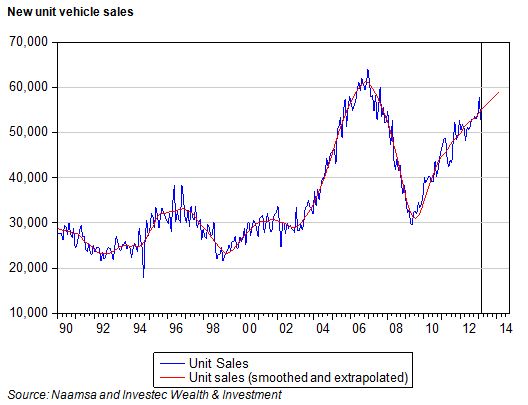
New unit vehicle sales fell off the torrid pace set in January 2013. On a seasonally adjusted basis, unit sales fell back from the 57 834 units sold in January to 52 760 units sold in February. We had suggested that January sales may have been boosted by pre-emptive buying in response to rand weakness.

As we show in the chart below, unit sales (seasonally adjusted and smoothed) remain on an upward tack. If current trends are maintained, the distributors of new cars in SA could be looking to monthly sales (seasonally adjusted) of 59 000 units by this time next year. This would take the industry almost back to the record levels of sales achieved in 2006. It is instructive to notice how little growth in vehicle sales volumes occurred between 1990 and 2002, but also how sales took off in the boom years (2003- 2007) before the recession knocked them back again. That sales are again approaching boom time volumes should be regarded as very good news about the resilience of the SA consumer.

While sales in the local market are satisfactory, even as their growth may have slowed, the motor manufacturers and component suppliers will be well pleased with fast growing export volumes. New vehicle exports numbered 27 011 units, or 5 057 more units than exported a year ago, a gain of 22.4%. It will be appreciated that vehicle exports are now running at a fraction more than 50% of domestic sales. This boost to exports will be particularly appreciated by the authorities and the currency traders worried about the slow pace of exports and the large trade deficit recorded in January 2013. Clearly vehicle sales have been encouraged by low interest rates and available bank credit. The low interest rates and banks eager to lend are very likely to continue to add impetus to the vehicle market. The weaker rand however, will make it harder for the dealers to compete on the price front – not only with other dealers but with all other goods and services that compete for a share of the household budget. Brian Kantor

Money and credit: No signs of a pickup in growth rates

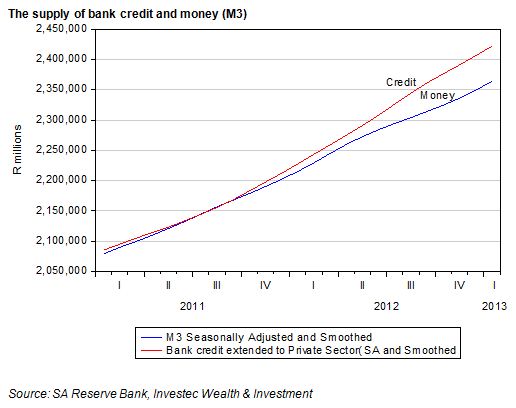
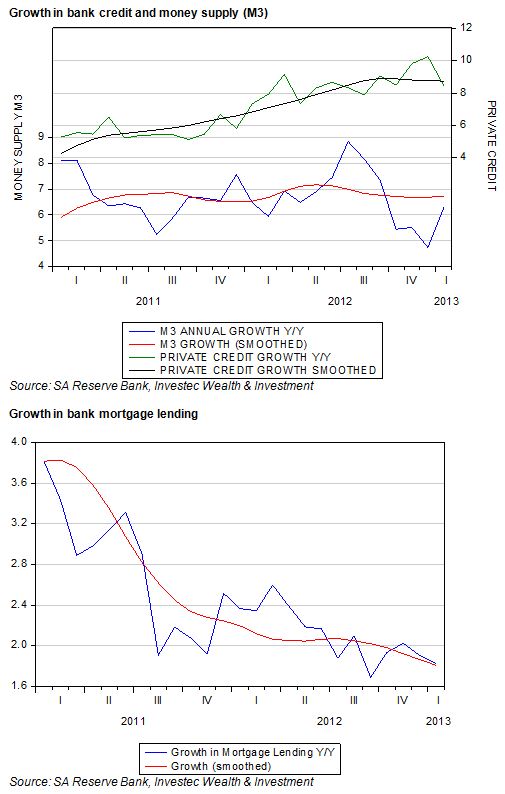
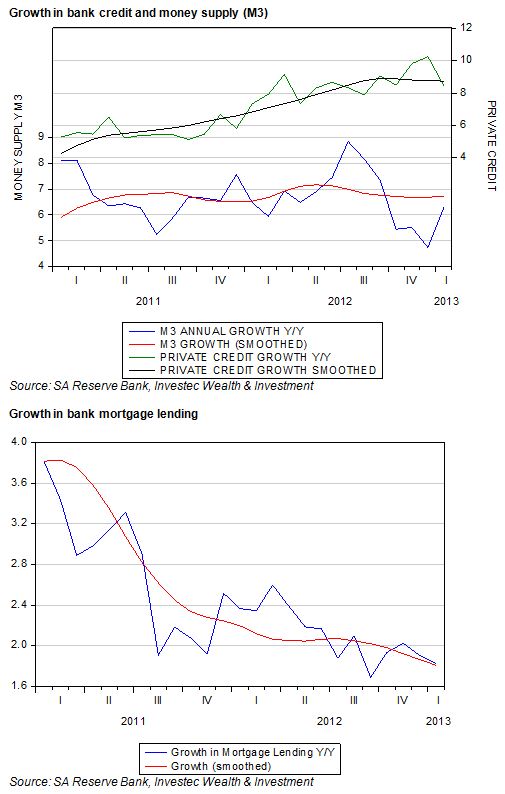
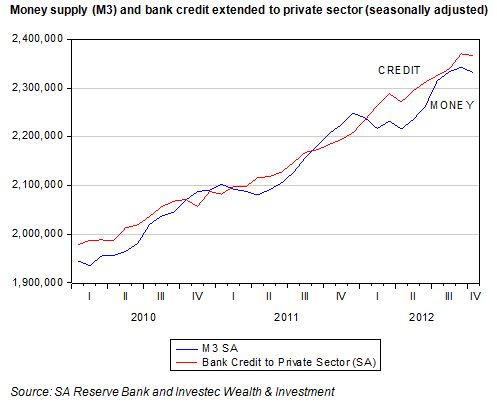
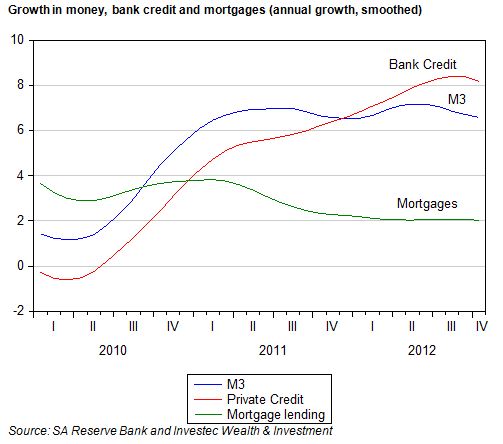
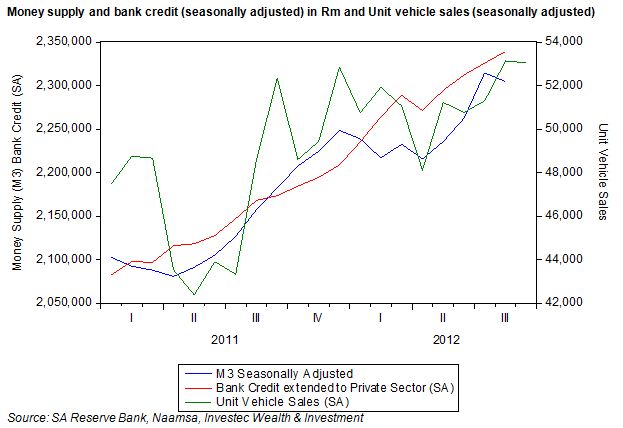
Money supply and credit numbers for January 2013 show that while the supply of money (broadly defined as M3) continues to increase, the pace of growth remains subdued at about the 6.5% to 7 % year on year rate. The asset side of the bank’s balance sheet, represented by credit granted to the private sector, has been growing at a slightly faster rate, closer to a 9%.

There would however appear little evidence of any pickup in growth in bank lending or in the broadly defined money supply. Mortgage lending, which is usually a large component of credit supplied by the banks, about 50% of all bank credit provided to the private sector, continues to grow very slowly. Clearly house price gains and thus growth in mortgage lending are increasing very slowly, with the rate of growth slowing down.

These money supply and credit trends, as well as the very subdued trend in house prices, make the case for lower interest rates. Until such time as these trends move strongly in a higher direction, short term interest rates in SA will remain on hold – though given these money and credit trends the economy could well have done with lower interest rates. Brian Kantor

Labour relations, the elephant in the room of the 2013 Budget

Pretence about wages and employment harms the SA economy and the poor

There is a politically convenient illusion at the heart of SA’s dysfunctional labour market, which is well demonstrated in the balancing act forced upon the Minister of Finance in his 2013 Budget proposals.

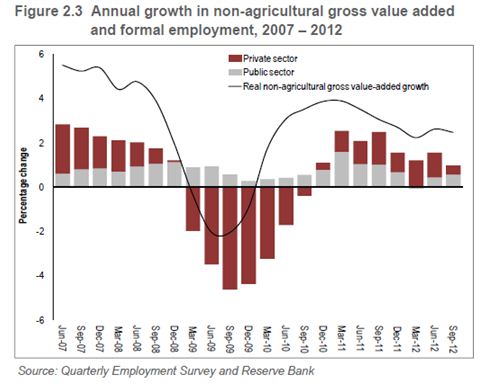
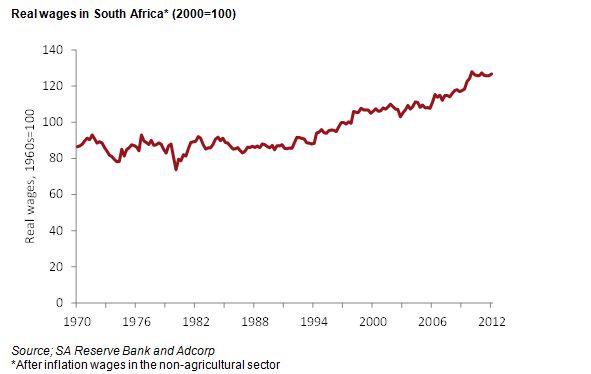
The dysfunction is the large and ever growing gap between the potential supply of labour and the demand for labour by formal sector employers. The formal economy has become ever less labour intensive, while the real wages of those in formal employment have grown significantly. The gap between real GDP and formal employment has grown consistently over the years. And competition between labour unions to represent the increasingly well paid formal sector workers has intensified, leading to unprotected strikes and the disruption of production. The figure included in the 2013 Budget Review makes the essential point: it show how the growth in GDP, or value added, has consistently exceeded the growth in the numbers employed. These are dangerous trends, crocodile jaws that might well eat up the economy unless this gap can be closed.

Employers in SA have been forced to pay higher wages by unions capable of disrupting production. Higher minimum wages and limited normal hours of work have added to the costs of hiring labour. The rights of employers and their rights of dismissal for unsatisfactory work have become highly attenuated and have added to the risks and costs of providing employment.

What is not appreciated by many in government and in the unions is that employers, sometimes to the obvious frustration of the unions and the politicians, retain the right to decide how many workers to employ. And private sector employers, with their own or their shareholders savings (capital) at risk, have responded by employing fewer workers whom they pay higher real wages but reinforce with more and superior quality machinery.

The reality for the average formal sector business is that capital has become relatively cheaper and equipment more productive while employing labour has become more expensive and maybe even less productive, when the contribution of capital to output is factored into their production functions – hence a smaller proportion of workers with formal sector jobs. And with fewer workers formally employed this means many more employed outside the formal sector, unemployed or discouraged from seeking employment.

The gains made by the formally employed have come at the expense of those who have found it so difficult to break into the ranks of the better off formally employed. Their frustrations are highly understandable but they appear to have had much less political support than the unionised workers, protected against lower wage competition. These labour market outsiders are not the only parties disadvantaged by these trends in the labour market. Artificially expensive labour is to the disadvantage of formal business as well, since they might have grown faster had they been encouraged to employ more labour. Labour intensive entrepreneurs able to compete with the established, capital intensive firms are thin on the ground.

It is not an accident that employment by government agencies has grown significantly while employment conditions have improved considerably, both in real terms and also in comparison with benefits provided in the private sector. Taxpayers have proved remarkably generous in their treatment of government employees. We cannot be definitive due to inconsistencies in the Statistics SA data, but private sector employment declined by around 1 million between 1994 and 2012 whereas government employment grew by around 1.5 million over the same period. At any rate, the public sector now employs 2.83 million people or nearly 1 in 4 formal sector workers.

This no doubt has encouraged the belief that neither wages nor the productivity of labour has anything to do with employment opportunities in the public sector, ie it is not economics but politics that determines who earns what.

The illusion is also that all employers can and should provide decent jobs with good pay. The unfortunate reality is that many South Africans and most of those without formal employment do not possess the skills to command so called decent (well paid) jobs. Therefore even when those without valuable skills manage to find work they will not easily escape poverty. Unfortunately low wage employment is the only realistic alternative to unemployment. Presumably, for many actively seeking work, low paid work would be preferred to no work at all. Given the quality of the SA labour force, and given the inadequacy of the education and training provided many South Africans during and after apartheid, the choices in the labour market are unfortunately limited to low paid work or no work.

It is this illusion that has led recently to a 50% increase in the minimum wage for agricultural workers, to a countrywide R105 per day. This is despite very different supply and demand conditions around the country. It is also despite the fact that employment in agriculture, hunting, forestry and fishing (according to the Quarterly Labour Force Survey) fell precipitously from 1.362 million in September 2000 to a reported 624 000 in September 2011. The presumption must surely be that minimum wages and other regulations applied to agriculture have had a major influence on this outcome and that the higher minimum wages will lead to further losses in employment. This is so even though the higher minimum wage of R105 per day, will not enable these farm workers and their families to escape poverty.

There is a great divide between those South Africans in what may well be described as “decent jobs” and those many more who stand outside the gates and are understandably anxious to enter the more comfortable world of formal employment. The outsiders may be unemployed – actively looking for work and able to accept a job offer at short notice – or they may be working, usually for lesser benefits in the informal sector, or they may well have withdrawn from the labour market. A definitive account of the unemployed or discouraged workers as well as those working part time or full time informally is not available. We have to rely on surveys and the responses of the sample of households surveyed for evidence of employment status (which may not be reliable).

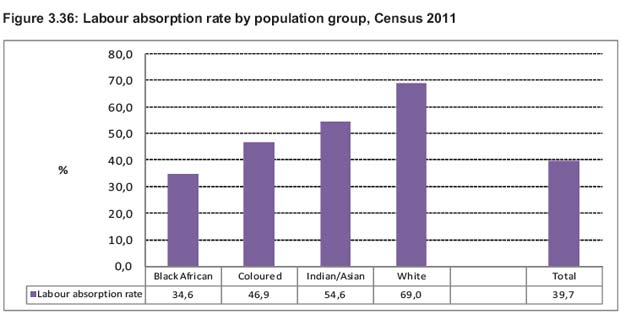
The 2011 census estimated the unemployment rate, narrowly defined as the percentage of active work seekers in the labour force as 29.8%, with the labour force being defined as the sum of the employed and unemployed. The absorption rate of the economy, that is the numbers employed as a percentage of the working age population, makes even grimmer reading: it averaged only 39.7% while the labour force participation rate (the labour force, employed and unemployed) as a percentage of the working age population was only 56.5%.

These rates varied widely by racial group and gender with black South Africans and black women the least likely to be employed or to participate in the labour force. The absorption rate for black men was estimated at 40.8% while that for black women was much lower at 28.8%. The percentage of white men of working age absorbed into employment was 75.7% while that of white women was 62.5%. The reality is that the real incomes of those in work have been rising significantly, while the numbers employed in the formal private sector have moved significantly in the other direction since the Labour Relations Act was introduced in 1995, even while the adult population and the potential supply of workers to the formal sector has grown significantly. Supply and demand for labour has not been allowed to work as it might have done with less interference.

The harsh truth is that for many South Africans unable to gain entry to formal employment, it will continue to be a choice between low pay determined by the realities of the supply and demand for labour or no pay at all. Migration from the regions of slow growth to seek work in the faster growing cities may be the only alternative to not working. Their opportunity set could however be widened significantly were the rules that govern employment opportunities to be relaxed.

It is high time, in other words, to restrain the power of the trade union movement that has been so enhanced in recent years by regulation and legislation . We can do so in several practical ways, all of which are consistent with Article 23.1 of the Universal Declaration of Human Rights, the so-called “right to work” as Loane Sharp of Adcorp has detailed (Business Day, 25 May 2012: http://www.bdlive.co.za/articles/2012/05/25/loane-sharp-sa-s-trade-unions-the-biggest-obstacle-to-job-creation#).

He suggests:

• Repealing the “closed shop” laws that compel job-seekers to join a trade union as a precondition for obtaining a job;
• Repealing the “agency shop” laws that compel workers to pay trade union membership fees whether they belong to a trade union or not;
• Requiring that trade unions ballot their members ahead of a strike, and further require that a two-thirds majority votes in favour of a strike;
• Prohibiting open ballots and requiring secret ballots, since open ballots lead to intimidation of union members who vote against a strike;
• Prohibiting employers’ collection of trade union dues on trade unions’ behalf;
• Prohibiting the automatic extension of bargaining council agreements to entire industries or sectors, so that these agreements are voluntary;
• On a nationwide basis, placing an upper limit on wage settlements, so that wage increases may not exceed labour’s marginal nominal productivity growth; and
• Making trade unions liable for the loss of company earnings that occurs during unprotected work stoppages.

The hope must be that over time increased spending on education and training will provide the entrant to the labour force with the skills that command good pay. The further hope is that the economy, helped by a much more flexible labour market, can grow fast enough to cause a shortage of unskilled labour relative to the availability of skilled labour, capital and natural resources. The competition for unskilled workers will then help in time to provide decent jobs for all. It can be much faster than trickle down – more like a torrent of real wage growth should the economy grow faster. It is certainly capable of doing this with the encouragement from a much more functional labour market. Brian Kantor

Electricity pricing: A shock for Eskom, a boost for the economy and a dilemma for the Treasury

The National Energy Regulator (Nersa) turned down the heat for the energy user, allowing Eskom to levy 8% annual increases for its electricity over the next five years, half the increases Eskom had applied for.

The most obvious beneficiaries are the large energy intensive users, the beneficiators of raw materials, who account of about 44% of the load. They contribute heavily to SA exports and they need all the help they can get with the trade balance under pressure form much stronger growth in imports than exports. Their viability would have been seriously compromised had Eskom had its way.

Property owners and their tenants, directly or indirectly paying more for electricity, will also be relieved, as will lighter industry and the ordinary household (though for them the electricity supplier is not Eskom but their local friendly municipalities).

When Eskom supplied artificially cheap electricity until recently – its charges have tripled over the past five years from about 20c per Kwh to the current 61c – the municipalities did not hesitate to use the monopoly power thay had to charge local users a whole lot more.

A new funding mechanism, the equitable share formula, introduced in the 2013 Budget, will give municipalities a grant of R275 for every household with income of less than R2 300 per month – this is estimated to mean more than 59% of all households in SA. This source of funding will hopefully take the pressure off the electricity tariffs that have been used as a very convenient tax. Using the broader tax base rather than electricity tariffs to help the poor is the right approach and should help encourage industrial and commercial users in the cities that generate jobs and incomes.

Nersa thinks the right price for Eskom’s electricity is the price that would give the utility a 3% real return on the capital it employs. This, as we have discovered, is very much in line with the global average. Listed utilities world wide seem to survive and even thrive with real returns on their large capital investments with returns on all capital employed of about 3-4%. They presumably also do a reasonable job of containing their costs than Eskom.

We have pointed out before that the less Eskom charges, the more debt it or the SA State will have to issue to fund its heavy and essential expansion programme, absent a willingness to sell off some of its generating capacity to private owners.

It would be a very good idea to have other managers running power stations so that useful comparative benchmarks on operational costs could be established for Eskom. Such partial privatisation might be judged essential should extra debt have to be issued.

In Eskom’s case for 16% annual increases it had estimated that some R350bn of debt would have to be issued by 2018. We have calculated that this debt would rise to over R500bn if price increases were confined to 8% and similar operational and capital costs were incurred. Nersa is of the view that these costs, as estimated by Eskom, should be better controlled. If Eskom achieves these cost controls, it would improve cash flow and reduce the volume of debt finance.

The SA Budget and borrowing plans have factored in about R330bn of Eskom debt. This will have to be revised higher. And with the extra government borrowing requirement now running at about R100bn a year, this additional debt of about R30bn a year for five years, will not be welcome to the Treasury or the bond market.

Listed electricity utilities are in practice the least risky activity of all – they realise the lowest betas on the US stock exchanges. They therefore can and should finance what are low risk operations with high ratios of debt (around 55% of assets on average). Furthermore a real return of 3% a year, if achieved, would allow Eskom to fund with debt and meet its interest and capital repayment obligations. After all, funding essential infrastructure with debt that supports economic growth, is very different to funding consumption spending by government (as the rating agencies should appreciate).

There is however an obvious alternative for government having to raise debt or taxes to fund infrastructure. This would be to sell off some of the valuable assets it owns. Privatisation may become a less dirty word when the after-Nersa realities are understood. The price to be realised by auctioning off an established power station on Eskom’s balance sheet (hopefully to be listed on the JSE) will be greatly enhanced by regulatory certainty. With its sensible target for electricity generators of a 3% real return, Nersa may well have provided this. Brian Kantor

Real exchange rates: All about capital flows

Explaining the rand – don’t look to Purchasing Power Parity (PPP), but to capital flows to explain the value of the rand

When exchange rates conform to Purchasing Power Parity (PPP), that is the exchange rate moves to compensate for differences in inflation between two trading countries, the exchange will not have any real effects on the economy. Given PPP, what is lost, say, for an exporter or gained by an importer in the form of faster or slower inflation, is fully offset by what is gained or lost by compensating movements in the exchange rate. This would leave importers or exporters no more or less competitive in their home or offshore markets. PPP exchange rates are however at best a very long run equilibrium rate to which exchange rates may trend but seldom conform.

The SA experience with exchange rates is one where large deviations from PPP exchange rates are the rule rather than the exception. The starting point for any calculation of PPP equivalent exchange rates is of crucial importance. The date should be be one when the exchange rate appears very close to its long term PPP value.

This was the case for the rand/US dollar in 1995. Before 1995 the value of the commercial rand (this was used to pay for imports, dividends and interest and dividend payments abroad and received for exports) was protected by exchange controls on both foreign and domestic investors. Flows of capital to and from SA were conducted through the transfer of a more or less fixed pool of so called financial rands. These financial rand movements, usually expressed as a discount to the commercial rand, left the value of the commercial rand largely unaffected by capital flows and insulated against changes in investor sentiment. Hence foreign trade driven commercial rand exchange rates stayed very close to their PPP values, as was the case in 1995.

The capital controls applied to foreign investors in the form of the financial rand were abandoned in 1995. Ever since then, flows of foreign capital to or from SA – driven by levels of SA or global risk tolerance – came to influence the value of the unified rand. The rand became less a trading and more a capital driven currency in the short run.

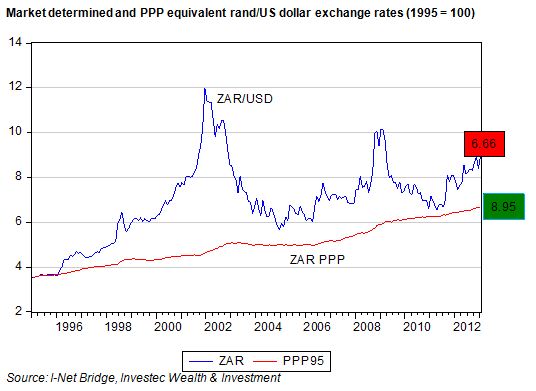
We show below (starting our calculation of the PPP equivalent rand/US dollar exchange in 1995) that the rand had become deeply undervalued by 2000. If PPP had held between 1995 and 2013, the US dollar that cost R3.35 in January 1995 would have cost a mere R6.66 in January 2013, leaving the rand about 28% undervalued compared to its PPP value.

If we start the same calculation in January 2000, when the US dollar fetched R6.31 and had PPP equivalent exchange rates been maintained, the US dollar would now cost R9.68, making the rand appear 10.5% overvalued. However, as we have shown, the PPP equivalent value of the rand in January 2000, using January 1995 as the starting point, was as little as R4.36, not the R6.31 it cost. The rand, as a result of freed up capital movements after 1995, was already deeply undervalued by 2000. It was to become much more deeply undervalued in 2001, but thereafter began to recover with improved investor sentiment.

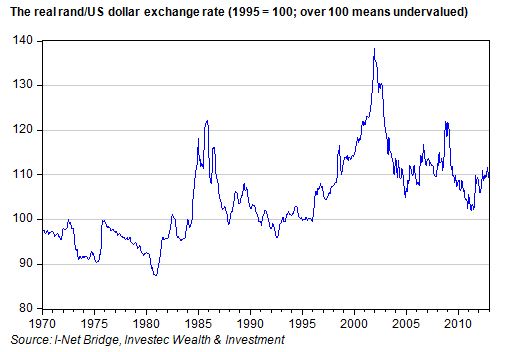
In the figure below we show the real rand/US dollar exchange rate, that is the deviation in the value of the rand from PPP, taking 1995 as the starting point. The real commercial (then unified) rand has fluctuated wildly over the years. It was slightly overvalued during the gold boom seventies. It weakened significantly when SA failed to cross its political Rubicon in 1986. The largest burst of weakness came in 2001 for SA specific reasons – largely related to the panic demands for asset swaps when they first became available – and the real rand lost as much as 40% of its value. Thereafter it began a more or less consistent recovery, helped by large foreign flows into the JSE (though it was interrupted by the Global Financial Crisis in 2008 that weakened all riskier emerging market currencies). The strength of the rand and the JSE after 2003 was not at all coincidental. The recent weakness of the rand, very much SA specific, has moved the real rand from near parity with the US dollar to about 10% undervalued.

Clearly it is investor sentiment that has come to drive movements in the exchange value of the rand. Sometimes these perceptions are SA specific and at other times much more generally explained by global attitudes to risk taking.

The reality for SA exporters and importers post 1995 is that they have had to cope with a highly variable real exchange rate. It is instructive to note that the extreme moves between 1983 and 1986 can also be explained by capital flows: the financial rand was temporarily abolished in 1983 and then reinstated in 1986.

It is these exchange rate fluctuations that greatly complicate the business of importing and exporting. Ideally, given consistency of economic policies, the real exchange rate would stabilise. Unfortunately fiscal and monetary policy in SA has been far more consistent than expectations of them. It is these expectations of policy that drive capital flows more than the policies themselves. Until SA can convince investors of the permanence of investor friendly policies, such real exchange rate volatility will continue.

The advice for SA policy makers is to maintain investor friendly policies, including the freedom to move capital in and out of the SA economy. The depth of the SA capital markets and the consequent liquidity it offers has been a major attraction for foreign investors, upon which the SA economy remains highly dependent for its growth, given the lack of domestic savings. The economy will have to trade off exchange rate instability against easy access to foreign capital.

Resorting to capital controls would drive capital away over any long term view. Moreover improved labour relations would be highly investor friendly. It would lead to a stronger real rand and a sronger economy supported by larger capital inflows. Brian Kantor

The 2011 census and the labour market: Getting the nation back to work

We look at the regional and other factors at play in the failure of to employ more people and draw some conclusions about what can be done about it.

Unemployment as well as incomes varies significantly by Province.

According to the 2011 Census a mere 39% of the adult population of SA is employed. The rate of absorption into the labour market varies from 70% for the white group to about 33% for households headed by black Africans (see below)


Source: Census 2011

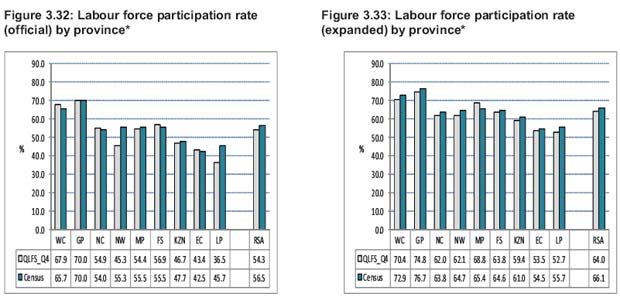
When those registered as unemployed by the census are added to those employed, the participation of the adult population in the labour market can be established. The average rate of participation of adults in the labour market is of the order of 55% of the adult population force, using the stricter definition of unemployed.


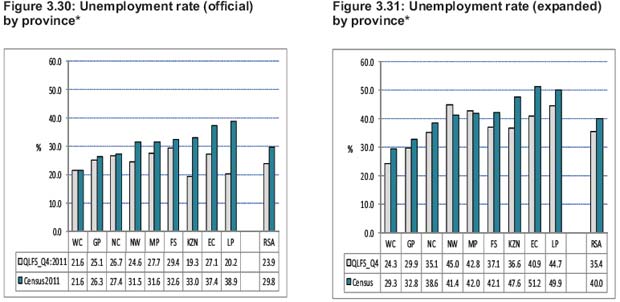
*Note The provincial order in the above two figures corresponds with the order used in the QLFS, and is therefore different from the geocode which is used in other publications.
Source: Census 2011


*Note The provincial order in the above two figures corresponds with the order used in the QLFS, and is therefore different from the geocode which is used in other publications.
Source: Census 2011

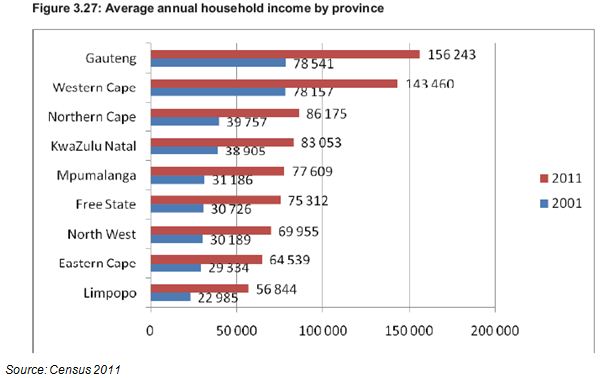
The census indicates not only significant income differences across the provinces, but also highly significant differences in the unemployment rate across the different provinces, as is shown above. The poorer the province, the higher the unemployment rate of that province and the lower the rate of participation of its adult population in the labour market. The unemployment rate ranges from about 20% in the Western Cape to nearly double 40% in Limpopo.

The participation rate in the labour force ranges from nearly 70% in Gauteng to barely 40% in the Eastern Cape. The divide between the provinces appears very much as an urban rural divide. It is the highly urbanised provinces, Gauteng and Western Cape, which deliver higher incomes and much faster growth in employment.

Population and employment has grown fastest in Gauteng and the Western Cape

The unemployment rate is lowest in the provinces to which people have migrated in significant numbers over the past 10 years: Gauteng, with net migration of over 1m people, and the Western Cape, which has absorbed over 300 000 extra people since the last census in 2001. The population of Gauteng, 12.27m in 2011, making it by far the most populous province, grew by 30% over the 10 years – twice the national average and that of the Western Cape (28%).

Clearly employment growth in the two fast growing provinces (given little change in the unemployment or labour force participation rates in Gauteng and Western Cape since 2001) has also been well above average too. The implications of these demographic and economic trends would seem to be obvious. If a greater number of South Africans are to be employed they are most likely to be employed in fast growing Gauteng and Western Cape. Or in other words, the rate of migration to Gauteng and Western Cape will have to accelerate further if the unemployment problem in SA is to be addressed in a meaningful way.

What it means to be employed, unemployed or not working and therefore not part of the labour force

According to the census, of the SA working age population (16-65) of 33.2m, only 13.18m were employed – a “labour force absorption rate” of a mere 39.7%. The census counted 5.594m workers as unemployed, leading to an unemployment rate of 29.8%. The SA labour force is the sum of the employed (13.18) plus the unemployed (5.6m) or a labour force of 18.7m potential workers. The numbers of adults defined as “not economically active” by the census numbered 14.5m. Thus, the labour force participation rate in SA was but 55.6% of the adult population of 33.2m in 2011.

The Quarterly Labour Force Survey (QLFS) conducted regularly by Stats SA counted fewer officially unemployed in 2011, some 4.24m unemployed and so an unemployment rate of 23.9% – presumably because those conducting the QLFS applied a stricter interpretation of actively seeking work. 

Those officially unemployed according to the Census would have responded affirmatively to the question in the census questionnaire (P25) “…that they had looked for any kind of job or tried to start a business in the four weeks before October 10th 2011”.

In other words you are only regarded as unemployed if you have recently actively sought work. You may not be working for a variety of reasons, including studying or having retired early or a full time home maker, or more simply because you prefer not to work. If you are neither working nor seeking employment you are understandably not counted as part of the labour force. By neither working nor seeking work your actions can have no influence on the numbers employed or employment benefits (wages and salaries) offered and accepted –hence you are not participating in the labour market.

The census asked a number of further questions as to why people were not seeking work. Among the possibilities considered  included “no jobs available in area” , “ Lack of money to pay for transport to look for work” and“No transport available”. The census also asked a supplementary question “If a suitable job was available would you take up the job within 7 days”?  A job to be regarded as suitable must include a sense of attractive enough pay as well as within easy reach of the household. Thus it is surely unlikely that any potential worker not working or seeking work would respond anything but positively to such a hypothetical, probably highly unrealistic, offer of a suitable job at an attractive wage nearby. If an attractive employment opportunity were on offer many of the currently not working in rural SA would happily take it up. But the prospect of finding such work in the rural areas is very poor. Answering yes to such a purely hypothetical question would therefore not make you a member of the labour force in the sense considered earlier, in the sense of your actions or intentions having any influence on the supply of demand for labour or rates of remuneration.

Including those who would work, if only an attractive enough opportunity were offered them, greatly increases the numbers of the unemployed. It would include as unemployed all those whose experiences seeking work and not finding it would have discouraged them from seeking work and so led them to withdraw from the labour force and to stop looking for work that is practically not available.  However should these discouraged workers be included in the ranks of the unemployed, a higher expanded unemployment rate would follow. Perhaps the census unwittingly included many more discouraged workers as unemployed compared to the QLFS.

Why those not working – especially in rural SA – should be regarded as not working and therefore as not part of the labour force or unemployed

For many potential workers, particularly in the rural areas of SA, the knowledge that there is no realistic chance of a job in the area does not make them unemployed and therefore they are not part of the labour force.

Workers in rural areas might be willing (even if reluctantly) to accept employment at lower wages if given the opportunity to do so within easy reach. The clothing workers in Newcastle, KwaZulu-Natal, provide such  a case study. The reasons why there are in fact so very few jobs offered in the rural area may have a great deal to do with the regulation of wage rates (minimum wages and nationwide wage agreements for example).

These regulations discourage potential employers, using labour intensive methods, from offering employment at lower wages that workers outside the major urban areas might well be willing to accept, as an alternative to not working. It is perhaps only lower wages that can make rurally based enterprises competitive with those employers operating in the urban areas. In the major centres, well established firms are able to provide better employment benefits, because of all the other advantages an urban area offers to business, for example, being close to customers or transport nodes and having easy access to essential services and skills. These advantages are not typically available in more remote regions and the opportunity to pay lower wages may be the only reason for operating in a more rural location.

The realistic alternative for many potential workers now not working in the rural areas is to seek work in the cities where opportunities to seek and find work are a realisitic alternative. When typically younger workers migrate to the urban areas to seek work they qualify as part of the potential labour force – and hopefully they will be only temporarily unemployed. Their decisions to migrate to the cities will have an impact on the labour market in the urban areas.

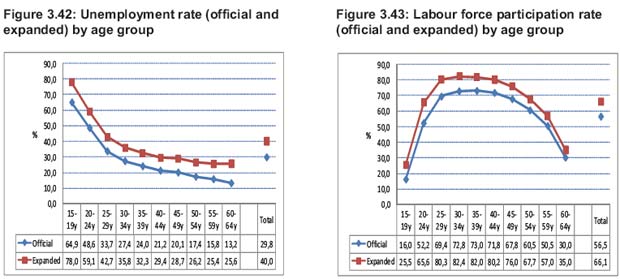
It is not accidental that labour force participation rates in SA (those in work and looking for work) as a percentage of the adult population peak at between 70% and 80% for the cohorts between the ages of 25 and 45. (see below)


Source: Census 2011

But potential workers, by electing not to migrate to the cities of opportunity for whatever reasons, are unlikely to ever be able to find work in the rural areas in significant numbers. But it makes little economic sense to describe such non-workers as unemployed. They are however part of a potential labour force that, with very different economic policies, might become a much more productive part of the labour force.

Regional policies to encourage employment and participation in the labour force

Such policies might usefully include better, well targeted Budget support for those urban regions of the country that have proved able to create additional employment. The right policies might include better funded housing, schools, vocational training and hospitals and the transport systems that could make these regions still more attractive to potential migrants and potential employers.

Poverty relief in the form of cash grants provided on a means tested basis to support children, the aged or the disabled can and has had the unintended consequence of discouraging entry into the labour market, especially from the rural areas of SA. As economists put it, such support for poor families raises the reservation wage of labour: it raises the wage that makes it worthwhile to accept or even seek work. Such work, at wages attractively higher than the reservation wage, may simply not be available in significant volumes outside of the urban areas.

It should be understood that for the unskilled the only work available might be physically onerous work at relatively low wages. But the incentive to work or seek work does depend on the improvements in the household’s standard of living that may be realised by some family members accepting work (or by not seeking or accepting work by subsisting on the welfare system) or the family relying on some mixture of work and welfare.

The fact that the participation and employment rates in the labour force are so much higher for the average white than the average black SA resident has everything to do with these economic incentives. The white South Africans participate much more fully in the labour force because they can earn much more on average than they could expect from welfare.

Conclusion: the path to faster growth in the labour force

The best form of poverty relief in the long run is the creation of employment opportunities and of the skills that qualify workers for higher earnings. The best prospects for employment and income growth in SA are in those regions that have performed so much better in attracting and employing labour. Improving the economic performance of the provinces with competitive advantages should be a clear objective of economic policy. In this way the successful regions can better facilitate the creation of higher incomes and employment over time. Allowing for more flexibility in wage determinations across a diverse geography should be another.

Spending signals: Rumours of the death of the SA consumer may be exaggerated

The first indicators of economic activity in November 2012 are now to hand, in the form of new vehicle sales and the value of Reserve Bank notes in circulation. Unit vehicle sales in November were marginally down on October sales, when adjusted for seasonal influences. Unit sales, seasonally adjusted, appear to have stabilised over the past three months at about the 53 000 per month rate, equivalent to about 645 000 units sold annually. When monthly sales are annualised, smoothed and extrapolated, unit sales appear to be still on an upward path and are heading for 695 000 units in 2013 compared to sales of about 645 000 in 2012.

This, if achieved, would represent growth of about 7.5%, and would take domestic unit vehicle sales close to their record levels of 2006. This would be regarded as highly satisfactory in circumstances of generally subdued spending growth. What with built up exports picking up strongly, to over 28 000 units in November (well up on the pace achieved earlier in the year), the sector involved in manufacturing, assembling and distributing new vehicles is a source of growth for the economy. Lower interest rates have probably helped and will continue to do so.

The supply of notes issued and demanded in November 2012 – a very good indicator of household spending intentions in the crucial month of December – continued to grow very strongly. As we show below, growth in the note issue, on a three months seasonally adjusted basis, has maintained the strong recovery that began in the second quarter of 2012. On a smoothed basis, annual growth in the note issue is running at about 13% p.a, indicating continuing strength in household spending.

We combine the note issue with unit vehicle sales to form our very up to date Hard Number Index (HNI) of the state of the SA economy. Our HNI for November indicates that the SA economy continues to move ahead at a more or less constant speed. Numbers above 100 indicate growth while the second derivative of this measure of the business cycle – the rate of change of the HNI – indicates that the pace of growth is slowing down but only very gradually (see below).

This up to date news about the state of the SA economy in November 2012 should be regarded as encouraging. The strong demand for cash at November month end indicates that the tills will be ringing loudly this December, given that spending in December at retail level is 36% above average spending month. The demand for new vehicles suggests that households and firms have not given up their taste for big ticket items. Rumours of the death of the SA consumer may well be exaggerated. Brian Kantor

Money supply and credit: Seeking encouragement

The news from the credit and money supply fronts is not very encouraging. Money and credit supplies need encouragement from lower interest rates, not discouragement from ill timed regulatory intervention

Broadly defined money supply (M3), as well as bank credit extended to the private sector declined marginally in October 2012 on a seasonally adjusted basis. Annual growth in these aggregates, when smoothed, also declined marginally. The broadly defined money supply, mostly made up of deposits with the banks, is now growing at an underlying rate of about 6.6% p.a. while underlying growth in credit extended to the private sector is about 8.2% p.a. Mortgage lending by the banks is growing at an even slower rate of about 2% p.a.


It should be appreciated that these are very modest growth rates, especially given inflation of the order of 6% p.a. With the economy operating well below its potential, it needs all the help it can get from domestic spending and the support money supply and credit growth give to domestic spending. With export prices and especially export volumes under severe pressure, household spending has been supporting economic growth and so the employment and incomes of employees. This helps them maintain their credit.

At this especially vulnerable stage for the SA economy, attempts to reform the credit system in SA are especially likely to lead to less credit being offered, less spending and still slower growth in incomes. Any additional restraints on the willingness to supply credit or to secure credit are precisely the wrong recipe. They are likely to lead to more, not less, distress in credit markets as the economy slows down. Brian Kantor

Domestic spending: Encouraging October

The demand for cash supplied by the Reserve Bank continued to grow strongly in the three months to October 2012. As we have explained before, the Reserve Bank note issue has proved to be a very good indicator of the spending intentions of SA households.

As we show below, the demand for cash fell off in early 2012 but picked up very strongly from mid year. Over the past three months the note issue, seasonally adjusted and annualised, grew by a robust 21%. As we also show, the growth in the broader money supply – mostly in the form of deposits issued by the banks – grew similarly in the three months to September month end.

Unit vehicle sales have followed a very similar trajectory to the note issue (adjusted for inflation), losing momentum in the first half of 2012 and then recovering strongly to October.

Unit vehicle sales and the note issue (adjusted for the CPI) make up our Hard Number Index (HNI) of the state of the economy. The HNI has two advantages: it is very up to date (updated to October 2012 month end) and it is based on actual recorded volumes (hard numbers) rather than the estimates made from sample surveys.

Given the strength in both vehicle sales and cash volumes, the HNI indicates that the economy has continued to move forward at a good pace. Its rate of growth – what can be regarded as the second derivate of economic activity – however continues to slow down. The indications therefore are that the SA economy is continuing to move forward at a good pace but that its forward momentum is slowing.


Other data releases for October – to be released in due course – are likely to confirm that domestic spending intentions and actions remain robust, surprisingly perhaps to the market place.

The figures for the note issue and unit vehicle sales are the first data posted for the economy post Marikana. It would appear that the strike action on the mines and roads of SA have had little negative influence on spending intentions. This resilience of domestic demand is very welcome when foreign demand is growing as slowly as it is, given the weak state of the global economy. If the economy is to retain its growth momentum, which is essential for political stability and a satisfactory fiscal state of affairs, it will continue to depend on the domestic spender. Domestic spending is being encouraged by low interest rates, which can be expected to stay low until global economic conditions improve.

The Census reports good real progress in household incomes and household numbers

The general impression provided by the census is that significant economic progress has been made in SA over the past 10 years. There are now 14.45m identified households, 28% more than were counted in 2001. Average household incomes of R103 204 were reported compared to R48 305 in 2001. That is an increase of 113% in money of the day terms. Given that the CPI increased by 77% over this period, this implies a real increase of approximately 36% in average household incomes over the 10 years.

The poorest SA households are those led by black Africans. However they did significantly better than the average SA household. Households headed by black South Africans increased their average household incomes by 169% in current prices or by nearly double, when adjusted for inflation between the censuses of 2001 and 2011. The objective of advancing the previously disadvantaged has been met about as well as the government could have realistically hoped for.

The census is consistent with National Income estimates

These increases in self assessed incomes, in response to the question asking respondents to estimate “gross monthly or annual income before deductions and including all sources of income” compare very well with the growth in per capita incomes as estimated by the National Income Accounts. Gross National Income per capita in real terms grew by 35.5% between 2001 and 2011 or at a compound average growth rate of 3.04% p.a. Such growth rates in per capita or average household incomes represent much more than the much despised trickle down. If growth is maintained at this rate over the next 10 years this would represent a doubling of average incomes in 20 years and significant economic progress indeed.

One of the benefits of higher incomes is more and smaller households

It is not surprising, given an improved standard of living, that the number of identified households has increased much faster than the population itself. The population grew from 40.58m residents in 2001 to 51.77m in 2011, an increase of 14.2%, compared to the larger 28% increase in the number of households. Many more family members have had the means able to form households of their own.

The average SA household therefore consists of a surprisingly few 3.58 average members in 2011 compared to a similarly few 3.62 members in 2001. Perhaps this small average household is attributable to the large number of female led households with presumably no males of working age to add to household income or numbers. Households led by women earn significantly less than the average. (see below)

The composition of the housing stock

Of the 14.4m housing units identified by the census the great bulk are formal houses or apartments. 1.14 units are described as traditional, 1.249m as informal dwellings (stand alone shacks) with a further 713 thousand shacks in back yards. The ownership structure of these housing units makes interesting reading. Nearly 6m of the units are identified as owned and fully paid off (See below). It is these owners who surely make the most reliable and sought after recipients of unsecured loans.

Stuff at home

These homes – owner rented and mortgaged – seem very well provisioned with household appliances and consumer goods. 10m refrigerators and 11m stoves were identified, together with 4.5m washing machines and more computers, 3m, than vacuum cleaners. 10.7m TV sets entertain the stay-at-homes backed up by as many as 8.5m DVD players and unsurprisingly, 13m cell phones.

Large differences in provincial income –or is it an urban / rural divide?

Much larger differences in household incomes are however recorded by the different provinces. Average household incomes are highest in Gauteng (R156 243) and the Western Cape R143 460 – almost three times as high as average household income in the poorest provinces (See below).

These income differences may be regarded as more of an urban-rural divide than a provincial one. The gap between household incomes in the Durban metropolitan region and that or rural KwaZulu-Natal is probably every bit as wide as it is between Gauteng and Limpopo.

Higher incomes mean greater opportunity and so migration – a force to be recognised in advance and encouraged

It is these differences in incomes and income earning opportunities that understandably have led to large numbers (presumably mostly younger men and women) migrating to Gauteng and the Western Cape. Over a million people have migrated to Gauteng over the past 10 years and over 300 000 to the Western Cape. The Eastern Cape has seen net outward migration of 278 000 persons, mostly to the Western Cape, and in Limpopo Province: a net 152 000 residents have migrated to other provinces, mostly to Gauteng.

Migration plus population growth has seen the population of Gauteng increase from 9.38m in 2001 to 12. 27m in 2011, an increase of 30%. This makes Gauteng by far the most populous SA province. The population of the Western Cape has increased by 28% over the 10 years to 5.8m people, more than the population of the much poorer Eastern Cape.

Since transfers from the central government to the provinces are based on the size of their populations, these developments have significant budgetary implications. The argument that the governments of the Western Cape and Gauteng will make is that with migration of this order of magnitude, 10 years is too long to wait to adjust budgets in recognition of population growth and the additional demands growth n population makes on provincial budgets.

However the logic behind the allocation of funds to the provinces based on existing populations, rather than their economic potential, should be questioned. If economic and employment growth were the objective of economic policy then it would surely be better to back the winning provinces – those that offer significant employment and income opportunity – rather than redistribute taxpayers’ contributions to those provinces where economic prospects and achievement are so lacking. The economic potential of SA, as everywhere in the world, lies in the urban not the rural areas. Brian Kantor

Retailers: Making sense of retail sales volumes and the value of JSE Retail counters

Retail sales volumes in August 2012 were up nearly 2% in August when measured on a seasonally adjusted basis, or 6.5% ahead of their December 2011 volumes. (See below)


Apparently the buoyancy of sales took economists somewhat by surprise. However observers of the note issue and unit vehicle sales (updated to September 2012 month end) that make up our Hard Number Indicator of the state of the SA economy, should have been less surprised. The retail volumes follow the pattern established by both vehicle sales and the real note issue. That is, growth in volumes, seasonally adjusted, when calculated on a three month rolling basis, picked up strongly towards year end 2011, then fell back sharply in early 2012, whereafter growth accelerated again. (See below)

As we have suggested, and has been confirmed by the strength in retail sales volumes, the SA economy has had more life in it than has generally been appreciated.

The stock market was perhaps less surprised by the strength in retail sales, given the recent strength of the General Retail and Food and Drug Indexes on the JSE. The value of the JSE General Retail Index, in real CPI adjusted terms, has increased by 35% between January 2011 and 17 October 2012 with much of this strength coming in 2012. Real sales volumes grew by 10% between January 2011 and August 2012.

The valuations of retail companies have clearly improved significantly faster than those of real sales. They have also outpaced real retail earnings per share, leading to elevated ratios of share prices to earnings of the retail counters, as has been well documented. However what has not been as well recognised is the extraordinary growth in real dividends distributed by the retail companies. Dividends per retail index share have grown much more rapidly than earnings per share. Dividends in fact have not only grown faster than earnings – 2.64 times as rapidly since 2002 – they have also outpaced the increase in the retail Index as we show below.

Thus, while the price to earnings multiple attached to the general retailers in SA has increased significantly since 2002 (from 9.32 in early 2002 to the current 19.6 times) the price to dividend ratio has in fact fallen since 2002, from R40 paid for a rand of dividends in January 2002 to a mere 31.3 times today.


Retail companies listed on the JSE have benefitted from strong growth in sales and stronger growth in bottom line earnings as operating margins have improved. But they have also been able to generate strong growth in free cash flow – that is cash generated after increases in investments in working and fixed capital. The strength of their balance sheets, or perhaps an inability to find sufficient opportunities to deploy cash inside their businesses, has encouraged the retailers to pay out cash to their shareholders in the form of share buybacks and a reduction in earnings cover. The ratio of earnings to dividends per share has declined dramatically over the years, a decline that appears to be accelerating.


These dividends per retail share (in US dollars) have grown at an average compound rate of about 27.1% p.a since 2003 and have clearly had great appeal for foreign investors who have come to hold an increasing proportion of the shares in issue while SA fund managers have (regrettably) reduced their stakes. The Index in US dollars (excluding dividends) has increased at an average compound rate of 24.9% p.a over the same period.


Dividend yield and growth in dividends that SA retailers have been able to generate have had particular appeal in a world of very low interest rates. The exceptional returns provided by SA retailers in recent years are therefore not at all surprising in the circumstances. Their valuations – seen as a dividend rather than an earnings plays – make every sense. Brian Kantor

Outrageous pricing is bad for economy’s competitiveness

SOUTH African Airways (SAA) is a wholly owned subsidiary of the Republic of South Africa, as is Airports Company South Africa (Acsa).

SAA has run out of cash and has been given authority to raise R6bn in debt guaranteed by taxpayers to keep flying.

Acsa, by contrast, is awash with cash. For the financial year to the end of March, it generated R2.9bn in cash flows on customer revenues of R5.8bn — compared with R1.7bn on revenues of R4.6bn the year before. Last year, SAA generated just R278m of cash flow on income of R22.8bn.

This very different state of affairs is not coincidental. Acsa’s gains have been the losses or sacrifice of revenues that SAA and other airlines have had to make in favour of Acsa’s tariffs. SAA is almost certainly Acsa’s largest customer — the collector of the bulk of the fees paid by airlines and their passengers for the use of Acsa’s airports. These fees have risen significantly in recent years and account for a large proportion of what we pay to fly. The revenues the airlines can collect from their passengers is constrained by competition between them. There is no such constraint on the charges Acsa can levy given its near monopoly over all the airports in South Africa.

Acsa has not been shy to exploit its pricing power and neither the regulator nor the Competition Commission has acted as much of a constraint on the exercise of this monopoly power. An increasing proportion of the gross price per passenger flight that the market for air travel will bear, is being collected by Acsa at the expense of the airlines.

This is an issue recognised in economics as the pipeline problem. If you own an oil well or a coal or iron-ore mine and somebody else owns the only pipeline to the port, you are at their mercy. The owner of the transport monopoly can extract all the surplus you might otherwise earn from your mining operations — which is why the mine owners would do well to either own the lines to the market or sign very long-term leases for their use on terms that make economic sense.

Failing that, they may have to rely on the mercy of the regulators, who may control tariffs. The regulators, however, may be inclined to exaggerate the returns required by the owners of very low-risk rail, pipelines and ports, and so allow them to charge more heavily than would be the case were the ports and the lines to compete actively with each other for business. There is every reason to suspect the regulators in South Africa of this bias.

The government has invested on the ground and in the air. The airline business is notorious for the poor returns provided for shareholders while passenger numbers have soared over the years. The major airlines would have done much better to have invested in airports as well as fleets of airliners — as indeed the government, which owns SAA and Acsa, has done. It therefore makes economic sense for the government to keep SAA going — if only to collect the fees Acsa is able to charge. It would also make sense for SAA to be competently managed so that it, as well as Acsa, could contribute dividends and taxes to government revenues and help relieve the burden on ordinary taxpayers.

Another wholly owned subsidiary of the government (and also awash with cash) is Eskom. With much higher prices for the electricity it generates and delivers, cash is pouring into the utility. Some ball-park numbers taken from Eskom’s financial statements will help to make the point. In 2009, Eskom’s cash flow from operations was R5.16bn on revenues from electricity sales of R53.09bn. In the year to March, cash flow from operations was R38.7bn on sales of R114.7bn. Since 2009, cash flows from operations have increased 7.5 times on sales revenues that have grown 2.16 times. This shows how freely the cash flows from all the established capacity when prices are allowed to increase as they have done.

Eskom continues to invest in new capacity. In 2009, it spent R44.7bn on new plants and securing fuel supplies. This year it has spent nearly R59bn for the same purpose. But given the abundant supplies of cash delivered from operations (R38.7bn this year), Eskom needed to raise only R16.5bn of additional debt in the past financial year compared with R30.5bn of debt raised in 2009. Eskom’s debt-to-equity ratio is falling significantly. No doubt this is to the satisfaction of Eskom’s management and the Treasury. But whether such extreme trends are good for the economy is moot.

What is the required return on capital invested in monopoly airports or electricity generators? The justification for higher prices is that they are needed to provide an economic return on the additional capital Eskom is investing in more plant and equipment. The principle of charging enough to cover the full costs of additional capital investment in additional capacity desperately needed by a growing economy is entirely valid. Prices have to be only high enough to cover operating costs as well as to provide an appropriate return on the additional capital invested.

A critical consideration is what return on capital is appropriate for this. The National Energy Regulator of South Africa regards a real return of 8% a year as appropriate for Eskom. Such a return is far too high given the nature of a monopoly utility business that is essentially a very low-risk activity. To aim at a return of about half of this would be about right for the owners of airports or power plants with monopoly rights. A real return of 4% is equivalent to a nominal return of about 10% or about 2% a year above the return on an South Africa long-dated bond. A risk premium of 2%, or about half the average equity risk premium, is consistent with a very low-risk enterprise. The global average real return for utilities of all kinds is about 4% a year.

My own spreadsheet on Eskom indicates that if it gets its preferred way for 90c/kWh, compared with the current 60c, the internal rate of return it would realise on its investment in new power stations, Medupi and Kusile, would be an extraordinary and outrageous 20% a year or more. The potential providers of alternative energy or of contributions to the grid will be cheering Eskom all the way to the bank.

Providing for a real return of 8% or more represents very expensive electricity or airports, even assuming best practice in the management of projects and supplies that may not be justified given such a comfortable financial environment. Inappropriately higher charges by state-owned enterprises, designed to realise much higher real returns on capital, while convenient for the boards and managers of Acsa and Eskom, are very bad news for the economy and its competitiveness. The much better alternative would be an agreed and much lower charge for capital — leading to lower prices for essential services and an insistence on best-practice cost management. It would mean less abundant cash flows for the utilities supplying the service and more debt on their balance sheets (guaranteed by the taxpayer), and so a more competitive economy.

It would also represent a pricing policy that is much fairer to current generations. Under the present practice of forcing savings from consumers through excessive charges for utilities, charges that should better be described as taxes, future generations will inherit the capital stock without the debt that they might appropriately be expected to be still be paying off over time.

Perhaps it might also lead to a fairer labour market in which strike action by relatively well-paid workers is apparently being encouraged by inroads being made on their real wages by ever-higher utility charges.

The SA economy: Hard numbers confirm the reliance on spending

We regard the note issue as a very reliable indicator of spending intentions in SA. It has a particular advantage in that it is updated every month with the release of the Reserve Bank balance sheet, usually within the first week of the next month. The Reserve Bank has now published its balance sheet for September and as we show below, the note issue, on a seasonally adjusted basis, grew strongly towards year end 2011, then moved largely sideways until May 2012 and since then has grown quite strongly. The note issue, seasonally adjusted in September 2012, maintained this strong upward momentum in September and is now well ahead of its level in December 2011.


The strong recovery in the note issue is well demonstrated by the growth measured on a three month rolling basis. This three month growth in the seasonally adjusted note issue, when annualised, turned negative in May 2012, picked up to 17% in June, grew by 24% in August and 18% in September 2012.


When adjusted for consumer prices, the recovery in the real note issue is equally impressive, with the three month growth rate recording about 20% in 2012. These trends in the real cash supply are matched very closely by trends in unit vehicle sales. They too were up strongly in late 2012, moved sideways until May and then also recovered strongly (see below).


These two series (both up to date hard numbers), rather than based on sample surveys make up our own economic activity indicator that we call our Hard Number Index (HNI). As we show below, supported by the uptick in vehicle volumes and the real note issue, the HNI has continued to move ahead – indicating continued growth in SA economic activity at a more or less stable rate. Numbers above 100 for the HNI indicate the economy is growing and its rate of change, also shown, indicates whether the economy is picking up or losing forward momentum. It would appear that the speed of the economy has slowed down from its peak but has in September almost maintained the speed reached in August 2012. Given the fears of a marked slowdown in activity this outcome should be regarded as highly satisfactory.


It would appear that the SA economy, on the demand side, has shown more strength than is perhaps widely appreciated. Spending appears to have picked up, rather than slowed down, between May and September 2012. These trends have also been confirmed by retail sales and broader money supply trends that we have reported upon. Given the disruptions on the supply side of the economy, this strength in demand is likely to also show up in a wider trade deficit. This might enhance the case for rand weakness – but the underlying strength of demand should also encourage investment and inward capital flows. Brian Kantor

Economic data: Still motoring along

Recently released data on the broadly defined money supply (M3) to August 2012 and new unit vehicle sales updated to September 2012 are consistent with a pattern observed for other indicators of the state of the economy. These include retail sales volumes and the note issue (cash held by the banks and public). The message is that a strong pick-up in activity was recorded in the final quarter of 2011 and was followed by, at best, a sideways trend until May. In June 2012 activity picked up and the higher levels of activity have been sustained since then.

We show this pattern of monthly activity, seasonally adjusted, below. Vehicle sales volumes now exceed the strong sales realised in December 2011 when seasonally adjusted. This recovery in sales volumes should be regarded as highly satisfactory by the industry. The money supply trends, also seasonally adjusted, show a similar pattern, while bank credit extended to the private sector has advanced more steadily as may also be seen in the chart.

Year on year growth rates do not tell the story of what can happen within a 12 month period. That vehicle sales have slowed down (off a higher base) to 1.34% p.a. appears to be something of a disappointment to the Industry but should not be. The growth in vehicle sales on a three month rolling basis – when seasonally adjusted and annualised – tells a much happier story about the state of the vehicle market. It also tells a happier story about the state of the domestic economy more generally when the note issue and the broadly defined money supply, calculated on a three month rolling basis, are taken into account.

The SA economy clearly picked up momentum in mid year while activity appears to be well sustained at higher levels. This strength has perhaps not been widely recognised, given a focus on year on year growth rates. These will come under further pressure from the higher base realised in late 2011. The strength of demand has however shown up in higher imports and (given pressure on export revenues volumes) in a wider trade deficit.

Lower interest rates have been helpful for sustaining domestic demand. Interest rates will need to stay low, and perhaps decline further, to encourage demand in the absence of any likely stimulus for the economy from exports – particularly exports from the disrupted mining sector.

SA economy: Retail strength

There would appear to be some disappointment with the retail sales numbers for July 2012, details of which were released on Wednesday. We would argue by contrast that sales volumes in July confirmed a strongly upward trend in sales that began in May 2012, gathered strong momentum in June and was well sustained in July 2012. Retailers and their shareholders have every reason to be satisfied with this sustained revival in sales volumes.

The highly satisfactory longer term and shorter term trends in recent sales volumes are shown below. It will be seen that retail volumes have recovered significantly from their recent recession which hit a trough in 2009. In constant 2008 retail prices sales volumes in July 2012 (at record levels as may be seen) were some 17.3% above their lows of October 2009.

The real (CPI) adjusted earnings per share of the General Retailers Index of the JSE has clearly benefitted from the strength in sales. Real Retail index earnings per share have responded even more strongly than sales volumes, having risen nearly 40% from their April 2010 lows – though they have still to exceed pre-recession real levels of earnings.


These differences in interpretation of the state of the retail trade sector owe everything to the period of time over which growth is measured. The year on year growth rates, comparing levels this month to the same month 12 months before, are highly smoothed estimates. They can easily miss much of what has transpired through the year. A year can be a very long time in economics as well as politics. The value in looking at retail sales trends over a shorter period than a year is particularly apposite this year.

Retail sales volumes grew strongly in the final quarter of 2011; they were especially buoyant in December 2012 when seasonally adjusted – as they have to be given the strong seasonal influence on sales. This is especially important in the Southern Hemisphere when Christmas spending is combined with summer holiday spending. The seasonal adjustment factor is 1.36 for December and 0.96 for August. That is to say: December sales can be expected to be about 36% stronger than the average month and July sales about 3.3% weaker than the average month.

The growth in retail sales volumes of 4.2% year on year was reported by I-Net Bridge as being well below market consensus that expected a 7.2% rise in sales volumes. The sales volumes reported were based on a new sample survey of the retail sector, making consensus forecasts perhaps less relevant than they usually are.

Based on these new sample sales volumes, seasonally adjusted as they have to be to make good sense of them, the level of real sales volumes in July were only up a marginal 0.1% on June 2012. However June 2012 was a very good month for retail sales volumes. Moreover estimates of sales in June 2012, applying the new sample estimates, were also revised upwards providing a higher base from which growth in July was estimated.

These trends are well captured by annual growth measured on a three month rolling basis. After rising sharply in late 2011, the rolling three month growth in the seasonally adjusted sales volumes fell off sharply in the first quarter of this year and then recovered strongly. The current year on year growth rate in the seasonally adjusted volumes is a robust 5.9% (not 4.2% as per the unadjusted numbers) while the rolling three month growth rates, having risen to over 10% in May and June, have receded to a 7.3% annual pace.


This momentum in retail sales volumes in July is highly consistent with other economic indicators we have reported upon. Retail sales volumes, like unit vehicle sales and the value of notes in circulation, when seasonally adjusted, were no higher in May 2012 than they had been in December 2011. Retail sales volumes, vehicle sales and cash in circulation had similarly demonstrated very strong growth in late 2011,

The economy therefore would seem to have a little more life in it than is usually recognised. Household consumption spending grew very slowly in the second quarter, at a less than 3% rate. It would appear that spending growth has picked up since then and perhaps a lot more so for the merchandise supplied by retailers and motor dealers. This is in contrast with the demand for services by households. Low rates of inflation have helped encourage demand for goods; while much faster inflation of the prices of services (as much as 10% per annum faster) has discouraged the demand for services.

The difference between year on year changes in the CPI (headline inflation) and more recent trends in consumer prices has also become vey significant recently. While year on year the CPI was up very marginally from 4.9% to 5%, recent trends in the CPI have been much more favourable. On a three month rolling basis CPI inflation slowed down to below 3% p.a in August, the result of a succession of very small monthly increases. The CPI increased by 0.24% in August 2012 from 0.325% in July, 0.24% in June and 0.08% in May 2012. Retail goods inflation, as represented by changes in the retail goods deflator, slowed down almost completely in the three months to July 2012, as we also show below.

A sense of inflation trending down (as per the rolling three months growth rates in the CPI) or trending up (as per the year on year growth rates) leads to implications for the inflation outlook and so perhaps to interest rate settings. That monthly increases in the CPI were very high in the early months of 2012 means that there is every chance of a sharp decline in the year on year inflation rates in early 2013. Monthly increases in the CPI in late 2011 were by contrast very subdued, meaning that the year on year headline rate of inflation is likely to rise in the months immediately ahead.

These month by month blips in the headline inflation rate should surely be ignored. It is the underlying trend that will be either friendly or unfriendly for the longer term trends in the CPI. And this trend will be dominated by the rate of exchange for the rand – over which interest rates and monetary policy have no predictable influence if again past performance is the guide.

The notion that year on year headline inflation should lead the direction of interest rates in SA – rather than the state of the domestic economy – is an idea that has fortunately lost credibility at the Reserve Bank if not yet in the media. Brian Kantor