The Reserve Bank announced its note issue for January this morning. This enables us to complete our Hard Number Index (HNI) of the immediate state of the SA economy. Our HNI combines unit vehicle sales with the note issue (adjusted for inflation in equal weights) to provide a very up to date indicator. We compare trends in the HNI with the Reserve Bank coinciding indicator of the state of the business cycle, although this has only been updated to October 2010. Three months can be a very long time in economic life. Continue reading The Hard Number Index: Recovery remains well on course
Author: Brian Kantor
New vehicle sales: A bright start to the year
The first bit of news about the SA economy in 2011 has been released by NAAMSA in the form of new vehicle sales in January. 45 135 new units were sold in January 2011, up from 39 504 in December 2010. But this does not tell the full story of very robust sales. January and December are usually well below par months for selling new vehicles. Holiday makers are more likely to buying Christmas presents for others than new toys for themselves.
On a seasonally adjusted basis new vehicle sales were up from 45 404 units in December to 45 758 units in January, an increase of 7.4%. This followed a very strong November. If these trends are sustained, sales in 2011 will approximate 585 000 units, up 18% from the 494 340 units sold in 2010. Continue reading New vehicle sales: A bright start to the year
Value for money and value add at the GSB Cape Town
Our readers may not have noticed but the Financial Times ranking of Business Schools around the world was published yesterday. The top schools as estimated by the schools themselves and by the opinions of their alumni were jointly the London Business School and the Wharton School at the University of Pennsylvania. Third was Harvard and joint fourth, Insead and Stanford Business School.
 In 60th place up from 89 in 2010 was the GSB at the University of Cape Town. It is the only business school in Africa that is ranked in the FT top 100. Most interestingly the Cape Town GSB ranked first in the Value for Money Category. This has a low three per cent weight in the overall score and so could not have made a great difference to the ranking order. Much more important for the ranking Measure are the categories Weighted Salary with a 20% weight (the average alumnus salary today with adjustment for salary variations between industry sectors. Includes data for the current year and the one or two preceding years where available) and the Salary Percentage Increase with another 20% weight (The percentage increase in average alumnus salary from before the MBA to today as a percentage of the pre-MBA salary). Continue reading Value for money and value add at the GSB Cape Town
The rand: What a growing global economy can do
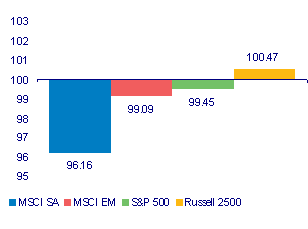
In our recent asset allocation overview we had made the case for overweight equities. However our ranking order, based on our valuation exercises, indicated a preference for developed markets (represented by the S&P 500) over emerging markets generally (represented by the MSCI EM Index) over the JSE All Share Index.
The indexes this year have behaved very much in line with our ranking order. We compare the performance of the respective Indexes this year in USD below. As may be seen the S&P was the out performer and the JSE the distinct underperformer in January 2011.
Continue reading the full Daily View here: Daily View, 1 February 2011 – The rand: What a growing global economy can do
Lessons from the Global Financial Crisis
The worldwide financial markets and the global economy have suffered from a financial crisis on a scale not experienced since the 1930s. But the crisis now appears to be over. Credit spreads have returned to more normal levels, activity in credit markets has recovered strongly, and the volatility of day-to-day movements in share prices has declined. Moreover, the recovery of the global economy, of which the U.S. is such an important part, now appears strong enough to suggest that the recession of 2008-9 may turn out to have been a mild one of short duration. The IMF is forecasting global growth of 4% in 2011 after recording a marginal decline of about 1% in 2009, and thus the global financial crisis does not appear to have led to an economic crisis.
Click to read the full article: Lessons from the Global Financial Crisis (Or Why Capital Structure Is Too Important to Be Left to Regulation)
76JEBQJN5MTY
The global forces that drive SA’s Financial markets from day to day
This study demonstrates with the aid of single equation regression analysis the role global capital markets play in determining the behaviour of the Johannesburg Stock Exchange(JSE ALSI) the Rand/ US dollar exchange rate (ZAR) and long term interest rates in South Africa on a daily basis represented by the All Bond Index (ALBI) or long term government bond yields represented by the R157. It will be shown that since 2005 the state of global equity markets, represented in the study bythe MSCI Emerging Market Index (EM) has had a very powerful influence on the JSE. The EM Index is shown to have had a less powerful yet statistically significant influence on the ZAR while it is also demonstrated and that conditions in global capital markets, and the ZAR have had some weak but statistically significant influence on the direction of long term interest rates in South Africa. It will be demonstrated that movements in policy influenced short term interest rates, have had very little predictable influence on share prices, the ZAR or long termbond yields. The causes as well as the consequences of the ineffectiveness of policy determined interest rates for monetarypolicy are further analysed.
Turbulence on the Nile – ripples elsewhere
The likely fall of an Egyptian Pharaoh, after a very long reign, added uncertainty to global markets last week. Exposure to equities was reduced and share markets retreated with most of the weakness experienced on the Friday. A weaker rand made the JSE an underperforming Emerging Market in USD. The weak rand furthermore did not spare the Resource stocks that are regarded as riskier than most. (See below)
Global Equity markets Weekly USD returns; January 23rd= 100
JSE Weekly Rand returns; January 23rd= 100

Earnings: The trend is your friend – but which trend?
JSE All share index earnings are highly cyclical. And the cycle is one of high peaks and deep troughs in the growth rate ofearnings, as the illustration of the cycle of inflation adjusted or real earnings growth for the JSE since 1961 shows.The cycle has been particularly vicious lately. After a surge in earnings growth after 2004, which was sustained until 2008, thegrowth cycle turned very negative in 2009-2010. Real earnings at the bottom of the trough in late 2009 were some 40% lower thana year before. This represented the deepest trough in the JSE earnings cycle since 1960. Real JSE earnings growth turnedpositive again late in 2010 and consensus forecasts would have them grow by about 25% in 2011.
Continue reading today’s Daily View here: Daily View 26 January 2011
The building cycle: When a plan comes together
There are increasing signs that the global economic recovery is building momentum, and is very strong in many instances. We saw this last week with Chinese GDP numbers for the fourth quarter, which grew at an annualised 12.7%. But even in the developed world the signs are looking promising, with good business activity survey numbers out of Japan and Germany, and a promising set of jobless claims numbers out of the US last week.
Continue reading the Daily View here: Daily View 24 January 2011
Minding the Gap
The Monetary Policy Committee (MPC) of the Reserve Bank opted to keep the repo rate unchanged at 5.5% yesterday, in a move entirely in line with market expectations. Perhaps of more interest was the MPC’s outlook for inflation, which it upped to 4.6% for 2011 (from 4.3%) and 5.3% for 2012 (from 5.8%). We discuss the monetary stance of the MPC elsewhere in Daily View, but there has certainly been more talk in recent weeks of higher inflation later this year, as a weaker rand and rising commodity prices take their toll.
Continue reading the Daily View here: Daily View 21 January 2011