What is Happiness? For a Minister of Finance and his Treasury true happiness must be surging revenues. Revenues this fiscal year 26-27 are running R54.1b faster than the Budget of February 2026 and counting, Thanks largely to higher precious metal prices and income taxes and royalties paid by gold and platinum mines. Revised estimates of revenue are up 6.6% on the 25-26 budget – and are expected to rise by a further 18% by 29/30.
This bonanza not only improves the critical ratios- debt and borrowing to GDP as well as the primary budget surplus- revenues ahead of expenditure other than interest paid- which translates to less borrowed in the future. But perhaps even more exhilarating it allows the Minister to answer yes to many more requests for money, which is unlimited. Government expenditure this year has been revised up by R45.5b while the three-year plan is for further increases in government expenditure at about the expected rate of inflation. Now planned to increase from R2.72 trillion in 26/27 to 3.02 trillion by 29/30. The revised three-year plan It would l reduce the fiscal deficits and borrowing requirements –because tax revenues are planned to rise at a faster rate than expenditure. Is this good for growth?
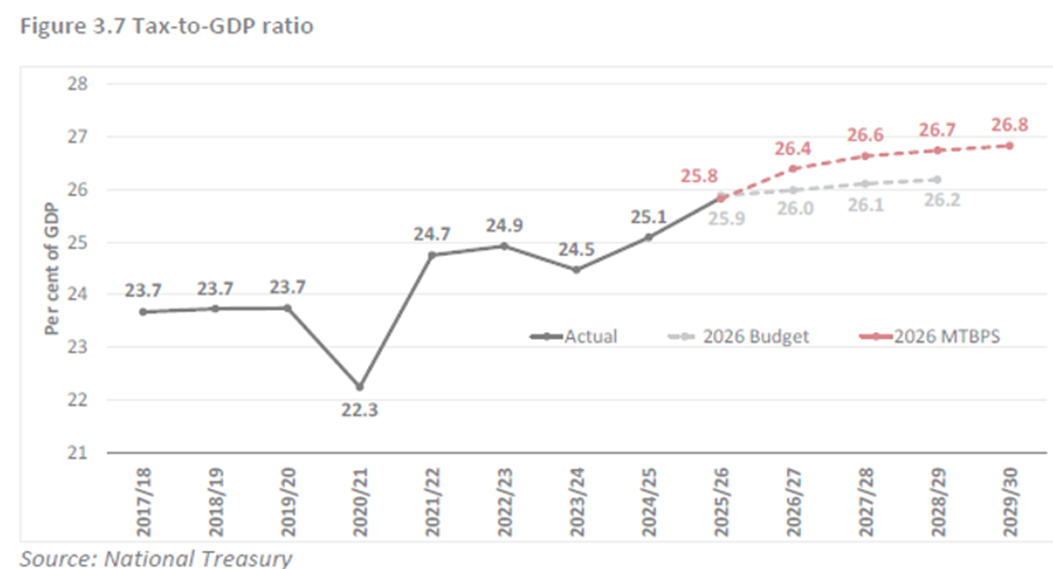
If formal fiscal rules are to be introduced to constrain government spending to what is affordable by taxpayers, they would most importantly have to include a limit to taxes raised – determined as a tax to GDP ratio – currently expected to rise to 26.8% of GDP. Taking more than 26% of South Africans hard earned incomes is more than income earners should bear.
Allocations to infrastructure delivered via public-private partnerships under hoped for new improved arrangements and authorities, will rise by over 5% a year. Supplying capital to add to the essential infrastructure is but a first step. Ensuring that it is productively employed- earns more than it truly costs to reward the suppliers of capital- be it taxpayers or drawn from retirement funds – is essential to the purpose. Without cost conscious, properly incentivised private sector partners, capital will be wasted on a large scale as the track record shows so clearly. It disappears down the familiar rat holes.
Among the beneficiaries of extra spending is the SANDF that will receive an extra R823m to fight crime and a similar amount to cover post-retirement benefits for retired soldiers and their dependents. Was there any attempt to reduce these retirement benefits in the public interest? And what are the hidden from sight liabilities for providing post-retirement benefits in other parts of the public sector- including public universities that struggle to fund such benefits. What about the unfunded liabilities of the Road Accident Fund? When will these promised benefits be brought in line with the capacity of taxpayers to pay up? The police are given an extra R810m to revive their fleet of vehicles. While an extra R2.2b is provided to enhance “Judicial Independence” and R516 million has been found for the Madlanga, Khampepe and Nkabinde commissions of inquiry. Truth does not come cheaply. While money has been found to hire 3500 social workers and to establish specialised courts in a campaign to combat gender-based violence. The programme to digitalise government operations is allocated a further R150m. And so on.
As they say a billion here and a billion there and you are soon talking about real money. Real money is to be spent sacrificing a part of the fuel levy- some R10 billion – in the form of lower excise duties starting next month. About 10% of what is expected from the fuel levy that run at about R100b a year. Clearly not small change. But is an excise duty on an essential input into the economy – diesel and petrol – a good idea? It introduces an artificial gap between the cost of production and the prices charged. A gap not at all consistent with economic efficiency that drives costs and prices together.
Excise duties are designed to discourage consumers from doing damage to themselves. Feuling up is not a sin – it is an essential ingredient in the production of goods and services and for global competitiveness. When a large gap opens between the cost of producing something – and its selling price on the streets – presents its own temptations. Illegal production and smuggling are bound to follow.
The same outcomes could follow a higher proposed tax on gambling activity. Illegal bookmakers, home based or via the internet could exploit the gap and offer superior odds to attract custom at the expense of the legitimate operators. Avoiding excise duties is not only corruption in practice. It is corrupting- including of the senior police, who inevitably do their own lifestyle audits -for a meaningful share of the illicit benefits – to look away – as our commissions have made clear.
The Treasury might inform us how large is the illegal trade in fuel and more important how to revive the capacity to refine oil in South Africa. An essential contribution to the SA infrastructure. A realistic return on the private capital necessary to this purpose would be required as it would of any public-private partnership. Demonstrating fiscal sustainability has brought down the risk premium for supplying capital to the SA economy. There is much more to be done to promote the economic growth that would justify more investment by the private and public sectors. Enhancing growth that would raise tax revenues without adding to the real burdens of taxpayers.