Point of View: In praise of the global consumer plays

How the global consumer plays on the JSE have kept up well with the S&P 500.

A noticeable feature of global financial markets has been the strong recent performance of the S&P 500 Index, both in absolute and even more impressively in relative terms. As we show in the charts below, the S&P 500, the large company benchmark for the US equity market, continues to outperform both emerging markets (EM) and also the US smaller listed companies represented in the Russell 2500 Index.

The S&P 500 has gained approximately 15% against the MSCI EM benchmark since a year ago and is about 5% stronger vs the Russell.

We also show that, compared to a year ago, the SA component of the benchmark EM Index (MSCI SA) that excludes all the companies with a primary stock exchange listing elsewhere (SABMiller, British American Tobacco, Anglo American, BHP Billiton and the like) has done well compared to the average EM market, of which only about 8% will be made up of JSE listed companies. The JSE All Share Index, converted to US dollars, has lagged the S&P 500 by about 10% over the past 12 months.

Continue reading Point of View: In praise of the global consumer plays

Hard Number Index (HNI): Pulling out of the dip

The State of the SA Economy in October 2014

Two up-to-date indicators of the state of the economy are now to hand. New vehicle sales in October as well as the cash in circulation at the October month end are now known. As we show below, new vehicle sales have held up very well in 2014. It appears that the sales cycle has turned up, indicating that if recent trends continue the industry might look to improved sales in 2015, which would be close to the record ales volumes achieved in 2006.

A blow for Mark Shuttleworth – but not for freedom

Mark Shuttleworth has struck the Reserve Bank a heavy R350m or so blow. Most significantly and laudably he is to put R100m of his damages into a fund to help South Africans pursue their constitutional rights. In this way he may well help to protect SA property against seizure by the government without proper compensation. Whether exchange control itself would survive a constitutional court action remains as moot as ever.

The Shuttleworth Appeal succeeded on the basis that the 10% levy collected by the Reserve Bank did not pass the constitutional test of “A Money Bill – as defined by sections 75 and 77 of the Constitution of South Africa” and not because the court decided that exchange control was either illegal or unhelpful. Nor, it appears, was the court asked to so decide. Continue reading A blow for Mark Shuttleworth – but not for freedom

What can be done to reform the tax system in a useful way? We explore some of the possibilities

What can be done to reform the tax system in a useful way? We explore some of the possibilities

The newly appointed Minister of Finance, Nhlanhla Nene, will step into the limelight next week to provide an update on the state of government finances and reveal the Treasury plans for the direction of national government expenditure and revenues over the next three years.

Of particular interest will be to learn how government revenues are holding up in the face of slower economic growth, and what this may mean for the funding requirements of government. Most important: whether or not higher tax rates will be called for, a move that will damage the growth prospects for the economy.
Continue reading What can be done to reform the tax system in a useful way? We explore some of the possibilities

An extraordinary day in the markets

For a while now – since 19 September to be precise – the markets have stopped worrying about what US growth might do to interest rates (threatening equity valuations) and began to worry about growth itself.

News of deflation in Europe had fed these fears and helped force bond yields everywhere (including RSA yields) lower. Yesterday morning a weak US retail number, announced before the market opened in New York, was more than enough to encourage a dramatic sell off of leading equities and an equally dramatic rush to the apparent safety of bonds. We show the intraday moves in the bond markets below.

The SA economy: Finding a driving force

How fares the SA economy? Unexpectedly better thanks to the vehicle market – but it remains hostage to interest rates

The strength of new vehicle sales in September has come as a welcome surprise given the prevailing and understandable pessimism about the state of the economy and particularly about the fragility of household income and spending intentions.

Unit vehicle sales to South African customers – including sales of light and heavy commercial vehicles – have recovered strongly enough over the past three months to reverse the suggestion of a downturn in the new vehicle cycle. If current trends are sustained, by no means a given, sales this time next year could be at an annual rate of 720 000 units and not far from the record sales achieved in 2006. Continue reading The SA economy: Finding a driving force

Equity markets and interest rates: September suffering

September was a tough month for equities, even though interest rates had declined by month end.

September proved to be a difficult month for equities and it was especially difficult for emerging market (EM) equities, including the JSE that once more behaved like the average EM equity market. The S&P 500 lost less than 2% of its US dollar value in the month while the EM bench mark lost almost 8% of its value and the JSE All Share Index, measured in US dollars, had fallen by more than 8% by the end of the month. Continue reading Equity markets and interest rates: September suffering

Acsa could put Eskom on the right path

This piece was published in the Business Day on 22 September 2014:

THE Treasury’s package of measures for dealing with Eskom is like the curate’s egg — it is good in parts. The Treasury has devised a package of measures to sustain Eskom. Some will be welcomed, others not. Unfortunately, the government, sole shareholder of this failing corporation, is not willing to recapitalise Eskom fully so it can complete its build programme without further harm to hard-pressed electricity users. Continue reading Acsa could put Eskom on the right path

National Treasury and Eskom: The curate’s egg

National Treasury’s package of measures for dealing with Eskom is another case of the curate’s egg – it is only good in parts.

The Treasury has come up with a package of measures to sustain Eskom. Some of these measures will be welcome, others less so. Unfortunately the government, the sole shareholder of this failing corporation, is not willing to fully recapitalise Eskom so that it can complete its current programme without further damage to the hardpressed users of electricity – firms and households. Continue reading National Treasury and Eskom: The curate’s egg

Developed or emerging markets? The JSE offers easy access to both

The JSE All Share Index, when converted into US dollars at current rates of exchange consistently tracks the benchmark MSCI Emerging Market (EM) Index, making the JSE a very good proxy for the average EM equity market.

This relationship, as we have often pointed out, is not co-incidental. It is the very similar earnings performance of the average JSE-listed company compared to that of the average EM company that presumably explains the closeness of the fit. We show below how closely the two earnings per index share series compare. Continue reading Developed or emerging markets? The JSE offers easy access to both

National income accounts: Demand side reality check

There is even less comfort than before from the demand side of the SA economy – calling urgently for an economic reality check


The national income accounts for Q2 2014 now include the aggregate expenditure estimates and these make for very uncomfortable reading. These estimates of expenditure make it clear that SA has a serious demand side as well as a supply side problem.


The Reserve Bank confirmed that growth in spending by households, firms and the government is slowing down and may shrink further in the quarters to come.  Estimates of expenditure for Q2 2014 reveal that final demands for goods and services, adjusted for higher prices, slowed to a 1.3% annual rate in Q2 2014, down from a still weak 2.9% rate in 2013. Spending by households slowed to a paltry 1.5% rate. Growth in spending on plant and equipment also slowed down, to a half a percent crawl as private businesses reduced rather than extended productive capacity. Private formal businesses not only reduced their capital stock, they also employed fewer workers in Q2 2014.

Continue reading National income accounts: Demand side reality check

Emerging markets: On the comeback trail?

Emerging and developed equity markets this year are tracking each other rather closely. As we show in the chart below, this has not always been the case.

Between 1990 and 1995, emerging market (EM) equities made their first significant bow on the global capital market stage and outperformed the US S&P 500, the leading developed market benchmark, by some 80%. After 1995 and until 2000, they lost all of this ground gained and much more in relative performance. EM was again the preferred flavour after 2000 until the Global Financial Crisis, an event that took even more out of EM valuations than the out of the S&P and other developed equity Indexes. EM, then in recovery from the global recession, outperformed the S&P 500 until 2010, but then became a decided outperformer until this year. Continue reading Emerging markets: On the comeback trail?

Woolworths: Why the share market did not react (much) to the rights issue

What really matters for shareholders is the decision to invest in David Jones – much more than the funding choices made.

The Woolworths (WHL) rights issue designed to finance its takeover of Australian Department Store David Jones has been in the wings for some time. Despite the prospect of more shares in issue and dilution to come, the share market correctly has not yet reduced the price of a WHL share. Continue reading Woolworths: Why the share market did not react (much) to the rights issue

Point of View: There’s not so much gold in them thar hills

The front page of the Wall Street Journal this week (25 August) carried a story about South Africa leading the world – in illegal gold digging. To quote the report “Dangerous Economy Thrives in South Africa’s Abandoned Gold Mines” by Devon Maylie:

“After years of watching its dominance over the gold industry shrink dramatically, South Africa has emerged as the world capital of illegal gold digging. In staggering numbers—easily into the tens of thousands—desperate former miners and gang members have created a subterranean subculture of abandoned mine-shaft wanderers. Armed with a few crude tools, they dig into blasted or cement-sealed mines, comb through tunnels, and spend days chiseling away at bedrock.
“Once the world’s biggest gold producer, South Africa accounted for 80% of the global supplies as recently as 1970. Today, that figure is less than 1%, in large part because China and other countries have sharply picked up their own production, forcing mine closures here that created an opening for freelancers. Today, some 4,400 abandoned mines dot the countryside, almost four times the number in operation, according to South Africa’s Council for Geoscience. And while there are still about 150,000 formally employed gold miners in South Africa, ‘we’re very close to the point where there will be more illegal miners than legal miners,’ says Anthony Turton, a South African mining consultant.”

The Journal continued:

“… taken together, the output of these swelling ranks are having a noticeable affect on the bottom-line of the country’s sagging mining industry and tax revenues. South Africa’s Chamber of Mines, a body that represents mining companies, estimates that the country loses about 5% of its potential annual mineral output to illegal mining activities, equivalent to around $2 billion. In 2010, the most recent year available, the government estimated losing $500 million in tax and export revenue from gold illegally mined and sold in the black market, compared with about $2 billion it raises annually in corporate taxes from all mining companies.”

A few caveats are perhaps in order here. In 2012 the the Chamber of Mines reported gold production of 167 metric tonnes, or 5.8% of world production that year, well down on output and share of global production in 2003, as illustrated below:

The member companies of the Chamber did much better in extracting gold bearing ore from their mines than in extracting gold as the second table shows. The tonnes of gold-bearing rock they milled actually increased in recent years. What has declined precipitously is the average amount of gold contained in each tonne of ore raised to the surface. Each tonne of rock extracted, expensively and dangerously, from the bowels of the earth now contain a miniscule average 2.9 grams per metric tonne. The loss of SA’s share in global mine production has much more to do with declining grades (from 4.56 grams per tonne in 2003) than it has to do with increased output elsewhere. Global gold output has increased by approximately 230 tones since 2003, while production from all SA mines fell by 208.6 tonnes over the same period. In other words, production outside SA has increased by a little more than SA production has declined.

An important further point worth making is that annual production of gold is a very small proportion of the gold ever produced. Almost all of this has survived and is held as a store of wealth. Therefore, as is surely apparent, the price of gold is little affected by current output – legal or illegal. The legitimate mines may lose potential output to thieves and the SA government is not able to collect income from illegal or informal miners, while the price is unaffected by illegal mining activity – equivalent to 5% to 10% of the legal production. Furthermore, if the gold has been extracted illegally from shafts that have been permanently abandoned, such output is incremental, not lost. The gold would have stayed in the ground and not helped produce any income at all. The costs of mining this otherwise abandoned gold is borne entirely by the workers themselves, including the risks of losing their lives to rock falls and their gold to gangsters preying on them.

Incidentally, the gold produced in SA in 2012 earned R73bn, well up from the R32.9bn realised in 2003 thanks to the higher rand gold price. 5% – 10% of this attributed to illegal gold miners is significantly more than the R2bn worth of illegal mining revenues reported by the WSJ and does not take account of other mining sales that altogether totaled R363.8bn in 2012. Such illegal mining activity, currently largely unrecorded, could add significantly to the SA GDP were it to be included in the national income accounts.

Yet while the recorded output of gold has declined and the numbers employed in gold mining has fallen from 198 465 employees in 2003 to 142 201 in 2012, average earnings of these workers have improved significantly over the same period. Total gold mining earnings amounted to R22.24bn in 2012 or R156 386 per employee, compared to approximately R63 900 earned by the average worker in 2003, or to R103 000 in 2012 (the equivalent when adjusted for CPI). In other words, the average employee in the gold mining industry, of whom there are now fewer, appears to be earning about 48% more in CPI adjusted terms in 2012 than they did in 2003.

These improved remuneration and employment trends are unlikely to be independent. The fewer surviving gold mine workers have become more productive, helped no doubt by more and better equipment per worker, judged by the volume of ore extracted rather than the gold produced. The industry would not have survived otherwise than by providing fewer jobs in exchange for what have become better paid and more productive workers. Operating margins for the Chamber member mines have improved rather than deteriorated over the years, as we show below, despite lower grades of gold mining ore.

The safety record of the industry, judged by fatality rates, has also improved as we show below. Thus the industry has provided better and safer jobs, but for regrettably fewer workers.

As the WSJ makes only too clear, the willingness of the illegal miners to undertake the hazardous and poorly remunerated work they engage in has much to do with the lack of alternative employment opportunities. To quote the article again:

”’If I could find a proper job, I would leave this,’” says Albert Khoza, 27, who says he started illegal prospecting eight years ago because he couldn’t find work and was desperate to send money to his family. On this day, outside an old mine about 60 miles from where Mr. Matjila mines, he has been handling mercury with his bare hands. His eyes are bloodshot and infected, as he stokes the fire with plastic containers”.

Or, as the other illegal miner interviewed, Mr. Matjila, is reported to have said: “’We’re not criminals, I don’t want to be doing this. But I need to make some money.’ Then he stood up to walk down the road to the hardware store to check on prices of new supplies. ‘We have to make a plan to find another hammer,’ he says.

The challenge to the SA economy is to resolve the inevitable trade-offs between better jobs for some workers and the very poor alternatives then open to those who are unable to gain access to what is described as ”decent jobs”. The formal SA labour market has not been allowed to match the supply of and demand for labour at anything like market-clearing employment benefits. And so we have the insiders, those with formal employment and willing to launch strike action to further improve their conditions of employment; and the outsiders who find it so difficult to gain entry to formal employment, of whom the illegal miners represent a numerically important group, as numerous, so we are told, as those formally employed in gold mining.

The solution to the general lack of formal employment opportunities appears as far away as ever. Strike action not only leads to higher real wages and reduced employment opportunities, but still greater incentives to substitute reliable machinery for more expensive and unreliable labour that makes continuous production very difficult to achieve. The unpredictable impact of strikes on production is perhaps as much an incentive to reduce complements of relatively unskilled workers as are higher real costs of their employment.

To encourage employment in the gold mining industry and everywhere else, it would be very helpful if workers were willing to share in the risks of production, as the illegal miners appear willing to do: that is to accept less by way of guaranteed pay and more by way of rewards linked to performance and profits. In other words, for workers to become, to a greater degree, owners of the enterprises they engage with. If pay went up and down with the gold price, the gold mining industry would surely be willing to bear the risks of hiring more workers.

Global interest rates: The lowdown on Europe

Long term interest rates have kept surprisingly low – and the source of this surprise is the threat of deflation in Europe. The ECB will have to do what it takes to avert this threat.

We have long been of the view that the key to the short term behaviour of global equity markets is the direction of long dated US Treasury yields. Until fairly recently it may have been said that the actions of the US Fed were decisive for the direction of these interest rates. The Fed, via its Quantitative Easing (QE) programme had become a very large holder of US Treasuries and mortgage backed securities.


These exchanges of Fed cash (in the form of Fed deposits) for bond and mortgage backed securities were undertaken with the specific intention of not only protecting the financial system, but of holding down mortgage rates to assist the recovery of the US housing market and so of household wealth. At the peak of these operations US$80bn of these securities were being added to the asset side of the Fed balance sheet each month and simultaneously to the cash balances kept by US banks.

The slow but more or less steady recovery of the US economy allowed the Fed to suggest in May 2013 that it would be tapering such injections of cash into the system and that by late 2014 it would hope to end QE. It has since followed through on this prospect. Monthly net purchases of these securities in the market have been tapered and the security purchase programme will be over soon. This announcement of a likely end to the Fed support of the fixed interest market led however to the “taper tantrum” of May 2013. Long bond yields rose significantly and equity values declined. Volatility, in the form of daily moves in equity markets, increased and emerging equity and bond markets – regarded as more risky than developed markets – were particularly affected.

Then, despite the Fed taper in 2014, the trend in long term interest rates reversed direction, markets calmed down and share markets recovered. Indeed, market volatilities as measured by the Volatility Index, the VIX (the so-called “fear index”), had fallen back to pre financial crisis levels by mid 2014 and the US equity markets has moved back to record high levels.

The danger of the VIX at such low levels was that volatility could spike higher and share markets accordingly retreat (given that they were regarded by many observers as, at worst, fairly valued by the standards of the past, as represented by conventional Price/earnings multiples).

It could be demonstrated by reference to past episodes of low volatility and demanding valuations that such a combination of low volatility and generously valued equities would need more than good earnings growth to provide good returns. In the past it appeared that only lower long term interest could overcome well valued equities and low volatility. Moreover, it was widely assumed that long term interest rates in the US, very low by the standards of the past, could only be expected to increase. The upwardly sloping US treasury yield curve indicated very clearly such expectations of higher interest rates to come and incidentally still does so.

To the surprise of the bond market and despite the Fed taper, long term interest rates in the US fell rather than rose in July and August 2014. It was lower interest rates in Europe, especially in Germany, that led global rates lower in July. Not only did German Bund yields fall, with US and other rates falling in sympathy, but the spread between lower European and US rates actually widened, surely adding to the appeal of US Treasuries. The Spanish government now pays less for 10 year money than Uncle Sam.

The Fed therefore is no longer the lead steer of the bond market herd. The danger of deflation in Europe is that it leads interest rates lower. And this deflation is all the more likely given quantitative tightening in Europe to date, rather than easing. Unlike the Fed or the Bank of Japan, the assets and liabilities of the ECB have been falling significantly rather than increasing. That the supply of European bank credit and broader measures of money has been falling is consistent with a lack of demand for ECB deposits.

These broad trends will have to be reversed if European deflation is to be avoided. The ECB will have to do what it takes to increase the supply of money and bank credit. QE action is called for and can be expected to continue to hold down global bond yields. Euro deflation trumps the risk of higher interest rates.

The figures below fully illustrate this story of falling interest rates, declining volatilities and higher share prices. We also show how the US dollar has strengthened in response to this improved spread in favour of the US and how developed and emerging equity markets (including the JSE) when are running together, when measured in US dollar terms.

Banks and shadow banking: Out of the shadows

Should we be frightened of our banks and their shadows or should we rather learn how to deal with banking failure?

Shadow banks rather than non-bank financial intermediaries

A new description – shadow banks – has entered the financial lexicon. The term is, as we may infer, is not used in a positive context. Rather it is to alert the public to the potential dangers in shadow banks, as opposed to the presumably better regulated banks proper.

This is a use of language consistent with one of the dictionary definitions of the word:

A dominant or pervasive threat, influence, or atmosphere, especially one causing gloom, fear, doubt, or the like: They lived under the shadow of war.

Or perhaps alluding to shadowy, defined as:

1. full of shadows; dark; shady
2. resembling a shadow in faintness; vague
3. illusory or imaginary
4. mysterious or secretive: a shadowy underworld figure

 Source:  www.Dictionary.com

An older, less pejorative description of this class of financial institution or lender would have been non-bank financial intermediary or perhaps near-bank financial intermediary to describe those firms that closely resembled banks in their lending activities. Examples are mortgage lenders (once called building societies), insurance companies, pension funds, money market funds and unit trusts, all of which would have fall under the modern description, shadow banks.


As we show below, drawing on the March 2014 Financial Stability Report of the SA Reserve Bank, the share of SA banks in the total business of Financial Intermediation in SA has declined over the past few years while the share of other financial intermediaries (including money market funds and unit trusts) has risen consistently, also in part at the expense of pension and retirement funds
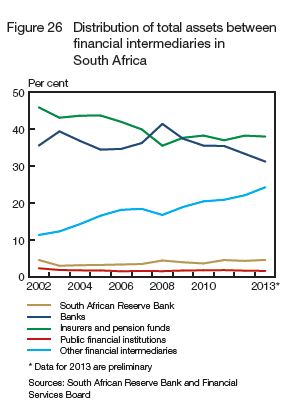
 

Source; SA Reserve Bank Financial Stability Report, March 2014

The role of financial intermediaries is to facilitate the capital providing and raising activities of economic actors, domestic and foreign. They stand between (intermediate) the providers of capital in the economic system, be they households or firms, and those raising funds, to cover (temporary) financial deficits, that is, other households and firms and government agencies needing finance. They also compete for financial custom with those providers and users of finance who might bypass the financial intermediaries completely and deal directly with each other.

Such activities may be described as disintermediation when, for example, a firm previously dependent on bank finance bypasses the banks and issues its own debt or equity in the financial markets. The subscribers to such issues may however well be other financial intermediaries, for example pension funds, in which case  it is the banks that will have been disintermediated.


Why banks are different from all other financial intermediaries

What then makes banks different in principle from other financial intermediaries? It may be in the detailed manner in which they are regulated, as we indicate above. But pension and retirement funds are also subject to particular regulations and regulators designed to protect providers of capital to them as are the managers of money market funds or unit trusts.

Banks are different not because they borrow and lend (or, more generally, raise and provide capital); they are different fundamentally because an important part of their function is to provide, via some of the deposit liabilities they raise, an alternative to the cash provided by the central bank that can be used for transactions, in the older terminology, as a much more convenient medium of exchange . In so doing, they provide an essential service to the economy, providing a payment system without which the modern economy would founder.


The danger with banks, narrowly confined to those few institutions that provide the payments mechanism, is that a large bank failure would bring down the payments mechanism with it. This is a danger to the broader economy almost too ghastly to contemplate. It is a danger that makes a large transaction clearing bank, on which all other financial institutions depend, not only to hold their cash, but more importantly, to help make payments, too big to fail. If such a bank were in danger of failing and unable to recapitalise itself in the market place, it would be obliged to call on the taxpayer for additional capital and the central bank for cash as a lender of last resort. A call that the central bank and the government could not, in good sense, resist. Shareholders given such a rescue should then lose all they have invested in the bank while depositors might be saved while bank creditors generally may or may not be obliged to accept a haircut. A possible haircut would help bank creditors exercise essential disciplines over banks as borrowers. The moral hazard of too big to fail and therefore too big to have to worry about default could be overcome without jeopardising the payments system with a predictable well recognised set of bankruptcy procedures for banks.


Clearly, facilitating payments by transferring deposits on demand of their depositors, is not all that banks do. Not all their funding is by way of deposits that may be transferred or withdrawn on demand. Term deposits as well as ordinary debt may be more important on their balance sheets than current accounts or transaction balances.


Banks, narrowly defined as the providers of a payments system, largely originated by offering an alternative medium of exchange to that of transferring gold or silver and the notes issued by a central banks to settle obligations. The owners of banks came to realise that they did not have to maintain anything like a 100% backing in gold or notes or deposits with the central banks for the deposits that could be withdrawn without notice, to survive profitably.


Fractional reserve banking was seen to be possible and profitable. In other words, the interest spread between the cost of raising deposits, with demand deposits paying the lowest interest or no interest at all, helped the banks make profits on the spread between their borrowing costs and interest income and so helped pay for the costs of maintaining the payments mechanism – a form of cross subsidy. It may be surmised that had the banks had to levy fees to cover all the costs, including a return on capital, of providing the payments mechanism, bank deposits might have proved less attractive and the growth of retail banks accordingly more inhibited than it was.


Banks in SA have become more dependent on net interest income in recent years, rising from about 5% to 10% of net income, while operating expenses have grown by about the same percentage. Return on equity has declined but remains a respectable 15% p.a.
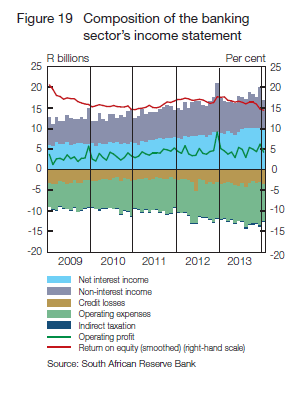
Source; SA Reserve Bank Financial Stability Report, March 2014


The inevitable risks in fractional reserve banking and leveraged banks

Such fractional reserves however do pose a risk to the shareholders of banks as well as to their depositors. There might be a run on the bank that could cause the bank to fail, making the shares they owned in the bank valueless. Clearly, the interest earning assets it typically held could not be cashed in as easily as its deposit liabilities. Banking failures led to responses by regulators – firstly in the form of a compulsory cash to deposit ratio demanded of banks and in the form of deposit insurance designed to protect the smaller depositor. This was introduced in the US in the 1930s in response to the Great Depression and the banking failures associated with it.

Compared to most other financial institutions, including the so-called shadow banks, banks proper have always been among the most highly leveraged of business enterprises.. Their debts include all deposits, current and time deposits, equivalent to 90% or more of their assets, leaving little room for errors in the loans made.

The protection provided to depositors in the form of required cash or liquid asset reserves could not insure any bank or financial institution against the bad loans that could wipe out shareholders equity and cause a bank to go out of business.  Hence the regulatory focus in recent years, not so much on cash adequacy, but on equity capital adequacy. The Basel rules promoted by the central bankers’ central bank, the Bank for International Settlements located in Basel, Switzerland, have imposed higher equity capital ratios of banks.

Understandably, the SA Reserve Bank as the regulator of the SA banks has given attention in its Financial Stability Report to the capital adequacy as well as the operating character of the banks under their supervision. The results of this analysis indicate that by international standards, the four large SA banks are well capitalised and well managed. As the table below shows, a capital to asset ratio of nearly 15% provides a return on banking shareholders’ equity of close to 15%, even though the return on total assets held by the banks is only 1.1%. Without high degrees of leverage SA banks might not be profitable enough to be willing to cross-subsidise the payments mechanism. If so other providers of a payments mechanism would then have to be found.

Funding such alternative providers with fees charged might not seem an attractive alternative to the current banking system that facilitates payments, partly through the interest spread, but with the danger than banks can fail. Dealing with the possibility of failure may well prove a better approach than imposing capital and cash requirements of banks that make them unable to easily stay in business.
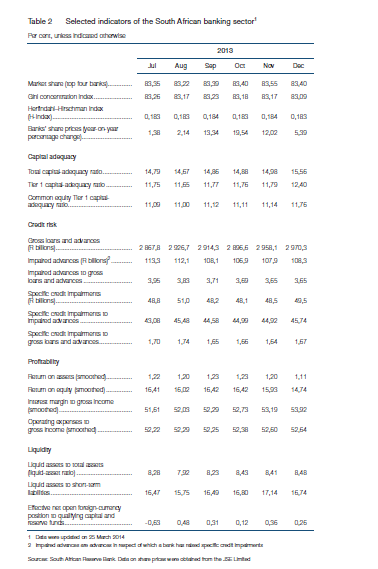
There are no guarantees against banking failure


There is no guarantee that regulated bank capital, adequate for normal times and not so demanding as to threaten the profitability of banks and their survival as business enterprises, would be sufficient to support the banks in abnormal times. The global financial crisis of 2008 took place in most unusual circumstances, that is when the an average house price in the US declined by as much as 30% from peak to trough. Such declines meant that much of the mortgage lending of US banks had to be written off. Even a capital adequacy ratio of 15% might not protect a banking system, with a typically large dependence on mortgage lending, against failure, should the security in house prices collapse as they did in the US. SA banks have held up to 50% of all their assets in the form of nominally secure mortgage loans. They too would not have survived a collapse in house prices of similar magnitude.


Is it possible to insulate the payments mechanism from other banking activity? And what would it cost the holders of transaction balances?


It may be possible, given modern technology, to separate the payments system from  bank lending and borrowing. The payments system could be conceivably managed by the specialised equivalents of a credit card company that would compete for non interest bearing transactions balances on a fee only basis. The transfer mechanism could well be a smart phone or some equivalent device.


The proviso would have to be 100% reserve backing for these balances held for clients to transfer. These reserves that would fully cover the liability would have to take the form of a cash deposit with the central bank or notes held in the ATMs.  A deposit with a private bank would not be sufficient to the purpose- the other private bank, unlike a central bank can also fail and so bring down the payments system. If such a separation of banking from payments was enforced by regulation, large banks might not then be too big to fail any more than any other financial intermediary or indeed any other business enterprise might be regarded as too big to fail. But the unsubsidised transaction fees that would have to be levied to cover the costs of such an independent  payments system, fully protected against failure, that would include an appropriate return on shareholders capital invested in such payment companies, might prove more onerous than the costs of maintaining transaction balances with the banks today that provide a bundle of services, including facilitating transactions.


It is striking how expensive it is to transfer cash through the specialised agencies that provide a pure money transfer service. A fee of 5% or more of the value of such a transaction is not unusual. The case for bundling banking services, even should banks need to be recapitalised should they fail in unusual circumstances, may well be a price worth paying. In other words what is required for financial stability and a low cost payments service is a predictable rescue service for the few large banks that manage the payments system.


Volatility: The calm before the storm or is the balmy weather to continue?

Share markets have calmed down, as have most other financial markets. The S&P 500 Index is as relaxed as it was before the Global Financial Crisis broke in September 2008. Daily moves in share prices are confined to an unusually narrow range and the cost of an option on the market (insurance against volatility) has fallen accordingly, as we show below.

A similar benign pattern of modest daily moves can be observed of the JSE Top 40 Index as is also shown.
The volatility priced into an option on the S&P 500 is the Volatility Index (VIX), which is actively traded on the Chicago Board of Exchange. This index is sometimes described as the Fear Index. The more fear or uncertainty about the state of the world, the more investors struggle to make sense of it all, the more prices move in both directions. The theoretical equivalent of the VIX calculated for the JSE is the SAVI. In a global capital market where uncertainty about the future is a common denominator, the VIX and the SAVI move closely together. Force one winds in New York City translate into force one winds on the JSE.

Both the VIX and the SAVI may be understood as forward looking measures of volatility used to price options, but they appear to track actual volatility – measured as the standard deviation (SD) about average daily price moves – very closely. We compare the VIX this year to the 30 day rolling moving average of the SD of the S&P 500 below. Both measures of volatility have declined this year, indicating that investors generally have a much more sanguine view of the future prospects of the companies they invest in.

The stability of the global financial system appears well secured by QE in the US, while the Draghi pronouncement “to do what it takes” to shore up European sovereign credit has soothed the sometimes savage breast of Mr and Ms Market.

So far so very good. Lower volatility (less fear of the future and so less of a risk premium demanded of financial assets hence higher present values attached to expected earnings) has been accompanied, as it almost always is, by higher share values.


The relationship between share prices generally and volatility is consistently strong: when volatility is up, share prices move down and vice versa. The correlation of both the daily level of the VIX and the S&P 500 and percentage changes in both series since 2005 remains very high, of the order of (-0.60) or higher when levels are correlated and even higher (-0.74) when daily changes are correlated.

The good news about financial markets today is that volatilities are low and fear of some economic crisis apparently largely absent. The down side is literally that – if volatility is already so low can it go lower? and if not, can we expect share prices to go much higher? The answer is still perhaps so if the fear stays away. The markets may well continue to grind mostly higher as they have been doing recently. But the chances of a global event that would again frighten shareholders and their agents cannot ever be ignored.

It appears that markets are much more inclined to crash lower on bad news that may mean a change in the world as we know it, than to crash higher on good news. Good news seems to dribble in slowly, bad news can come crashing down on your head overnight. Let us hope that the flow of economic news continues to be mostly encouraging and volatility stays low and share prices grind higher.

Point of View: A growth, not a savings problem

SA has a growth in income problem – not a lack of savings problem. The lack of growth and its consequences are plain to see. The apparent shortage of savings (the difference between domestic savings and capital formation) shows up in the current account deficit of the balance of payments and in the equivalent inflows of foreign savings.

The bigger the current account deficit, the larger the inflows of foreign savings. Without the access to foreign savings, the current account deficit would be much smaller, spending on all goods and services including plant and equipment would have to be cut back even further and the economy would be growing even slower. Faster growth would mean higher returns for savings and help attract more foreign savings and keep more of domestic savings productively applied back home. Slower growth undermines the case for investing in SA. It will mean a weaker rand and more inflation and perhaps higher interest rates to undermine growth prospects further.

Faster growth and the extra profits that come with it would also be retained by SA businesses, so adding to domestic savings. Of the gross savings rate of SA, equivalent to only about 14% of GDP, more than 100% is undertaken by corporations that retain earnings and cash flow. We would like them to plough back their earnings and cash flow (after paying taxes) into additional plant and equipment and larger work forces, rather than paying dividends, buying back shares or repaying debts. They would do more of this good stuff if they were more confident about the growth prospects.

The problem for any economy is not a lack of capital (savings by another name), but a want of good returns on it. Raise the returns and the capital will be freely available. The focus of attention of South Africans should not be on a lack of capital, or its reflection in the current account deficit, but on how to promote faster growth that will help raise the return on capital to attract more of it from all sources, domestic and foreign.

Deidre N. McCloskey in her book Bourgeois Dignity – Why economics cannot explain the modern world (Chicago University Press 2012) makes the crucial points in the following highly individual and entertaining way:

“There are many tales told about the prehistory of thrift. The central tales are Marxist or Weberian or now growth-theory-ish. They are mistaken. Accumulation has not been the heart of modern economic growth, or of the change from medieval to the early-modern economy, or from the early modern to the fully modern economy. It has been a necessary medium, but rather easily supplied…The substance has been innovation. If you personally wish to grow a little rich, by all means be thrifty, and thereby accumulate for retirement. But a much better bet is to have a good idea and be the first to invest in it. And if you wish your society to be rich you should urge an acceptance of creative destruction and an honouring of wealth if obtained honestly by innovation. You should not urge thrift, not much……………You should work for your society to be free, and thereby open to new ideas, and thereby educable and ingenious. You should try and persuade people to admire properly balanced bourgeois virtues without worshiping them. Your society will thereby become very, very rich. American society nowadays is notably unthrifty. The fact is much lamented by modern puritans, left and right. Yet because the United States accepts innovation and because it honors Warren Buffett it will continue to be rich, in frozen pizzas and in artistic creativity and in scope for the average person.” (pp 166-167)

South Africans are also notably unthrifty, understandably so, given the transformation of the middle class who achieve this status with little by way of household capital. Get a good job and the financial system will arrange for a house and a car on credit, as it should. The problem now is not too much credit, but rather too few jobs and the income that comes with employment and so the capacity to borrow.

But South African business has been notably innovative – hence the excellent returns on capital invested and rising share prices. The current account deficit, that is the consumption propensities of South Africans, has been financed to an important degree by reducing our stake in our excellent businesses (many of which have become plays on the global economy) thanks to SA’s improved status in the world and relative freedom from capital controls. Most important, while South Africans have reduced their stake in JSE-listed businesses, partly in exchange for shares in companies listed elsewhere, the remaining stake is worth a lot more than it was. The share of the cake may have declined, but the cake is a much bigger one, thanks to innovative management who are appreciated by fund managers abroad.

For SA to grow faster, the innovative power of business must be released and encouraged rather than discouraged by government interventions. Business should be treated with respect rather than the hostility that seems to be the inclination of a bureaucracy that lacks appreciation of the essential bourgeois virtues that McCloskey celebrates.

Go to the supermarket thou sluggard- consider their ways and be wise

In mysterious (super) markets we should trust to serve our economic interest – not regulators of prices

A typical supermarket carries many thousands of separate items on its shelves. It may also offer a variety of other services at its tills or counters, including payment or transaction services. The operating profit margins on these different items or services will vary greatly and may even vary from day to day as buyers take advantage of opportunities to buy low and sell high. Their suppliers may also offer discounts for prompt payment or bulk orders or their payment terms may be extended to help add profit margins.

The shopper couldn’t possibly hope to know such details nor should they care to know. All they might be aware of is the price of some KVI (known value item), for example a jar of coffee or a box of tea. And the supermarket will try and make sure that the KVIs are priced competitively. If the tomatoes are a profitable line at the vegetable counter they may well help cross subsidise the cooking oil, but nobody other than the shop managers needs to be well aware of this.

What will matter to the shopper, a matter of which the shopkeeper will be well aware, is not the price of any one item on the menu, but of the cost of a trolley load of groceries and the cost in time and transport of collecting it. Shareholders and managers care whether the selling price of the average shopping trolley or basket will more than cover the average costs of delivering the trolley load – rents and employment costs included. Most important is that these prices on average are high enough to provide a satisfactory return on the capital invested in the chain of shops and distribution centres and trucks needed to keep the shelves well stocked and so the customers coming through the doors. Margins may go down and true profits go up, to the ultimate advantage to both customers and shareholders.

If the realised return on capital is above risk adjusted returns, shoppers and non-shoppers can be assured that the essential service of supplying and delivering goods and services to households will continue to be provided at prices they prove willing to pay for. Indeed, the more profitable the enterprise, the more likely the retail offering will be extended to more locations, with fuller stocked shelves in ever greater variety.

Consumers generally can be assured that the cure for high or “exploitative” prices and margins is high prices themselves. High prices that lead to above normal or required returns on capital encourage more supply, that in due course will reduce prices. In other words, consumers can rely on market forces to supply goods and services and to restrain pricing power.

The owners of profitable firms are well incentivised to expand their offerings. Unprofitable firms who are unable to charge enough (sometimes inconveniently for their loyal customers) will go out of business. Perhaps as consumers we should worry more about unsustainably low prices than unsustainably high prices. High prices bring more goods with greater variety; low prices will mean reduced supplies and less variety and quality.

In the presumed absence of competition, we rely on regulators to determine prices on a cost plus basis; hopefully not too high a return that might mean very high prices not vulnerable to competitive forces. There is a danger that regulation of some prices in an essentially bundled offering may fail to recognize the overarching role played in the economy by return on capital and the important tendency for excess returns to be competed away.

The threats to SA consumers of additional regulation that come to mind are the potential assaults on the menu of charges made by furniture retailers who supply furniture bundled with credit, delivery costs and perhaps personal insurance. Or on the suppliers of chickens bundled with brine, the proportion of which is regulated. Or the services of cell phone companies, who among the services they provide, include connections to other cell phone companies, that are now subject to a lower regulated charge.

The itemised insurance or delivery charges levied by a furniture retailer may look exorbitantly high, seemingly well above observable costs. A regulator may then demand lower charges for them. But such lower charges may well mean a higher price for the separately itemised furniture item. The insurance charges may well have cross subsidised the price of the furniture item. Then lower charges for insurance will mean higher explicit prices for the furniture itself, if the cost of capital is to be recovered. Similarly, by reducing the cell phone interconnection charge – the cost of a bundled pre paid contract – perhaps the subsidized cell phone itself may well will go up. And if it costs less to bulk up a chicken with brine than with mealie meal, the price of chicken will surely reflect this as the chicken producers compete with each other to make extra sales.

Provided furniture retailers, cell phone companies or chicken producers compete with each other, we need not concern ourselves with the charges of the individual items, than we need to concern ourselves with the gross profit margins of all the separate items provided by a supermarket. We can rely on competition rather than regulation to constrain prices and to secure essential supplies.

An easy to recognise feature of regulated markets is insufficient supply and non-price rationing – that is long queues for service or forced sacrifices of quality and variety. Think of the waiting lists for “free housing” or medical services at public hospitals in SA or of power load shedding due to the lack of regulated generating capacity.

The essential problem is that it is hard to understand and appreciate the hidden hand of market forces. It seems easier to think that prices are some simple mark up on costs. The problem is compounded in that students of economics are more easily and taught how markets fail than how they work in what appears to be mysterious ways. History tells us that governments (that is government officials) are much more easily prone to failure to supply essential goods and services than market forces driven by profit seeking companies.

The price regulator is bound to be some university-trained economist. The successful entrepreneur does not need to understand theoretical economics at all – only how to buy low and sell high and the more they succeed the better off we will all be. More important than price competition will be innovation, new products / services or improved methods of production that are introduced to the economy by enterprising companies and risk loving individuals. These companies and individuals will have high prospective margins very much in mind but in turn will be subject to emulation and margin pressure. Regulation can only serve to stifle, not promote, innovation.