The SA economy needs a level playing field

A key role in a growing economy is played by the start-up enterprise. They introduce new ways of doing business- supply new products and services – that challenge established business practices and so help make the economy a more productive one. They can start small but if they get it right, and execute  well they can become large and successful.

They do so by serving their customers better than the competition did or sometimes could not have imagined. They also have to satisfy the interests of their employees who could work elsewhere and they also have to meet the interests of other suppliers of services or goods to them, including those of the suppliers of capital, for which they have to compete with all other firms. Most important is that by by attracting custom and covering their costs they can provide their owner-managers with benefits and returns on their savings (capital) far superior to those they might have realised working for somebody else.

But their chances of such success are not good ones. The owner-managers of most start-ups, even most small businesses, do not realise well above average returns for their founders- ahead of what they might have earned elsewhere or from their savings plans. This means judged by past performance these true entrepreneurs are not deterred by the prospect of low average rewards but are inspired by the (small) chance of realising exceptional rewards. This makes them risk lovers rather than risk averse and society has every good reason to encourage their unusual appetite for taking on risk. And so not to impose regulations that favour the large firm. Those large enough to afford specialised human resource and legal departments that keep key managers out of the time consuming mediation procedures – and able to employ skilled accountants that can complete complicated tax and other returns.  Should it however be easy for new entrants into the market place to succeed? Easy pickings would reflect an undesirable lack of market efficiency. If the market is working well it should be difficult to beat the market.

Better than promoting or discouraging small over large or large and established firms over smaller rivals would be to ensure that all firms can contend freely and openly in the market place. The proverbial level playing feel serves the interests of all the consumers, workers and taxpayers who will always be far more numerous than the owners or senior managers or professionals who engage with them.  .

But such freedoms to compete will always be threatened by the established producers who have a large and easily measured economic interest in limiting the competition through laws and regulations favourable to them. In the old SA a minority of suppliers of goods or services enjoyed such protections. Most others, as consumers and taxpayers and workers suffered from import and capital controls and maize and banana boards etc. that put some producers and some white workers and professionals first in line for jobs to the disadvantage of their potential competitors and the customers who stood to benefit.

It needs to be recognised that the producer interests that now tilt the playing feel against consumers and workers and taxpayers in SA and against the interests of perhaps more worthy beneficiaries of government spending, are those of the owners of black businesses and skilled black professionals. They are being favoured with higher prices and rewards by affirmative action. As before it is the economic interests of a minority of producers that are being served by regulation and law. As before, the politics of such actions are easier to understand than their economic consequences. Though the low growth trap that has now caught the SA economy should concentrate minds on the costs and benefits of interfering with competition.

Power Play

A power play unfolds before our eyes. Comedy as tragedy or farce?

Prospects for the SA economy early on Tuesday 11 October had improved significantly when we learned that SA’s first two independent privately owned coal-fired power stations (IPPs) had been given the go-ahead. Foreign interest in these projects, as suppliers of the equipment and technology and of the necessary capital, was welcomingly strong. Most important, the 863MW of additional electricity is to be delivered at an agreed wholesale price of 79 and 80 cents, plus inflation.

Alas later that morning a further very troubling scene in the opera buffo that has become SA’s fiscal affairs, was played out when Public Prosecutor Shaun Abrahams announced that he was charging Finance Minister Gordhan with fraud. The economic damage caused by a weaker rand, higher borrowing costs for the state and lower values for businesses that depend on the SA economy, was immediately registered, while firms with operations mostly outside SA gained rand value. The outlook for inflation deteriorated with the weaker rand and so the possibility of lower interest rates from the Reserve Bank has receded. The income and job prospects of SA households and their willingness to spend and borrow more, essential to any cyclical recovery in SA, has been undermined accordingly as has the willingness of SA business to invest more in meeting their demands and employment needs. Many billions, incalculable billions of lost economic opportunity, will have followed. Those responsible cannot possibly count the damage they cause.

The two announcements however are linked – perhaps in a way that can still produce a happy ending. Can we doubt that the fiscal power play has much to do with the prospect of nuclear power as opposed to power from coal or gas? The deal for nuclear energy, details of which are awaited and are to be reluctantly supplied, and about which the Treasury has had its serious reservations made well known, will be on a scale well beyond impressive sums now to be invested in additional coal fired capacity. Business Day referred to R40bn per private IPP. Capturing a chunk of this nuclear deal from the people of South Africa at the expense of their living standards is seemingly well worth fighting for.

The problem for advocates of nuclear power in SA, well intentioned or perhaps not, is the firm offer of 80 cents per kilo watt hour from the new IPPs. We have a strong recent indication of just how expensive nuclear power can be. Britain has just given the go ahead for the nuclear Hinkley Point Power Plant, that plans to deliver 3200MW of power at a “strike price” of, believe it or not, £95.5 per MW plus inflation after 2012, that is at current exchange rates only roughly, since these rates move around so much, the equivalent of R1660 per MW, or equally roughly twice the price tendered by the IPPs. The wholesale electricity price in the UK is now much lower, about £45 per MW leading the National Audit Office to estimate that electricity consumers in the UK having to spend an extra £29.7bn for the benefit. Similar calculations of cost per hour and extra spend that will have to be charged to pay for nuclear in SA cannot be denied. They have to inform the process.

There is a more important lesson to be learned about the business of capturing the state from the citizens who pay for the state and its failures – intentional or not. The opportunity for corrupting the state is only as big as the state itself. There is no good technical reason to place airlines, electricity or water production, ports and railways, toll roads, hospitals and schools in the hands of the state. The reason why the state as supplier, rather than private producers, is so strongly supported by the politicians, is because they can so easily be captured by the suppliers of all kinds to these organisations, at the cost of the consumers of the essential services and the taxpayers who pay for them. South Africans watching the stage unfold might wise up to these facts of life.

Help or hinder?

GDP grew in the second quarter, despite very weak spending. Without a recovery in spending the SA economy will continue to struggle. Will the Reserve Bank help or hinder a recovery?

The SA economy, measured by GDP (the real output of goods and services) grew in the second quarter (Q2), at a satisfactory (annual equivalent) rate of 3.3%. In the first quarter (Q1) output had declined at a -1.3% annual rate. Hence the economy avoided a recession – defined conventionally as two successive quarters of negative growth. However an examination of the expenditure side of the economy reveals a much less satisfactory state of economic affairs. Total spending, Gross Domestic Expenditure (GDE) in real terms declined in Q2 by as much as GDP increased, at a -3.3% rate. The difference between GDP and GDE is by definition net exports: the difference between exports that add to domestic output and imports that substitute for domestic output. On a seasonally adjusted basis, export volumes grew very strongly in Q2, while import volumes declined enough to add a net 6.7% to the GDP growth rate.

Final demand makes up a large component of GDE. It aggregates the compensation spending by households and government and the expenditure by government agencies and the private sector on additional capital goods. This aggregate declined (by 0.1%) in Q2 – an improvement on the 2.8% decline estimated in Q1. The further component of GDE is inventories accumulated or run down. In Q2 inventories are estimated to have declined by a real R22.7bn, contributing a large negative (-3.2% p.a) to the GDP growth rate in Q2.

When the spending of households is aggregated with that of privately owned businesses on capital equipment, that is when government spending and investment in inventories are excluded from final demand, we find a similar reluctance of private households and firms to spend more. Private demand for goods and services has been growing at consistently slower rates in recent years appears and now appears to be in retreat, having declined marginally in Q2 2016, not quite keeping up with inflation, defined as the year on year increase in the GDP deflator. The supply of money and bank credit has been growing as slowly as private spending. This is clearly not co-incidental. The growth in spending and credit to fund spending tend to run together.

The performance of the economy in recent years indicates clearly that the increases in interest rates imposed on the economy since January 2014, while they have worked to reduce spending and so the growth in GDE and GDP, have not helped in any significant or predictable way to reduce inflation or inflation expected. Inflation in SA – that leads rather follows inflation expected – has been dominated by shocks in the form of a weaker exchange rate that has driven up the prices of imported goods and a drought that has reduced domestic supplies of food staples and increased dependence on imports. Higher regulated prices and taxes on expenditure have added to the supply side shocks that can drive prices higher – despite weak demand that only to a limited extent has helped to hold back prices. The exchange rate itself has taken its cue, not from interest rates set in Pretoria, but in Washington DC. It is not only the rand but all emerging market currencies that have depreciated as capital flowed to developed, rather than less developed markets, in recent years. Moreover wage rates and prices are determined simultaneously and interdependently in SA. Higher wages have come at the expense of employment opportunities as well as recent profit margins, when final demand is lacking and the firms lack a degree of pricing power.

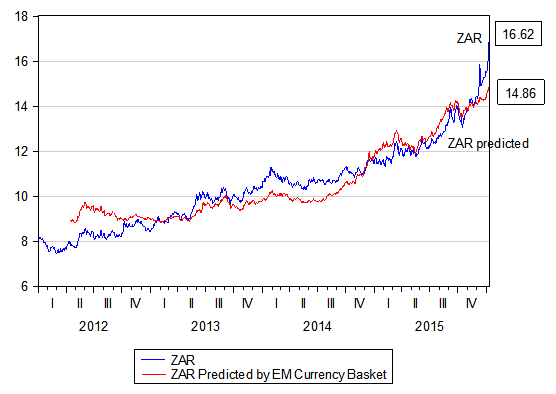
The reality that the Reserve Bank finds so hard to recognize is that scope for an independent monetary policy to control inflation is very limited if the domestic authorities do not have any consistent influence over the exchange rate. This has been the case for South Africa as it is for most emerging market central banks with flexible exchange rates that respond to highly unpredictable capital flows. The figures below demonstrate that the common global rather than SA forces that have been responsible for almost all of the weak rand and the higher prices that have come with it. The EM Currency basket represents nine equally weighted emerging market currencies (The Russian ruble, Indian rupee, Hungarian forint, Mexican, Chilean and Philippine pesos, Turkish lira, Brazilian real and Malaysian ringgit). Though it must be added, the rand has been a distinct underperformer since 2012 – losing about 20% more than the EM basket Vs the US dollar. The current value of the rand is now (20 September) a little ahead of where it would be predicted to be – given the exchange value of the EM basket as its predictor – and so also taking into account the weaker bias against the rand.

The Reserve Bank, through its unhelpful interest rate and money supply actions, has significantly influenced the growth in spending. Higher interest rates may have reduced measured GDP growth by as much as 2% p.a. The limited feedback loop from interest rates to spending and so on to inflation has been dominated by the independence of SA interest rates and other highly unpredictable forces acting on the exchange rate and administered prices. The hope for a cyclical recovery of the SA economy and the lower interest rates that will be necessary to the purpose, rests on a degree of rand stability that will accompany a revival of capital flows into EM markets and currencies. A normal harvest will also help to hold down inflation in 2017.

It will take lower interest rates to encourage the demand for and supply of bank credit. It will take lower inflation and inflation expected to encourage the Reserve Bank to lower short term rates. It would seem self-evident, given the want of demand for goods and services and for the labour to help produce them, that the direction of SA interest rates should be downward rather than upward.

The highly competitive weak rand – now some 30% below its purchasing power equivalent value (see below) will continue to encourage exports (labour relations permitting) and discourage imports and may help sustain GDP, as it did in Q2 2016. However, given the importance of household spending for the economy, accounting as it does for over 60% of all spending and given also the further dependence of capital expenditure by private companies on the demands households make on their established capacity, any consistent recovery in the SA and the weak economy – will require the stimulus of lower interest rates. We can hope that a stable or better, a stronger rand and less inflation, makes this possible. We can also hope for a more realistic and helpful narrative from the Reserve Bank that recognises that interest rates influence growth much more than inflation and that maintaining growth rates is a highly appropriate objective for monetary policy – especially when controlling inflation is not within its control. 20 September 2016


Tough Love

National Minimum Wage Panel – do your duty and offer tough love and resist the arguments for economic miracles.

The government has (thankfully) decided to kick the National Minimum Wage (NMW) into touch. The hope must be that the panel come to advise that any NMW high enough to make a meaningful difference to the circumstances of the working poor, is a very bad idea. It’s a bad idea because it cannot offer much poverty relief (to those who keep their jobs) without destroying the opportunity for many more in SA, particularly the young and inexperienced and those outside the cities, to find work.

The problem is that even many of those who find work (mostly in the cities), at the lower end of the wage scales, remain poor. The working poor in SA have been defined as those who earn less than R4000 per month. Yet the problem is that most of those with jobs in SA earn much less than this, while a large number of potential workers are unemployed and earn no wage income at all.

According to a comprehensive recent study of the labour market in SA by Arden Finn for the University of the Witwatersrand, 48% of all wage incomes, representing 5m workers, fell below R4000 per month in 2015 and 40% earned  less than R3000 per month, about 2.7m workers out of a total employed of about 13m. The proportion of those employed who fall below R4000 are much higher in the rural areas, higher in agriculture (nearly 90%) and domestic services (95%). In mining, 22% of the work force earned less than R4000 per month in 2015, while in the comparatively well paid and skilled manufacturing sector, about 48% of the work force were estimated to earn less than R4000 per month.

How many would lose their jobs? And how many would hold on to them to receive the promised benefits of higher minimum wages? These are the numbers that would have to be estimated by the panel. They would have to allow for all the other independent forces at work, other than wages, that could favourably or unfavourably influence numbers employed. For those on the panel who believe that SA can repeal the laws of supply and demand for labour and that wages have little to do with what workers are expected to add to business revenues, and so higher minimums can happen without very unhelpful employment effects – there is a question they will have to answer.

If a higher NMW can make such a helpful difference to poverty without serious consequences for the unemployed and their poverty, why not set the NMW ever higher?  If an NMW of R4000 a month is not enough to escape poverty, why not double or treble these minimums? They must surely agree that the number of job losses would increase as the distance between current wages and the intended minimums widened. Agree, that is, that the only way to avoid extra unemployment would be to set the minimums very close to actual minimum wages in the very different locales where they are earned, a symbolic rather than a practical gesture.

The panel could turn to the well-known relationship between employment, employment benefits and output (measured as value added or contribution to GDP) in the formal sector of the SA for evidence that improved employment benefits, for those who keep their jobs, leads to less employment for the rest. GDP has grown consistently while employment has stagnated and the numbers unemployed have risen as the potential work force has grown. Yet the real wage bills have grown more or less in line with real GDP. In other words, the percentage decline in the numbers employed has been less than the percentage increase in employment benefits paid out. Nice work if you can get it and too many South African have not got it. And wages and profits have maintained their share of value added. Firms have adapted well to more expensive labour; the unemployed have not been able to do so. Their interests should be paramount in policy action.

An NMW set well above market related rewards will reinforce such trends. It will not be fair to the non-working poor nor promote economic growth, the only known way to truly relieve poverty and raise wages over time. It is the duty of economists to practice tough love – to recognise the inevitable trade-offs should a NMW be introduced. We can but hope the panel will do its duty and resist politically tempting actions that have predictably disastrous effects. After all, if we knew how to eliminate poverty with a wave of a wand (the NMW is such a wand) we would have done so a long while ago.


The rand is mostly well explained by global forces. Yet SA specific risks have also declined to add further value to the ZAR. Long may these trends persist.


The rand has enjoyed a strong recovery in recent weeks. We say enjoyed advisedly. A strong rand is very helpful to households and their spending. It means less inflation (even deflation of the prices of goods or services with high import content or of those that compete with imports) and so less inflation expected in the prices firms set for their customers. If rand strength or even rand stability can be maintained, lower interest rates will follow to further encourage spending. Households directly account for over 60% of all spending, while spending by firms that supply households on capital equipment and their wage bills will take their cue from household demands. Any hope of a cyclical recovery of the SA economy depends crucially on the now more helpful direction of the rand.

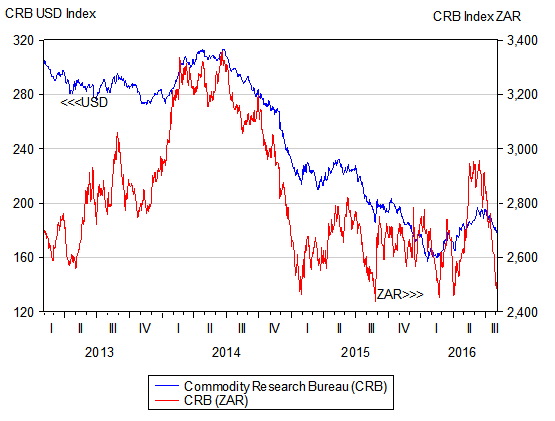
Exporters may see their profit margins contract with a stronger rand. However, crucial for them will be the reasons for rand strength or weakness as the case may be. If the rand appreciates because the global economy is gathering momentum, or is expected to do so, then rand strength may well be accompanied by higher US dollar prices for the metals and minerals they sell on world markets, and vice versa, rand weakness might well be accompanied by or even caused by lower commodity prices. In which case revenues gained via a depreciated rand may well be offset by weaker US dollar prices. As has been the case for much of the past few years. Falling dollar prices for metals and minerals for much of the past few years – other than gold- have accompanied the weaker rand. And to some extent can be held responsible for the weaker rand.

Fig 1; Commodity Price Index (CRB) in USD and in ZAR

fig1

It is therefore important to identify the sources of rand weakness or strength. It is important to recognise the difference between global forces and SA-specific events that have driven or can drive the rand weaker or stronger, even though the implications for the state of the SA economy of rand strength or weakness, from whatever cause, global or SA specific, will be similar. The more risky (uncertain) the outlook for the global and SA economies, the weaker the rand and vice versa whatever the sources of more or less risk- be they Global or South African.

However if the cause of rand weakness is SA in origin – attributable to economic policies or expectations of them – those responsible for currency weakness and a consequently weaker economy can be held accountable by the democratic process. Policy makers may lose support, enough to change the direction of policy direction that could add rand strength. The rand strength that has accompanied the local government elections and a politically damaged Presidency are pointing in this direction and have made disruptive interference in SA’s fiscal policy settings less likely. Hence an extra degree of ZAR strength for SA specific reasons.

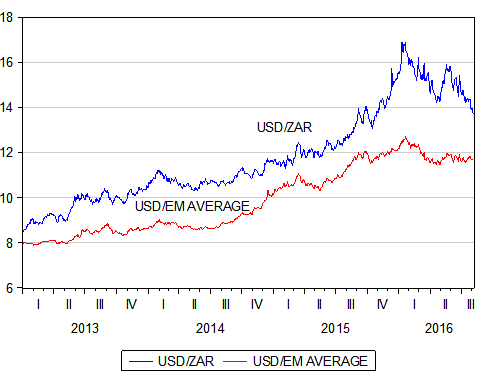
We offer an analysis that clearly can identify the causes of rand weakness or strength as either global or SA specific. The simple method is to compare the behaviour of the USD/ZAR exchange rate with that of nine other emerging market (EM) currencies that can be expected to be similarly influenced as is the ZAR by global forces. We compare an Index of these USD/EM exchange rates with that of the USD/ZAR exchange rate below (The exchange rates included in the Index are all given the same weight. The Index is made up of the Turkish Lira, Russian Ruble, Hungarian Forint, Brazilian Real, the Mexican, Chilean, Philippine Pesos, Indian Rupee and the Malaysian Ringgit). It may be seen that the weakness of the rand since 2013 has been accompanied by EM currency weakness generally. Much of the rand depreciation of recent years may therefore be attributed to global not SA specific influences on capital flows and exchange rates. It has been an extended period of dollar strength as much as EM weakness. The US dollar has also gathered strength vs the euro and the yen over this period.


Fig.2; The USD/ZAR and the USD/EM Average, 2013-2016 (Daily Data)

fig2

Source; Bloomberg and Investec Wealth and Investment


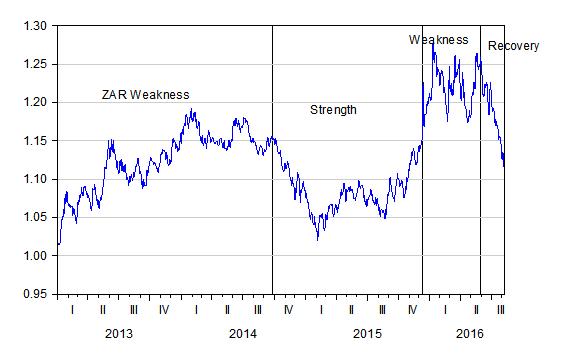
However it has not been only a matter of USD strength. As may be seen below when we compare the performance of the ZAR to the EM basket there have been periods of rand weakness – from January 2013 to September 2014- followed by a period of relative rand strength that turned into significant weakness in late 2015 when president Zuma frightened the market for the rand and RSA’s with his surprise sacking of the then Minister of Finance Nene. As may also be seen the recovery of the rand dates from late May 2016 and has gained significant momentum recently with the outcomes, expected and realized in the Local Government elections of August 3rd 2016. Since the close of trade on Friday 5th August the ZAR has gained 2.6% vs the USD while the nine currency EM average exchange rate is about 0.90% stronger vs the USD.

Fig.3; Performance of the USD/ZAR Vs the USD EM average. (Daily Data; January 2013=1)

fig3

Source; Bloomberg and Investec Wealth and Investment

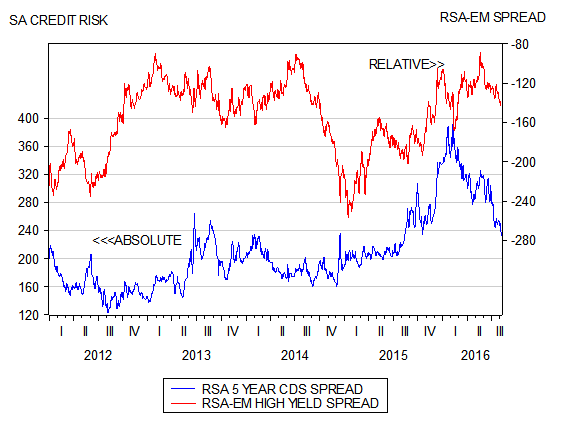
A similar picture emerges when we trace the Credit Default Swaps for RSA dollar denominated debt and high yield EM debt in Fig 4. The CDS spread is equivalent to the difference in the USD yield on an RSA or EM 5 year bond and that of a five year US Treasury Bond. The credit rating of RSA debt in a relative sense can be expressed as the difference between the cost of insuring RSA debt against default Vs the cost of insuring high yield EM debt. The larger the negative spread in favour of RSA’s, the more favourable SA’s credit rating compared to other EM borrowers. As may be seen the RSA rating deteriorated in 2015 and is now enjoying something of an improved rating. Though the credit spreads indicate that there is some way to go before RSA credit attained the relative and absolute standing it had in 2012.

Fig.4; SA and Emerging Market Credit Spreads.

 fig4

Source; Bloomberg and Investec Wealth and Investment


To take the analysis further we have run a regression equation that explains the USD/ZAR exchange using the USD/EM exchange rate as the single explanatory variable. The fit is a statistically good one as may be seen in figures 5 and 6.  The EM currency basket explains over 90% of the USD/ZAR daily rate on average over the three and a half years. But as may be seen in figure 4, the ZAR was significantly undervalued in late 2015. The predicted value of the USD/ZAR at 2015 year end, given the exchange value of the other EM currencies might have been R14.86 compared to actual exchange rate at that fraught time of R16.62. Or in other words SA specific risks had made the USD almost R2 more expensive than it might have been at the end of 2015.

Fig.5; Value of ZAR compared to EM Basket on 1/1/2016.

fig5

Source; Bloomberg and Investec Wealth and Investment

As we show in figure 5 this valuation gap had disappeared by August 5th 2016.  The USD/ZAR exchange rate is now almost exactly where it could have been predicted to be by global forces alone. That is to say the current exchange value of the ZAR is precisely in line with other EM exchange rates.


Fig.6; Value of ZAR compared to EM Basket on 8/8/2016 Daily Data (2013-2016 August)

fig6

Source; Bloomberg and Investec Wealth and Investment

The future of the ZAR will, as always, be determined by the mix of global and SA specific forces. At current exchange rates it may be concluded that there is no margin of safety in the exchange value accorded the ZAR. It will gain or lose value from this level with changes in SA risk or with the direction of global capital flows that determine the value of EM currencies, bonds and equities.

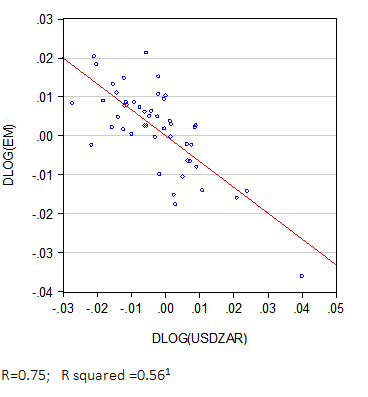
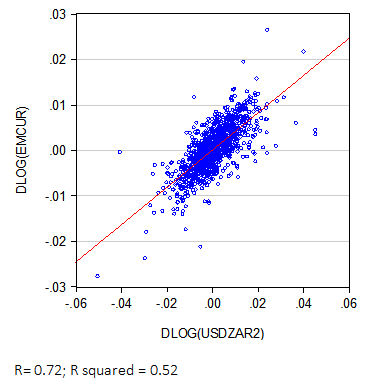
The global capital flows acting on the ZAR are well represented by the direction of the EM equity markets. The ZAR and other EM exchange rates will continue to take their cue from flows into and out of EM equity and bond markets. In figures 7 and 8 below we show how sensitive has been the relationship between daily moves in the ZAR and by implication other EM exchange rates, to daily moves in the value of EM equities – represented by the benchmark MSCI EM Index. We show a scatter plot of these daily percentage changes below. This relationship has been particularly close recently as may be seen in the figures below.

Fig 7. Daily % Moves in the MSCI EM Equity Index and the USD/ZAR,  June 1st 2016- August 8th 2016

fig7

R=0.75;   R squared =0.56[1]

Source; Bloomberg and Investec Wealth and Investment

Fig 8: Daily % Moves in the EM Currency Index and the USD/ZAR; January 1st 2013 – August 8th,2016

fig8

R= 0.72; R squared = 0.52

Source; Bloomberg and Investec Wealth and Investment

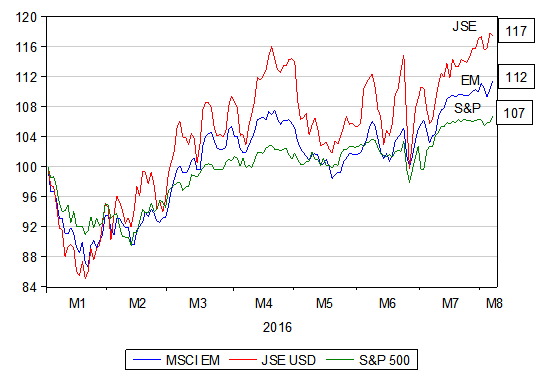
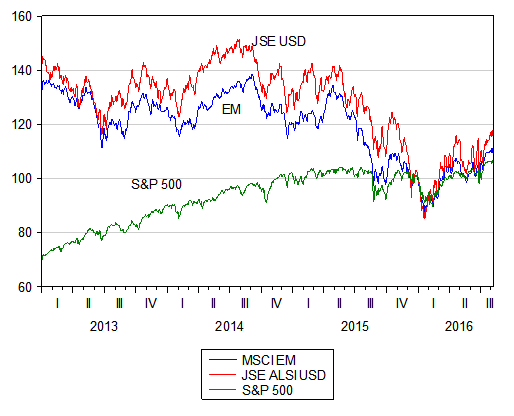
A further feature of global equity markets this year has been the highly correlated movements in the S&P Index and EM Indexes including the JSE- when valued in USD. (See figure 9 below) Also notable is the extent to which the JSE, when valued in USD has outperformed other EM equities as well as the S&P tis. This has come after years of EM and JSE underperformance of a similar scale- especially when measured in strong USD.

Fig.9;  Equity Market Trends; USD. Daily Data 2016 (January 2016=100)

fig9

Source; Bloomberg and Investec Wealth and Investment

Fig.10; Equity Market Trends. USD.  Daily Data 2013-2016 (January 2016=100)

fig10

Source; Bloomberg and Investec Wealth and Investment

These recent trends are a reflection of less rather than more global risk aversion- and so a search for value in equities rather than in the defensive qualities of global consumer facing companies paying predictable and growing dividends. For the sake of the SA economy we can only hope that such trends persist. If they do the opportunity may soon present itself to the Reserve Bank to lower interest rates. It should do so and immediately stop predicting higher interest rates to come. The Treasury moreover should resist the opportunity a rand aided lower petrol and diesel price will give it to raise fuel taxes. A much needed cyclical recovery will take less inflation and lower interest rates. The opportunity a stronger rand may give to lower interest rates and to avoid higher tax rates should not be wasted.

[1] R is the correlation co-efficient. The R squared is for a least squares equation  dLog(ZAR) = c+ dLog(EM) + e

Brexit so far – not so bad for the global economy

Having spent the first post Brexit week in London it is hard to exaggerate the disappointment, even foreboding, felt by our colleagues in the London office of Investec. A leap into a world where the known unknowns have multiplied exceedingly is naturally unwelcome to those whose vocation it is to manage risks to wealth in an as well-considered way as possible. Clearly risks to the outcomes in the real economy and the financial markets – particularly in the UK – have become greater than they were and volatility in markets is likely to be exaggerated until a clearer view of what the future may hold for Britain, Europe and the Global economy, of which the share of Britain and Europe is above 20%.

The most obvious unknown is the impact on the UK economy – though the description United Kingdom may well be an exaggeration – with the sharp regional and generational divides of the referendum revealed. The political unknowns seem unlikely to be resolved any time soon as the UK is understandably in no hurry to formally invoke the exit option. An accompanying unknown is who will lead the UK through these negotiations, the outcomes of which, to be decided in Westminster by the legislators not the voters, will surely lead to further appeals to voters by way of a general election or even a further referendum. However, under new rules the next general election will only be called in 2020 – unless a large majority of the MP’s determine otherwise. The Conservative government and no doubt the parliamentary Labour Party, in turmoil over its leader, are clearly not of any mind to go to the country any time soon.

The obvious issue for any updated economic forecast of the UK economy is the degree to which the prevailing uncertainties and the risks associated with them will undermine the confidence business and household decision makers have in their economic prospects. Less confidence will mean less spending, as investment and consumption plans are put on hold and as plan Bs are evolved. It will not take much of a deviation from trend to turn positive GDP growth into stagnation, or worse, recession. But neither the Bank of England under Governor Mark Carney nor the Treasury under George Osborne have waited for the dust to settle. They have reacted with promises of counter measures: lower interest rates and less onerous applications of the requirements of banks to reserve capital, at the expense of lending. But as Carney cautioned correctly – “there are limits to what the Bank of England can do” – if people are determined to tighten their belts in a more uncertain environment. Confidence in the future outlook for revenues and employment benefits is the all-important and fragile foundation of all forward looking economic actions. Decisions made today that are taken not only by firms, but more importantly by households, that account for 70% of all spending in the UK.

Though to be sure it is the revenue to be gained or lost from supplying financial services to Europe and the world (a particular strength of the UK economy) – despite, or is it because of, sterling rather than the euro – that is uppermost in the considerations of the City of London. A square mile that is currently in the throes of a most impressive building boom. It is very hard to count the cranes from my bedroom window overlooking much of the City.

George Osborne, the Chancellor of the Exchequer, was doing his best over the weekend to bolster confidence and enhance spending. The intention to balance the government’s budget by 2020 has been abandoned. Less rather than more austerity is in prospect – understandably so – given the encouragement provided by extraordinarily low borrowing costs. In the midst of a financial crisis the yield on 10 year Gilts dropped well below 1%. Gilts, like almost all other government bonds – including those issued by RSA – were regarded as safer, except by the rating agencies. It becomes much less of a crisis when government debt becomes still cheaper to issue rather, than as is more usually the case in a crisis, when government loans become ever more expensive to raise and austerity in a recession becomes impossible to resist.

Osborne moreover promised more than more government spending. He made the case for a sharply lower corporate tax rate of 15% – close to the 12.5% rate in Ireland – a matter of already deep anguish to Brussels who would much prefer less rather than more fiscal competition in Europe. The UK, with all its other advantages in the form of good commercial law and as a tax haven, could become an even more powerful competitor for corporate head offices.

Escaping the clutches of the Brussels bureaucrats may offer Britain many such opportunities to trade more freely with each other and with the rest of the world, while hopefully negotiating full access to trade with the European community, not only with mutually beneficial low tariffs but – more important – to reduce non-tariff barriers to trade. This is particularly the case in services that have made the European community much less of a free trading zone than it appears to be on the surface.

Clearly the biggest threat to growth to incomes and profits of companies in the UK and everywhere, including in the US, is the rising populist threat to freer trade and globalisation generally that is considered to have left important constituencies behind. The leave vote was surely a protest vote as much as a vote for independence (independence to control the flow of immigrants to the UK, who in fact have proved generally to be a source of faster growth) as well as a response to the income earning opportunities that a fast growing UK economy has provided.

For a South African analyst in London with long experience analysing volatile exchange rates, the one most obvious conclusion to draw is how helpful weaker sterling has been to absorb some of the shocks caused by UK-specific uncertainties. Sterling devalued by about 10% on the Brexit news. The sterling value of the FTSE Index has largely held its own. Shares, particularly those of the global companies very well represented on the FTSE Index, have seen a weaker sterling translate into higher sterling values, particularly when their US dollar values improved with the strong recovery registered in New York last week.

Equities can perform as currency hedges when the currency weakness represents additional country specific rather than global risks. The sterling or rather the UK economy hedges on the FTSE came, as they do on the JSE, from global rather than local economy plays.

On this exchange rate note it is encouraging to note how well the rand, in company with most other emerging currencies and bonds, held up through the Brexit crisis (see below). Some stability in commodity and energy prices were consistent with these developments. The news about the global economy since Brexit has not reflected a state of crisis for the global economy, to which emerging markets are especially vulnerable. So far not so bad.


Now to turn a reprieve into a recovery

The markets have reacted favourably to the S&P rating decision – is there more favour to be shown?

The markets have reacted favourably to the Standard & Poor’s (S&P) decision to leave SA’s credit rating broadly unchanged that was announced after the SA markets had closed on Friday, 3 June. Clearly the danger of a formal derating of RSA debt was reflected in market yields before the S&P announcement. As we show in figure 1, RSA bond yields and risk spreads have narrowed. The current spread of about 285bp provided by a RSA five year bond over a US Treasury of the same duration now indicates a near investment grade status in the market place. The spread is shown below where it is compared to Credit Default Swaps (CDS) on high yield emerging market (EM) bonds and also on Mexican bonds of the same duration. These spreads represent the cost of insuring the debt against default.

In figure 2, we show how RSA debt has enjoyed something of a re-rating in recent days when compared, as it should be, to other EM debt yields. The yield gap between EM and RSA debt has widened, indicating an improved status for SA, while the extra yield provided by RSA debt compared to Mexican debt has also declined from about 140bp. A longer view of these relationships is also shown in figure 3, which shows that RSA debt has suffered a de-rating in the market place since early 2015, a de-rating magnified by the Zuma intervention in the Ministry of Finance in December 2015. While RSA yields have declined in a relative sense over recent days, SA’s credit rating in the market has not regained the status it enjoyed prior to the Zuma intervention.

A similar pattern of improved sentiment has been revealed in the foreign exchange markets. The rand has gained value vs the US dollar recently, not only in an absolute sense, but also relative to other EM currencies that might be expected to be influenced by moves in the US dollar vs all currencies. In figure 4, we compare the USD/ZAR rate of exchange to that of an equally weighted basket of nine other EM currencies (Turkey, Russia, Hungary, Brazil, Mexico, Chile, Philippines, India and Malaysia). As Figure 4 shows, the rand and the average EM currencies have gained against the US dollar recently. However the ratio of the rand to the EM currencies (April 2012=1) has improved from 1.32 in late May to about 1.28 on 6 June, an improvement of about 3%. A longer term view of these relationships is shown in figure 5, where it may be seen that the rand, compared to other EM currencies, is still slightly weaker than it was before the Zuma actions in December.

In figure 6, we show the RSA 10 year bond yields since early 2015. We also show the difference between RSA yields in rands with US Treasury bond yields in US dollars. This risk spread may be regarded as the average rate at which the rand is expected to depreciate against the US dollar over the next 10 years. The higher yields compensate investors for the expected exchange rate losses. This risk spread has declined in recent days but remains well above the spreads offered prior to the Zuma shock to the bond and other markets.

The SA Treasury has been able to convince the rating agencies of its commitment to fiscal conservatism. The Treasury will need to be allowed to get on with the task without interference from the Presidency. The bond and currency markets, given but only a partial recovery, would still appear to regard such interference as a possibility. What the Treasury also needs, as much as it needs the authority to manage SA’s fiscal affairs, is a cyclical recovery and faster growth. Such a recovery would be greatly assisted by further strength in the rand and lower bond yields. US dollar weakness would further help promote such trends, as they have done recently. If such favourable trends were to materialise, the Reserve Bank would surely have to reverse its own damaging interest rate course. A loosening rather than a tightening interest rate cycle is urgently called for. Lower interest rates and lower interest rates expected will make a cyclical recovery all the more likely. SA has enjoyed something of an unexpected reprieve from the rating agencies. A strong follow up in the form of lower interest rates across the yield curve can turn a reprieve into a recovery.

Not so Moody after all

Moody’s Investors Service showed its softer side when confirming SA’s investment grade credit rating. The rating agency made it clear that to maintain this grade, SA would need to increase its GDP – that is, simply not fall into recession. A mere 0.5% increase in 2016 would meet Moody’s modest expectation, followed by 1.5% in 2017.

Growth, as Moody points out, not only makes government debt easier to manage. It helps the banks and the households meet their obligations and will also encourage firms to invest more in additional capacity.

To quote the preamble to the report:

“The confirmation of South Africa’s ratings reflects Moody’s view that the country is likely approaching a turning point after several years of falling growth; that the 2016/17 budget and medium term fiscal plan will likely stabilize and eventually reduce the general government debt metrics; and that recent political developments, while disruptive, testify to the underlying strength of South Africa’s institutions.

“The negative outlook speaks to the implementation risks associated with the structural and legislative reforms that the government, business and labor recently agreed in order to restore confidence and encourage private sector investment, upon which Moody’s expectations for growth and fiscal consolidation in coming years — and hence the Baa2 rating — rely.”

Moody’s identifies three drivers that inform its decision. The first, most critical, we would suggest, is that the economy will recover from a business cycle trough:

“..The first driver for the confirmation is Moody’s expectation that South Africa’s economic growth will gradually strengthen after reaching a trough this year, as the various supply-side shocks that have suppressed economic activity since 2014 recede. Specifically, the electricity supply is now more reliable, the drought is ending and the number of work days lost to strikes has shrunk significantly (a trend that planned rule changes are likely to embed further). In addition, the inflation outlook is more subdued, which would suggest fewer interest rate rises ahead than we expected when the South African Reserve Bank saw inflation heading towards 8% by year end. Less severe tightening of monetary policy would alleviate extra pressure on South Africa’s relatively highly-indebted household sector and support growth.

“Alongside the more competitive exchange rate, these improving trends are likely to strengthen growth in South Africa from the second half of this year and thereafter. While we expect the economy to expand by only 0.5% in 2016, we expect growth to rise to 1.5% in 2017. Moreover, ongoing structural reforms and diminished infrastructure bottlenecks offer upside potential for growth over the medium term. The recent rapprochement between the government, business and labor holds promise from the standpoint of identifying areas of mutual concern. A number of benchmark actions related to matters such as the rationalization of state-owned enterprises (SOEs) and the enactment of labor market reforms have been identified in the process. To the extent that implementation of such measures helps boost business confidence, investment and job creation, they would improve prospects for gradually reducing wide economic disparities and high levels of poverty, deprivation and unemployment.”

The second driver for the unchanged rating was “The Stabilization of government debt ratios likely to occur in 2016/17” and the third was “Recent political developments testify to the strength of South Africa’s institutions”.

The rating was placed on a negative watch because such hopeful predictions have still to materialise. Or, to put it bluntly, will the economy grow by 0.5% in 2016 and 1.5% in 2017? These are not demanding outcomes even by SA’s well below average growth performance in recent years. What then could cause SA to fall into recession?

The simple short answer would be a further slowdown in household spending. Since households account for over 60% of all spending, any further reluctance in their willingness or ability to spend more will drag the economy into recession. It will neither encourage firms to invest more in people or capacity nor encourage foreign savers to fund our savings deficit.

It is striking that Moody’s could look to lower rather than higher interest rates to improve the growth outlook and the ratings prospects. To repeat the observation made above from Moody’s:

“In addition, the inflation outlook is more subdued, which would suggest fewer interest rate rises ahead than we expected when the South African Reserve Bank saw inflation heading towards 8% by year end. Less severe tightening of monetary policy would alleviate extra pressure on South Africa’s relatively highly-indebted household sector and support growth.”

We have long questioned the Reserve Bank’s decisions to raise interest rates into higher inflation and a weaker economy. It seems to us that the higher rates can make no predictable impact on inflation or, it may be added, on inflation expected – that has also risen lately despite the weakness of the economy and despite interest rates that have been rising since early 2014. This proves only that inflation and expected inflation is dominated by forces well beyond the influence of higher short term interest rates. That is in particular by the behaviour of the rand, the behaviour of the weather, the behaviour of the President, the behaviour of global commodity and oil prices and Eskom and its regulators, to mention some of the supply side shocks that have driven inflation in SA higher.

Interest rate increases do nothing useful to contain inflation in a world where the supply side shocks are pushing prices higher and household spending lower. What they do is to reduce household spending further than would have been the case with stable or lower interest rates. For every one percent increase in the repo rate, the Reserve Bank forecasts a 0.4% reduction in GDP growth over two years.

This should be emphasised, in the light of the Moody’s report, since rate increases prejudice rather than enhance our credit rating. An independent central bank is one of SA’s institutional strengths. But such independence could have been much better managed than it has been. Lower, not higher interest rates, would have served the economy better (and still can) and helped preserve its growth rates. Moody’s would seem to agree.

Are there other forces at work that could help the economy grow a little faster? The weaker real and more competitive rand finally seems to be helping the manufacturers as well as the tourist business. The latest survey of manufacturing activity, the Barclays PMI, shows a very healthy recovery and positive growth. If the past strong statistical relationship between the PMI and GDP growth is to be relied upon (showed below), this improvement does suggest significantly faster growth to come. The PMI is well up and the GDP growth rates in Q2 can be expected to follow. We thank Chris Holdsworth of Investec Securities for drawing this relationship to our attention:


The other helpful influence at work is a much smaller foreign trade deficit recorded over the past two months. Less imported and more exported add to GDP growth rates. A decline in inventories held, especially inventories with import content, may offset these favourable forces on recorded GDP growth. But a combination of a more competitive rand and a more cautious Reserve Bank, more sensitive to the growth outlook, as well as the business cycle trough from which conditions improve rather than deteriorate, should deliver growth of 0.5% this year and 1.5% next; enough to satisfy Moody’s. Raising the growth rates to permanently higher rates of over 3% requires the structural reforms of the labour and other markets that Moody’s appears surprisingly optimistic about. One can only hope that their optimism is justified.


The wisdom in foreign exchange control reforms

A notable milestone in SA’s financial history was passed in the second half of 2015. For the very first time, the value of South Africans’ foreign assets has come to exceed the value of the South African assets and debt held by foreign investors. At year end, our holdings of foreign assets, worth over R6 trillion, exceeded our foreign liabilities by as much as R714bn.


The buildup in offshore assets legally owned and managed by South African businesses, pension and retirement funds as well as directly by wealthy individuals, began from very modest levels in 1994, when South Africans became acceptable participants in global financial markets.

The growth in foreign assets and liabilities has served South Africans particularly well in recent years as the SA economy has been severely buffeted by a damaging combination of weak growth and higher inflation. Stagflation has accompanied a collapse in the currency, higher charges for utilities a severe drought and, to top all these economic body blows, we have seen (avoidably) higher borrowing costs imposed by the Reserve Bank.

The increasingly large foreign component in SA portfolios of assets therefore has helped significantly to mitigate the shocks to their incomes and balance sheets caused by specifically negative South African events, both political and economic. The protection against their exposure to SA risks has come in large measure from the shares they own in JSE-listed industrial companies whose major sources of revenues and earnings (as well as the costs they incur) are generated outside SA.

The successful industrial companies that began life in SA and have prospered abroad include Naspers (NPN), SAB, British American Tobacco (BTI), Mediclinic (MEI), Richemont (CFR), MTN, Steinhoff (SNH), Brait (BAT) and Aspen (APN) . They have come to dominate the JSE when measured by market value. Up to 50% of the value of the JSE is accounted for by these large firms, that we can describe as Global Consumer Plays (GCPs). Before the rise of these now global companies, investors on the JSE would have been much more exposed to the highly variable fortunes of Resource companies that used to dominate the JSE. Without these opportunities to invest in these world class companies on the JSE, as well as the investments made abroad by these companies and other SA based companies outside of SA, the value of SA pensions and retirement plans might have looked very sad indeed.

An equally weighted Index of 14 of these GCPs on the JSE (including recent underperformers MTN, ASP and CFR) has performed as well as the leading global index, the S&P 500, over the past two years or so, adding about 30% to its rand value of January 2015.

Well-developed liquid capital markets not only provide companies and governments with access to capital. They provide wealth owners, and their fund and business managers, with the opportunity to diversify away firm or country specific risks. A well-diversified portfolio with a full variety of investment opportunities, none of which will dominate the balance sheet and whose individual returns are somewhat independent of each other, makes for a much less risky portfolio, that is a portfolio whose value, while expected to rise over time, will do so more predictably than most of its separate components (especially individual shares) included in the portfolio. The well diversified portfolio provides positive returns with significantly less risk – that is smaller value movements in both directions.

Less risk moreover translates into lower required returns of the investor or wealth owner. Lower required returns also mean lower costs of capital for the firms hoping to raise capital to expand their businesses. Lower required returns in turn will mean more capital invested, a larger capital stock and a stronger economy. This is one of the benefits of a well-developed capital market that can attract capital from savers everywhere and not only domestic ones- as has the SA capital market – where capital inflows have more or less matched capital outflows over the years – as we have shown in figure 1 above.

Human capital effect

But the less risky returns that the opportunity to invest globally provided to South Africans benefits not only the owners of tangible capital but also the owners of intangible human capital committed to the SA economy.

There is always a global shortage of skilled professionals, including managers of businesses, for which competition is intense. By enabling skilled South Africans to invest abroad and diversify away SA risk, their required returns from SA sources have also declined. That is, they are more willing to apply their skills in SA – and therefore are more willing to sacrifice returns, that is employment benefits – because their wealth is better insured against SA risks to their wealth. This now more favourable exchange of less risk for lower returns by owners of a crucial resource- the human capital of skilled professionals- helps to make the SA economy more globally competitive

It has been wise of the SA government to relax exchange control over the years – it has helped the economy retain its skills and so better ride out economic misfortunes.

Were the economy to grow faster over the next few years, the outward flow of capital would be more than matched by inward flows of fixed direct investment (FDI) and portfolio capital. Also, foreign controlled companies would be more inclined to reinvest profits than pay them out as dividends. Growth leads investment by companies in additional capacity and stimulates the flow of funds to support growth. Without faster growth, the flows through the net flows through the SA balance of payments will continue to be more out than in.

The economy would grow faster were global market forces to become more favourable to our emerging, metal price-dependent economy. The rand would then strengthen (as it has lately) and the inflation and interest rates would come down rather than rise to help the economy along. Faster growth over the longer term would respond to more business, employment and wealth friendly policy reforms, of which exchange control reform is a very good and helpful example.

Some details about capital flows

FDI is defined as an investment by a foreign company with a more than 10% shareholding. Portfolio investment is defined as a less than 10% share. As may be seen below, outward FDI has recently come to exceed inward FDI, while inward portfolio investments continue to exceed outward flows – that have become significantly larger.

As important for the SA balance of payments is the flow of dividend receipts and payments. The flows of dividends from portfolios has become a net positive for the SA economy while the flow of dividends from FDI remains strongly in the other direction.

The rand: A global opportunity

Global rather than SA forces have taken the rand and the JSE higher. There is still much scope for improved SA fundamentals to add further strength to the rand and the economy

The rand has regained all the ground lost since December 2015 when President Zuma shocked the markets. How much of this recovery can be attributed to South African specifics (better news about the political state of SA) and how much can be attributed to global forces (less risk priced into emerging market currencies bonds and equities of which SA is so much a part of)? The answer is that to date almost all of the improved outcomes registered on the JSE and in the exchange value of the rand is the result of less global, rather than SA, risk.

The positive conclusion to draw from this is that were SA itself to be better appreciated in the capital markets on its own improved merits, there would be further upside for the rand – and for the SA economy that can only escape its current malaise with a stronger rand and the lower inflation and interest rates that will follow.

We show below that the rand has recovered in line with emerging market equities, represented by the benchmark MSCI EM. This index and the JSE indices are now also more valuable than they were in early December 2015. The JSE All Share Index (ALSI) in rands is also now ahead of its December value. MSCI EM is up about 20% from its recent lows of mid-January 2016 while the rand has gained about 15% since then. The JSE, when valued in US dollars, has performed even better than the average emerging market equity market, having gained about 25% since its lows of 18 January.


The higher SA-specific risks attached to the value of the rand in December are shown by the performance of the rand against other emerging market currencies since. As may be seen below, the rand has yet to recover its value of early December when measured against the Brazilian and Turkish currencies that have also strengthened against the US dollar over the period. On a trade weighted basis, the rand has lost about 4% since December.

A model of the daily value of the USD/ZAR that uses the USD/AUD and the emerging market bond risk spreads as predictors, with a very good statistical fit since 2012, indicates that without the Zuma intervention, the USD/ZAR might now have cost closer to R13 than the R14.7 it traded at yesterday (18 April), given the recovery in commodity currencies and the narrowing emerging market spreads.

That the recovery of the rand and the JSE has more to do with emerging markets rather than SA forces is shown below. Risk spreads attached to emerging market bonds and RSA dollar-denominated bonds have declined in recent months. However the difference between higher emerging market spreads over US Treasury yields and RSA spreads has narrowed. The wider this difference, the better the relative rating of SA bonds: the SA rating was at its relative high in late 2014 and has deteriorated since, though it is little changed from its rating of early December 2015.

A comparison of risk spreads attached to Brazilian and SA debt made below, shows how Brazilian credit has benefitted both absolutely and relatively to SA from the prospect that its President will be forced out of office. It should also be recognised that both Brazilian and SA debt are currently trading as high yield bonds. Investment grade bonds offer up to about 2.7% p.a more than five year US Treasuries.

When we turn to the bond market itself, we see that the yield on RSA 10 year rand-denominated bonds has fallen below 9% p.a but is still above the yields offered in early December. The spread between 10 year RSA rand rates and US 10 year Treasury Bond yields however remain above 7% p.a. This is a further indication that SA-specific risks priced into the bond markets remain highly elevated. They reveal that the rand is still expected to weaken by about 7% p.a against the US dollar – implying consistently high rates of inflation in SA over the next 10 years.

There remains every opportunity for SA to prove that the markets are wrong about the inflation and exchange rate outlook, with policies that convince the world that we will not be printing money to fund government spending and that our policies will be investor friendly. Of more importance, a stronger rand and lower interest rates would help lift GDP growth rates, to the further surprise of the markets and the credit rating agencies.


The rand: A welcome question of specifics

Is the recovery of the rand for global or SA reasons? Whatever the explanation, it is surely very welcome.

A recovery of the SA economy needs a stronger rand. A stronger rand will mean less inflation to come and lower interest rates. Unfortunately a weaker rand leads interest rates in the opposite direction making it just about impossible for the business cycle to turn higher. A combination of higher prices on the shelves and the petrol station forecourts following rand weakness, depresses household spending. And the higher interest rates that follow add to the inability of households to spend more – and to borrow more. Household spending, which accounts for over 60% of all spending, leads the economy in both directions. Without a recovery in the propensity of households to spend more, the best the SA economy can hope to do over the next 24 months would be to avoid recession.

The foreign exchange value of the rand responds to both global forces – that is global risk appetites that drive emerging markets and currencies lower or higher (including the rand) – and SA-specific risks that encourage capital flows to and from SA.

An obvious example of SA-specific risks driving the rand weaker and interest rates higher was provided by President Jacob Zuma in December. The week of Zuma interventions in the Treasury saw the rand sharply weaken and sent long term interest sharply higher. These interventions added about R2 to the cost of a US dollar – according to our model of the rand – and about 100bps or more to the cost of raising long-dated government debt.

Our model of “fair value” for the USD/ZAR relies on two forces, the USD/AUD and the emerging market risk spread. Had Zuma not acted as he did, the US dollar might well have cost no more than R14 in early December 2015. With the recent recovery in the USD/AUD and emerging market bonds, the current fair value for the rand would be closer to R13 than R14. This suggests that the Zuma danger to the rand has not left the currency or bond markets. And that the welcome recovery of the rand is mostly attributable to global rather than SA forces. We attempt below to isolate the impact of global from SA-specific risks on the exchange value of the rand and show that the recovery of the rand is mostly global rather than SA specific.

If indeed the recovery of the rand is mostly attributable to global rather than SA forces, there is the possibility that a revived respect for SA’s fiscal conservatism – demonstrated in the Pravin Gordhan Budget for 2016-17 – can still prove more helpful to the SA bond market and the rand, global forces permitting.

In the figure below we compare the performance of the rand to other currencies including a basket of emerging market currencies. The rand weakened against all currencies in 2015 – including other emerging market currencies. Furthermore the significant recovery of the rand in 2016 is in line with that of other commodity and emerging market currencies. This suggests again that global rather than SA forces explain the recent rand recovery.

A similar impression of predominant global forces is provided by the bond market. The spread between RSA 10 year bond yields and US Treasury Bond Yields of similar duration have stabilised at more than 7% p.a. having widened dramatically in December 2015. These spreads are significantly wider than they were in early 2015. This spread may be regarded as a measure of SA specific risk, or more particularly as a measure of expected rand weakness. The rand has weakened – and is expected to weaken further. An alternative measure of SA specific risk is provided by the CDS spread paid to insure SA US dollar denominated debt against default. This spread has moved very much in in line with the interest rate spread.

The recent narrowing of this insurance premium has however also been accompanied by a narrowing of the more general emerging market CDS spread, reflecting global forces at work. The gap between the higher emerging market CDS spread and the lower RSA spread narrowed sharply in December 2015, indicating a deterioration in SA’s relative credit standing. This relative standing has not improved much in 2016, as may be seen by a difference in spreads of only about 120bps. Note that the wider this spread, the better SA’s relative standing in the global credit markets.

The spread between RSA rand yields and their US Treasury yields of similar duration are by definition also the average rate at which the rand is expected to depreciate over the next 10 years. The fact is that the rand has weakened and is expected to weaken further – despite the wider interest carry in favour of the rand.

Given these expectations of rand weakness it is not surprising and entirely consistent that inflation compensation provided by the RSA bond market being the difference between an inflation linked yield and a nominal yield. This is a very good measure of inflation expected and has also risen and remains above 7% p.a.

The Reserve Bank pays particular attention to inflationary expectations, believing that these expectations can drive inflation higher. But without an improvement in the outlook for the rand, it is hard to imagine any decline in inflation expected. It is also very hard to imagine how higher short term interest rates can have any predictable influence on the spot or expected value of the rand and therefore on inflation to come. As we have emphasised the risks that drive the rand are global events or SA political developments, for which short term interest rates in SA are largely irrelevant.

The only predictable influence of higher short term interest rates in SA is still slower growth in household spending. Less growth without any predictably less inflation is not a trade off the Reserve Bank should be imposing on the SA economy, even though but may well continue to do so. The only hope for a cyclical recovery is a stronger rand – whatever its cause, global or South African.

Point of View: The optimum competition policy

Is there a true public interest in employment retention, either at Optimum Coal Mine or anywhere else in the economy?

The controversy surrounding the purchase by Tegeta Exploration and Resources, a Gupta controlled company, of Optimum Coal Mine for R2.5bn from Glencore has been grabbing the headlines in the local media. Optimum Coal Mine supplies Eskom and enjoys a near 10% share of the Richards Bay coal export terminal.

Part of the controversy was about the alleged role of Mineral Resources Minister Mosebenzi Zwane. According to a report in Business Day by Natasha Marrion on 23 February: “Mr Zwane said his only interest in the deal was to ensure that no jobs were lost under the new owner.”

Business Day further reported “that the Competition Tribunal has cleared the way for the Gupta-controlled Tegeta Exploration and Resources to acquire Optimum Coal, on condition there are no merger-specific job losses. The approval comes as the Treasury is reviewing all of power utility Eskom’s coal and diesel contracts.”

There is heightened public interest in the terms of this deal, for many reasons. What is of interest in this instance though is that the Competition Commission and Tribunal however chose to interest themselves only in the employment implications of the deal, following their mandate to consider the public interest as well as the competition implications of any deal of this magnitude. As the Appeal Court indicated in its precedent making judgment in 2011 on the Massmart-Walmart merger, the task of Competition Policy is to determine:

1. Whether or not the merger is likely to substantially prevent or lessen
competition;
2. If the result of this inquiry is in the affirmative, whether technological,
efficiency or other pro-competitive gains will trump the initial
conclusion so reached in stage 1 together, with the further
consideration based on substantial public interest grounds, which in
turn, could justify permitting or refusing the merger; and
3. Notwithstanding the outcome of the enquiries in 1 or 2, the
determination of whether the merger can or cannot be justified on
substantial public interest grounds.
The legislature sets out specific public interest grounds in s 12 A (3):
“(3) When determining whether a merger can or cannot be justified on
public interest grounds, the Competition Commission or the
Competition Tribunal must consider the effect that the merger will
have on –
(a) a particular industrial sector or region;
(b) employment;
(c) the ability of small businesses, or firms controlled or owned by
historically disadvantaged persons, to become competitive;
and
(d) the ability of national industries to compete in international
markets.”
Clause 3d, “the ability of national industries to compete in international markets”, as well as clause 3b “employment” might well have also have been used to examine the contract. Clearly the competitive terms on which Eskom sources its coal will affect its costs and the prices it will ask the regulator to approve. The ability of all SA industry to compete effectively depends on the price and availability of electricity.

That the Treasury is apparently also investigating this Eskom contract, among other Eskom contracts, might be a reason for the competition authorities to have ignored this public interest in the terms of the contract. Be that as it may be, the Competition Commission’s determination of the mandated public interest as in 12a clause 3 of the Act, in employment retention, following that of the Competition Appeal Court judgment in the case of the Walmart Merger, and further pursued in the Tegeta case, needs to be seriously examined.

The case of the entry of WalMart to the SA economy. The welcome mat was not laid out.

An important case for competition law in SA, resolved in 2011 on Appeal to the Competition Appeal Court headed by Judge Dennis Davis, involved the purchase of a majority stake in a local JSE-listed retailer and wholesaler, Massmart, by the largest retailer in the world, Walmart. Approval of the deal was given by the Competition Tribunal because it was “common cause” – to quote the Judgment of the Competition Appeal Court, on the Tribunal – “that there was no threat to competition”. Indeed it was so conceded by the counsel for the parties contesting the approval of the merger in Court, to quote a report on the proceedings: “Paul McNally, who submitted closing arguments on behalf of the union… said his clients accepted that there would be lower prices as a result of the acquisition, but that these would come at the expense of local jobs.” 1

Surely this common cause should have been sufficient to approve the merger and to extend a warm welcome to Wal-Mart, especially from SA consumers, who were bound to benefit from more competition for their spending power. Given the importance of foreign capital for the economy and its growth prospects, a warm welcome too might have been extended in recognition of the confidence that the world’s largest retailer was expressing in the SA economy. This friendly response to an important investor in the SA economy might well have encouraged more direct foreign investment that is very obviously in the broad public interest.

The Competition Tribunal however surrounded its approval of the deal with a number of onerous and complicated conditions. Such conditions were highly sympathetic to the arguments made by the trade unions interested in the merger, but costly to Walmart and therefore its ability to compete in the market place with other retailers and wholesalers.

The conditions required of the merged entity by the Tribunal included restrictions on retrenchments, preferences for previously retrenched workers when employment opportunities presented themselves and R100m to be invested in a programme to support local business, combined with a requirement to train local South African suppliers on how to do business with the merged entity and with Wal-Mart with the programme and its administration to be “advised by a committee established by it and on which representatives of trade unions, business including SMMEs, and the government will be invited to serve”.

However the merger was taken on appeal to the Competition Appeal Court by the concerned unions and Ministers of State who sought to have the merger disallowed on public interest grounds. The Appeal Court agreed to allow the merger but decided to largely support the Tribunal by surrounding the deal with the conditions as had been recommended by the Tribunal (somewhat modified) but clearly not to the advantage of Wal-Mart as a competitor.

This seems a very unhelpful and unlikely course to take for a body designed to promote competition. Mergers and acquisitions, friendly and especially hostile ones, are among the more important ways in which businesses realise economies of scale that allow them to become more efficient more profitable and by definition more competitive in the interest of its customers of whom they wish to win more over. Any synergies to be realised in a larger, combined entity almost inevitably involve retrenchments of staff. Indeed, the ability to avoid duplication of personnel and systems and to reduce operating costs and improve margins is often the prime motivation for any merger or acquisition.

A vibrant economy is one where, over time, workers and managers are continuously being allocated and reallocated to more efficient purposes. This requires that some firms will be reducing their complements of workers while others are increasing theirs and net employment gains are registered for a growing potential labour force. Without job losses, there would be far fewer job gains made possible. A system that made it very difficult to retrench workers is one that discourages hiring in the first place. It makes for a stagnant economy, with a feudal style labour market that treats jobs as an entitlement, not at all easily discarded and highly discouraging to job creation.

A flexible labour market, by contrast, gives firms a high degree of freedom to hire and fire and allows workers to freely choose their employers and move easily from one job to another. The favourable outcomes of such freedoms enjoyed over time can be observed in the US or UK, with a highly productive and well paid labour force and a significant rate of turnover of jobs.

The South African labour market, or at least the labour employed in the formal sector of the economy that provides the much prized, so-called “decent jobs”, is highly inflexible. Job retention, rather than job growth, has become the primary objective of labour market regulations and it would appear also competition policy. The prospect of an extended period of unemployment is an unhappily realistic one for many of those threatened with retrenchment.

This is a weakness of the labour market that policies for competition should be addressing, not reinforcing. The competition authorities, by their rulings on job retention, have made the economy less efficient and competitive than it could be. By setting these precedents, it also makes efficiency enhancing investments and acquisitions less likely and so the efficient use of capital and labour less likely.

There is a public interest in a more competitive and efficient market for goods and services and for labour. There is only a private interest in avoiding particular retrenchments. Competition policy misuses the public interest in employment. The public interest is in employment growth and a more productive labour force to which mergers and acquisitions can make a very important contribution.

1 http://mg.co.za/article/2011-05-31-walmartmassmart-deal-approved-with-conditions

The Hard Number Index: Hope rests with the rand

The SA Business Cycle, a call on interest rates – which is a call on the rand. Here’s hoping for lower interest rates

The release of new vehicle sales and the note issue for February 2016 allows us to update our Hard Number Index (HNI) of the current state of the SA economy. The HNI has proved to be an accurate leading indicator of the Reserve Bank Business Cycle Indicator that is now only updated to November 2015.

The HNI for February is little changed from the January reading and indicates that the currently slow pace of economic activity is being maintained. See the figures below, where the HNI is compared to the Reserve Bank Business Cycle and extrapolated to February 2017. As may be seen below, the forecast is for but marginally higher levels of activity this time next year. The good news is perhaps that no obvious further deceleration in the pace of economic activity was recorded in February 2016.

New unit vehicle sales continued to decline slowly last month. The time series forecast is for sales to decline from the current annual rate of 607 000 units to an annual rate 582 540 new units sold into the SA market in February 2017, a decline of 6.8%. This would represent a modest cyclical decline when compared with past downturns in the vehicle cycle. This atypical, low amplitude new vehicle sales cycle will have had much to do with the current, comparatively low amplitude uptick in the interest rate cycle.

The other component of the HNI, the cash cycle, adjusted for inflation, has also turned lower, mainly the result of higher inflation. As may be seen in the chart below, current growth rates are of the order of 2% per annum and are forecast to remain at this rate, consistent with the GDP growth outlook.

The cash cycle possibly captures the influence of the informal economy. The vehicle cycle reflects the spending on capital goods, the cycle of firms and the household’s demands for consumer durables. This includes motor vehicles as well as washing machines, furniture, appliances etc that are financed with credit. Very few new vehicles are now exchanged for cash. Therefore market interest rates are possibly the largest influence on the cost of leasing (renting) a new motor vehicle.

The other important influences on the cost of ownership will be the value of any used vehicle traded in, or the residual value agreed to. The higher the residual value or the longer the repayment schedule, the lower will be the monthly rental payment. And the monthly payment may well be offset by the separately itemised charge for the motor plan. It is the highly negotiable gross monthly payment that will be the key influence on demands for new vehicles, rather than the theoretical list price, as is also the case with many other large ticket items bought by households.

Unfortunately it is this mostly theoretical vehicle list price that will rise with rand weakness and be reflected in the CPI and to which the Reserve Bank may react with still higher interest rates.

It would be a much more accurate measure, of the possibly less inflated monthly cost of owning a vehicle, were it reflected in the CPI by this leasing charge, rather than by new vehicle prices, as is the case with the CPI treatment of the cost of owning a home. This is correctly reflected in the CPI as an implicit rental charge to the owner occupier, rather than by house prices themselves. And so, the key influence on vehicle sales and house prices will be short term interest rates – though monthly payments may well be held back by more intense competition to make sales and issue motor plans.

For the sake of the motor manufacturers and dealers, and for the sake of the economy generally, the hope must be for lower, not higher interest rates. Such hopes rest with the behaviour of the rand, over which, it may be added, short term interest rates will have very little influence, judged by past performance.

The hope for lower interest rates in SA and a cyclical upswing rest with the exchange value of the rand. The rand will take its cue from the attraction of interest rates at the long end of the yield curve. Any improved flow into emerging markets will also attract funds into the RSA bond and equity market and strengthen the rand, as will any diminution of SA specific risks.

The risks of presidential intervention in fiscal policy have not dissipated, though they have declined compared from levels first reached with the dismissal of Finance Minister Nhlanhla Nene in December 2015. The risk premiums attached to RSA debt remain elevated accordingly. Furthermore, emerging market risks more generally have declined both absolutely and relatively to the SA CDS spread, as we show below. The gap between more risky emerging market debt and RSA debt has narrowed, even as both spreads have declined. The wider this spread gap, the better the SA rating. So it may be concluded that much of the recent improvement in RSA credit ratings is attributable to global, rather than SA, specific events.

The upside is that these SA risks are overstated and that President Jacob Zuma will prove them so by allowing Finance Minister Pravin Gordhan the essential freedom and authority to manage fiscal policy in the conventional way. If this happens, then the rand can strengthen further. This would help to put downward pressure on the inflation rate as well as on long term RSA interest rates. Less inflation and less inflation expected may well bring lower interest rates. The next cyclical recovery, including a recovery in the vehicle market, depends upon a stronger rand and the lower interest rates that will accompany rand strength.

The rand and the SA economy: All about the dollar

Markets are all about the mighty US dollar at the moment – weakness rather than strength is the hope for the SA economy. But rand strength could follow the right SA responses to our impaired credit rating

The markets this year have been most concerned about the danger of the Fed raising interest rates as US growth prospects were deteriorating. A strong US dollar, in such circumstances, posed a particular threat to emerging market currency, bond and equity markets. The presumed greater risk of a global recession was increasingly reflected by significantly lower commodity prices and the shares of the companies that produce them. Emerging market equities, bonds and currencies markets all revealed these increasingly risk averse sentiments.

The highly correlated and not co-incidental weakness in commodity and emerging markets continued until the last week in January as we show below. The Commodity Research Bureau Index (CRB) shown below includes about a 27% weighting in oil. A further figure compares the prices of particular metals to the emerging market (EM) equity index (MSCI EM). Price weakness until late January 2016 and a recovery since is revealed in the figures below.

The previously strong US dollar however weakened this week, as the danger of higher interest rates in the US faded away. Dovish interest rate comments by the Chairman of the New York Fed led the dollar lower. It was a spark that lit up the shares of the mining companies. The shares of leading mining companies listed on the JSE responded dramatically to a weaker US dollar. As at Friday afternoon 5 January, Anglo leads the pack and is up about 36% since the Monday close on 1 February.

The rand and the JSE as a whole responded as it usually does to the global forces that move EM markets. SA had earlier revealed particular dangers to its policy settings that led to a significantly weaker rand and higher risk spreads, compared to its EM peers. But these SA-specific risks were a December event, though the EM influence is apparent throughout the extended December to February period with a degree of extra SA risk revealed in December.

The striking impact of the stronger rand on the long end of the RSA bond market is shown below. The rand – as influenced by global forces, as it usually does – overwhelmed the impact of higher short term rates on the bond and equity markets, as imposed by the MPC of the Reserve Bank on Thursday 28 January.

In the figure below we compare alternative measures of SA risk that reveal a very similar pattern of SA risk aversion. The difference between RSA and USA bond yields compensates investors for the expected weakness of the USD/ZAR exchange rate. This risk premium jumped up sharply on 10 December 2015 when Finance Minister Nene lost his job. The risk premium has since declined, helped by the stronger rand and lower interest rates since. Yet the SA risks priced into the markets remain highly elevated as is shown by the wider five year CDS spread, both absolutely and relative to the spread on equivalent Turkish dollar-denominated debt. This spread, equivalent to the difference between the running yield on RSA US dollar denominated debt and its US equivalent, represents the cost of insuring against RSA debt default.

The SA economy is growing very slowly. The decision by the Reserve Bank to further increase its repo rate will add to the contractionary pressures acting on the economy. Fiscal austerity seems very likely to be introduced in the 2016-17 Budget to be presented later this month. The hope must be that the painful demonstration of fiscal conservatism will lower the risk premium attached to SA debt and equities, so attracting more capital to SA and so add to the value of the rand.

Only a stronger rand, bringing lower than expected inflation and lower interest rates, can reverse the cyclical direction of the economy. A weaker dollar and stronger flows into EMs will be a great help to the rand. But it will take more than a credible commitment to fiscal conservatism to reduce the SA-specific risks holding back the rand and the economy. A recognition by the government that the partial privatisation of underperforming state-owned enterprises would improve the performance of the economy and the quality of the RSA balance sheet, is essential to reducing the risk premium added to the returns of investments in SA.

Point of View: Credit anxiety

There is much anxiety about how much poor South Africans are paying in interest for the credit they receive. Newly shocking to observers is the fact that if a good is purchased on credit the monthly payments may amount to much more than the purchase price. For example, if a fridge had a face value of R10 000 to a buyer on credit, paying 25% p.a interest and repaying the capital sum over 10 years, the buyer would be making monthly payments of R227. And so over the life of the loan would have paid in interest and capital repayments an amount of R27 299 of which R17 299 would have been interest. Had the loan been a five year loan at the same 25% rate of interest, the monthly payments would have been higher, R294 per month, meaning lower total payments of R17 611 of which much less, R7 611 would have been the interest expense.

Why then would anyone borrow for a longer rather than a shorter period if it costs so much more? One could however ask an even more obvious question. Why would anyone buy on credit rather than pay cash, especially when the cash price is very likely to be a lower discounted one? The answer should be obvious. They buy on credit because they do not have the wherewithal to pay cash.

Without access to credit they would be denied the essential services of the fridge. Further saving the R294 minus R227 (R67) per month might mean a fridge fuller with essential food. The value of the fridge to the household borrower is in fact what they are willing to pay for it, the R227 or R294 per month. They are consuming the services of the fridge for which they are clearly willing to pay. For the lender, shorter repayment periods, higher monthly payments and less interest accrued becomes a less risky transaction, one they otherwise might wish to encourage. Borrowers however have to be judged as credit worthy enough to enjoy extended credit terms. The choice of extending the repayment period, paying more interest, may in fact be a limited one- unfortunately.

The cash buyer will not be paying interest, but nevertheless will be foregoing the opportunity to earn interest or dividends on the cash they have allocated to a particular asset. It might well be a good decision for them to rent or lease an asset rather than pay cash and put the cash to better use elsewhere. For example, to rent rather than buy a home and do something much more valuable with the cash invested, perhaps even to pay the deposit on a house bought to rent with a mortgage loan.

As with the fridge, somebody buying a home on credit pays out a lot more in interest and capital repayments than the purchase price of their home. A R1m home bought on mortgage credit at a low 10% per annum paid off over 20 years, will mean a monthly payment of R9 650 and will accumulate total payments of R2 316 052 – more than twice the purchase price paid. But the proud home owner would have saved rental payments over the period and the home will have a market value after 20 years, unlike some household appliance.

The house bought on credit will have provided a flow of services, accommodation services, similar in nature to the services provided by a fridge or TV – benefits that are received in exchange for interest and principal paid. Also, such leverage may prove to be a very good financial deal if the house more than maintains its after inflation value. Access to such credit provides a rare opportunity for salaried homeowners to add to their wealth through leverage. Such lending and borrowing on terms agreed to by borrowers and lenders surely deserves every encouragement, even if, as is bound to be the case, interest paid apparently means a more expensive house over time.

Household appliances do not provide the lender with anything like the same protection against losses should the borrower default – hence the higher charges required by lenders competing for the business. These charges reward the dealer who incurs the costs associated with the bundle of goods and services associated with any transaction concluded on credit. Charges that will be intended to cover the interest costs of supplying credit, the costs of goods supplied with the credit, and the services associated with the goods, for example the rent paid for trading space and the working capital invested in an inventory of goods from which customers can choose. This bundle of benefits – goods and services including credit services supplied to a customer – may come with a single charge, for example for a dress bought on credit at a given price to be paid off over time. Yet the price of the dress is very likely to incorporate a very high, but unknown to outsiders, profit margin intended to cover all the associated costs including the risks of non-payment. There is fortunately very little comment about regulating gross profit margins on goods supplied on credit.

There is much comment however about the apparent inequity when the terms of the transaction are in a mix of separately itemised charges – some combination of listed price, interest charges, delivery and insurance charges etc. may be specified. And complained about if one or other of the charges, considered alone, appears exorbitant. But what will matter to all buyers paying a single charge or multiple charges is how much they will be required to pay each month and whether or not it is worth making the monthly payment. And what will matter to the seller of the mix of credit and goods supplied, is whether the revenues they collect – perhaps is a variety of itemised charges – will cover their costs, including a return on capital invested appropriate to the risks incurred. If the returns exceed the required returns, more competition to supply goods and credit can be confidently expected. But if some of the charges made are controlled on an apparent cost-plus basis, such as insurance charges, any loss of revenue will have to be made up in one or other of the other charges (if the goods and credit are to be supplied in the same volume and variety). If the loss of revenue cannot be made up, less credit will be supplied.

The SA government has however decided not to leave the outcomes in credit markets to be determined by market forces. They have regulated the terms of the contracts by more than what willing lenders and equally willing borrowers might otherwise agree to. Loans, including mortgage loans, may be forced to be limited to some proportion of wage incomes and the terms of the loan, including the interest rate agreed to or charges for insurance arrangements, may be subject to regulation.

Treating borrowers in this way, as less than capable of looking after themselves, as adults managing their credit affairs, has consequences. So too has not trusting potential lenders to compete with each other with loan facilities that will compete away excess risk adjusted returns in providing credit. Such interventions in the credit market mean less credit supplied. It means fewer fridges, TVs, computers and furniture in homes, less clothing in the wardrobe, all understandably very important to the household. It also means fewer houses owned by the occupier.

Regulations of this kind may protect some less than responsible borrowers and lenders from borrowing and lending more than they should have. Yet by imposing regulations on the potentially credit worthy, as judged by willing lenders, they frustrate the plans of potentially worthy borrowers to gain access to credit that is valuable to them, credit that might be supplied to them on terms they would be willing to agree to. In the absence of credit from established businesses with reputations to protect and repeat business to encourage, desperate borrowers may well be forced into the clutches of the informal payday lenders and their ilk. Lenders who will charge much higher rates of interest for loans of typically very short duration, with repayment secured violently if necessary.

The regulators appear only aware of the costs of poor credit decisions, rather than the benefits of many more good ones made, under the discipline of market forces. Access to credit has played a very important role in improving the standard of living of many South Africans with improving income prospects but little wealth to draw upon. It is in reality a South African success story.

The self- regulatory capabilities of a market place, including those of a credit market, receive too little respect in South Africa. The costs – intended and unintended – of the flood of additional rules and regulations that prevent agreements between willing sellers and buyers, willing borrowers and lenders, are too easily ignored by an ambitious bureaucracy. These ever growing regulatory burdens on market participants are an important part of the reason why the SA economy is stagnating.

How fares the SA economy? An update to December

With new vehicle sales and the Reserve Bank note issue for December to hand, we can update our Hard Number Indicator (HNI) of the state of the economy at year end. The economy maintained its sedate pace in December. The forecast is for more of the same in the year ahead, that is for slow but not negative growth in 2016. Our HNI serves as a useful leading indicator of the Reserve Bank Business Cycle Indicator updated only to September 2015.

The HNI and the Reserve Bank coinciding business cycle indicator measure the level of economic activity. When these are converted into rates of change, we show below that the growth rate in the HNI has been declining since 2010 and is currently barely positive and is forecast to remain barely so. It is of some consolation to notice that the weak growth outlook has not deteriorated and is forecast no to do so. The consistent way in which growth in the HNI leads the Reserve Bank cycle helps to confirm its usefulness. It has the advantage of being very up to date and based on hard numbers not sample surveys.

Sales of new vehicles of all sizes in the SA market (that make up half of the HNI) are shown below. While sales are 4% down on a year before, sales volumes, which have averaged over 50 000 units a month, must be regarded as very satisfactory, given the state of the overall economy, especially for the SA manufacturers who also delivered 337 748 units to foreign markets in 2015, 20.5% up on a year before.

The other half of the HNI is made up of the growth in the real supply of and demand for cash. These demands for cash have been growing at a real 4% p.a as we show below. However the cash cycle appears to have peaked earlier in 2015, helped by lower inflation. The demands for cash, to spend on holidays and presents, rise strongly in November and December, though growth slowed this December off a very high base established in December 2014. The growth in demands for cash in SA, despite the heavy and growing use of electronic alternatives to cash, speak eloquently of the important role the informal economy plays in SA – a role however that is not reflected in official estimates of the size of the informal sector, as about 5% only of GDP.

The outlook for domestic spending has deteriorated, with the collapse in the exchange value of the rand. Higher rand prices for goods with high import or import replacement content or export potential will further discourage spending by households. That the oil price in dollars has declined by even more than the dollar value of a rand has been a welcome source of relief for households and firms. The inflation outlook has therefore not deteriorated as much as it would ordinarily have done with a rand this heavily damaged.

Hopefully this lesser inflation outlook will help restrain the Reserve Bank from raising interest rates as much as they would otherwise have done. Higher interest rates will do little to help the rand; they have not helped the rand to date that has been driven by global and SA forces well beyond the influence of monetary policy and interest rates. However higher interest rates will be sure to add to the contractionary forces slowing the economy- and undermine further the case for investing in SA. Is it too much to hope for a sanguine Reserve Bank- one that will allow the exchange rate to absorb the economic shocks- and not to add to them? And to happily surprise the market accordingly.

From Shanghai to Johannesburg – More than the weak rand at work

The JSE has, over the years, become less a play on the SA economy and much more a play on the global economy. This degree of independence for investors from the ups and downs of the SA economy and the value of the rand is provided by an important group of companies listed on the JSE that we describe as global consumer plays (GCPs). They comprise principally Richemont (CFR), SABMiller (SAB), British American Tobacco (BTI), Naspers (NPN), which has become largely a Chinese internet company through its 35% holding in Tencent, listed in Hong Kong, and MTN, which generates much of its revenues and incurs costs outside of South Africa. To these we added Steinhoff (SNR), Aspen (APN), Mediclinic( MDC), Netcare (NTC) and Intu (ITU), a London based property company.

We combine these companies into an Index, using their Swix weights (the proportion of their shares on the SA register) as the basis of their inclusion in our GCP Index. This gives NPN by far the largest weight in our Index. Foreign owners of NPN hold their shares in NPN on the JSE register because NPN shares are not listed on other exchanges. This is not the case when the shares are also primarily listed on other exchanges, as is the case with BTI, CFR and SAB, where only a small proportion of SA owners would be registered as such by the JSE.

Such independence is helpful to shareholders when the rand weakens. It is even more helpful when the rand weakens for particularly South African reasons, as it did in December 2015. In these circumstances the dollar value of these shares is likely to be little affected by events in SA and so their dollar values translate into rands at a higher USD/ZAR rate. When the rand weakens in line with all emerging market currencies, because of increased global risk aversion, the dollar value of these shares may well come under pressure, giving them less of a rand hedge quality. In such circumstances the rand can weaken by less than the decline in the dollar value of such shares, meaning that their rand value can go down even as the rand weakens. Nonetheless their rand values are likely to hold up better than the purer SA economy plays. Thus it is better to describe these shares as South African economy hedges than as rand hedges.

In the figure below, we compare the performance of the GCP Index with that of the S&P 500, also measured in rands. The comparison was highly favourable to the GCPs until this year. It has become very unfavourable in January 2016 as the chart shows. The S&P 500, in devalued rands, continues to move ahead while the GCP Index has gone backwards.

The main reason for this recent underperformance has been the NPN share price. As we show below, NPN outperformed the S&P 500 over a long period, but this has not been the case since mid-2015. The Shanghai market weakness would appear to have extended to Tencent and so to NPN. The links between Shanghai and other global equity markets has become much stronger recently and NPN is clearly affected by this.

Some of the other important components of our GCP Index have done significantly worse than NPN, as we show below where we compare total returns over the past 12 months to 15 January 2016. The distinct underperformers are APN and MTN and the distinct outperformer SAB. Clearly as with any company, firm specific risks as well as market risks including risks to the rand can greatly affect performance – as they have done with APN and MTN in 2015.

In the figure below we compare the performance of other sectors of the JSE with that of the GCP Index. Both the group of Top 40 SA Industrials and the SA interest rate plays have also had a very poor January. The commodity price plays (excluding the gold mines) continue to underperform both absolutely and relatively. The weak rand and the higher interest rates that are expected to follow a weaker rand are unhelpful market forces for SA economy plays.

The one consolation in all this JSE weakness across the board is that the oil price has fallen by more than the rand (see below). Thus the inflationary pressures that usually follow a weaker rand and usually higher fuel and transport costs, are not present. This means less inflation to come. Interest rates in SA may not rise as much as they are expected to rise. If this turns out to be the case, the depressed SA plays may well offer value over the next 12 months.

Monetary policy and the MPC: Recognising the facts

The members of the Monetary Policy Committee (MPC) of the Reserve Bank will be even more perturbed about the behaviour of the rand than the rest of us. However they have had (and will have) as little influence over its direction as you or me. The link between short term interest rates that they control and the USD/ZAR exchange rate is shown in the chart below. As may be seen, they began a rate hiking cycle in January 2014 and since then, the higher the rates, the weaker the rand has been. It is very hard to argue that the rand would have been any weaker than it now is had interest rates remained on hold over this period.

There is no good reason to believe that this relationship between interest rates and the rand will be any more predictable in the year ahead than it has been. What is predictable is the impact of interest rates on spending and so GDP growth. Higher interest rates have served to slow the economy down over the past 24 months. Still higher rates will mean even slower growth – without necessarily supporting the rand – and perhaps might even encourage further rand weakness. The slower the growth, the less reason foreign and domestic owners or managers of capital have to invest in South Africa. Growth expected leads the capital flows that determine the value of the rand.

The sooner the members of the MPC fully recognise these facts of SA economic life, the less likely they are to damage the growth prospects of the economy. The exchange value of the rand and so the inflation rate and the expectation of inflation (that take their cue from the exchange rate, for good reasons also incorporated into the Reserve Bank forecasts of inflation) is beyond their influence. Raising interest rates at a time like this because it may support the rand makes no sense at all. The rand may or may not strengthen – for altogether other reasons – especially sentiment about the investment case for emerging markets generally.

More global risk tolerance will mean a stronger rand and vice versa as usual. But the rand has not behaved as usual since President Jacob Zuma intervened so dramatically in SA’s fiscal affairs last month. Without such intervention, the rand, given global risk appetites, would have been much closer to 14 to the US dollar than 17. Zuma’s actions caused financial markets to raise significantly the doubts it has about SA’s ability and willingness to fund its government expenditure without printing money – and so causing inflation.

Hence not only did the rand weaken dramatically, but the expected value of the rand weakened even further. The spread between RSA and US Treasury bond yields, that indicate the compensation for expected rand weakness in the bond market, widened with rand weakness. A weaker rand has resulted in an even weaker rand to come- expected to lose value vs the US dollar at an over 7% p.a rate on average over the next 10 years.

Furthermore the risks of default on SA’s dollar denominated debt widened significantly – enough to take SA dollar bond yields into junk territory. SA dollar-denominated interest rates have risen ahead of equivalent junk-rated Russian debt but are still below those on even more vulnerable Brazilian foreign currency denominated debt.

The newly appointed Minister of Finance, Pravin Gordhan, has committed himself and the country to fiscal sustainability. The market place should believe him, in my judgment. But the market as yet is not giving him the benefit of their doubts. They are going to take a great deal of convincing that SA can live within its means by sticking to the strict limits on government spending that it has set for itself. The role the Reserve Bank can play in this is a limited one. Monetary policy settings will not make much of a difference to perceptions of fiscal policy. They can make a difference to the state of the economy with their interest rate settings. Slower growth makes the task of funding the fiscal deficits even more difficult. They will not be doing Gordhan or you and me any favours hiking interest rates.

The SA economy at month end November 2015. Do we thank the informal (unrecorded) sector?

We have received some useful information about the state of the SA economy at the end of November 2015. New motor vehicle sales and cash in circulation at month end November present something of a mixed picture. We examine both below and combine them to update our Hard Number Index (HNI) of the current state of the SA economy.

Vehicle volumes in November came in marginally ahead of sales a year before and on a seasonally adjusted basis were also slightly ahead of sales in October 2015. But the sales cycle, when seasonally adjusted and smoothed, continues to point lower, albeit only very gradually so.

The local industry is delivering new vehicles at an annual rate of about 600,000 units and the time series forecast indicates that this rate of sales may well be maintained to the end of 2016. Such an outcome would be regarded as highly satisfactory when compared to peak sales of about 700,000 units back in 2006. (See below) For the manufacturing arm of the SA motor industry, exports that are running at an impressive, about half the rate of domestic sales, are a further assist to activity levels. This series may be regarded as broadly representative of demand for durable goods and equipment.

New Unit Vehicle Sales in South Africa

Source; Naamsa, I-net Bridge and Investec Wealth and Investment.

The demand for and supply of cash in November by contrast has been growing very strongly. By a 10.6% p.a or 5.7% p.a rate when adjusted for headline inflation of 4.6%. This represents very strong growth in the demand for cash- to spend presumably. Though as may also be seen the cash cycle may have peaked.

The extra demands for cash presumably come mostly from economic actors outside the formal sector. The formal sector has very convenient electronic transfer facilities as alternatives to transferring cash. Electronic fund transfers have increased from a value of R4,919b in 2009, that is nearly 5 trillion, to R8.4t in 2014 or at a compound average rate of 8.9% p.a over the six years. Over the same period credit card transaction increased from R142,198b in 2009 to R258.6 by 2014 or by a compound average rate of 9.9% p.a while the use of cheques declined from a value of over R1.1t in 2009 to a mere R243b by 2014.

The supply of notes issued by the Reserve bank have grown from R75.2b in November 2009 to R134.7b in November 2015, that is at a compound average rate of 9.7% p.a. That is the demand for and supply of old fashioned cash has grown in line with the growth in electronic alternatives. Clearly there is a great deal of economic activity in South Africa that escapes electronic action or surveillance. We show the respective nominal and real note cycles below. Both show a strong acceleration in 2015.

The Cash Cycles- annual growth in the note issue.

Source; SA Reserve Bank; I-net Bridge and Investec Wealth and Investment.

The note issue cycle and the retail sales cycle in money of the day are closely related as we show below. The advantage of observing the note issue is that it is a much more up to date statistic than is the estimate of retail sales, the most recent being for September 2009. The strength in the note issue in November 2015 bodes rather well for retail sales in December and perhaps especially so for sales made outside the electronic payments system.

The cash and retail cycles. Current prices

Source; SA Reserve Bank; I-net Bridge and Investec Wealth and Investment.

When we combine the vehicle cycle with the cash cycle we derive our Hard Number Index (HNI) of economic activity in SA. As may be seen the HNI indicates that the SA economy continues to maintain its current pedestrian pace, helped by strength in the note issue and not harmed too severely by the downturn in unit vehicle sales.

As indicated 2016 seems to offer a similar outcome. The HNI is compared to the Reserve Bank Business Cycle Indicator that has been updated only to August 2015. The HNI can be regarded as a helpful leading indicator for the SA economy-more helpful than the Reserve Bank’s own Leading Economic Indicator that consistently has been pointing to a slow down since 2009 – a leading indicator belied by the upward slope of the Business Cycle itself- and the HNI. ( See below)

S.A. Business Cycle Indicators (2010=100)

Source; SA Reserve Bank; I-net Bridge and Investec Wealth and Investment.

The slow pace of economic growth in SA is partly attributable to the dictates of the global business cycle. The weak state of global commodity and emerging markets remains a drag on the SA economy. Any business cycle recovery in SA will have to come from a revival in emerging market economies linked to a pick-up in metal and mineral prices that will be accompanied by a stronger rand and less inflation and perhaps lower interest rates. This prospect now appears remote. Though a mixture of stronger growth in the US and Europe with less fear about the Chinese economy would be very helpful to this end. South Africa could help itself with growth improving, market friendly, structural reforms. This prospect unfortunately appears as remote as the recovery in global metal markets.

Another own goal for SA

The SA government seems determined to press ahead with a national minimum wage (NMW). This is apparently with the agreement of organised business and labour, though the minimum levels themselves are still in dispute. It however appears likely that the NMW will be set close to the incomes that define “the working poor”, those who earned less than about R4000 per month in 2015 for a 35 hour working week.

Not much poverty relief at R4000 per month, you may think. Yet the problem is that most of those with jobs in SA earn much less than this while a large number of potential workers are unemployed and earn no wage income at all. According to a comprehensive recent study of the Labour Market in SA1 , even after adding 40% to wage incomes to compensate for “underreporting” in the Labour Force Surveys undertaken by Stas SA, 48% of all wage incomes representing 5m workers fall below R4000 per month and 40% earn less than R3000 per month, about 2.7m workers out of a total employed of about 13m. The proportion of those employed who fall below R4000 are much higher in the rural areas, higher in agriculture (nearly 90%) and domestic services (95%). At the other end of the spectrum is mining, where 22% of the work force earn less than R4000 per month. Even in the comparatively well paid and well skilled manufacturing sector, about 48% of the work force are estimated to earn less than R4000 per month.

Unless the laws of supply and demand for labour can be repealed, it seems obvious that were the NMW to be made effective, the consequences for currently low paid workers would be very serious. Many will lose their jobs, while many more young workers hoping to enter the labour market will find it even more difficult to gain entry to formal employment. Some excluded from formal employment may find work in the unregulated informal sector and many others will be required to work fewer hours, as employers seek to make their work force more efficient, to compensate for an artificially higher hourly rate. This trend is already well under way, according to the study. Other employment benefits provided by employers, such as pensions, health, housing and food, may be reduced to compensate for higher take home pay.

Why then would the government wish to push ahead with such a predictably disastrous initiative, imposed without regard to labour market fundamentals? Can the government and its advisors truly believe that wages have little to do with employment or that some miracle of economic growth or currently unrealised productivity gains will come to raise the demand for labour? Surely not, though the support of trade unions and large businesses for an NMW, expecting less competition for jobs from low paid workers or firms able to hire them, is entirely rational self-interest at work. Unions attempt to maximise the wage bill they can draw member dues from and business seeks to maximise profit, not employment. Robots can replace workers very easily especially at higher wages or rather improved employment benefits.

The case for an NMW must be a political one. It cannot be an economic one. If an NMW, proclaimed at levels well above market determined wages could cure poverty, the economic problem of poverty in SA and everywhere else would have been solved by decree a long time ago. The government must believe that fewer but better paid, so called decent jobs, will mean more support for it at the ballot box. Nobody would thank a government for employment at wages that do not provide an escape from poverty, even if the alternative more poverty for now and more dependence on government hand-outs of cash and housing.

Our labour market regulations and interventions have long been pushing employment and employment benefits strongly in this direction. Fewer well paid private sector formal jobs have been provided – relative to GDP – and many people have joined the ranks of the unemployed or the informally employed, the latter not fully captured in GDP estimates.

NMW may be a recipe for political survival but is not a cure for poverty in SA. It will retard the rate of economic growth in SA that is the only long term cure for poverty. Economic growth, sustained at a rate well above population growth, would gradually lift all incomes in SA, including those of the worst paid, as well as skilled workers. Achieving higher growth rates demands a more flexible labour market. Unfortunately SA continues to move in the other direction.