How to promote competition- leaving well alone.

The wider the market the less monopoly  power any seller can have over it. If households choose, as they will, between all of the many goods or services households offered them, there can  be no monopoly power. No one seller can command more than a very small share of the household budget that can easily be reallocated in response to higher prices or inferior service or changes in tastes and fashions. And households account for more than 60% of all final expenditure in SA.

Intense competition for their spend comes not only in the form of price settings. But is also revealed by the ability of suppliers to meet demands anywhere at the prices set with supply chain management- another key area in which suppliers compete. As important, as a source of competition for the household spend, will come through innovations in the form of new products or services introduced to the marketplace.

The all-important competition for revenues and profits is reflected in the updated menus presented to households and individuals. The new offers are disruptive of established interests in the status quo ante. Part of a dynamic evolutionary process that is good for consumers and tough on producers who are given no guarantees of consumer loyalty.

The great majority of business organisations will have a degree of power to set the terms at which they will transact, including the prices they charge and the payment terms acceptable to them. The economy is mostly made up of price makers who must judge what prices their customers will bear and the prices and terms that will be worth supplying them at. Making crucial business decisions to justify the scarce capital and labour and natural resources employed in satisfying their customers.

It therefore would be best to let the many competitors for the household’s spending decision to slug it out without regulatory interference. That is accept that the market economy broadly defined and left alone will work well to satisfy consumers. And that the survival of any business will depend on its ability to compete successfully for scarce capital and labour with which to serve households with the variety of goods and services that are willing to pay for.

Successful businesses have every incentive to increase output and to add to the capital and the labour and natural resources they employ- not to limit them with discouragingly high prices or unattractive terms.  While businesses who fail for want of an ability to supply households at a profit should be encouraged to release the resources they are wasting for better use by other firms.

Economic efficiency demands no less. Given this competition by a very large number of firms who supply goods and services for a tiny, but potentially very valuable, share of the household budget. Is there any good reason to worry about what may or could be a temporary and limited degree of monopoly power that might be abused? Worry enough to actively conduct an expensive  pro-competition policy to force unknown changes in the evolving structure of an economy?  I would suggest not.  

An active competition policy can however provide perverse incentives. Competition policy can be utilised to limit competition in the interest of the established firms. The case of Lewis Stores intervening in the proposed amalgamation of the household furniture and appliances divisions of Checkers and Pepkor seems an obvious case of this. On the face of it, any merger that led to fewer competitors, in an artificially and narrowly defined market segment, would be welcomed by the other potential suppliers, from smaller rivals  with currently smaller market shares (so defined) hoping to take advantage of any complacency or abuse of market power.

But this presumably is not the Lewis Stores view. I presume they wish to block the merger because they fear the extra competition for the household spend from a now stronger rival. In this dispute the specific market to be affected has been narrowly and arbitrarily defined as the market for household furniture and appliances accompanied with credit provided by the retailer. Yet one where the potential seller also competes with the on-line offers of a Takelot or an Amazon offering goods sourced from all over the world.  

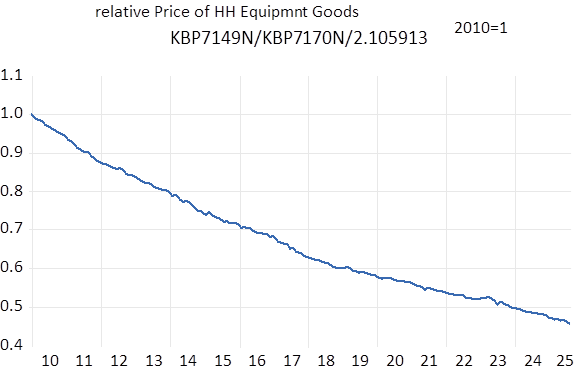
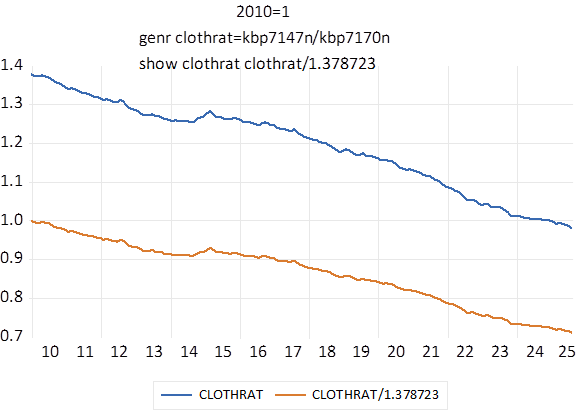
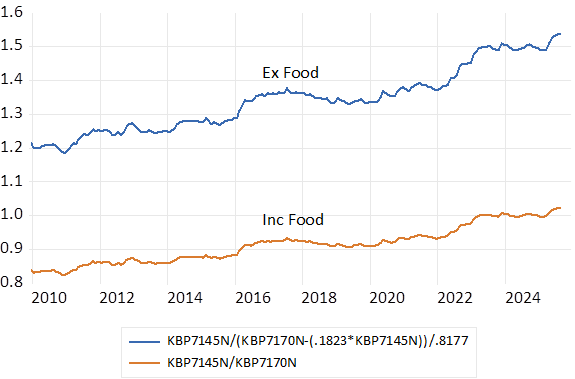
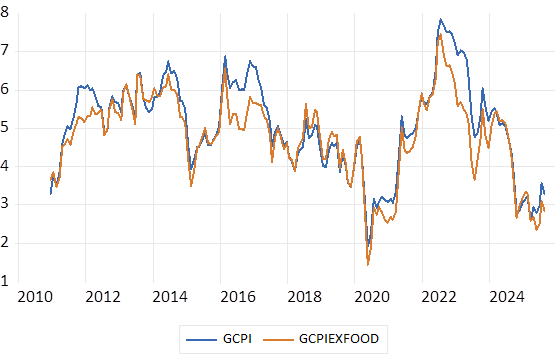
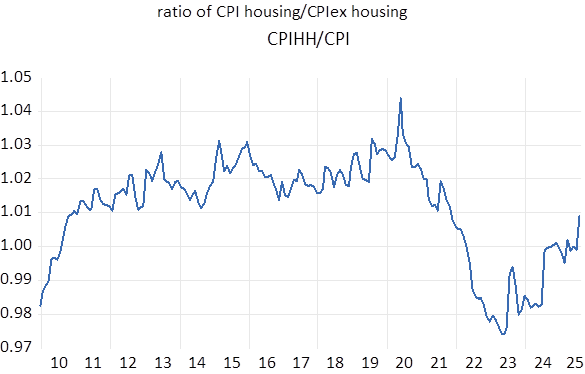
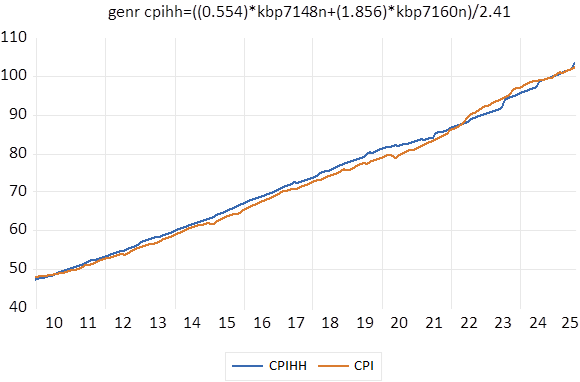
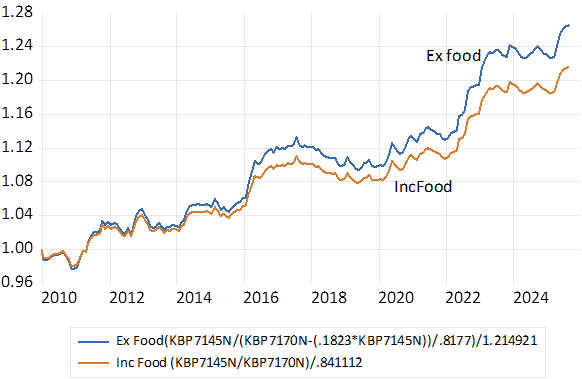
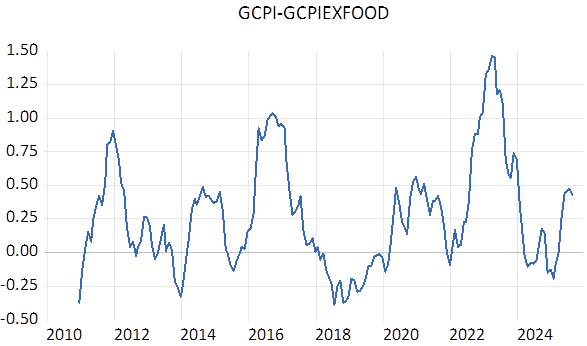
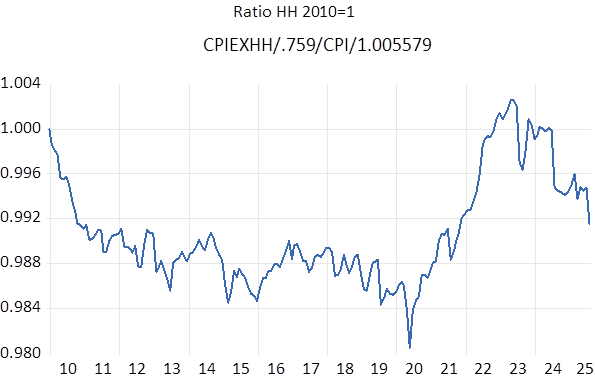
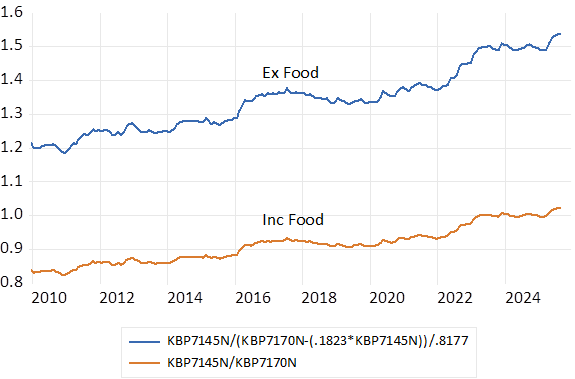
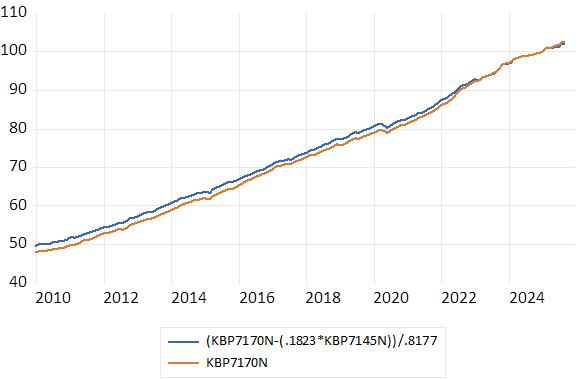
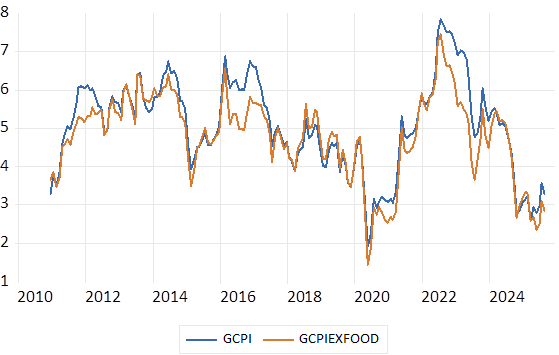
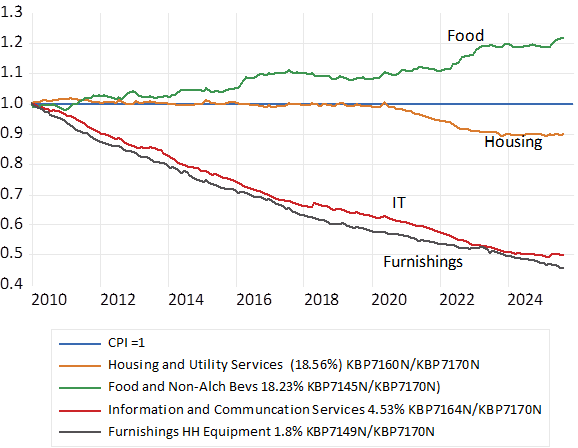
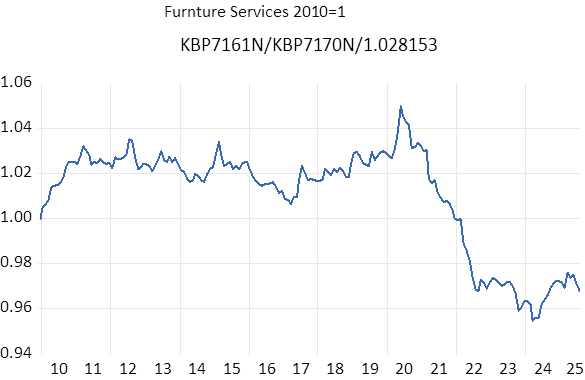
The share of furnishings and household equipment in the CPI- representing the share of the household budget spent on furniture etc  in SA, is now of the small order of 1.8%. And the price of furniture has risen by only half the rate of consumer prices in general, in line with cheaper communications. Food and beverage prices with an 18% share have risen by 20% more than the average while housing costs – including the rent attributed to owner occupiers with a weight slightly heavier than food, is now about 10% lower in real terms than it was in 2010. All evidence of a highly dynamic economy with real price competition.

The SA competition authorities, if they approve the Pepkor-Shoprite deal, are very likely to order the new venture  not to reduce its workforce. That is not allowed to reduce its costs to become more efficient, more price competitive and hence made less able to compete for a larger share of the household spend. Providing another case of competition policy in SA inhibiting rather than encouraging competition and an efficient economy.

Relative Prices (2010=1) and Share of CPI

Source; SA Reserve Bank and Investec Wealth & Investment.

Inventors, Innovators, and Entrepreneurs

Distinct Aptitudes for Creative Contribution in a Complex World

by Etienne van der Walt

with an introduction by Brian Kantor

Introduction- the Nature of the Business Enterprise

by Brian Kantor

The behaviour of the modern firm can be understood in the simplest of terms: every enterprise competes for a share of the household budget. Out of this struggle for consumer attention and limited spending power flows the entire logic of business decision-making—investment, research, marketing, training, and the perpetual search for efficiency.

Firms that succeed are those able to learn quickly which practices work, and to abandon those that do not. They thrive on pattern recognition, on imitation of what proves profitable, and on the courage to innovate when established methods falter. Competition, whether between shops on a high street or among global technology giants, ensures that the search for better methods never ceases.

Some of these improvements are incremental: a more efficient supply chain, better training for staff, sharper marketing. Others are revolutionary, altering not just the fortunes of one firm but the very way households live and spend. The Industrial Revolution provides a clear illustration. The contributions of James Watt to the steam engine, George Stephenson and Richard Trevithick to locomotive power, or Henry Cort to iron production were not simply scientific advances. They were practical, applied innovations that reshaped an economy and a society. Thomas Edison in the United States epitomised the same principle: a relentless adapter who turned available science into usable systems, transforming electricity from a curiosity into a foundation of modern life.

We live through an equally striking transformation today. The so-called “Magnificent Seven” firms—Microsoft, Amazon, Apple, Nvidia, Google, Meta, and Tesla/SpaceX—

began as fragile startups with little more than ideas about how to compete in the digital age. They now account for over 30% of the S&P 500 Index and collectively represent trillions of dollars of market value. Their founders—Gates, Bezos, Jobs, Cook, Huang, Page and Brin, Zuckerberg, Musk—have joined the pantheon of history’s most influential entrepreneurs. Their success illustrates not only the power of entrepreneurship but also the extraordinary returns available to those who anticipate the future needs of households and businesses.

Such stories rightly inspire admiration, but they should not obscure the reality that most startups fail. Entrepreneurship carries risk, often at great cost to founders and investors. The United States has been especially well served by a culture of risk-taking and angel investment, where deep pools of capital are available to back bold ideas. This willingness to accept failure as part of progress is a distinctive advantage of the American economy.

Can entrepreneurship be taught? I have always been sceptical. The entrepreneur is more often born than manufactured. Yet education can play a vital role in preparing minds to see possibilities, to ask the right questions, and to imagine lives that would otherwise remain closed. Innovation is not only the province of heroic founders; it is equally the work of competent managers, motivated employees, and adaptive organisations that encourage creativity at every level.

In the end, the system benefits from both types of contribution: the revolutionary breakthrough and the steady flow of incremental improvements. Together, they sustain the great process of adaptation that drives economic growth.

It is in this larger story that Dr. Etienne van der Walt’s reflections should be read. He shifts our gaze from the balance sheet to the biology, from the competitive firm to the adaptive human mind. His essay explores inventors, innovators, and entrepreneurs not only as economic actors but as expressions of human adaptive intelligence. By situating entrepreneurship within the broader logic of living systems, he offers a perspective that complements economic history with biological depth.

The economy, after all, is a living system of its own. Its vitality rests on the creativity of individuals, the resilience of organisations, and the constant adaptation to an ever-changing world

Distinct Aptitudes for Creative Contribution in a Complex World

Etienne van der Walt

The Misunderstood Triad of Contribution

We live in an era where innovation has become a sacred word.
From boardrooms to classrooms, the message is clear: be agile, be disruptive, think outside the box, start something. Entrepreneurship is celebrated as one of the highest forms of economic and creative expression. Governments build accelerators, schools run pitch competitions, and social media rewards founders who hustle harder and fail faster.

But beneath this glossy narrative lies a quieter truth, one that many people feel but few articulate:

Not everyone is wired to be an entrepreneur.
Not all creativity takes the form of startups.
And not all contribution begins with disruption.

I believe that in our rush to democratize innovation, we may well have flattened three profoundly different ways of creating value. The inventor, the creative innovator, and the entrepreneur are not interchangeable roles. They may sometimes co-exist within one individual, but more often they live in distinct people, each with their own cognitive architecture, motivational signature, and innate aptitudes.

To confuse these roles is more than a semantic mistake, it’s a systemic one.

It leads to misaligned career paths, increased chronic stress and burnout, dysfunctional teams, and education systems that try to train people for roles they were never built to play. Worse, it dilutes the unique contribution of those whose gifts lie elsewhere, people who might invent quietly in solitude, or recombine ideas across disciplines without ever launching a product, or who might master execution without the need to originate anything new.

This paper is a call to restore nuance.


It’s a call to understand the biology of contribution, to recognize that while skills can be taught, gifts matter. And those gifts, when honoured and aligned with the right context, lead to exponential outcomes, for individuals, teams, and systems.

We propose a simple but powerful distinction between three archetypes of high-value contribution:

  • The Inventor – the deep specialist who generates novel mechanisms or ideas, often from within a specific domain
  • The Creative Innovator – the sense maker who recombines across disciplines to solve meaningful problems
  • The Entrepreneur – the executor who brings solutions to market with scale, structure, and speed

These three roles overlap in places, but their roots, trajectories, and energetic expressions are distinct. By examining them closely, and by exploring the innate aptitudes that underpin them, we can begin to design a more intelligent approach to talent development, team formation, and education for the future.

Because the future doesn’t need more generalized pressure to “innovate.”
It needs more people doing what they were born to do, at the intersection of their natural gifts and cultivated strengths.

The Problem with the “Everyone is an Entrepreneur” Myth

There is a seductive narrative alive in our culture, one that says anyone can be an entrepreneur, and everyone should try. It’s told in classrooms, in keynote speeches, in startup incubators, and increasingly in the minds of young people trying to prove their worth through disruption.

This message is often well-intentioned. It aims to democratize opportunity, to foster resilience and creativity, to equip people with agency in a volatile world. In truth, there is real value in teaching the skills of entrepreneurship, opportunity recognition, problem framing, prototyping, storytelling, execution. These are powerful tools for any life path.

But somewhere along the way, the tool became the identity.
Entrepreneurship was no longer something you could do, it became something you were expected to be.

The result is a kind of ideological pressure: a cultural insistence that everyone must think like a founder, act like a builder, and pursue scalable ventures as the ultimate form of success. Even institutions that once honoured diverse kinds of contribution, universities, research institutes, public health bodies, now frame impact almost exclusively through the lens of entrepreneurial scale.

But there’s a hidden cost to this flattening.

It misrepresents the diversity of human creative potential. It pressures people with non-executive temperaments, those who thrive in deep focus, solitude, or quiet integration, to perform in roles that are unnatural to them. It fuels burnout, imposter syndrome, and wasted effort when individuals are coached to run a race that doesn’t match their stride. And it distracts teams from the deeper intelligence of complementarity, the reality that great ventures are built not by uniform founders, but by diverse minds playing different parts.

This problem is especially acute in education.
When entrepreneurship is treated as a universal prescription, we begin misdiagnosing the developmental needs of young people. Not every child is a born hustler or market-scaler. Some are quiet recombiners. Some are deep thinkers. Some are systems stewards. When these archetypes are ignored, students begin to believe that unless they can “found something,” they have failed to contribute.

But biology doesn’t work that way.
Nature favours specialization within systems. In every living organism, and in every intelligent team, different cells, roles, and intelligences co-exist. The neuron doesn’t envy the immune cell. The liver doesn’t try to become the brain. Each plays its part in service of a larger intelligence.

The same is true of contribution in human systems.

We need inventors who go deep, innovators who connect across, and entrepreneurs who bring the vision to life.
To pretend these are all the same person is to commit a category error.
To build systems that force everyone into the same mould is to commit a moral one.

The Three Archetypes – A Distinction That Matters

It is tempting to view invention, innovation, and entrepreneurship as steps in a linear process: invent something new, innovate a use for it, then build a business to scale it. But this linearity oversimplifies the deeply distinct nature of the minds behind each role. These are not stages of a project. They are archetypes of contribution, each with its own gifts, motivations, and natural modes of cognition.

By understanding the differences, we gain clarity not only about the creative process, but about how to align people with roles where they are most likely to thrive.

1. The Inventor – The Deep Specialist of the Hidden Layer

The inventor is the one who descends into the vertical shafts of knowledge and returns with something never seen before. They are not always solving a problem, they are often solving a puzzle, one that only becomes apparent as they deepen into a specific field or phenomenon.

Their intelligence is focused, recursive, and structurally generative. It is not breadth they seek, it is depth. They may move across multiple domains, but only after mastering the logic of each. Their breakthroughs come from technical decomposition, not broad recombination. In many cases, the inventor works alone, not by preference, but by necessity. Their work often demands solitude, immersion, and an internal rhythm that resists interruption.

The inventor’s gift is vertical pattern recognition.
They see what others miss by looking longer and deeper.

Innate Aptitudes:

  • Persistent focus
  • Tolerance for ambiguity and failure
  • Internal reward sensitivity (curiosity > external validation)
  • Depth-memory and recursive abstraction
  • High need for solitude and self-direction

Cognitive Structure:

The inventor builds within domains, assembling mental models like intricate machines. Their neural bias favours within-network depth, less reliant on horizontal integration across systems. This makes them brilliant in closed loops of understanding but sometimes disconnected from broader application.

Typical Shadows:

  • May struggle to communicate value
  • Can become stuck in perfection loops
  • Risk of under-valuing timing, relevance, or usability
  • Disconnection from market or team logic

Representative Examples:

  • Nikola Tesla
  • Tim Berners-Lee
  • Barbara McClintock
  • Marie Curie

The inventor’s contribution is often years, or decades, ahead of its time. But without the right collaborators or context, it may remain a brilliant whisper rather than a resounding change.

2. The Creative Innovator – The Sense maker at the Edges

If the inventor descends, the creative innovator moves laterally, from silo to silo, weaving meaning at the margins. Innovation happens not through depth alone, but through connection. These individuals are alert to resonance: between ideas, disciplines, metaphors, and moments in time. They thrive in borderlands, where two ideas meet, clash, or reveal something new.

Unlike the inventor, the creative innovator is not always interested in origin. They are interested in integration. Their contribution is often invisible at first, it arrives through reframing, bridging, or combining existing elements in a way that makes something feel inevitable in hindsight. This is not technical novelty, it is contextual creativity.

The creative innovator’s gift is pattern recombination.
They see what others miss by sensing what matters now and weaving it into something new.

Innate Aptitudes:

  • High salience sensitivity
  • Conceptual flexibility
  • Narrative cognition and metaphorical thinking
  • Empathic resonance across disciplines
  • Tolerance for ambiguity and complexity

Cognitive Structure:

Their brain acts like a network bridge, flexibly switching between the Default Mode Network (imagination, abstraction), the Salience Network (what matters now), and the Executive Control Network (goal setting, framing). Innovation emerges not from sustained focus, but from sensitive navigation of relevance and meaning.

Typical Shadows:

  • Can over-index on conceptual elegance at the expense of delivery
  • May lack executional patience
  • Risk of being misunderstood in highly linear or hierarchical environments
  • Vulnerable to burnout from overstimulation or constant integration

Representative Examples:

  • Leonardo da Vinci
  • Maya Angelou
  • Steve Jobs
  • Brené Brown

Creative innovators are often mistaken for generalists. But in truth, they are specialists in interconnection. Their genius lies in reconfiguring the world so that others can see its meaning more clearly.

3. The Entrepreneur – The Orchestrator of Action and Scale

The entrepreneur is not defined by what they invent or reframe. They are defined by what they build. This is the person who takes a seed, an idea, a prototype, a flash of insight, and turns it into a vehicle that moves through the world. Entrepreneurs are not only motivated by value, but they are also wired to deliver it. They see potential in things, but they also see paths, obstacles, timing, and opportunity.

Their gift is not simply execution. It is orchestration under uncertainty. While others may hesitate, the entrepreneur moves. While others wait for clarity, the entrepreneur tests, adapts, and scales. Their energy is contagious, their momentum, catalytic. And they are at their best when leading people toward a shared outcome, not just through vision, but through structure.

The entrepreneur’s gift is applied systems design.
They see what others miss by moving faster, testing earlier, and executing more persistently than most could tolerate.

Innate Aptitudes:

  • High goal orientation
  • Dopaminergic drive and tolerance for risk
  • Fast decision-making under uncertainty
  • Energy throughput and social pattern recognition
  • Adaptive leadership and strategic focus

Cognitive Structure:

The entrepreneur’s cognition privileges applied relevance over abstract elegance. Their mind naturally integrates salience, strategy, and reward feedback. They’re less concerned with whether something is novel or beautiful, more concerned with whether it works and can scale. Their networks fire toward action.

Typical Shadows:

  • Can devalue depth or nuance
  • May neglect internal sustainability (their own or their team’s)
  • Risk of confusing speed with substance
  • Vulnerable to founder over-identification or burnout

Representative Examples:

  • Elon Musk
  • Oprah Winfrey
  • Richard Branson
  • Melanie Perkins

Entrepreneurs bring ideas to life, and then ensure they stay alive. Without them, innovation dies in the lab. Without their complementary partners, it may scale too quickly and burn out. Their genius is motion, energy, and alignment with need.

Together, these three archetypes form a living system of contribution.
None is superior. Each is vital. And in the world we’re building, marked by increasing complexity, interdependence, and rapid change, we need to move beyond the myth of the solo genius. We need to understand how these distinct roles can be seen, honoured, and supported within individuals and teams alike.

The Role of Aptitude – What Can Be Trained, What Must Be Honoured

If the previous section clarified the difference between inventors, creative innovators, and entrepreneurs, this section addresses the natural next question: Can anyone become any of these things with the right training?

The short answer is: yes, but not equally, not easily, and not always wisely.

We live in a world where the line between potential and pressure has blurred. We are told that with enough grit, exposure, and instruction, anyone can become anything. While this may be motivationally useful, it is biologically incomplete.

The truth is that skills can be taught, but gifts must be honoured.

In the realm of invention, innovation, and entrepreneurship, this distinction is critical. Each of these archetypes draws on a different constellation of innate aptitudes, neurobiological, psychological, and motivational traits that shape how a person naturally processes information, tolerates ambiguity, manages energy, and responds to feedback.

These aptitudes aren’t fixed like destiny, but neither are they neutral.
They set the stage for natural ease of development, for how quickly and deeply a person can enter the mode of contribution that each archetype demands.

Aptitude ≠ Skill

Let’s be clear: aptitude is not skill.
Aptitude is potential energy, the inherent capacity to grow in a certain direction with less friction and greater flow. Skill is applied competence, what someone can do reliably and effectively through learning and experience.

A person can have aptitude without skill (early talent, undeveloped), and they can develop skill without aptitude (through grit, structure, or necessity). But the most sustainable, high-performance contribution happens when the two align, when talent is cultivated in the direction of gift.

This is the difference between performing and thriving.

Why Aptitude Matters in High-Stakes Roles

When the demands of a role are high, when the complexity is nonlinear, the pace is intense, and the outcomes are uncertain, aptitude becomes the limiting factor. You can teach the steps of a pitch deck or a design sprint. But you can’t teach someone to feel instinctively energized by ambiguity, or to tolerate prolonged solitude in a mental tunnel, or to see emerging patterns across disciplines under pressure.

These are neurobiological endowments. They live in the architecture of personality, motivation, attention, and salience processing. They can be nurtured, yes, but not manufactured wholesale.

Ignoring aptitude leads to:

  • Misaligned career trajectories
  • Burnout from role–person mismatch
  • Team breakdowns due to hidden assumption gaps
  • Wasted development efforts chasing the wrong kind of excellence

From Talent Cultivation to Contribution Matching

A more intelligent system doesn’t try to turn every student into an entrepreneur, or every team member into an innovator. It asks:

Where does this person’s innate potential lie?
How can we cultivate that into mastery, without forcing them into someone else’s template?

This is what we call contribution matching:
The art of aligning a person’s energetic design to a domain of value creation that fits.

This means:

  • Placing a high-aptitude inventor in an R&D setting with long feedback loops
  • Giving a creative innovator space to connect silos, reframe problems, and advise across functions
  • Allowing an entrepreneur to build systems, respond to need, and drive toward value without being shackled to perfectionism

It’s not about limiting people. It’s about liberating them, into the roles where their gifts create the greatest yield, with the least unnecessary suffering.

Why the Aptitude Matters Now More Than Ever

In complex adaptive systems, from organizations to societies, we do not thrive by standardizing minds. We thrive by differentiating contribution and weaving it into collective value.

The future will require not just more entrepreneurs, but also:

  • Inventors who go deeper
  • Innovators who integrate more wisely
  • Collaborators who know how to play their part with pride and precision

Through emphasizing aptitude, we attempt to honour this logic, to make contribution visible, measurable, and integrated. It helps shift us away from the question, “How can I be like them?”
And toward the more vital question:

“Where does my energy belong, and how do I build the skills to bring it fully to life?”

Implications for Education, Leadership, and Policy

If we accept that invention, innovation, and entrepreneurship require different aptitudes, and that these aptitudes can be observed, cultivated, and mapped, then the implications stretch far beyond individual coaching or team design.

They touch the foundations of how we educate, how we build organizations, and how we structure incentives and support systems at scale.

1. Education: Teach Broadly, Develop Precisely

Education systems are increasingly embracing “entrepreneurial thinking” as a blanket goal, from grade school through to university. While this exposes students to valuable skills, it risks conflating exposure with identity. Not every student is a builder, and that’s not a flaw.

What we need instead is:

  • Early exposure to all three archetypes, so students can explore which energies resonate
  • Tools to measure aptitude helping students self-identify their natural leanings
  • Custom development tracks that support:
    • Inventive depth for domain specialists and technical thinkers
    • Integrative thinking and sensemaking for cross-disciplinary students
    • Applied venture-building for action-oriented leaders

By doing so, we move from one-size-fits-all to one-purpose-fits-you.

2. Leadership: Design Teams Around Complementary Aptitude

Leadership today requires more than charisma or decisiveness. It requires systems literacy, energetic awareness, and talent orchestration. The best leaders know how to:

  • Identify what kind of contribution a person is wired to give
  • Design roles that fit natural architecture, not arbitrary job descriptions
  • Build teams where each person’s genius makes the others better

This means moving away from performance models that measure output without understanding orientation.

Leaders who measure aptitude can:

  • Spot invisible friction between roles and people
  • Reduce misalignment that causes burnout or stagnation
  • Create cultures where everyone feels useful, and seen

In this model, leadership becomes not a position of power, but a function of biological intelligence in action.

3. Policy and Public Investment: Fund the System, Not the Stereotype

Public funding for innovation often leans toward visible entrepreneurs, pitch decks, MVPs, and venture-readiness. But true innovation ecosystems thrive when all three archetypes are supported.

This calls for:

  • Long-cycle investment in deep invention and research, even without immediate marketability
  • Cross-sector hubs that allow creative innovators to reframe and integrate across silos
  • Seed-stage support that includes mental health, coaching, and capacity-building for entrepreneurs, not just capital

Imagine if startup ecosystems were designed not as winner-take-all contests, but as living systems of complementary minds.
Imagine policy frameworks that rewarded not only scale, but precision of contribution.

In such a world, we would stop trying to turn inventors into hustlers or innovators into founders and instead build bridges of mutual empowerment.

A Word for Startups – Building the Fleet Before You Burn Out

The startup world is rich in energy but often poor in design. Founders are expected to be visionaries, inventors, operators, marketers, and therapists, all in one. And while resource constraints may make this multitasking unavoidable at first, it is a dangerous myth to believe it’s sustainable.

Too many early-stage ventures fail not because the idea is weak, but because the founder is stretched across roles they were never designed to play. They try to drive innovation, generate product–market fit, and build scalable systems, alone or with ill-fitting support. It feels like a focus problem. In truth, it’s a structure problem.

Founders often say, “I just need someone to help me focus.” But this request can be misleading. It’s not about focus, it’s about alignment of function to innate contribution. What they’re really saying is: “I’m trying to carry the entrepreneurial function, but I’m wired more like an innovator or inventor.”

This is where measuring aptitude may offer its most practical guidance.

As early as viably possible, founders should build their core team around differentiated aptitudes, not just skill sets, but energetic architectures.

In other words:

  • Don’t hire clones of yourself.
  • Don’t outsource critical roles to people who are merely available.
  • Instead, structure your venture like a fleet.

The Startup Fleet Model

Every high-functioning early-stage venture is not one ship, it’s a fleet of smaller ships, each captained by a different archetype:

  • The Inventor ship dives deep, exploring the mechanism, refining the model, building the underlying system.
  • The Creative Innovator ship moves laterally, reframing, integrating, and making meaning across silos and markets.
  • The Entrepreneurial ship sails outward, navigating risk, validating fit, and orchestrating execution at speed.

If all three ships are captained by one person, the fleet will eventually stall, or worse, break apart.

Instead, we call on startups to:

  • Use the first viable capital infusion not just to hire more hands, but to build the full cognitive and energetic spectrum of the venture
  • Identify which of the three aptitudes the founder naturally leads from
  • Then deliberately bring in partners or leads who can carry the other two roles as captains, not as subordinates

This is not a luxury. It is a design principle.

Too many startups fail because they believe execution is the only success function. Or because the founder, brilliant in one domain, keeps being told to “just focus” when their mind is built for conceptual navigation, not constraint repetition.

This article aims to provide a diagnostic language to build smart from the start, to anticipate where burnout will emerge, where misalignment will erode performance, and where synergy will allow the fleet to move as one.

This doesn’t mean that every startup will have a full archetypal team on Day 1. But it does mean that:

  • Founders can lead with clarity, knowing their strengths and where they will need reinforcement
  • Investors and advisors can support constructively, by scaffolding around aptitude gaps instead of pushing founders into unnatural roles
  • Teams can be designed to scale with integrity, not just urgency

In a world where everyone is told to be everything, the smartest founders are now learning to ask:

What am I naturally gifted at, and who do I need beside me to complete the system?

Because startups are not solo journeys. They are fleets of differentiated minds, navigating uncertainty toward shared value.
The sooner we acknowledge that, the sooner we build ventures that last, not just in scale, but in soul.

Conclusion – Contribution with Clarity, Ventures with Integrity

Invention, innovation, and entrepreneurship are not interchangeable terms. They are distinct expressions of human intelligence, shaped by different aptitudes, driven by different forms of curiosity, and brought to life through different patterns of work and energy.

In this article, we’ve offered a new framing:
The Triadic Aptitude Matrix, a model to identify and align the natural architecture of contribution across three core archetypes:

  • The Inventor: deep, recursive, focused on novel mechanisms
  • The Creative Innovator: integrative, reframing, tuned to timing and context
  • The Entrepreneur: action-oriented, scalable, execution-driven

What we’ve argued is simple but often forgotten:

People thrive not when they are told what to become, but when they are empowered to become what they already are, more fully.

This shift, from uniform expectation to differentiated design, has far-reaching implications. For education, it invites us to teach for clarity of contribution, not just for general skill acquisition. For leadership, it opens the door to complementarity over conformity. For policy and investment, it encourages us to build ecosystems that support the full value chain of creativity, not just its most visible expressions.

And for startups, where energy is precious and failure is unforgiving, it offers a simple but profound correction:

Don’t try to be the entire system.
Build the system.
Find the others.
Create the fleet.

Because in a world of increasing complexity, we don’t just need more entrepreneurs.
We need inventors with space, innovators with trust, and builders with direction.
We need teams designed from the inside out, ventures that scale without distortion, and futures built on the deep integrity of matching what we are with what we do.

When we get this right, we don’t just accelerate success.
We liberate it, into its most beautiful, useful, and sustainable form.
The Mag7 – there is little ugly about them

A great business is one that has created enormous wealth for its founding owners and for those who bought and held. Graduating from a start up to a company valued in billions, even trillions of dollars, will bake in two essential ingredients. Firstly, excellent returns on the capital invested initially and subsequently. Returns (true profits) that exceed the opportunity cost of the owners capital invested.

But for true financial success a cost of capital beating return on capital will not be enough to add value for its owners. It must be accompanied by growth in the sales and operating profits of any start-up. The excellent cash returns will be retained and re-invested in the enterprise to fund its growth. It is a combination of consistently profitable operations plus the willingness the opportunity to grow the business organically, or by acquisitions, that opens the path to greatness.

Attempting growth however is always risky and not always worth attempting. The hard-earned savings of the business – cash retained not paid out – can easily be wasted. Not all profitable businesses will have sensible opportunities to grow. Think of a great highly profitable restaurant with an outstanding owner manager chef. There is only one such chef and the opportunity to add further branches and hire expensive additional chefs may not make good sense.

The owner might well be better off not scaling up the business. Continuing to pay out the considerable, perhaps highly predictable profits to herself and partners and be invested in a well-diversified portfolio. And acquire wealth that is capable of withstanding unpredictable shocks to the dining out or indeed any other established business.

But the business without ambition will be valued by potential investors accordingly. Valued essentially as you would an annuity that provided largely guaranteed income – discounted heavily by the risk adjusted cost of capital reflected in the market for fixed interest income.

It takes growth, or more precisely the expectation of profitable growth, that will encourage investors to pay up for a share – that is to value a business as worth much more than its current profits. It should be appreciated that for any closely watched business it is not the expected growth that provides exceptional returns for shareholders. The expected but uncertain growth prospects will be recognised and valued accordingly and be well reflected in the share price. It is the profitable or less profitable growth that surprises investors, in both directions, that leads shareholder returns.

South African economy facing businesses- retailers and banks for example – often deliver highly respectable cost of capital beating returns on the capital invested. But their valuations are heavily deflated by the absence of organic growth opportunities. The economy holds them back and is widely expected to continue to do so.

For an extraordinary demonstration of the value to shareholders of a combination of high returns on capital combined with unexpectedly strong growth in revenues, operating profits and in market value we can look to the performance of the Magnificent Seven (MAG7) companies listed in New York. Nvidia (NVDA) Apple (AAPL) Amazon (AMZN) ( Meta) Alphabet (Google) Tesla (TSLA) and Microsoft (MSFT) They demonstrate the value to their owners of an economic transformation under way and of their making. The future of which is unknown as is the future value of these companies in the vanguard of change. But so far so very good.

The market value of the Mag7 grew by 3.5 times or by about 12 trillion dollars between January 2020 and June 2025. The market value of chipmaker NVDA is up 24 times, the next best performer TSLA is up nearly ten times with the market value of the others up between two and four times their market values of five years ago.

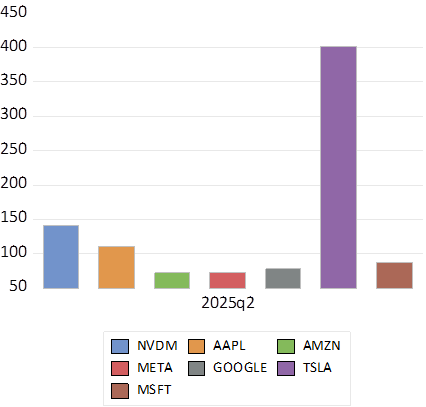
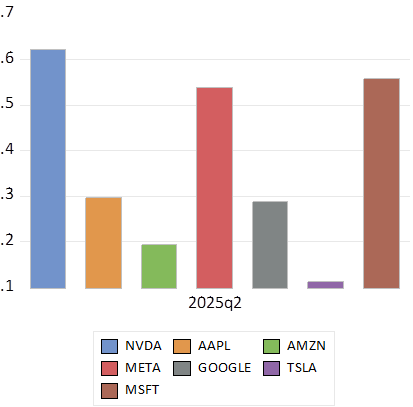
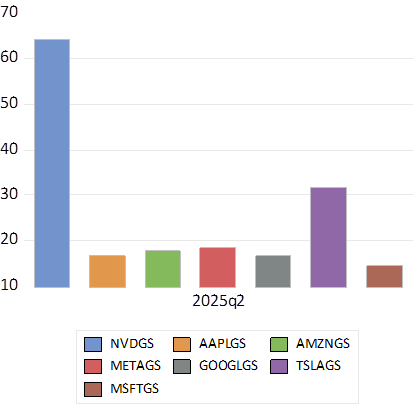
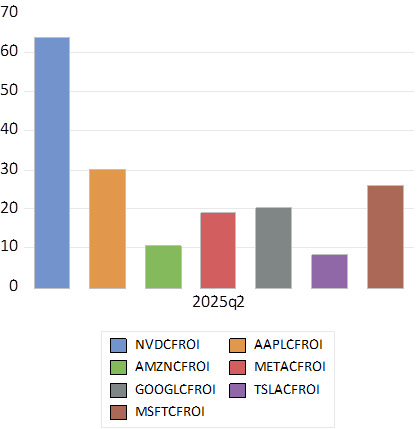
They are all generously valued, the ratio of market value to operating cash flows varying between the 400 multiple attached to TSLA and the 50 plus multiples attached to the others. Their sales and  operating cash profits have been growing strongly and the operating profit margins (Sales/Operating Profits) are impressively high ranging from over 60% for NVDA and over 50% for MSFT and Meta. The under performers on this metric are AMZN and TSLA. Return on Capital invested (CFROI) is well above cost of capital except for TSLA and AMZN. It is over 60% p.a. for NVDA – clearly the outstanding performer in the group by all accounts. Its growth in capex is very strong but very well covered by operating cash flows and revenues.

Market Rating – Market Value to Cash Operating Profit Ratios (June 2025)

Source; Bloomberg and Investec Wealth & Investment

Operating Profits to Sales Ratios (June 2025)

Source; Bloomberg and Investec Wealth & Investment

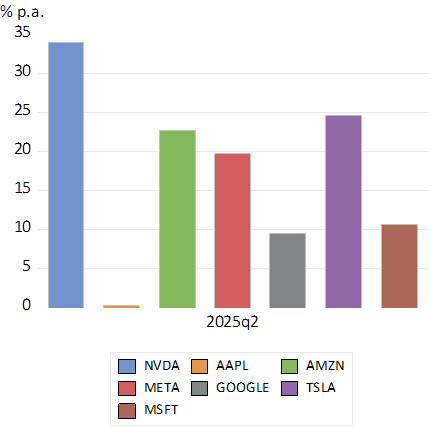
Annual Average Growth In Capital Expenditures (2020-2025)

Source; Holt and Investec Wealth & Investment

Growth In Revenues; 5 year Compound Average 2020-2025

Source; Holt and Investec Wealth & Investment

Cash Flow Return on Investment (CFROI) 2025

Source; Holt and Investec Wealth & Investment

A further very important feature the Mag7 is their huge volume of R&D. They are estimated to have spent $264 billion on R&D in 2024, even more than the $253b of capex undertaken that year. The Mag7 R&D spend is larger than that of the US health care sector. Mag7 capex is also well ahead of the capex of the combined Energy, Industrial and materials sector- some 220b in 2024. The R&D spend is not usually capitalised and is written off as an operating expense. This flow of spending is clearly a very large bet on the future structure of the economy. It represents competition for a share of the future economy in a most intense way. The financial success of the Mag7 has made such bets on the future possible. But they are very large bets indeed.

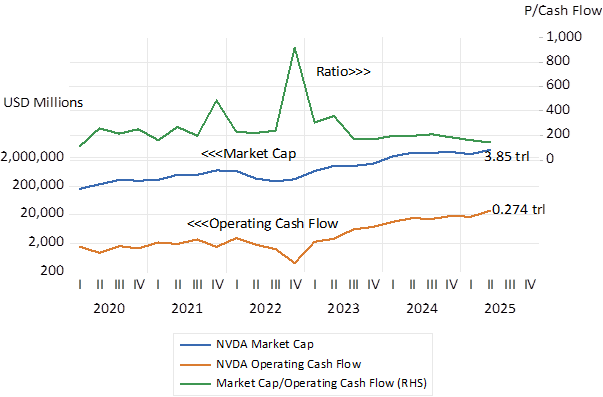
The extraordinary performance of NVDA is summarized below. The rise in its share price and market value has been matched by the growth in operating cash flow. It was expensive five years ago – and it is as expensive now- but much more valuable. Its growth in capex is very strong but very well covered by operating cash flows. A less risky exposure than of some of the other Mag7’s well reflected in its outperformance on the share market.

NVDA; Summary Performance Measures (2020-2025)

Source; Bloomberg and Investec Wealth and Investment

The difficulty for the investor in NVDA and the other Mag7’s is how do we value them with any confidence in our calculations of present value.  Their current values depend so heavily on future performance that is impossible to predict with any degree of certainty. Though they are not lacking in past performance. Can performance be maintained or better exceeded to the further satisfaction of investors? Can it meet their expectations of revenue growth and justify the risky exposure to capex and R&D?  We will have to wait and see.

Market values secure solvency

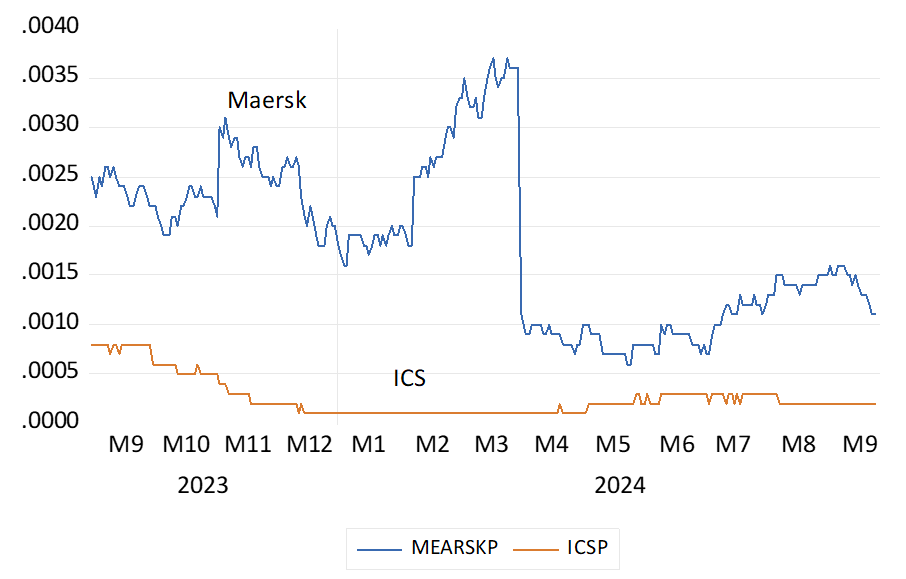
I read with some astonishment,  (BD Dineo Faku 22nd September) about the court action taken by shipping company Maersk to overturn the award by Transnet of the Durban Container Port Tender to the Philippine Company International Container Services (ICS) On the grounds that the ICS tender should have been disqualified because it, only it, used its share market value rather than its book value to calculate and report its “solvency ratio”

It would seem obvious that a borrower is solvent when the value of its assets, should they have to be realised, is expected to exceed the value of debts it has incurred. And the closer the ratio of market value to debt the greater the danger that the company would be forced to wind up. If the company is listed its market value is clear and explicit and continuously available. The book value of a private company might be the best initial and readily available estimate of what the assets might realise. If the accountants for the firm have following recommended good practice and have been consistently marking the books to market.

As I write the market value of shipping giant Maersk is 25.9 billion dollars with total debts of 16.7 billion US dollars ( 1.6 times) and that of ICS with a market value of 15 billion dollars, with total debts of 4.16 billion dollars. (3.6 times) The earnings before taxes to interest paid ratio is similar for the two companies 4.5 times for Maersk and 4 times for ICS.

There is a rigorous test of Corporate Default Risk applied to any listed company anywhere, more than 65000 of them, including Maersk and ICS. A test no further away than your nearest Bloomberg Terminal. A click or two calling up the company and the DRSK model will give you an immediate probability of default. And one that will be closely allied with the conventional ratings provided by the debt rating agencies. The Bloomberg model easily downloaded is adapted from the original financial economics of Nobel laureate, Robert C Merton, and is very well known in financial economics. The theory as adapted by the Bloomberg team in 2021 is elegant and is very well tested by the evidence presented of its predictive power. Science, that is theory with predictive power for a large sample is at work here.

The Bloomberg model uses the market value of the assets of a company as the basis of its assets to debt ratios. But with an important proviso. The market value of a company in the model  is adjusted for the volatility of its share price . The market value is estimated as a “down and out” call on the assets with a maturity date. Hence providing a highly realistic estimate of what you might realise the assets for. The more volatility, the less predictable the share prices and the less the company may be expected to fetch

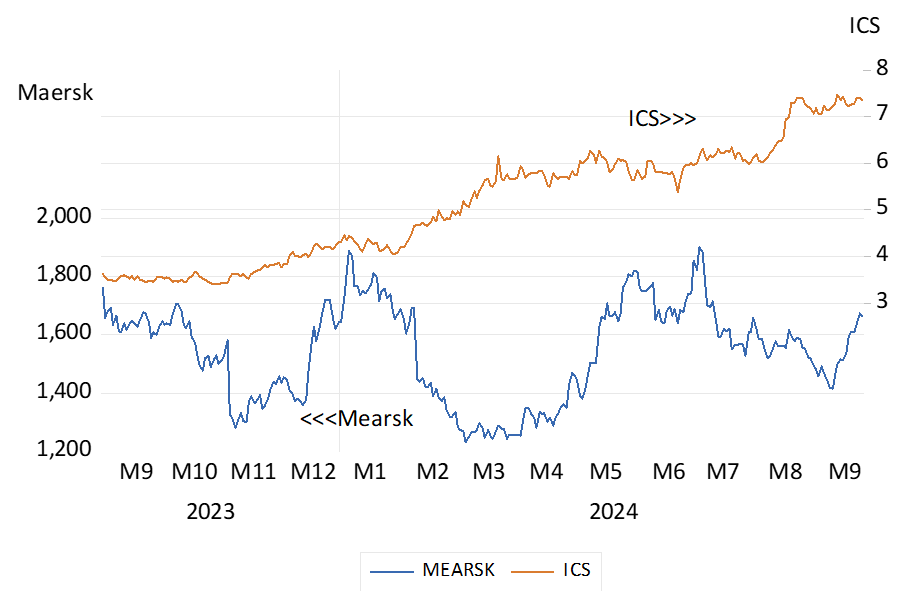
The Bloomberg model gives very similar measures for the very low probability of either Maersk or ICI defaulting over the next twelve months.  (see below) Both companies, as predicted by Bloomberg, would enjoy a comforting Investment Grade rating. The market value of ICS has risen strongly over the past twelve months while that of Maersk has changed little. The volatility of the two share prices- until recently higher for Maersk, is now very similar. The improved value of ICS may well have much to do with winning the tender. It clearly is a valuable contract worth fighting over.

The Maersk and ICI share prices. Daily data (2023-2024) US dollar value.

Source. Bloomberg and Investec Wealth & Investment

Maersk and International Container Services. Probability of Default; over the next 12 months. %

Source. Bloomberg and Investec Wealth & Investment

A South African Case Study Pick N Pay (PIK)

Underperforming companies raising more debt do not necessarily go broke when the market value of their assets approaches the barrier of debt. They may be rescued by shareholders willing to subscribe additional equity capital. When shareholders prove unwilling to provide support a company will go under. Hence the market value of a highly indebted company, close to default, will always reflect the chances of a rescue.

South African retailer Pick ‘n Pay (Pik) has provided a very clear example of the benefits of shareholders coming to the rescue with additional share capital necessary to avert the dangers of a default. The operating performance of the company had deteriorated significantly in recent years. A drain of cash had been funded with much additional debt. Net debt had increased from R3.8 billion in August 2023 to R7.2 billion by January 2024. As the market value of Pik declined from 28.02 billion in January 2023 to R11.48 billion by year end 2023 with elevated daily volatility.

A recapitulation of the business had become essential for the survival of the business and was announced in January 2024. The plan was to raise R4 billion from existing shareholders in the form of a rights issue. To be followed by the listing of and an offering of shares in its profitable subsidiary company Boxer. Bankers also agreed to modify their debt covenants in February 2024.

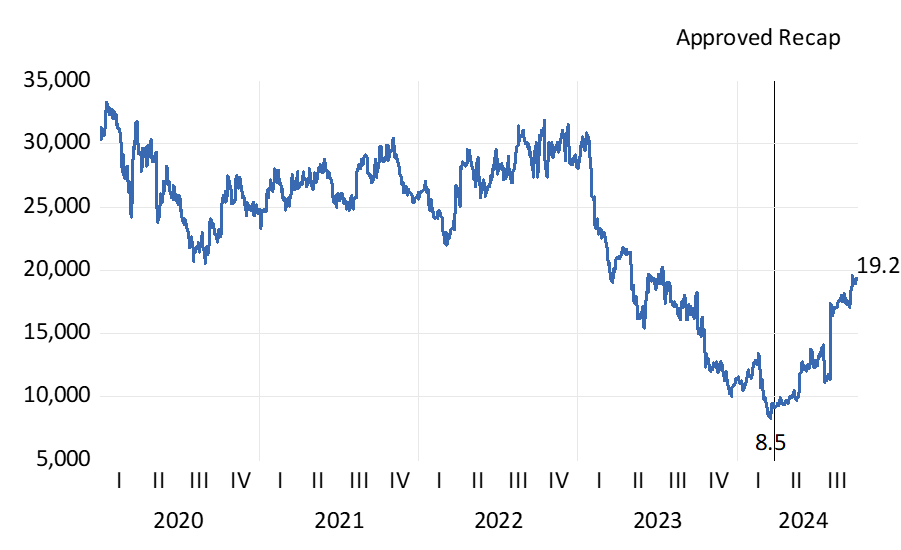
On the 27th February 2024 the company announced the approval of the capital raising and debt reduction scheme. At which point in time the market value of Pik bottomed out at R8.5b. The rights issue when concluded on July 30th raised the number of shares in issue by as much as 51%.

The market value of Pik is now approximately R19b. Thus, the capital raise of R4 billion must be regarded as having added much value for the shareholders subscribing the extra capital. The value of Pik is now up by approximately R10.7b (19.2-8.5) March 2024 after an investment of R4 billion That is for the initial subscription of R4 billion the shareholders have gained R6.7b. (10.7-4)

Source; Iress and Investec Wealth & Investment

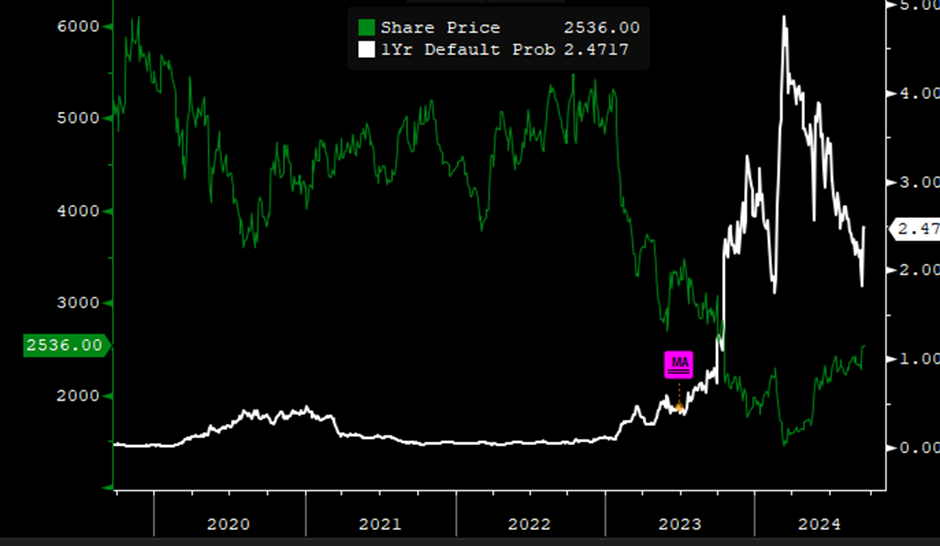
The recent history of Pik – its share price and probability of default as calculated by the Bloomberg model – is shown below. As may be seen the probability of default rose sharply as the share price fell away with heightened volatility. The probability of a default in 12 months has now receded sharply placing Pik debt if it were to be rated in the High Yield category.  (see below)

Pick ‘n Pay Probability of Default and Share Price. Daily data

Source; Bloomberg

Doing penance with purpose

JSE listed companies have been beating down on themselves very heavily. Kabelu Khumalo reports some R250 billion of recent write offs and write downs of assets. (BD August 12th) It will mean that the book values recorded on the balance sheets perhaps will accord more closely with the market value of the company. Yet the cash flows of the business would be unaffected by the action and there are unlikely to be any taxes saved on the losses because they will not be recognised as a business expense. And the bottom line will be even less meaningful.

The prior damage done to cash flows and market value by poor investments or acquisitions will long have been recognised and deducted from the value of the company by investment analysts and the investors they advise. They will have made their own diminished sum of parts calculations of the present value of the divisions of any company. And they may still have a very different view of what the underlying assets might bring shareholders in the future.

Notice something important about these adjustments to the books designed to align book and market value. There is very unlikely to be an equivalent urgency to upvalue the assets on the balance sheets that have proved to be market value adding. The great new mine that has proven to be so valuable to shareholders is likely to remain on the books at something close to its historic costs. Not written up in the books to enhance earnings and equity capital employed and the strength of the balance sheet.  And when an excellent acquisition was made paying above the book value of the company acquired, this goodwill is very likely to be amortised against earnings, so reducing book value and the capital employed by the business. Rather than logically seen as adding to the amount of valuable capital employed by the business.

The benefits of writing off capital employed in a business, rather than writing it up, will show up in an important measure, and that is as Return on Equity Capital employed (ROE) The less capital recognised the better the return on equity all other operating details remaining the same. And the managers of the business are very likely to be rewarded directly on the basis of ROE. Shareholders will benefit when the company they entrust their savings can deliver a return on the capital they employ that exceeds the opportunity cost of capital employed. That is the returns shareholders might expect investing in an alternative company with similar operating risks.

Making poor investment decisions reduces ROE. Recognising past failures will not change past performance. It might however indicate that milk has been spilled, that costs have been sunk, that bygones are bygones and most important that more good money is less likely to be thrown away on lost causes. And if the managers are surprisingly contrite might help add market value by improving expected performance.

But what could be more helpful to an incoming CEO, also to be measured on future ROE’s than to begin a reign with less capital? True kitchen sinking, recognising the mistakes made by predecessors, could be managers wealth enhancing, if future rewards are to be based on higher ROE’s, as indeed they should be.

If the actual capital entrusted to the incoming CEO and the team of operating managers is accurately measured, it is only then that improvements in ROE can be properly recognised and encouraged. And rewarded appropriately in all the operating divisions whose managers can be held responsible for the capital they are given to manage, again accurately estimated.

South African directors of companies now burdened with justifying not only what they pay their senior managers, but with also justifying the absolute difference between the rewards at the top and bottom of the pay scales, may point to the example of Starbucks. Changing their CEO yesterday immediately added over 20 billion dollars to the market value of Starbucks. Paying the right CEO enough, not too much, nor too little, rewards based predominantly on improvements in ROE, properly calibrated and communicated, should be the primary task of any Board of Directors.  And when put into good practice with successful and well and competitively paid CEO’s, will deserve the approval of shareholders.

The Shoprite Story. How impressive is it really?

Shoprite is an outstandingly successful South African business as its interim results to December 2023 confirm.   It has grown rand revenues and volumes by taking an increased share of the retail market. The return on the capital invested in the business remains impressively high. Post Covid returns on capital invested has encouragingly picked up again.
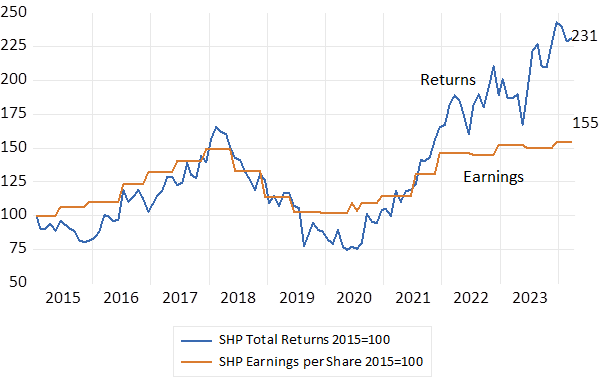
R100 invested in SHP shares in 2015, with dividends reinvested in SHP, would have grown to R231 by March 2024. Earnings per share have grown by 55% since January 2015. (see below) The same R100 invested in the JSE All Share Index would have grown to a similar R198 over the same period. (see below) Though SHP bottom earnings per share seemed to have something of a recent plateau – load shedding and the associated costs of keeping the lights on have raised costs.

SHP Total Returns and Earnings (2015=100)

Source; Bloomberg and Investec Wealth and Investment

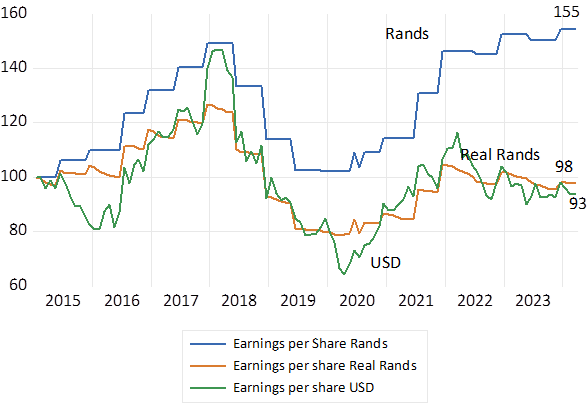
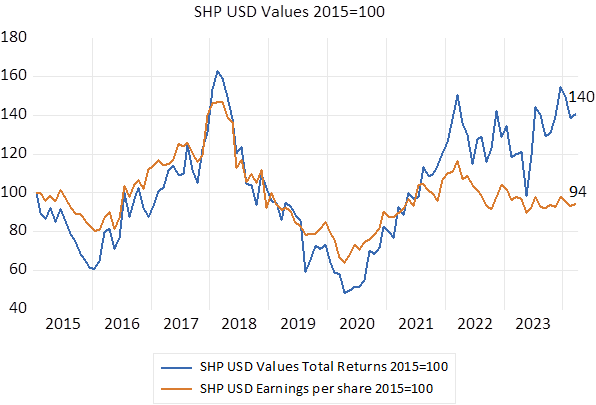
But earnings and returns for shareholders in rands of the day that consistently lose purchasing power need an adjustment for inflation. The performance of SHP in real deflated rands or in USD dollars has not been nearly as imposing. Recent earnings when deflated by the CPI or when converted into USD are still marginally below levels of January 2015 and well below real or dollar earnings that peaked in 2017. (see below) The average annual returns for a USD investor in SHP since 2015 would have been about 6% p.a. compared to 10.6% p.a. on average for the Rand investor. SHP earnings in US dollars are now 6% below their levels of 2015.

Shoprite Earnings in Rands, Real Rands and US dollars (2015=100)

Source; Bloomberg and Investec Wealth and Investment

Shoprite- performance in USD (2015=100)

Source; Bloomberg and Investec Wealth and Investment

The SHP returns realised for shareholders compare closely with those of the JSE All Share Index but have lagged well behind the rand returns realised on the S&P 500 Index. (see below) Even a great SA business has not rewarded investors very well when compared to returns realised in New York. It would have taken a great business encouraged by a growing economy to have done so.  

The depressingly slow growth rates realised and expected are implicit in very undemanding valuations of SA economy facing enterprises. The investment case for SHP and every SA economy facing business, at current valuations would have to be made on the possibility of SA GDP growth rates surprising on the upside.

It will take structural supply side reforms to surprise on the upside. Of the kind indeed offered by the Treasury in its 2024 Budget and Review. The Treasury makes the case for less government spending and a lesser tax burden to raise SA’s growth potential. It makes the right noises and calls for public – private partnerships and  “crowding in private capital”. The help for the economy would come all the sooner in the form of lower interest rates, less rand weakness expected and less inflation, were these proposals regarded as credible. With more growth expected fiscal sustainability would become much more likely. Long term interest rates would decline as the appetite for RSA debt improved. And lower discount rates attached to SA earnings would command more market value.

Lower long term interest rates (after inflation) would reduce the high real cost of capital that SA businesses have now to hurdle over. Whichever fewer businesses are understandably attempting to do. Without expected growth in the demand for their goods and services, businesses will not invest much in additional plant or people. SHF perhaps excepted. The current lack of business capex severely undermines the growth potential of the SA economy over the long term.
Yet SA suffers not only from a supply side problem. The economy also suffers from a lack of demand for goods and services. Demand leads supply as much as supply constrains incomes and demands for goods and services. The case for significantly lower short term interest rates to immediately stimulate more spending by households – seems incontestable- outside perhaps of the Reserve Bank.
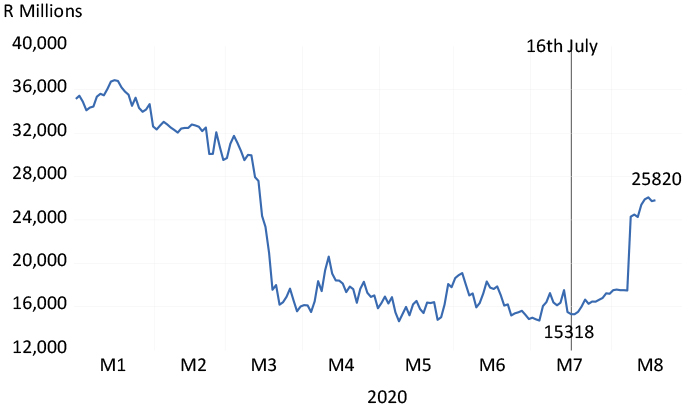
Buying back shares for good and sometimes regrettable reasons

The case for a company buying back its own shares is clear enough. If the shareholders can expect to earn more from the cash they could receive for their shares than the company can expect to earn re-investing the cash on their behalf, the excess cash is best paid away.

Growing companies have very good use for the free cash flows they generate from profitable operations. That is to invest the cash in additional projects undertaken by the company that can be expected by managers to return more than the true cost of the cash. This cost, the opportunity cost of this cash, is the return to be expected by shareholders when investing in other companies.  Such expected returns, a compound of share price gains and cash returned, are often described as the cost of capital. And firms can hope to add wealth for their shareholders when the internal rate of return realized by the company from its investment decisions exceeds the required returns of shareholders.

All firms, the great and not so good, will be valued to provide an expected market competing rate of return for their shareholders. Those companies expected to become even more profitable become more expensive and the share prices of the also rans decline to provide comparable returns. How then can a buyback programme add to the share market value of a company?  Perhaps all other considerations remaining the same- including the state of the share market, the share price should improve in proportion to the reduced number of shares in issue. But far more important could be the signaling effect of the buy backs. Giving cash back to shareholders, especially when it comes as a surprise, will indicate that the managers of the company are more likely to take their capital allocating responsibilities to shareholders seriously.

The case of Reinet (RNI)  the investment holding company closely controlled by Mr. Johann Rupert is apposite. Mr. Rupert believes the significant value of the shares bought back by Reinet have been “cheap” because they cost less than their book value or net asset value (NAV) Yet the market value of Reinet still stands at a discount to the value of its different parts and may continue to do so. Firstly, shareholders will discount the share price for the considerable fees and costs levied on them by management. Secondly, they may believe the unlisted assets of Reinet may be generously valued in the books of RNI, so further reducing the sum of parts valuation suggested by the company and reducing the value gap between true adjusted NAV and the market value of the holding company. Finally, the market price of RNI has been reduced because the returns realized by the investment programme of RNI may not be expected to beat their cost of capital and will remain a drag on profits and return on capital. Therefore the value of the holding company shares is written down – to provide market competing, cost of capital equaling, expected returns- at lower initial share prices.  And realizing a difference between the NAV reported by the holding company (its sum of parts) and the market value of the company – share price multiplied by the number of shares in issue (net of the shares bought back)

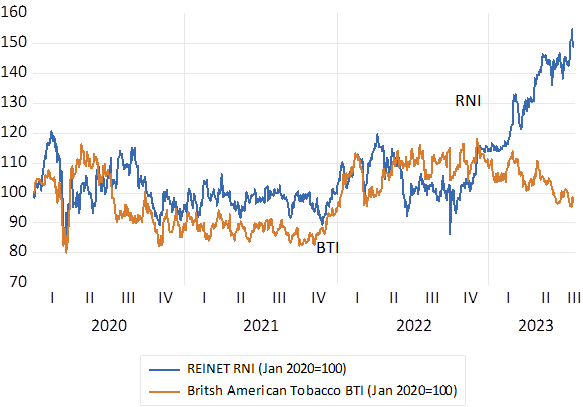
Yet for all that, the shares bought back may prove to be cheap should Reinet further surprise the market with further improvements in its ability to allocate capital. And the gap between NAV and MV could narrow further because the value of its listed assets decline. Indeed, shareholders should be particularly grateful for the recent performance of RNI when compared to the value of its holding in British American Tobacco (BTI) its largest listed investment. RNI has outperformed BTI by 50% this year. Unbundling its BTI shares – an act normally very helpful in adding value for shareholders because it eliminates a holding company discount attached to such assets- would have done shareholders in RNI no favours at all this year.

Fig.1; Reinet (RNI) Vs British American Tobacco (BTI) Daily Data (January 2020=100)

Source; Iress and Investec Wealth and Investment

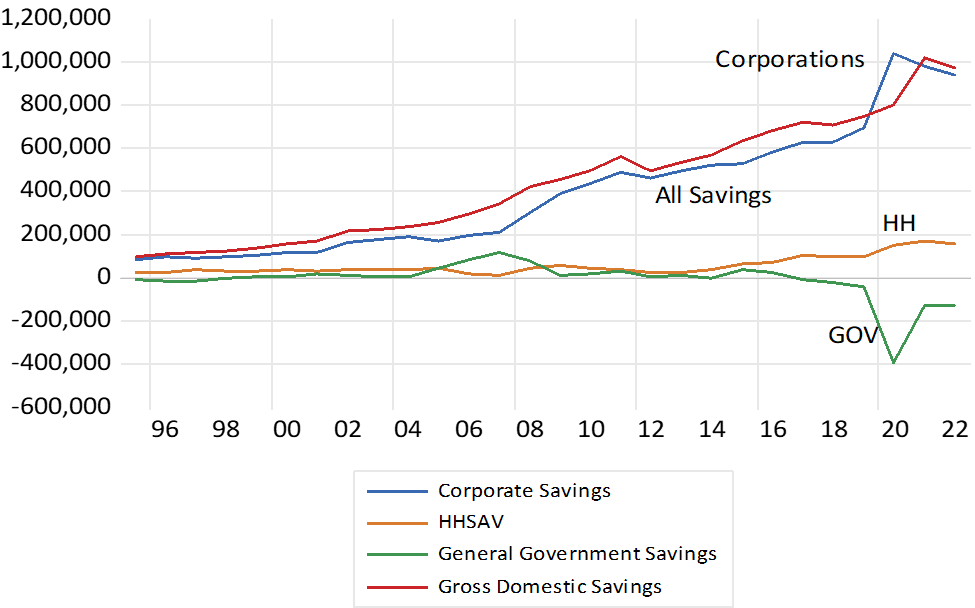
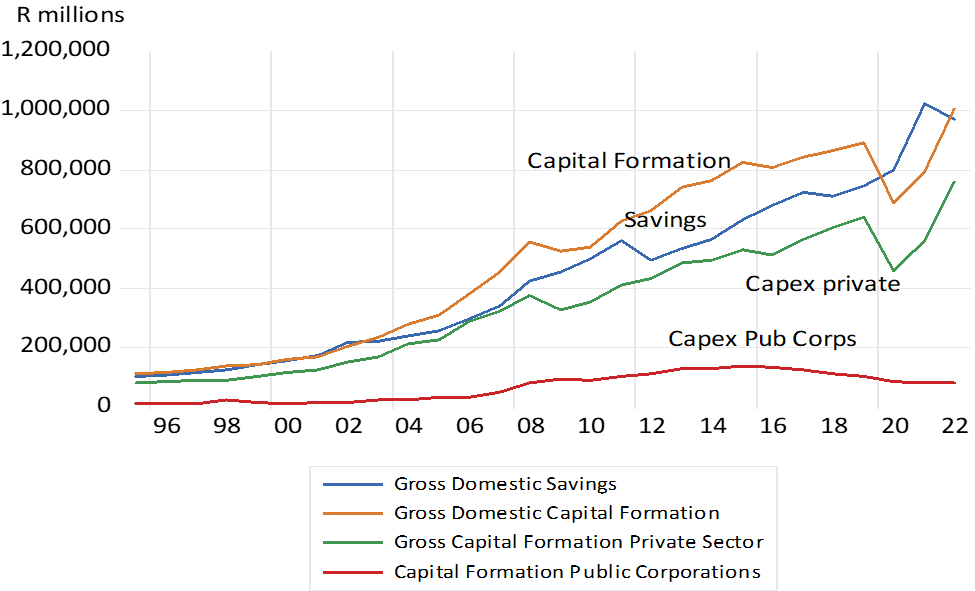
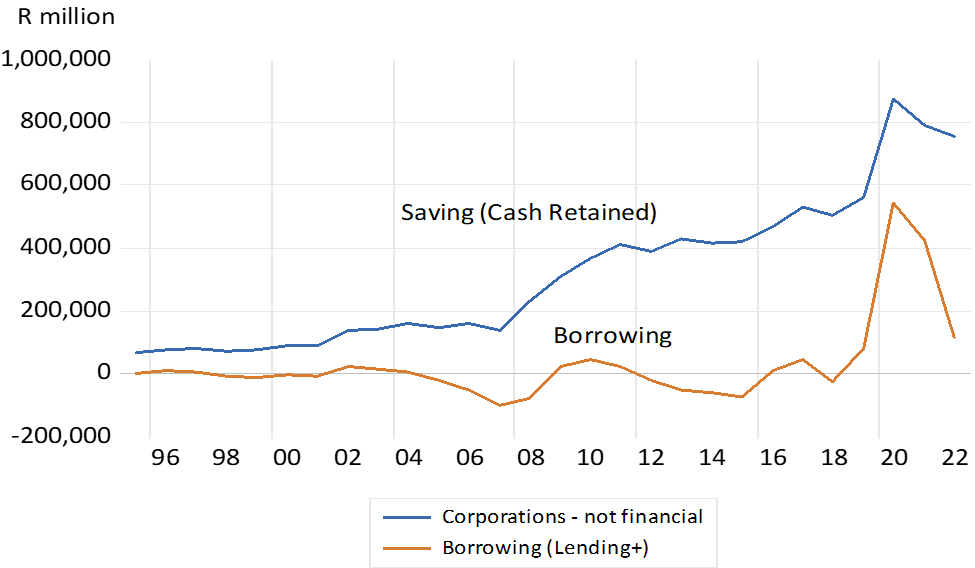
The  recent trends in flows of capital out of and into businesses operating in SA are shown below. It may be seen that almost all the gross savings of South Africans consist of cash retained by the corporate sector, including the publicly owned corporations. (see figure 2) Though their operating surpluses and retained cash have been in sharp recent decline for want of operational capabilities and revenues rising more slowly than rapidly increasing operational costs. Their capital expenditure programmes have suffered accordingly as may be seen in figure 3.  The savings of the household sector consist mostly of contributions to pension and retirement funds and the repayment of mortgages out of after-tax incomes. But these savings are mostly offset by the additional borrowings of households to fund homes, cars, and other durable consumer goods. The general government sector has become a significant dissaver with government consumption expenditure exceeding revenues plus government spending on the infrastructure.  It may be noticed that the non-financial corporations in South Africa have not only undertaken less capital expenditure with the cash at their disposal- they have also become large net lenders- rather than marginal borrowers- in recent years. (see figure 5)

Fig.2; South Africa; Gross Savings Annual Data (R millions)

Source; South African Reserve Bank and Investec Wealth and Investment

Fig.3; South Africa; Gross Savings and the Composition of Capital Expenditure by Private and Publicly Owned Corporations

Source; South African Reserve Bank and Investec Wealth and Investment

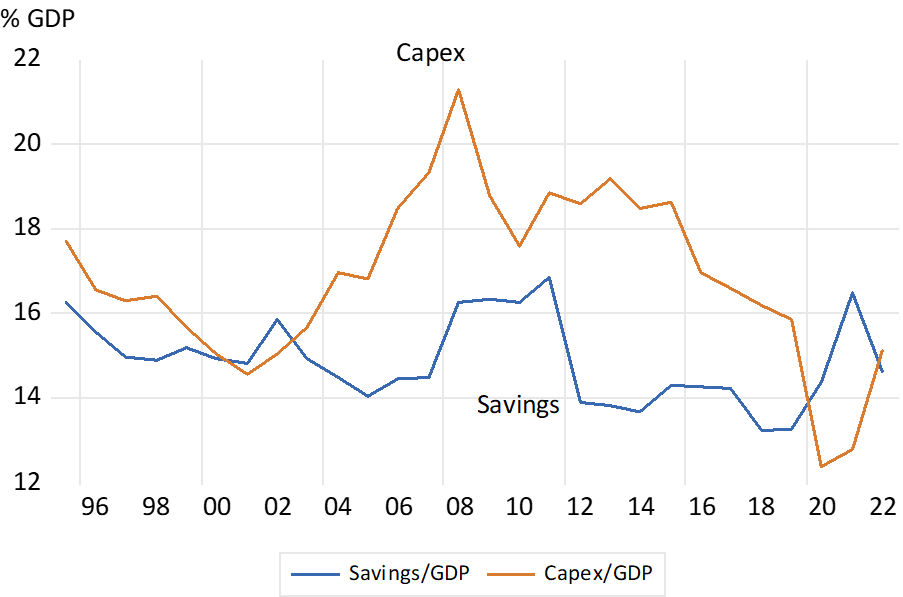
In recent years, during and post the Covid lock downs, total gross saving has come to exceed capital; formation providing for a net outflow of capital from South Africa. Rather a lender than a borrower might be the Shakespearean recipe, but the problem is that both gross savings and capex in South Africa commands a comparably small share of GDP as shown below. South Africans save too little it may be said for want of income to do so. But they invest too little in plant and equipment and the infrastructure that would promote the growth in incomes, consumption and savings. The source of capital exported is that the gross savings rate held up while the ratio of capex to GDP fell away significantly.

Fig.4; South Africa, Gross Savings and Capital Formation – Ratio to GDP – Annual Data, Current Prices

Source; South African Reserve Bank and Investec Wealth and Investment

Fig. 5; South African Non-Financial Corporations; Cash from Operations Retained and Net Lending (+) or Borrowing(-) Annual Data

Source; South African Reserve Bank and Investec Wealth and Investment

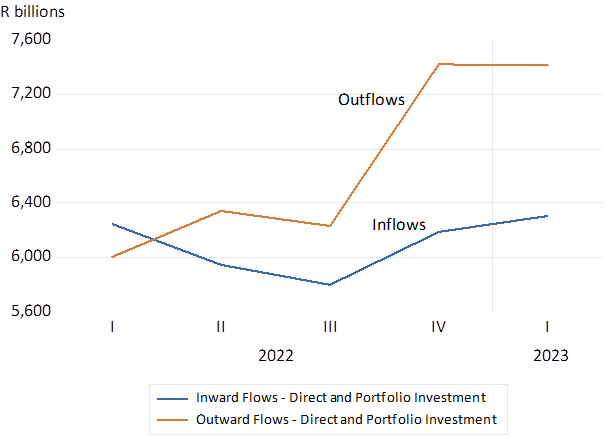
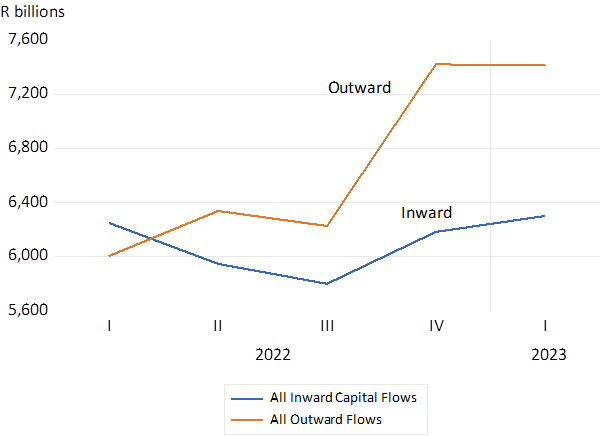
The reason many SA companies are buying back shares on an increasing scale is the general lack of opportunities they have had to invest locally with the cash at their disposal. And the cash received has been invested offshore rather than onshore on an increasing scale. For want of growth in the demand for their goods and services for all the obvious reasons. As a result the aggregate of the value of South African assets held abroad at march 2023 exceeded those of the foreign liabilities of South Africans, at current market valuations, by R1,699 billion. Total foreign assets were valued at approximately 9.5 trillion rand.

Fig 6; South Africa;  Inflows and Outflows of Capital; Direct and Portfolio Investment. Quarterly Flows 2022.1 – 2023.1[i]

Source; South African Reserve Bank and Investec Wealth and Investment

Fig.7; All Capital Flows to and from South Africa;  Quarterly Data (2022.1 2023.1)

Source; South African Reserve Bank and Investec Wealth and Investment

The reluctance to invest in SA makes realizing faster growth ever more difficult. That the cash released to pension funds and their like is increasingly being invested in the growth companies of the world, rather than in SA business, is the burden of a poorly performing economy that South Africans have to bear. Rather a borrower than a lender be- if the funds raised can be invested in a long runway of cost of capital beating projects. Faster growth in the economy would lead the inflows of capital and restrain the outflows of capital required to fund a significant increase in the ratio of capital expenditure to GDP and a highly desirable excess of capex over gross savings.


[i] The investments are defined as direct when the flows are undertaken by shareholders with more than 10% of the company undertaking the transactions. And as portfolio flows when the shareholder has less than 10%. Much of the economic activities of directly owned foreign companies in South Africa, including their cash retained and dividends paid to head office will be regarded as direct investment. For example, describing the activities of a foreign owned Nestle or Daimler Benz in SA.

No room at the till. Towards a note less economy.  

Starbucks has a prominent notice. Responsibly Cashless. It might have read better or more honestly as profitably cashless. Avoiding the costs and dangers of handling and transporting cash and the associated bank charges – including the likelihood of cash not making it to the till in the first instance – will surely be in the owner’s interest and justifiably so.  On the proviso that the sales lost would not be at all significant as affluent and tech savvy customers tender their telephones. It is not a conclusion the owner manager of a small stand-alone enterprise in control of what goes in or out of the cash register will come to.  For them cash is still king.

Starbucks and other cash refusers are probably within its rights refusing legal tender. Only the notes and coins issued by the Reserve Bank qualify as legal tender in SA – money that cannot be refused in proposed settlement of a debt. But presumably can be rejected when offered in exchange for a good or service. SARS would probably approve of a cashless society for obvious income monitoring purposes. The Reserve Bank might, were it a private business, have mixed feelings about reducing the demand for a most valuable monopoly. It pays no interest on the notes it issues and earns interest on the assets the note liabilities help fund. In 2004 the note issue funded 40% of the Assets on the Reserve Bank. That share is now down to 15%. It was 20% before Covid.

Clearly notes, have lost ground to the digital equivalent- a transfer made and received via a banking account. A trend that becomes conspicuous after the Covid lockdowns. Since then, the transmission and cheque accounts at SA banks have grown very strongly from R790 billion in early 2020 to nearly 1.1 trillion today- or by about a quarter. By contrast the notes issued by the Reserve Bank since have increased only marginally – by R20b – with most of the extra cash issued being held by the public. The private banks have managed to reduce their holdings of non-interest bearing cash in their vaults and ATM’s. By closing branches and ATM’s and retrenchments. Replacing notes with digits- have been a cost saving response. A central bank replacing paper notes with a digital alternative could be an alternative. But it would be very threatening to the deposit base of the private banks and their survival prospects.

South Africa; Money Supply Trends.

Source; SA Reserve Bank and Investec Wealth and Investment

The Banks in SA have however dramatically increased their demands for an alternative form of cash- deposits with the Reserve Bank. They now earn interest on these deposits. What used to be significant interest charged to the banks when they consistently borrowed cash from the SARB – to satisfy the cash reserve requirements set by the SARB – at the Repo rate- has now become interest to be earned on deposits held with the SARB. These deposits have grown by R100bilion since 2020 while cash borrowed from the SARB has fallen away almost completely from an earlier average of about R50 billion a month.

SA Banks – demand for and supply of cash reserves since Covid

Source; SA Reserve Bank and Investec Wealth and Investment

The SARB, following the Fed, regards the interest it pays on these deposits as fit for the purpose of preventing banks from converting excess cash into additional lending. Which would lead to increased supplies of money in the form of additional bank deposits. It takes a willing bank lender and a willing bank borrower to power up the supply of cash supplied to the banking system by a central bank into extra deposits The testing time for central banks in a banking world full of cash will come when increased demands for bank credit accompany the improved ability and willingness of the banks to turn excess cash into extra bank lending. Then interest rate settings may not control the demand by banks for cash reserves to sufficiently restrain the conversion of excess cash into additional bank lending, that in turn will lead to extra and possibly excess supplies of money and so extra spending as money is exchanged for goods, services and other assets, that will force prices higher. Clearly not for now the banking state of SA or of the US where the supply of money is in sharp retreat.

The HNI- in whose interest?

A depressing reflection of the State of South Africa was the complaint of Richard Friedland, CEO of private health provider, Netcare, about a coming nursing crisis. An aging cohort of nurses, many more of whom will be retiring, is not being replaced for want of government action – ‘…..about which it was warned well in advance and chose to ignore it …” Netcare, he reported “…had been accredited to train more than 3,000 a year; it now trains barely a 10th of that…”

Clearly there is a demand for more nurses and a very large potential supply of aspirant nurses, given the current employment benefits and prospects. Why the government stands in the way of Netcare helping to close the gap between supply and demand of nurses is perhaps not as obvious as it should be?

Let us attempt to round up the usual suspects. The first suspect must be the arguments against private medicine that are made in principle. The case for equal treatment for all, paid for by the taxpayer, is one that ideologues employed in the Department of Health, hold fervently. Helping the nursing and other services a private hospital provides may provide may threaten this vision.

Though even the ideologues appear to concede the case for top up medical benefits paid for by the more prosperous. Perhaps they realistically understand that the better off in their key economic roles are much more likely to take themselves and their contribution to the revenues of government away from SA, for want of a world class and affordable medical service. A benefit we assuredly receive from the private hospitals and independent physicians that they are willing to pay for through a pay as you go system.

For an economy so obviously lacking in human capital, and not only for the capital embodied in the cohort of nurses, who are especially attractive immigrants, the consequences of an uncompetitive medical offering for highly mobile skilled South Africans are truly disastrous for income growth and taxes collected in SA. Upon which any National Health Service must ultimately

depend. Equal and hopelessly inferior is not an attractive prospect even for those who ignore the current realities of our government provided medical services.

It may still be asked why can’t the government, via its own large suite of public hospitals and large budgets, are failing to train more nurses and doctors for that matter? The answer is in the existing budget constraints. Budgets that provide well for those already in government service, provide employment benefits that keep up with and often exceed inflation of living costs, but leave very little over to employ new entrants to government service, of whom there are potentially legions. The private sector does not compete at all well with the public sector in the competition for workers of all skills- taking into account the private medical and pension benefits that the public sector employees draw upon.

But more important in the resistance to private medicine may be the force already prominent in explaining the actions and allocations of budget, commonly taken by state operated agencies in SA. Public hospitals and their procurement practice –definitely not excepted. The taxpayer has been held to ransom by the opportunists who intermediate between the State as payer and the service and goods providers. They have been extracting wealth from the taxpayers on a mind-numbing scale as Zondo our media and the US government has revealed.

The envisaged National Health Service will be a single payer for all the health services provided by the state. The intended budget will be an enormous one and the opportunities to navigate the gaps between the government as payer and the service and goods providers will be many and valuable. That that you can’t do (big) business with the SA government without a bribe or kickback must be regarded as alas, unproven. The evidence, the reality of SA, vitiates the case for a universal health system. But the private interest in such arrangements is a powerful one. That providers of private medicine in SA will have to resist to survive. They must make their case to the voting public- as Netcare has done.

The impact of more equity and less debt for a growth company

Mpact a South African paper and packaging company has recently reported highly satisfactory results. It has a rare attribute for a SA based industrial company. It appears to have very good growth prospects linked to good export prospects for SA agriculture as highlighted in BD on May 2nd.

And Mpact seems very willing to invest in the growth opportunity and to raise capital from internal and external sources to fund the growth opportunities. It speaks of a 20% internal rate of return on these projects which would be well above the 15% p.a. that could be regarded as the opportunity cost of the capital it raises.

But the Mpact story is complicated by its shareholding. Caxton an apparently less than friendly shareholder unwilling to raise its 34.9% stake to the point where it has to make an offer to all other shareholders. It prefers to merge its operations with Mpact, a prospect the Mpact board is actively discouraging.

Caxton however argues that Mpact has raised too much debt for its comfort. It may have in mind using its own cash pile to fund the capex after a merger. It may nevertheless have a generally valid point. Mpact might be better advised to fund its growth raising more additional equity capital and less extra debt. This might not suit Caxton but would be a less risky strategy. And there is not good reason that SA pension funds with their typical 60% equity – 40% debt would not welcome the opportunity to contribute additional equity capital that promises good returns.

It is a strategy to be recommended to any growing company. Any equity capital raised that beats its cost of capital will very likely add value for its shareholders old and new. The value of the firm will increase by more than extra capital raised- adding wealth for shareholders with a smaller (diluted) share of what will have become a larger cake. Dilution can take place for good growth reasons- and not only to save off the bankruptcy – that always comes with too much debt.

The temptation always offered by interest rates below what prospective internal rates of return on capex is to raise debt to improve the return on shareholder’s equity. When the internal rates of return have in fact exceeded the costs of finance, hindsight tells us more debt, would and should have been the obviously preferred source of capital. But in an uncertain world such favourable outcomes cannot be known in advance.

The savings in taxes paid, because interest payments are deducted from taxable income, that is equal in value to the tax rate multiplied by the interest paid, may be presumed to reduce the “weighted average cost of capital’ – and so perhaps reduce the target internal rate of return required to justify an investment decision. I would counsel against such an approach. Expected return on all the capital put to work, however funded, should be the initial critical consideration independent of tax to be paid. If the expected returns are attractive, the appropriate financial structure can then be considered.  Debt is not necessarily cheaper than equity – because it is more risky – and the firm may well have to pay up for the financial risk it has taken on, usually when it is least convenient to do so.

When the source of any reported growth in earnings appears to be financial engineering, and is largely debt financed, it should be treated with suspicion by actual or potential investors in the shares of such a company. Returns on all capital invested needs to be greater than the interest rate on debt raised and in addition need to at least meet the returns required by shareholders who have alternative investment opportunities. How best to fund the growth should be a secondary consideration after the favourable return on all capital invested can be assumed with confidence.

MPact should be strongly encouraged by its shareholders and South Africans more generally to realise all the projects that can confidently earn 20% p.a. And raising extra equity rather than only debt capital will help ease their way down their apparently long runway -should the 20% materialise.

Using competition policy to inhibit competition. A new case study. SAB Vs
Heineken and Distell

SA Breweries with 90% or more of the beer sold in South Africa has intervened before the Competition Tribunal on the terms of the Heineken acquisition of Distell. SAB has argued that the Tribunal should force Heineken to dispose of its powerful Hunters and Savanah brands rather than, as Heineken has proposed, to dispose of its own weaker by sales, Strongbow cider brand, to a local consortium.  That is in order to meet the likely Competition Policy objections to the deal of what would become a cider monopoly. Heineken’s intended local buyer is a consortium of the craft brewer Devil’s Peak and a BEE partner. SAB has argued that it would lack the “relevant expertise, financial muscle or distribution network”, to effectively compete with the other two ciders: Hunters and Savanna”

What is at work here is but another example of rivals or potential rivals hoping to influence competition policy to improve their own ability to compete in the market. In other words, to manipulate policies, intended presumably to enhance competition, to limit competition, in the interest of their owners, their shareholders.  And why, it may be asked, should they not attempt to do so? They are simply playing by the rules made by their governments for them.

To expect corporations and their managers to do otherwise – other than to attempt to maximise the value of the assets including their brands – competing in all the ways they are permitted to do – including in the courts of law- is not only naïve but also unwise. Self-interest is the powerful driving force of the market led system that delivers the beer and the cider and everything else that consumers choose – subject to regulation.

It is competition that keeps the prices companies charge in close relationship to the costs they incur. Cost that they have every incentive in containing in the interest of holding down prices, improving service and realizing the profit maximizing, optimum scale of operations. Which may, when economies of scale present themselves, as it does in beer and cider production, lead to a degree of dominance in the markets served. When the competition policy or any policy outcomes are perverse, we should look to reforming the policy, not the business modus operandi that naturally competes in all the ways legitimately open to them.

That Advocate Jerome Wilson acting for Heinekens to quote BD “… accused SAB of being “opportunistic” and using the guise of competition concerns for its own business interests…”  is a non-sequitur of the kind more easily made by lawyers than economists. It reinforces my concern that competition policy in SA has become such a fertile field for lawyers with precedent, not necessarily good economics, as the guide.

But there is a certain irony in SAB, now a wholly owned subsidiary of ABN-INBEV, choosing to compete in this way. The pioneers who built SAB to the great global company it became, as well as the dominant brewer in SA, effectively expanded the demand for and supply of beer in SA at what were surely attractive prices and terms for their customers. They could not have succeeded otherwise.  Then in a final glorious act, agreed to sell their business at what has proved to be highly favourable terms for their highly appreciative shareholders. Pensioners living off the SAB shares they owned can well say cheers. They might not have thought it in their interest, or even perhaps, appropriate to invoke competition policy. The goose can easily become the gander.

SAB were fond of arguing evocatively that they were competing for a “share of throat” That is with every other beverage, alcoholic or non-alcoholic that competed with their beer for a share of household’s budgets. And that this gave them every motivation to expand, not restrict the supply of beer, with truly competitive pricing and related services. And they were right. And their successful practice proved it so. Market dominance was the outcome of serving the customer. They earned it and did not abuse the power it gave them. If we widen the definition of any market, as we should to be realistic, we reduce the share of any participant in it.

The competition will always be intense for the choices that households make, regulations permitting. The pursuit of self-interest will ensure a constant striving to beat the market and become very wealthy doing so. How consumers will come to choose from the unpredictable and changing menu placed before them is impossible to predict. Their larger interest is in changing the menu, in innovation and technology that can significantly alter how they spend over time. Best therefore to leave the mysterious forces of competition to evolve.  To trust the pursuit of self-interest and competition – not its regulators- with possibly very different interests to those of consumers.

Competition policy would best ask the simple question, will some acquisition or arrangement be in the consumers’ interest? Will it mean lower prices, better service – enhanced supply and or quality – more R&D -more innovation or not?  Chat-GPT might provide the answer.

The problem with competition policy in SA is that it pursues a broad public interest. And the public interests, very diverse public interests, may conflict with that of consumers. Maintaining employment (in the interest of workers) after an acquisition is likely to mean higher costs and higher prices and or less capable service delivery. And will in advance, given the likely constraints on efficiency, reduce the case for a potentially cost-saving merger that will not be in the interest of consumers.  Cost saving is very much in the customer’s or potential customer’s interest.

Forcing the owners of any business, local or foreign owned to meet empowerment or any other criteria demanded of their potential investors, is likely to reduce the ability of an acquirer to raise capital on favourable terms. Capital with which to compete with established interests in the SA throat – as SAB is surely well-aware

More and better public private partnerships please

The value of your home only partly depends on is location, size and the quality of all its fittings and fixtures. It also depends crucially on the quality of the services provided by your local municipality. By how much they charge for services they deliver or fail to  deliver and how much of a wealth tax they impose for your right to own. The better the services provided the more valuable will be your home. And the more you are charged the less the home will be worth to others for any services provided. Negative feedback effects on home values are painfully apparent to home-owners in most parts of the country. The real value of homes of all kinds and types are falling because of the growing in-balance between what is being extracted by municipal governments compared to what they deliver.

But not in Cape Town. Where service delivery is holding up well, as are home values. The difference between what you get for a home or apartment owned or rented in Cape Town and in the other major urban centres is strikingly wide. Despite the charges levied by the City that have been rising well ahead of inflation. In 2010 Rates collected by the city were R3.84b. By 2020 these had grown to R10.08b, that is at an average compound rate of growth of 8.8% p.a. Well ahead of inflation that averaged about 5% over the period. Evidence surely of more valuable real estate. Revenue from electricity water etc compounded from R8.7b to R19.8 at an average rate of 7.5%  p.a. over this period. They took a knock from Covid, declining by R329m in 2020. Which begs a question – what is the present value of a predictable income stream of R10b growing at a real 3% p.a? Perhaps twenty times current revenues or possibly R200b. It is this potential value that secures any borrowing the City or any city might want to do to support its growth with well-designed and honestly executed capex.

The City of Cape Town does however have a spending problem. It has spent far too little on its infrastructure over many years now. Capex (PP&E) was R4.7b in 2010 and only R6b in 2020. Capex in Cape Town has been declining in real terms by about 2.5% per annum on average. Surely not nearly good enough to support and encourage a growing metropole and its property values.

The result is a very strong City balance sheet. The financial assets on the 2019 CTC balance sheet, cash, other financial assets less debts meant net financial reserves of a positive R10.1b. The equivalent amount on the 2015 balance sheet was a mere R2.3b. Debts have remained constant at about R6b since 2015 while cash reserves grew from R3.2 to R8.4b.  It is a build-up in financial strength that should be hard to justify to property owners and residents. Perhaps it is the self-evident hopelessness of the potential competition to run the City that explains such parsimony. The reserves did come in useful in 2020. The City had budgeted to raise an extra 2.5b in debt in 2020. It did not have to do so. It drew down its cash reserves by R2.6b still leaving it a large cash pile of R5.8b.

The City is now realistically budgeting for a significant increase in its capex. It plans to increase its capex to over R11b in three years. To be funded in part by an extra R7b of debt that will cost the City a very manageable net financial charge of 573m in 2023-4. Cash reserves nevertheless are planned to increase to R9b by the end of the three-year planning horizon. I would suggest that the City urgently needs help with its capital expenditure problem. It should partner closely and usefully with the businesses that could help plan and undertake the spending programmes.

Voters at the next municipal elections should choose their mayors and councillors on local not national issues. Essentially by what they can be expected to do to protect, perhaps even enhance, the value of their highly vulnerable homes.

Still chasing the corporate tax tail

Written after being fully frustrated listening to an Interview on how we can and should collect more taxes from SA companies that Michael Avery conducted with Keith Engers, Edward Kieswetter and Dennis Davis on Business Day TV Tuesday 20 th April 2021.

Janet Yellen the US Secretary of the Treasury wants to collect more tax from US corporations She is lobbying for the same minimum rate of corporate tax to be applied everywhere to prevent competition between different tax regimes. Edward Kieswetter, SARS Commissioner, as unsurprisingly, also wishes to collect more tax from companies who do international business from SA. But he knows better than to believe that standardising tax rates would mean more tax collected. He points out that the amount of taxable income these companies report is much more important than the rate at which they are taxed. He intends to employ more skilled tax collectors, armed with more powerful algos to closely examine the company spread sheets, to ensure more income is reported. To make sure that local costs are not inflated by off-share head office levies or by overstated imports – or indeed overstated exports that are not included in value added and so on and so forth ad infinitum, given the ingenuity of the CFO’s.

What would be required to eliminate the competition is an internationally code of generally agreed standard to measure taxable income. But more important, for any economy, is how well will taxable income as defined for tax purposes, accord with the after-tax income that drives the income and wealth producing actions of the economic decision makers? How consistently does it treat investment allowances that can exceed or fall well short of the decline in the market value of any asset employed be treated that can make a large difference to true economic income? Or how will incentives of one kind or another, tax concessions made to employ more workers, and employ more of them in special zones, or differences in the tax treatment of R&D expenditure be managed? It all calls for a standardisation of fiscal policy that seems very unlikely.

Furthermore, will the calculation of business income under a new standard include an allowance for the opportunity cost of employing equity capital in a business, as it does for interest paid on debt? An unlikely but essential treatment of business costs that are not only measured in cash paid out. Such irrationality about the treatment of economic, as opposed to cash costs, is meat and bread and taxable income to the legion of analysts and investors who know better. Only by providing true economic returns that cover all costs including opportunity costs of own capital employed, is a business likely to gain market value. And provide capital gains- including unrealised gains, which is as useful a form of income as any other even if not paid out in cash. And is only taxed when realised and so best postponed, or used as collateral to fund spending or investments. And helpfully too the interest incurred on the extra borrowings may be regarded as a business expense. And then the gains in cash are only taxed when realised by the private investor or company, not by the pension funds and other investment collectives who own most of the large, listed companies.

If we are to reform our tax system sensibly, the truth to be recognised is that taxes of all kinds are ill suited for redistributing income. They end up influencing pre-tax incomes and so the prices of goods and services, including wages and salaries. It is the distribution of government expenditure that should be used to help the poor and deserving. To tax the corporation, as well as its beneficiaries, the dividend receivers, some more than others, is unnecessary, inconsistent, and harmful to the economy.

The corporation can be treated as a limited liability partnership and be required to act as an efficient tax collector. By withholding tax from all the dividend, interest and rental payments it makes to all parties, without exception, as it does now from its employees and its suppliers. With the tax collected reconciled in tax returns as is the case with PAYE. The lesson to be learned from the tax havens, and how best to compete with them, is to adopt the same zero rate of corporate tax. It then becomes a simple matter for the tax authority to measure what is paid out, and it will not have to police the tax legitimacy of revenues or costs. No well-paid tax sleuths need be employed. The tough measurements of economic returns and what should be done with them, how much cash should be retained and how much paid out are then well left to the business organisation. They will know very well how well they have really done for their shareholders and will measure their results accurately. Economic rationality will rule. Not after-tax rationality. With very helpful consequences for the economy. More will be invested wisely, more paid out in dividends and wages and salaries and more wealth (capital gained) will be created. And the tax base of the economy would become a much wider one. The tax dog, however pedigreed, having to chase the tail of corporate income will be of the past.

But alas do not hold your breath that SA will adopt policies that are truly radical and useful. Our ability to think creatively for ourselves is not well developed.

Thinking and acting long term comes with a price – the discount rate

An analysis of discount rates shows the extent to which a high risk premium encourages short-term thinking.

In making economic or social choices today, how far ahead do you look? You may blow your Friday wage packet on hedonistic pursuits without any regard to how little food will be on the family table the following week. Or you may run up the mortgage bond to fund the next holiday abroad. We might ascribe such myopic actions as reflecting high personal discount rates. In such cases, future benefits clearly command very little competition with immediate pleasures.

When a business contemplates an investment decision, how far ahead should it calculate its expected benefits? How many years of future cash flow would your business estimate as necessary to justify an acquisition or an addition to plant and equipment? The longer the estimated pay-back period, the greater will tend to be the present value of the investment decision.

Expecting to get back capital risked in 10 or 20 years, rather than in five years, encourages investment by reducing required returns. It means the application of a lower discount rate to future incomes or expected cash flows. It brings higher present values that are more likely to exceed the current costs of the plant, equipment or acquisition. Future-conscious economic and social actors, with longer time horizons, benefit themselves by saving and investing more. They also benefit their broader communities, by helping to contribute to a larger stock of capital and so more productive workers capable of earning higher incomes.

South African investors are exposed to high discount rates. They are as high as they have been in recent times and are high when compared to discount rates in the developed world. The long-term promises of interest and capital repayments by the SA government are discounted at about 9% a year. Adjusted for expected inflation of 5%, this provides savers with a real return of about 4% a year, with which every risky SA business contemplating capex has to compete for capital.

A risk premium of at least 5% for a well-established and listed SA company would have to be added to this 4% and so the discount rate applied to any prospective cash flow. A required return of more than 10% a year after inflation makes for short pay back periods and so limited capex and limited growth opportunities generally. It also means much lower present values attached to established SA business so that they can satisfy such demanding expectations. Higher discount rates destroy wealth.

For example, assume you have an investment that earns income, initially worth 100, that is expected to grow at 5% a year over the next 20 years. Assume a developed world discount rate of 6% – made up of 1%, which is all that is available from government bonds, plus an assumed 5% extra for risky equity. The present value of this expected income or cash flow stream will be 320. Moreover 81% of its current market value can be attributed to the income expected after five years.

The same business, with the same prospects in SA, and with the same risk premium, but competing with government bonds offering 9%, would have future income discounted at 14%. This is more than double the discount rate applied to an averagely risky investment in the developed world. It would have a present market value of 116, about a third lower. Of this, only 54.9% of its present market value will be attributed to income to be expected after five years. This forces such a business to adopt a much shorter focus, with fewer viable investment opportunities.

The direction of economic policy reforms in SA should be evaluated through the prism of the discount rate. The purpose of reform must be to build confidence in the future growth and stability of the economy to lower the damagingly high discount rate. Only this can make businesses more valuable, by encouraging their managers to think more about the long term than the short, and to invest more and thus improve the economic prospects for all South Africans.

PSG and Capitec – Shareholders’ (un)bundle of joy

By unbundling Capitec, PSG has done the right thing for shareholders – but shareholders remain sceptical about its prospects.
PSG shareholders should be pleased. The decision to unbundle PSG’s stake in Capitec has delivered approximately R7.85bn extra to them. This estimated value add for PSG shareholders is calculated by eliminating the discount previously applied to the value of the Capitec shares held indirectly by PSG.Without the unbundling, the discount applied to the assets of PSG would have been maintained to reduce the value of their Capitec shares. The market value of the 28.1% of all Capitec shares unbundled to PSG shareholders, worth R960 a Capitec share, would have been worth R31.4bn on 16 September. These Capitec shares might have been worth 25% less, or nearly R8bn, to PSG shareholders, had it been kept on the books.

The PSG holding in Capitec had accounted for a very important 70% of the net asset value (NAV) or the sum of parts of PSG. Before the unbundling cautionary was issued in April 2020, the difference between the NAV and market value of PSG, the discount to NAV, had risen to well over 30%. The difference in NAV and market value of PSG was then approximately R20bn in absolute terms. The discount to NAV then narrowed to about 18% when the decision to proceed with the unbundling was confirmed.

Now with the unbundling complete, PSG again trades at a much wider discount of 40% or so to its much-reduced NAV.

Capitec and PSG delivered well above market returns after 2010. By the end of 2019, the Capitec share price was up over 18 times compared to its 2010 value. By comparison, the PSG share price was then 10 times its 2010 value, and the JSE 2.1 times.  The Capitec share price strongly outpaced that of PSG only after 2017.

The Capitec and PSG share prices, compared to the JSE All Share Index (2010 = 100)
The Capitec and PSG share prices, compared to the JSE All Share Index chart
Source: Iress and Investec Wealth & Investment

The better the established assets of a holding company perform, as in the case of a Capitec held by PSG or a Tencent held by Naspers, the more valuable will be the holding company. Its NAV and market value will rise together but the gap between them may remain wide. Investors will do more than count the value of the listed and unlisted assets reported by the holding company. They will estimate the future cost of running the head office, including the cost of share options and other benefits provided to managers of the holding company.  They will deduct any negative estimate of the present value of head office from its market value. They may attach a lower value to unlisted assets than that reported by the company and included in its NAV.

Investors will also attempt to value the potential pipeline of investments the holding company is expected to undertake. These investments may well be expected to earn less than their cost of capital, in other words, deliver lower returns than shareholders could expect from the wider market. These investments would therefore be expected to diminish the value of the company rather than add to it. They are thus expected to be worth less than the cash allocated to them.

To illustrate this point, assume a company is expected to invest R100 of its cash in a new venture (it may even borrow the cash to be invested or sell shares in its holdings to do so). But the prospects for the investments or acquisitions are not regarded as promising at all. Assume further that the investment programme is expected to realise a rate of return only half of that expected from the market place for similarly risky companies. In that case, an investment that costs R100 can only be worth half as much to its shareholders. Hence half of the cash allocated to the investment programme or R50 would have to be deducted from its current market value.
 
All that value that is expected to be lost in holding company activity will then be offset by a lower share price and market value for the holding company – low enough to provide competitive returns with the market. This leads to a market value for the company that is less than its NAV. This value loss, the difference between what the holding company is worth to its shareholders and what it would be worth if the company would be unwound, calls for action from the holding company of the sort taken by PSG. It calls for more disciplined allocations of shareholder capital and a much less ambitious investment programme. The company should rather shrink, through share buy backs and dividends, and unbundling its listed assets, rather than attempt to grow. It calls for unbundling and a lean head office and incentives for managers linked directly to adding value for shareholders by narrowing the absolute difference between NAV and market value. Management incentives, for that matter, should not be related to the performance of the shares in successful companies owned by the holding company, to which little or no management contribution is made.

On that score, a final point directed towards Naspers and its management: the gap between your NAV and market value runs into not billions, but trillions of rands. This gap represents an extremely negative judgment by investors. It reflects the likelihood of value-destroying capital allocations that are expected to continue on a gargantuan scale. It also reflects the cost of what is expected to remain an indulgent and expensive head office.

The case for funding with equity, not debt

Two recent cases of JSE-listed companies reveal the advantages of equity funding over debt funding.
While issuing debt can be more dangerous than issuing equity, it receives more encouragement from shareholders and the regulators. Debt has more upside potential: if a borrower can return more than the costs of funding the debt (return on equity improves) and there is less to be shared with fellow shareholders.

But this upside comes with the extra risk that shareholders will bear should the transactions funded with debt turn out poorly. Any increase in the risk of default will reduce the value of the equity in the firm – perhaps significantly so.

The accounting model of the firm regards equity finance as incurring no charge against earnings. You might think it would help the argument for raising permanent equity capital rather than temporary debt capital. But this is clearly not the case, with the rules and regulations and laws that govern the capital structure of companies. It is also represented in the attitude of shareholders to the issuing of additional equity. They have come to grant ever less discretion to company boards to issue equity. Less so with risky debt.

(Note: I am grateful to Paul Theodosiou for the following explanation of the different treatment of debt and equity capital raising. Paul was until recently non-executive chairman of JSE-listed REIT, Self Storage (SSS), and previously MD of the now de-listed Accucap of which I was the non-executive chairman).

Typically at the AGM, a company will seek two approvals in respect of shares – a general approval to issue shares for cash (which these days is very limited – 5% of shares in issue is the norm) and an approval to place unissued shares under the control of directors (to be utilised for specific transactions that will require shareholder approval). These need 75% approval. So shareholders keep a fairly tight rein on the issue of shares.

Taking on or issuing debt, on the other hand, leaves management with far more discretion. Debt instruments can be listed on the JSE without shareholder approval, and bank debt can be taken on at management’s discretion. The checks and balances are more broad and general when it comes to debt. Firstly, the memorandum of incorporation will normally have a limit of some kind (for REITs, the loan to value ratio limits the amount of debt relative to the value of the assets). If the company is nominally within its self-imposed limits, shareholders have no say. Secondly, the JSE rules provide for transactions to be categorised, and above a certain size relative to market cap, shareholders must be given the right to approve by way of a circular issued and a meeting called. The circular will spell out how much debt and equity will be used to finance the transaction, and here the shareholders will have discretion to vote for or against the deal. If they don’t approve of the company taking on debt, they can vote at this stage. Thirdly, shareholders can reward or punish management for the way they manage the company’s capital structure – but this is a weak control that involves engaging with management in the first instance to try and persuade, and disinvesting if there isn’t a satisfactory response.)
Perhaps the implicit value of the debt shield – taxes saved by expensing interest payments – without regard to the increase in default risk, confuses the issues for investors and regulators. It is better practice however to separate the investment and financing decisions to be made by a firm. The first step is to establish that an investment can be expected to beat its cost of capital, whatever the source of capital, including internally generated cash that could be given back to shareholders for want of profitable opportunities. When this condition is satisfied, the best (risk adjusted) method of funding the investment can be given attention.

The apparent aversion to issuing equity capital to fund potentially profitable investments seems therefore illogical. Or maybe it represents risk-loving rather than risk-averse behaviour. Debt provides potentially more upside for established shareholders and especially managers, who may benefit most from incentives linked to the upside.

Raising additional equity capital from external sources to supplement internal sources of equity capital is what the true growth companies are able to do. And true growth companies do not pay cash dividends, they reinvest them, earning economic value added (EVA) for their shareholders. A smaller share of a larger cake is clearly worth more to all shareholders.

There are two recent JSE cases worthy of notice.  Foschini shareholders approved the subscription of an extra R3.95bn of capital on 16 July to add about 20% to the number of shares in issue. By 19 August, the company was worth R25.8bn, or R10.5bn more than its market value on 16 July, or R6.5bn more than the extra capital raised. The higher share price therefore has already more than compensated for the additional shares in issue.

The Foschini Group – market value to 19 August 2020

The Foschini Group - market value to 19 August 2020 chart

Source: Bloomberg, Investec Wealth & Investment

The other example is Sasol, now with a market value of about R87bn, heavily depressed by about R110bn of outstanding debt. The extra debt was mostly incurred funding the Lake Charles refinery that ran far over its planned cost and called for extra debt. Sasol was worth over R400bn in early 2014, with debts then of a mere R28bn. The recent market value, now less than the value of its debts, is clearly being supported by the prospect of asset sales and a potential capital raise.

The company would surely be much stronger had the original investment in Lake Charles been covered more fully by additional equity capital, capital they might have been able to raise with much less dilution. It might also have prevented the new management team from having to sell off what might yet prove to be valuable family silver – assets capable of earning a return above their cost of capital. In this case, a large rights issue could still be justified to bring down the debt to a manageable level and, as with the Foschini increase, the value of its shares by more (proportionately) than the number of extra shares issued.

Sasol – market value and total debt, 2012 to July 2020

Sasol - market value and total debt, 2012 to July 2020 chart

Foresight not only hindsight may well justify equity over debt

While issuing debt is more dangerous than issuing equity it receives more encouragement from shareholders and the regulators [1]. Clearly debt has more upside potential. If a borrower can return more than the costs of funding the debt- return on equity improves- and there is less to be shared with fellow shareholders. But clearly the upside comes with extra risks that shareholders will bear should the transactions funded with debt turn out poorly. Any increase in the risks of default will reduce the value of the equity in the firm – perhaps very significantly so.

The accounting model of the firm regards equity finance as incurring no charge against earnings. Hence you might think would help the argument for raising permanent equity capital rather than temporary debt capital. But this is clearly not the case with the rules and regulations and laws that govern the capital structure of companies. It is also represented in the attitude of shareholders to the issuing of additional equity. They have come to grant ever less discretion to the company boards and their managers to issue equity. Less so with risky debt.

Perhaps the implicit value of the debt shield – taxes saved expensing interest payments – without regard to the increase in default risk- confuses the issues for investors and regulators. It is better practice to separate the investment and financing decisions to be made by a firm. First establish that an investment can be expected to beat its cost of capital,-. Cost of capital being the required risk adjusted return on capital invested whatever itsthe source including investing the cash generated by the company itself. Somethingof capital, including internally generated cash that could be given back to shareholders for want of profitable opportunities. When this condition is satisfied the best (risk adjusted) method of funding the investment can be given attention.

The apparent aversion to issuing equity capital to fund potentially profitable capes or acquisitions seems therefore illogical. Or maybe it represents risk loving rather than risk averse behaviour. Debt provides potentially more upside for established shareholders and especially managers who may benefit most from incentives linked to the upside.

Raising additional equity capital from external sources to supplement internal sources of equity capital is what the true growth companies are able to do. And true growth companies do not pay cash dividends, they reinvest them earning Economic Value Added (EVA) for their shareholders. A smaller share of a larger cake is clearly worth more to all shareholders

There are two recent JSE cases worth notice. TFG shareholders approved the subscription of an extra R3.95b of capital on July 16th to add about 20% to the number of shares in issue. The company on August 19th was worth R25.8b or R10.5b more than its market value of the 16th July. Or worth some R6.5b more than the extra capital raised. The higher share price therefore has already more than compensated for the additional shares in issue. ( see below)

The Foschini Group (TFG) Market Value R millions (Daily Data to August 19th 2020)

f1
Source; Bloomberg, Investec Wealth and Investment

The other example is Sasol (SOL) now with a market value of about R80 billion so heavily depressed by about R110b of outstanding debt. The extra debt was mostly incurred funding the Lake Charles refinery that ran so far over its planned cost and called for extra debt. SOL was worth over R400b in early 2014 with debts then of a mere R28b. The market value of SOL (R86b) now less than the value of its debts, is clearly being supported by the prospect of asset sales and a potential capital raise. The company would surely be much stronger had the original investment in Lake Charles been covered more fully by additional equity capital. Capital they might have been able to raise with much less dilution. It might also have prevented the new management team from having to sell off what might yet prove to be valuable family silver that they intend to do. That is assets capable of earning a return above their cost of capital. If so a very large rights issue could still be justified to bring down the debt to a manageable level and as with TFG increase the value of its shares by more (proportionately) than the number of extra shares issued. (see chart below)

f2
Source; Bloomberg, Investec Wealth and Investment


[1] Paul Theodosiou until recently non-executive chairman of JSE listed Reit Self Storage (SSS) and previously MD of now de-listed Acucap (ACP) of which I was the non-executive chairman repoded to my enquiry about the differential treatment of debt and equity capital raising as follows

Typically at the AGM a company will seek two approvals in respect of shares – a general approval to issue shares for cash (which these days is very limited – 5% of shares in issue is the norm) and an approval to place unissued shares under the control of directors (to be utilized for specific transactions that will require shareholder approval). These need 75% approval. So shareholders keep a fairly tight rein on the issue of shares.

Taking on or issuing debt, on the other hand, leaves management with far more discretion. Debt instruments can be listed in the JSE without shareholder approval, and bank debt can be taken on at managements discretion. The checks and balances are more broad and general when it comes to debt. Firstly, the MOI will normally have a limit of some kind (for Reits, the loan to value ratio limits the amount of debt relative to the value of the assets). If the company is nominally within its self-imposed limits, shareholders have no say. Secondly, the JSE rules provide for transactions to be categorised, and above a certain size relative to market cap, shareholders must be given the right to approve by way of a circular issued and a meeting called. The circular will spell out how much debt and equity will be used to finance the transaction, and here the shareholders will have discretion to vote for or against the deal. If they don’t approve of the company taking on debt, they can vote at this stage. Thirdly, shareholders can reward or punish management for the way they manage the company’s capital structure – but this is a weak control that involves engaging with management in the first instance to try and persuade, and disinvesting if there isn’t a satisfactory response.