The rand – causes and effects of weakness

How weak is the rand? Or to put it another way – how competitive is the rand? By my calculation the rand was at its weakest, most competitive and most undervalued in late 2001. At R11.98 for a US dollar or a mere 8.3 US cents for a rand, it was selling for about 23% less than its purchasing power (PPP) equivalent. If the dollar/rand exchange rate had merely compensated for differences between higher SA inflation and lower US inflation, the dollar would have cost no more than R7.70 in late 2001.

It was an expensive time for South Africans to visit New York and a bargain for Americans and Europeans traveling in SA. If differences in inflation were the only force driving the dollar/rand exchange rate we would now (in August 2018) be paying less than R10 for a dollar, rather than over R14.

The figure below tracks the real dollar and trade weighted rand since 1995, using December 2010 as the base month. A real exchange rate value of 100 would indicate an equilibrium for foreign traders. One where what is lost on the inflation front is fully made up with exchange rate weakness. As may be seen, the rand has been mostly undervalued since 1995 – the real rand has averaged about 90, or about 10% weaker than PPP on average and with a wide dispersion about the average.

The past performance of the real rand moreover suggests that theoretical PPP exchange rates are an unlikely outcome and not something exporters or importers should fear. Indeed they would be justified in assuming something of a permanent advantage in exporting – with rand prices for exports rising persistently faster than rand operating costs and vice versa. Implying a permanent competitive disadvantage for importers and their price offerings.


This history indicates that inflation differences cannot explain the direction the rand takes.  It is much more a case of (unpredictable) changes in the market determined exchange rates that drive inflation higher or sometimes lower and lead the widening or narrowing of inflation differences between SA and its trading partners.


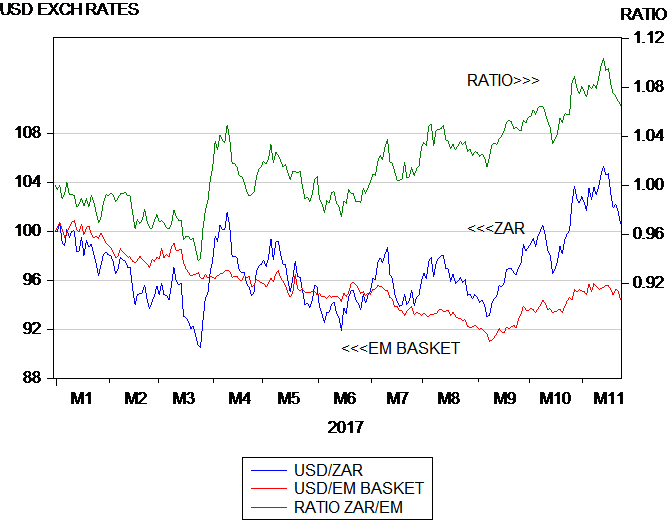
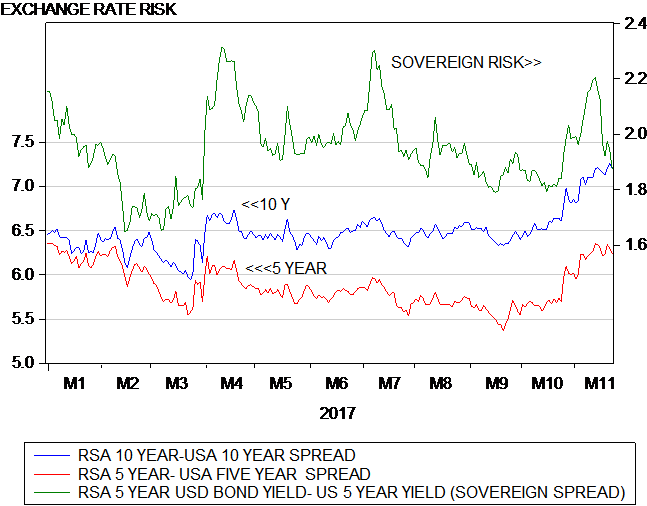
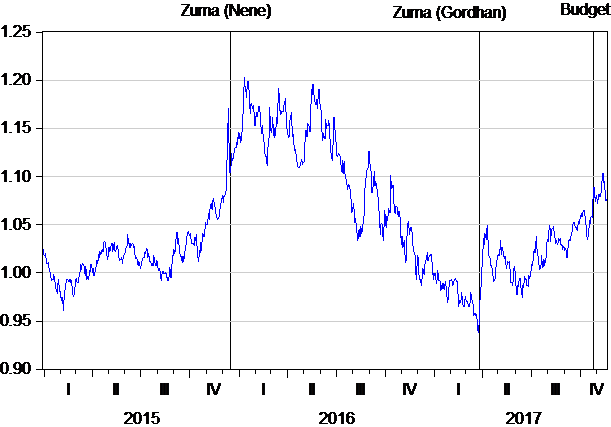
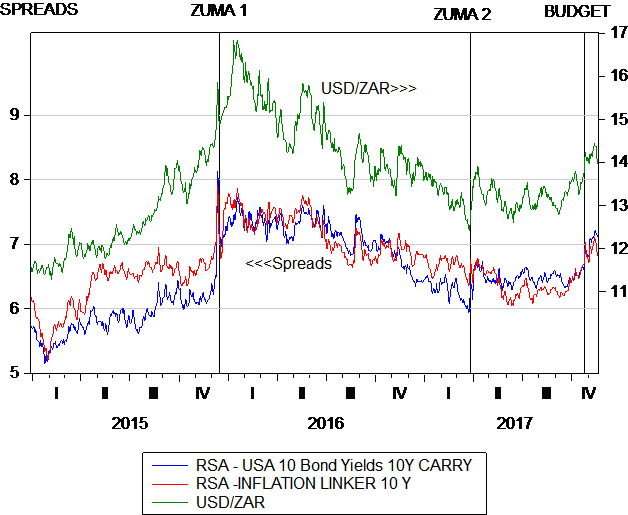
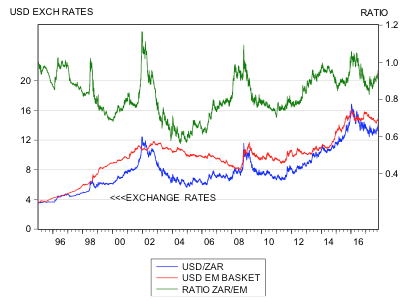
What then drives the exchange value of the rand? It is surely not any strong tendency for exchange rates to revert to PPP? The answer is that capital flows to and from SA drive the exchange value of the rand – as they explain emerging market exchange rates generally. The rand mostly follows the direction taken by emerging market (EM) currencies vs the US dollar as we show blow. It is the limited extent to which the rand behaves independently of its peers vs the dollar that explains the specifically SA risks that can independently drive the dollar/rand. These are shown by the ratio of the dollar/rand to the US/EM basket.


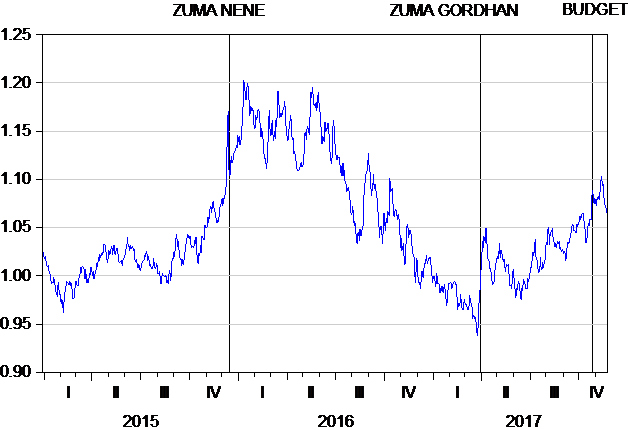
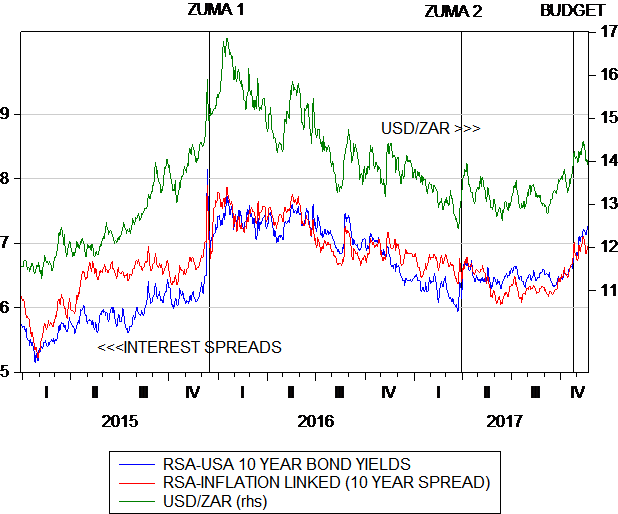
As may be seen, when we compare the performance of the rand to a fixed weight basket of nine other EM exchange rates vs the dollar, the rand has been in very weak company since 2014. Though in better company after 2016 when EM currencies and the rand improved vs the US dollar. The rand, as may be seen, did weaken in a relative sense with the Zuma interventions in the Treasury, especially in late 2015 when he dismissed Finance Minister Nene. The positive reaction in the currency markets to the succession of Cyril Ramaphosa in late 2017 may also be identified by an improved rand/EM ratio. But despite the importance of these political events for South Africa it would appear that the predominant influence on the exchange value of the rand over the years have been global economic forces, common to many EM economies, rather than domestic politics and policy intentions.

Moreover the potentially helpful effect of a weaker, inflation-adjusted rand on SA exports have been overwhelmed by unfavourable price trends themselves. Especially of the US dollar prices of metals and minerals that make up such a large part of our exports. These price trends linked to global growth trends themselves help explain capital flows. Capital flows in when the outlook for the mining sector and the economy improves and vice versa when the outlook deteriorates and prices fall away

As we show in the chart below exports and imports, valued in US dollars, grew very strongly, by about three times, between 2002 and 2010. The prices SA exporters received in US dollars more than doubled over the same period, as is also shown. The price and volume trends since then have been in the reverse direction – until very recently. The super commodity price cycle came and then went and the exchange rates went inevitably in the same weaker direction.

Yet not all has been bad news for SA exporters, especially those supplying foreign tourists – for whom the undervalued rand has proved a great attraction. The travel statistics of the balance of payments show a dramatic improvement in recent years. Travel receipts from foreigners, measured in US dollars, have been well sustained as payments for foreign travel by South Africans have trailed away (see below).

SA receipts from travel by foreign visitors are now running at about a US$10bn rate that now compares quite well with the value added by the mining sector- also shown in dollars below.

Would it be unfair to say that the achievements of SA tourism – extra income, employment and taxes paid – owe something to the exchange rate and perhaps as much or more to the helpful absence of any Tourism Charter? Conventional property rights have been more than sufficient to the purpose of increased supplies. As they would be helpful to mining output, threatened as it has been by the Mining Charter. 30 August 2018

Talking Turkey about the rand

How best to respond to rand weakness that has nothing much to do with SA

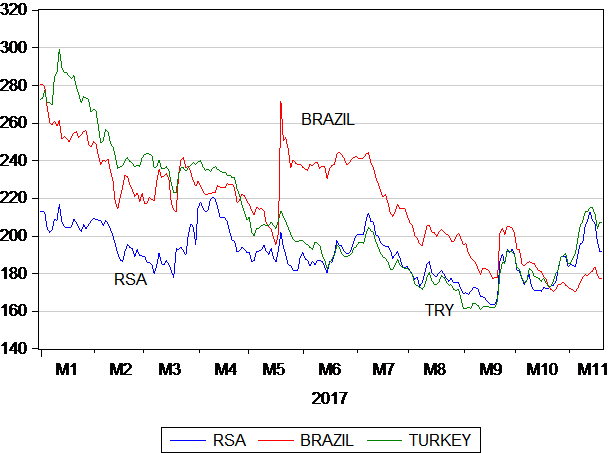
The SA economy has been subject to a new sharp burst of unwelcome rand weakness. Weakness that would appear to have little to do with events political or economic in SA itself. It has been a reaction to the shocks that have overwhelmed the Turkish lira. Weakness in other emerging market exchange rates has been part of the collateral damage.

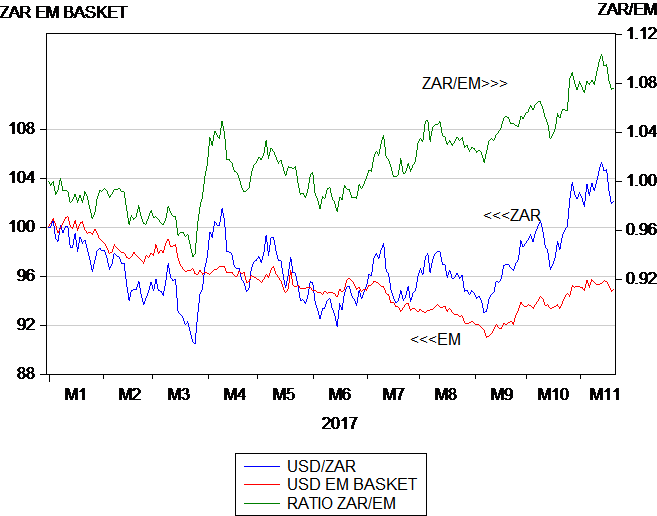
The Turkish lira has lost 34.79% of its US dollar value since the July month end – from USD/TRY4.91 to USD/TRY6.96 by 14h00 on 13 August. The USD/ZAR was 13.27 on the morning of 1 August and was at 14.38 yesterday afternoon, a decline of 7.97%. But it should be recognised that the rand has been a marginal underperformer within the emerging market (EM) peer group. The JPMorgan EM currency benchmark, which includes the Chinese Yuan with a 11% weight, has lost 6.1 per cent of its USD value over the same period (see figures below where in the second, the relative to other EM currencies underperformance by the rand, shows up as a higher ratio).


A weaker rand leads to more inflation that depresses the spending power of households. It may also lead to higher interest rates, given the reaction function of the Reserve Bank. The Reserve Bank believes that higher inflation will lead to still more inflation expected and hence still more inflation as a self-fulfilling process. That is unless demand is suppressed even further with higher interest rates. This is described as the danger of so-called second round effects of inflation itself (for which incidentally there is little evidence, when demand is already so depressed). The typical SA business now has very limited power to raise prices, as has been revealed by little inflation at retail level. A still weaker rand is likely to further restrain operating margins and the willingness of SA business to invest in plant or people.

We have long argued that this represents a particularly baleful approach by the Reserve Bank to its responsibilities. We have recommended that the Reserve Bank not react to exchange rate shocks, over which they have little influence. Moreover, that raising interest rates can further depress demand without having any predictable influence on the exchange rate itself.

Indeed we have argued that slow growth itself weakens the case for investing in South Africa. Slow growth to which monetary policy can contribute adds investment risk without any predictable influence on inflation because the value of the rand is itself so unpredictable.

The best the Reserve Bank can do for the economy at times like this, when the rand is shocked weaker, is to say very little and do even less and wait for the shock to pass through – as it will in a year or so. The statement of the Deputy Governor, Daniel Mminele, made yesterday that “The South African Reserve Bank won’t intervene to prop up the rand unless the orderly functioning of markets is threatened” is to be welcomed.

The weaker rand, for whatever reason, discourages spending and weakens the case for investing in any company that derives much of its revenue from South African sources. Companies listed on the JSE that derive much of their sales offshore stand to benefit from higher revenues recorded in the weaker rand. These include the large global industrial plays that dominate the Industrial Index of the JSE by market value. Included in their ranks are Richemont, British American Tobacco and AB Inbev.

Even better placed to benefit from a weaker rand will be companies with revenues offshore but with costs incurred in rands. The increase in these rand costs of production may well lag behind the higher revenues being earned in rands, so adding to the operating margins enjoyed. Resource companies quoted on the JSE with SA operations fall into this category. Kumba and the platinum companies, as well as Sasol, are examples of businesses of this kind.

But the appeal of global and resource plays for investors will also depend on the prevailing state of global markets. Global strength will add to their value measured in USD and even more so when these stable or higher dollar values are translated into rands at a weaker rate of exchange. In such circumstances, when the rand weakens for SA specific reasons, rather than for adverse circumstances associated with a weaker global economy, the global and resource plays on the JSE have additional appeal.

The additional weakness of the rand, when compared to other EM currencies, may well have added to the appeal of JSE global and resource companies. The movements on the JSE on 13 August – at least up until mid-afternoon – do suggest that a degree of rand weakness for partly SA specific reasons- has been helpful for the rand values of the JSE global and resource plays. This is shown below. The global industrial plays and Naspers, another very important global play, have moved higher with JSE Resources. The SA plays have weakened as may also be seen and would have been predicted.

The news about the global economy may not have improved with the Turkish crisis. Nor however is the global economy greatly threatened by the state of the Turkish economy. The weakness of the Turkish Lira would appear to have much to do with the unsatisfactory state of Turkish politics. The risk is that Turkey is less willing to play by the rules of international diplomacy and business and may be isolated accordingly. A serious spat with the USA has led to economic sanctions being placed on leading Turkish politicians to which Turkey has responded with outrage rather than negotiations with the US.

The lesson for South Africa is to remain fully committed to global trading and financial conventions. To reinforce its attractions as an investment destination at times like this when the rand comes under pressure. This will help support the rand and the prospects for the SA economy. 14 August 2018

Is pessimism about the SA economy overdone?

The SA economy: will it gain relief from a stronger rand and less inflation?

The SA economy (no surprise here) continues to move mostly sideways. Growth in economic activity is perhaps still slightly positive but remains subdued. Two hard numbers are now available for the June 2018 month end: for new vehicle sales and the real supply of cash – the notes in issue adjusted for prices that we combine to form our Hard Number Index (HNI) of economic activity. Because it is up to date, the HNI can be regarded as a leading indicator of economic activity that is still to be reported upon.

Its progress to date is shown below. It shows a falling off in activity in 2016 and a more recent stability at lower levels. It is compared to the Reserve Bank’s business cycle indicator based on a larger number of time series that continued to move higher in 2016-17 but has also levelled off in recent months. The problem with the Reserve Bank series is that it is only available up to the March month end for which GDP data is also available.


We show the growth in the HNI and the Reserve Bank cycle below with an extrapolation 12 months ahead. The HNI cycle suggests growth of about 1% in 2019 while the Reserve Bank cycle is pointing lower.


It is striking how well the real cash cycle (included in the HNI) can help predict the cycle of real retail sales. Retail sales volumes gathered momentum in late 2017 stimulated it would seem by an increasing supply of real cash. This momentum has however slowed more recently as inflation turned higher in the face of a weaker rand. Retail sales have been reported only to April 2018.

The key to any revival in domestic spending will be less SA inflation. And inflation will, as always, take much of its momentum from the exchange rate. The recent weakness in the rand has been a body blow for the SA consumer. It has little to do with events in SA and much to do with slower growth expected in emerging market economies, especially China. Where the dollar goes, driven higher by relatively stronger growth and higher interest rate prospects in the US, emerging market currencies, including the rand, move in the opposite direction.

The best hope for the rand and for the SA consumer is that the pessimism about emerging market growth has been overdone. If so some recovery in EM exchange rates can be expected – and that the rand will appreciate in line with capital flowing in rather than out of emerging markets. Some of these forces have been at work this week, helping the rand recover some of its losses and improving the outlook for inflation in SA. It may also if sustained even lead to lower interest rates in SA – essential if any cyclical recovery is to be had.

The importance of inflation for the business cycle is captured in this correlation table of key growth rates in SA. Inflation may be seen to be negatively correlated (and significantly so) with the growth in retail volumes and new vehicle sales. It is even more correlated (0.85) with the growth in the supply of real cash – that is in turn highly correlated with the growth in retail activity. And as may be seen, the growth in retail activity is also strongly correlated with growth the Reserve Bank’s cyclical indicator (Resbank) (0.80 correlated):


The problem for South Africa and the Reserve Bank that targets inflation, is that so little of the inflation experienced in SA is under its control. The exchange rate takes its own course – driven by global sentiment – so pushing prices higher or lower, that in turn drives spending lower or higher. Interest rates that may rise with more inflation and then fall with less inflation make monetary policy pro-cyclical rather than counter cyclical. 11 July 2018

Why China is so important to SA

The outlook for the SA economy depends on China

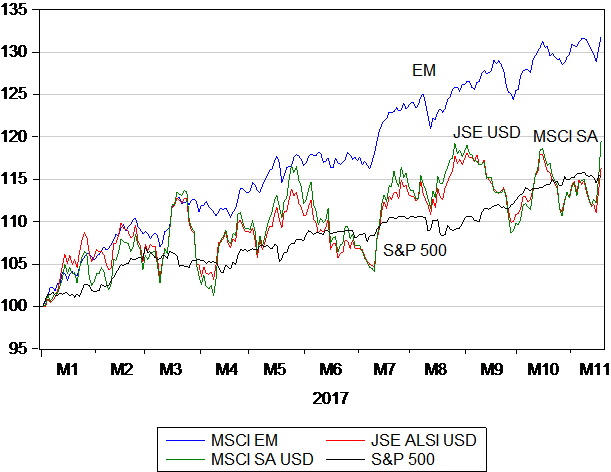
Emerging markets (EMs) and their currencies enjoyed a strong comeback in 2017, after years of underperformance when compared to the S&P 500. The JSE All Share Index kept pace with the S&P 500 in 2017 in US dollars. An EM benchmark-tracking stock would have returned over 40% in the 12 months to January 2018 while the S&P 500 delivered an impressive 26%, less than the 28% delivered to the dollar investor in a JSE tracker.

Investor enthusiasm for equity markets in general and for EM securities and currencies in particular however ended abruptly in January 2018 and waned further in April. The EM equity drawdowns since January have been depressingly large. The MSCI EM Index and the JSE have now lost about the same 16.5% of their end January US dollar values, while the S&P 500 was down by a mere 4% at June month-end.


The carnage was widespread across the EM universe. The SA component of the EM Index, with a weight of 6.5%, has been an averagely poor EM performer in 2018, as shown in the figure below. Turkey is the worst performer in 2018, down nearly 30% in US dollars in the year to June. The All China component of the EM benchmark, with a large weight of 31.7%, has lost about 12% over the same period, with much of this loss suffered since March, including a large 7% decline in June. The Brazil Index has suffered a heavy 27% decline in its US dollar value in the past quarter.


The capital that had flooded into EMs and their currencies in 2017 has rushed out even more rapidly, presumably back to the US, so driving the US dollar higher and other currencies, especially emerging market currencies (including the rand) weaker. The rand has traded mostly in line with its peers in 2018, though it has lost ground to them recently.


It should also be recognised that the similar flows of dividends and earnings from the JSE and EMs over many years, in US dollars shown in the figure above, is not some co-incidence. It is the result of the similar economic performance of the companies represented in the two indices.

The JSE has been well representative of the EM universe taken as a whole, when measured in US dollars. Naspers, with a 20% weight in the JSE All Share Index and a close to 30% weight in the SA component of the EM benchmark, is largely a Chinese IT company. Naspers is riding on the coattails of its subsidiary Tencent, and this helps account the similar behaviour of the respective indices.

In the long run, it is past performance reflected by earnings, dividends and return on capital invested that drives equity valuations, not sentiment. Reported dividends, discounted by prevailing interest rates, do a very good fundamental job in explaining the level of an equity index over time. In the short run, expectations of future performance (sentiment), will move markets one way or another, as they have moved equity markets in the past.

The sell-off in EM equity markets is not explained by their recent performance, which has benefited from synchronised global growth. It reflects uncertainty about the prospective growth in dividends and earnings and therefore global growth rates to come. We may hope that pessimism is being overdone.

The impact of the performance of companies that operate in China, on the outcomes for EMs generally (including SA), cannot be overestimated. Not only is the direct weight of China in the equity and currency indices a large one, but China is an important trading partner for all other emerging market economies.

Therefore the ability of China to maintain its growth and trading relationships successfully and manage its exchange rate predictably and responsibly will be a vital contributor to the prospects for all EMs. Realised global growth, including growth in the US, Europe and China, will determine the outcomes for EM equity and bond markets and exchange rates. The performance of the global economy and the companies dependent upon it are as good or better than they were a year ago.

The performance of the SA economy would be assisted by a stronger rand and damaged by a weaker rand that moves inflation, interest rates and spending faster or slower. Exchange rate and inflation trends in SA are bound to follow the direction taken in all EM economies, especially China. We must hope that renewed respect for growth in China will make this happen. Our immediate economic future depends more on what happens in Beijing than in Pretoria. 5 July 2018

The mining charter- its true purpose

Version published in Business Day 23rd June 2018


There is much to be gained from a thriving mining sector. Its promise for growing incomes is as great- perhaps greater than any other sector of the SA economy- given the opportunity. There would be extra income to be earned on the mines and rigs and additional taxes paid by many more workers. There would be more jobs gained and increased incomes earned supplying goods and services to additional mining enterprises.


Exports would grow and the balance of payments would benefit from inflows of permanent mining capital. The exchange value of the rand would become less vulnerable to outflows of portfolio capital – to the advantage of all businesses and their customers in our economy.


The recipe to stimulate rapid growth in mining activity is simple It is to make the rules and regulations applied to the owners of mining companies at least as attractive as anywhere in the world.. Applied to capital that realistically can only be expected from well-established, well-diversified global mining companies with the appetite for taking on mining risks and the balance sheets and borrowing capacity to do so.


And wouldn’t it be a game changer for exploration activity were ownership of the rights to the potential value below the surface be transferred from the state to the owner of the land above. Including to communities with traditional rights to graze or plant land that could be far more valuable than they can possibly know before exploration. Rights ceded in exchange for a significant betterment tax should ownership be transferred to a mining company received on transfer from the buyer.


However the newly proposed and amended mining charter informs us very clearly that this more competitive landscape for mining is not about to happen. The intention is to put onerous constraints on the powers of owners to manage a mine as best they might. Owners will be required to contract with suppliers, directors and managers and partners with preferred legal status rather than chosen on merit. It imposes further controls on how they have to share the benefits of ownership and the capital they will have put at risk. With partners not necessarily of their own choosing or on terms chosen by them should the mine prove successful.


They will be required to pay taxes and royalties and declare dividends based on cash flows, not on normal accounting principles. For fear – not doubt legitimate – that taxable income might be minimised by transfer pricing – reducing revenues and raising costs. Or by exaggerating the interest paid on loans provided by holding companies residing in no tax or low tax jurisdictions. Interest payments (expensed for tax purposes) that are intentionally more like capital repaid.


Eliminating tax avoidance and applying the complex regulations will take a costly to taxpayers and owners army of competent officials on both sides of the fence to hopefully ensure compliance.


It would be much more sensible if mining companies in SA were not subject to any income taxes at all. This would eliminate all attempts to minimise tax payments and protect the tax base. All income distributed by companies as employment benefits, rents, interest dividends or capital repayments can instead be taxed in the hands of the receivers- reported by the company making the payments. Compliance becomes much less onerous and the case for investing much improved – to the great advantage of mining output.


It should be very clear therefore that the intentions of the mining charter are not to stimulate mining output and employment. Its primary purpose is to redistribute its benefits. The mining charter is symptomatic of this approach to economic development in South Africa. Redistribution at the expense of potential growth. The consequential sacrifice of growth, so balefully apparent, should not be regarded as unintended.

Looking at the hard numbers

Our review of the state of the SA economy indicates a modest but welcome pick-up in economic activity. This was driven by lower levels of inflation particularly at retail level where even some lower prices helped spur spending by households.

Unfortunately the suddenly weak rand will reverse inflation trends and slow down spending all over again. As Mike Tyson said, everybody has a plan in the ring until they get hit in the face. Consumers have had to take another punch in the form of a weaker rand that will soon show up at the stores. They will depend on the Reserve Bank rolling with the punch: leaving interest rates unchanged to soften the blow of higher prices. The real danger is that the Bank will do the opposite and raise rates, doing nothing for the rand and only depressing spending further.

We have updated our index of the current state of the SA economy with data released for May 2018. We call it the Hard Number Index (HNI) because it relies on two hard numbers that are provided very close to the month end. The data we rely upon and combine to form our Index are new vehicle sales, provided by the National Association of Vehicle Manufacturers (NAAMSA) and the cash (notes) in circulation issued by the Reserve Bank. The note issue is a liability on the Reserve Bank balance sheet, reported soon after each month end.

These are hard numbers and not the result of sample surveys that inevitably take time to collect and estimate. A further advantage in the May releases is that they are less likely to be influenced by the Easter effect that comes at different times in March or April, and so always makes seasonal adjustments very difficult to claculate accurately for those months. The seasons of the year do make a difference to vehicle sales and even more so on demands for cash that tend to rise as consumers intend to spend more on holidays, especially at Easter and Christmas.

The current state of the economy, according to the HNI, as of the May month end, is shown in the chart below (Figure 1). The HNI is compared with the Reserve Bank Business Cycle Indicator that has only been updated to February 2018 (an especially out of date measure given that disappointing first quarter GDP estimates have already been released). The disappoinment was that in the first quarter GDP, declined at a 2.2% annual rate. the economy will have moved on – hopefully forward.

The HNI may be regarded as a leading indicator of the SA business cycle and has served very well in this regard as may be seen in figures one and two. However the two series parted company to a degree after 2016. The HNI has pointed to lower levels of activity than the Reserve Bank Indicator. However in late 2017 the HNI stabilised and picked up some momentum. These trends, when extrapolated, suggest that the economy will stabilise at its current pedestrian pace for the next 12 months.

We show the second derivative of the business cycle in figure 2, the growth in the economic indicators. As may be seen the growth in the Reserve Bank activity indicator has been slow but persistently slow in 2017 and 2018. The HNI has recently turned from negative to positive growth.

The components of the HNI have shown a different direction. Supply (and demand) for cash, adjusted for prices, has shown a welcome upward direction, and is forecast to be sustained over the next 12 months. However vehicle sales, while they have shown a modest recovery in 2017, are pointing marginally lower: down from their current annual rate of about 546 000 new passenger cars sold, to a marginally lower rate of sales of 535 000 cars forecast to be sold this time next year. See figures 3 and 4.

The pick-up in the real cash cycle was assisted by less inflation in 2017. Figure 5 compares the growth in the value of notes issued (at face value) with the slower inflation adjusted rate of growth.

The increase in prices at retail level has been unusually lower than headline inflation in recent months. In March 2018, retail inflation was running at 1.6% compared to headline inflation that month of 3.8% that increased to 4.5% in April. This pick up in what are spending intentions, hence demands for cash, would be faster if prices were measured at retail rather than headline inflation.

Lower levels of retail inflation in 2017 owed much to the end of the drought, the recovery of the rand and the weakness of spending at retail level that gave retailers very little pricing power. The consequently lower inflation rates at retail level – sometimes deflation – undoubtedly helped stimulate extra spending at retail level in late 2017. The real money cycle is almost always closely linked to the cycle of retail sales volumes as we show in figure 6.

As we show in figure 7, measuring the increases in the real supply of cash using retail prices rather than the CPI accords better with the faster pace of retail sales volumes in recent months.

It may also be seen in figure 8 that the forecast for both is for slower growth over the next 12 months. Both the growth rates in real cash and real retail sales are forecast to slow towards a three per cent per annum pace by early 2019.

The recent weakness in the rand will not be helpful in this regard. It will mean more inflation and so more pressure on the spending power of households. We may hope that the Reserve Bank will not be adding to this depressing effect on spending by raising interest rates and also doing nothing to help the rand while only slowing down economic growth further. 13 June 2018

Retail peaks and troughs

Retail spending has gathered momentum. Have we reached a (low) peak in the retail cycle?

The volume of retail sales in South Africa has gained momentum, off a very weak base. By March real sales were up 4.8% compared to a year before. Will this cyclical recovery in spending at retail level accelerate or fall back? The answer will depend on the future path of inflation in SA, to which short term interest rates and the cost of credit for households and firms are linked. The future path of the rand will be critical to the inflation outcomes, as we discuss below.

This growth in spending was stimulated by a sharp decline in retail inflation from early 2017 (see figure 1 below). Retail inflation in March 2016 was 7.4% and declined steadily to 1.6% in March 2018. Retail sales growth was a negative 1.7% in December 2016. Growth in sales a year later was over 5%. The real sales cycle was at a trough when the retail price cycle was at its peak in Q4 2016.

(Retail inflation is calculated as the annual change in the retail price deflator, being the ratio of retail sales at current prices to retail sales at constant prices. It has fallen far below headline CPI inflation that was 3.8% in March 2012.)

A large part of the answer to whether or not the retail recovery will accelerate or decelerate will depend on the direction of retail prices and on interest rates that will take their cue from the price trends. As may be seen in figure 1, the time series forecast is for a slowdown in sales growth from its peak and a modest pick-up in retail inflation from its recent trough. It will take rand strength to avoid these outcomes.

In figure 2 we show this clearly negative relationship (inflation up and sales growth down) over an extended period. It also shows how low the current rate of real sales growth is in comparison to the previous peak growth rates realised in 2006 and 2011. There would be little reason to regard the current rate of retail sales growth as representing a peak in the cycle – were it not for a concern that retail price inflation may have reached a cyclical trough.

The declining trend in retail and headline inflation since mid-2016 had much to do with the stronger rand. Another force acting particularly on food price inflation was the end of the drought in the eastern part of the country of 2016. The drought had pushed food price inflation to double digits. Food price inflation was 3.5% in March 2018. Inflation peaked after the USD/ZAR exchange rate had reached its weakest point in late 2015. And headline and retail inflation receded after the rand had come to strengthen on a year on year basis. Thus the future of inflation in SA will depend, as ever, on the exchange rate, given the openness of the economy to foreign trade. Exports and imports together add up to the equivalent of 60% of GDP.

We compare CPI (headline) inflation with retail price inflation in figure 3 below. We show the impact of the exchange rate on inflation in figure 4.


In figure 5 we compare the correlated movements in the USD/ZAR and trade-weighted rand. Both rand exchange rates are helpfully for inflation trends that still marginally stronger than they were a year ago, even after recent US dollar strength and rand weakness.


The key to the exchange value of the rand in the months to come (and so for the outlook for inflation) will be the behaviour of the US dollar. Dollar strength vs peers is likely to mean weakness in emerging market currencies, including the rand, as has been the case since mid-April. Dollar strength in 2014 was associated with emerging market currency weakness until mid-2016. A degree of dollar weakness, and rand and emerging market strength followed until very recently. It may be seen that since April 2018, renewed dollar strength vs the euro, yen, sterling and the Swiss franc has been associated predictably with emerging market and rand weakness.

The degree to which the rand moves independently of the other emerging market exchange rates as shown in the figures may be regarded as the additional SA-specific political events that can influence the exchange value of the rand. SA risks weakened the rand compared to other emerging market currencies in 2015 – and a diminished sense of SA-specific risks to investors strengthened the rand in a relative sense in 2016 and again in late 2017.

Thus it should be appreciated that most of what happens to the rand will reflect global forces acting on emerging market currencies generally, events over which SA has no influence. Nor are SA interest rates likely to influence the rand exchange rates in circumstances when global capital flows dominate exchange rate movements. In our view, with the Ramaphosa presidency now firmly in place, the exchange value of the rand in 2018 will be influenced largely by what happens to the US dollar and all emerging market currencies.

The recent strength of the US dollar is a clear danger to the rand and SA inflation. A stronger US dollar means rand weakness and more inflation in SA and at best stable short-term interest rates. More inflation and unchanged interest rates will hold back retail sales. A weaker dollar however would mean less inflation, possibly lower interest rates and continued strength in retail sales volumes.

The dollar strengthens when the US economy grows faster than other developed economies and vice versa. Relatively faster growth in the US means that US interest rates are likely to rise relatively to interest rates in Europe and Japan, so attracting flows into the dollar, as has been the case recently. More synchronised global growth is to be hoped for to restrain dollar strength and protect the rand and improve the outlook for inflation and growth in SA.

SA has little influence over the direction of the rand and hence inflation and the retail sales cycle. The best SA monetary policy can do in these circumstances is to let interest rates take their direction from the state of the economy and not the outlook for inflation – which is dominated by forces beyond interest rate influence. The danger to the economy comes from interest rate settings that react to the impact of a stronger US dollar on domestic inflation. 23 May 2018

What’s in a price?

What is in a price? And what does it all mean for our standard of living?

Automation, roboticisation and miniaturisation are changing wondrously the way we produce and consume goods and services, including the medical treatments that can keep us alive for longer and with much less morbidity. To which forces of change we could add the internet of things that connects us ever more effectively and commands so much more of our attention.

The benefits of this technological revolution that we can see and feel are not at all obvious however in the measures we use. We are informed that US productivity continues to grow very slowly. And real GDP is growing as slowly, as are wages and incomes adjusted for inflation. Apparently Americans are not getting better off at the pace they used to and are frustrated with their politicians they hold responsible.

Is our intuition at fault or the way we compare the prices of the goods and services we consume over time? All measures of output and incomes are determined in money of the day, calculated and agreed to in current prices. They are then converted to a real equivalent by dividing some sample of output or wages estimated at current prices, by a price index or a deflator. A price index measures the changes in the prices of some fixed “basket” of goods and services thought to represent the spending patterns of the average consumer. The deflator calculates the changes in the prices of the goods and services consumed or produced today, compared to what would have been paid for them a year before.

Both estimates attempt to make adjustments for changes in the quality of the goods and services we are assumed to consume. A car or a pain killer or cell phone we buy today on today’s terms may do more for us than it would have done at perhaps a lower price, or possibly a higher price (think dish washers or calculators) five or 10 years before. It is not the same thing we are making price comparisons with.

A piece of capital equipment today, robotically and digitally enhanced, is very likely to produce many more “widgets” today than a machine similarly described 10 years ago. And it may cost less in money of the day. It is a much more powerful machine and firms may well make do with fewer of them. Their expenditure on capex – relative to revenues – may well decline, indicating (wrongly perhaps) a degree of weakness in capital expenditure. The problem may not be a lack of willingness of firms to invest more, but how we measure the real volume of their investment expenditure – quality adjusted.

There is room for moving the rate at which a price index increases (what we call inflation) a per cent or two or three higher than they would be if quality changes were implied differently and more accurately. And if s,o GDP and productivity growth would appear as equivalently faster.

It is instructive that the US Fed targets 2% inflation – not zero inflation – because 2% inflation (quality adjusted) may not be inflation at all. And zero inflation may mean deflation (prices actually falling) enough to discourage spending now, to wait – unhelpfully for the state of the economy – for better terms tomorrow.

Over the past three months there have been no increases in prices at retail level in SA. The annual increase in retail prices (according to the retail deflator) fell below 2% in January 2018 and is far lower than headline inflation. (see below). The Reserve Bank would do well to recognise that the state of the economy – coupled with what the stronger rand provides businesses in SA – leaves both manufacturers and retailers with very little pricing power. Nominal borrowing costs – well above business inflation – are in reality applying a significant real burden for them. They could do with relief. 12 April 2019

The political economy of SA – promise and hoped for delivery

It is possible to get very rich from politics in an honest and old-fashioned way. Recent SA political and economic events prove so. Had you predicted that Cyril Ramaphosa would win the ANC election in December and ascend to the presidency of SA, and bought the rand and the shares and bonds that benefit from a strong rand, you would have done very well. And you’d have done even better if you had sold those securities (including the US dollar or euro) that weaken when the rand responds to good news about SA.

The USD/ZAR reached a recent low of R14.46 on 15 November. It is now R11.77, an improvement of about 20%. The rand has also gained 24% against the JPMorgan Index of emerging market exchange rates (FXJPEMCS), since then indicating it was South African-specific surprises rather than global forces that has driven the rand recently.

The cost to the taxpayer of issuing rand-denominated debt has fallen significantly. The yield on five year RSA bonds has fallen from 8.69% on15 November to 7.38% on 12 March that is by 1.31% or equivalent to a 16% decline in the cost of issuing new government debt of this duration. This even as US interest rates were moving in the opposite direction.

The extra yield SA has to offer investors in US Treasury bonds for five year money (the sovereign risk premium) has fallen from 206 to 139 basis points. Over the same period, enough to bring SA debt well within investment grade quality. A one per cent per annum saving on interest, given the volume of government debt to be serviced and rolled over, is worth about R6bn to the SA taxpayer (hopefully) or the recipient of extra government spending (alas more realistically).


A stronger rand means less inflation and encourages households (who do more than 60% of all spending in SA) to spend more on the goods and services to be supplied to them by SA business. And the more profitable firms in turn will then hire more workers and equipment to service their growing custom. And less inflation may bring a lower repo rate and mortgage payments to further encourage spending. Enough extra spending to at last spark a recovery in the economy that has been growing much too slowly for far too long.

These implications of the stronger rand has therefore been dramatically registered in the share market. Companies with revenues and earnings generated in SA, banks and retailers for example, have become more valuable. While companies listed on the JSE, whose main line of business is generated offshore, have lost value. An equally weighted group of 14 large offshore plays has lost about 20% of its rand value since mid-November (see figures 4 and 5 below).

By contrast the rand value of a group of 18 equally weighted large SA economy plays on the JSE has increased by about 25% over the same short period. Buying SA and selling the world on a Ramaphosa victory would have been very value adding. Simply buying the JSE – with its mix of global and SA plays would – as an exchange traded fund would do, would have been to miss the value adding bus. It is in surprising turbulent times like this that active managers earn their fees.


The government led by Ramaphosa could provide much more of the good stuff for the SA economy by delivering on the promise of better government. Better still for the economy and its growth would be less government. Officials should intervene less in the economy – and show more respect for business and market forces as the critical drivers of the economy. Government should tax business income at lower rates and avoid subsidising other businesses that survive only with government aid.

Less intrusive government and consequently lower compliance costs would allow small businesses to compete with large businesses. And, more important, to free up the market for workers that leaves so many unemployed.

Government should also show a genuine willingness to sell off rather than add capital to the companies it owns: firms that survive to protect their employees from the performance indicators that private owners would demand of them – and reward accordingly.

The cabinet should recognise that its current set of economic policies of high spending and tax – ever more intervening government – has been a primary cause of the debilitating slow growth realised in recent years. A mix of all of the above policy recommendations would deliver economic growth and votes. A still weak economy could lose the ANC the next election in 2019. 15 March 2018

Retail therapy

The SA economy is being helped along by lower inflation at the retail level

The SA economy did surprisingly well in the fourth quarter of last year. GDP grew at an annual rate of over 3%. The demand side of the economy did just as well, growing at the same rate as supply, which was augmented by a strong seasonal recovery in agricultural output. Demands from households, which account for 60% of all spending, increased by an annualised 3.6% in the quarter, well above recent trends, while expenditure on capital goods increased even more robustly by 7.4% annualised. Imports increased significantly faster than exports, so reducing GDP growth, but found their way into increased holdings of inventories – enough to offset the impact of the growth in imports (up 23%) and the negative trade deficit on GDP. Imports add to supply – the increase in inventories adds to demand.

The strength in household spending – essential to any cyclical recovery – was reflected in a strong recovery in retail sales volumes. These were growing at close to a 6% annual rate in the fourth quarter. Such growth was assisted by low rates of retail price inflation. The prices of goods and services at retail level were largely unchanged in the fourth quarter; hence sales in constant prices were rising as rapidly as were sales measured in prices of the day. Clearly consumers were getting the benefit of the end of the drought (lower food prices) and the stronger rand and presumably strong price competition at retail level.

The figures below tell the story of price competition and its effects. Extrapolating recent trends suggests that prices at retail level will be rising at a very slow rate in the months to come. The recent strength in the rand will be adding to these disinflationary, if not deflationary pressures in the months to come and will help to stimulate household spending. A time-series forecast of retail volumes indicates that they could retain a brisk growth pace of around 6% over the next 12 months.


Retail sales and price statistics are available only up to December 2017. Two more up-to-date hard numbers have been printed for the February 2018 month end, that is for vehicle sales and the cash (notes and coin in circulation) supplied by the Reserve Bank. We combine these indicators into a Hard Number Index (HNI) of economic activity in SA. As shown below, this index may be regarded as a good leading indicator of the business cycle in SA (itself only updated to November 2017).

As we show in figures four and five, according to the HNI, the economy has picked up some positive, though modest momentum, consistent with the 3% GDP growth realised in the fourth quarter.


The growth in the components of the HNI are shown below. As may be seen both the vehicle and the real cash cycles have recovered from their low points of mid-2017. However the impetus for the economy provided by cash in circulation and vehicle sales volumes is forecast to wane somewhat in the months ahead – absent any stimulation from lower interest rates.

The real cash cycle (notes/consumer prices) provides a consistently helpful predictor of the trends in retail volumes, and had been doing so recently, as we show below in figure 8. Were we to use retail prices rather than consumer price inflation to deflate the supply of cash, we might derive a better indicator of retail sales volumes. The divergence between CPI and retail inflation has become unusually large. It reflects the intense competition for strained household budgets. It surely provides a better measure of the lack of demand-side pressures on prices and supply side forces (exchange rates and drought) acting on prices in SA. The CPI is more exposed to administered prices and tax rates. The Reserve Bank would do well to acknowledge how low business inflation is in SA and lower interest rates accordingly to encourage households to spend more for the sake of a much desired economic recovery – with low inflation. 13 March 2018

The SA economy – some Christmas cheer

The incipient cyclical recovery identified in our last report on the state of the SA economy has been confirmed by the most recent data releases. New vehicle sales and the supply of cash to the economy at November month end both support the view that the economy is demonstrating resilience.

We combine these up to date, hard numbers (not based on sample surveys) to calculate our Hard Number Indicator (HNI) of the business cycle. As we show in figure 1 the HNI is now pointing higher after showing little momentum after 2014 and having moved lower in 2016. The annual change in this indicator (the second derivative of the business cycle) has moved into positive territory and is forecast to maintain this momentum.

The components of the HNI are shown below. The real money base, the note issue, adjusted for the CPI (to November 2017) has become less negative while the new vehicle sales have maintained an encouraging revival.

If recent vehicle sales trends are maintained, new vehicle sales would be running at a 600 000 unit rate at year end 2018. This would represent a welcome recovery from the cyclical trough of mid-2016 but would still leave sales well below the previous peak rates of 2006 and 2012-2014.

Sales volumes at retail level, excluding motor vehicles, have been reported for October 2017. They show that the retail sales cycle continues its upward momentum and is pointing to growth rates of about 3% through 2018. This growth will be assisted by the growth in demands for cash. Extra cash is still a very good coinciding indicator of retail spending intentions despite all the digital alternatives to cash in SA (see figure 4).

Perhaps a more important encouragement for households to spend more is that prices at retail level have hardly increased over the past few months. The retail price deflator has moved sideways even as the CPI continues its upward trend, though also at a more modest rate. Hence the trend in inflation at retail level is sharply lower and, if sustained, will prove a stimulus to spending (see figures 5 and 6). The key to the door of lower prices at retail level is the exchange value of the rand. The outcome of the ANC succession struggle at Nasrec this weekend will be well reflected in the rand and in turn in retail spending and inflation. 14 December 2017

ANC elective conference – what are the odds?

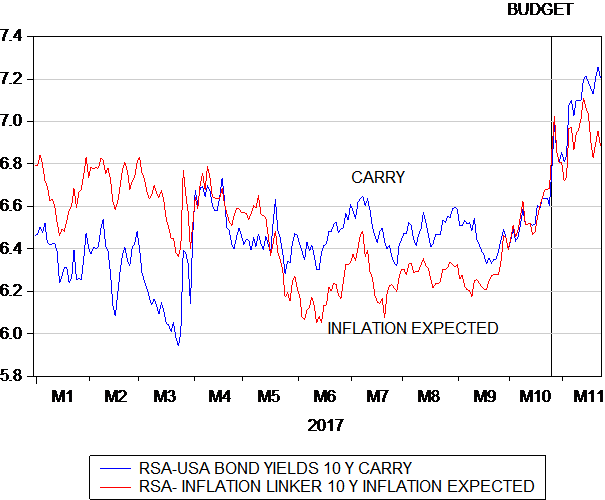
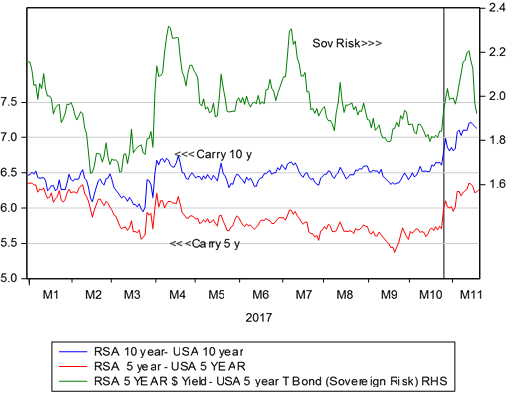
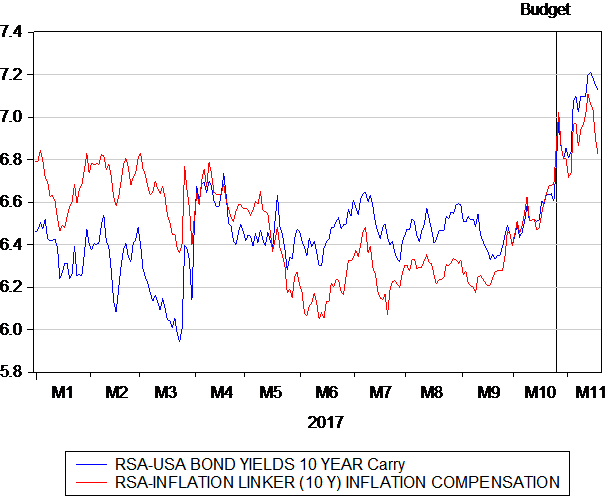
The markets have been recording their judgements about the outcome of the battle to succeed President Jacob Zuma as leader of the ANC to be decided over the next few days. The prospects of Cyril Ramaphosa succeeding has been recorded in the degree of rand strength versus its emerging market peers. As we show in figure 1 below, the rand weakened in response to the appointment of Minister of Finance Malusi Gigaba in March and weakened further after he presented his mini-Budget statement in October. Since then, and despite a very critical report from the credit rating agencies and a downgrade, the rand has recovered strongly – in an important relative sense – and not only versus the US dollar.

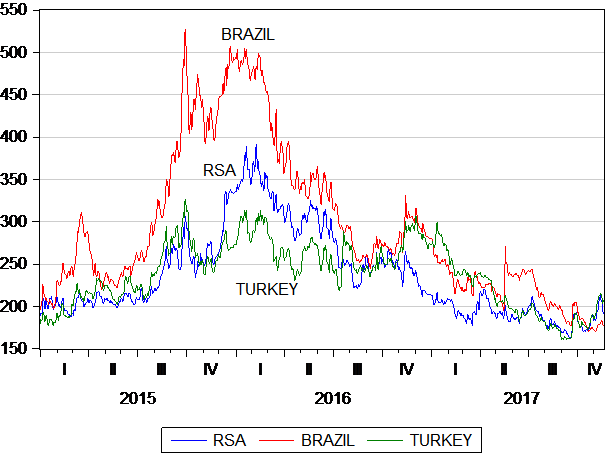
The same improvement in sentiment is revealed in the market for US dollar-denominated RSA bonds. As we show in figure 2, the spread between the interest rate yield on five-year RSA bonds and five-year US Treasury bonds that offers compensation for extra SA risks of default, has also narrowed from 2.2% in early November to about 1.8% on 14 December.

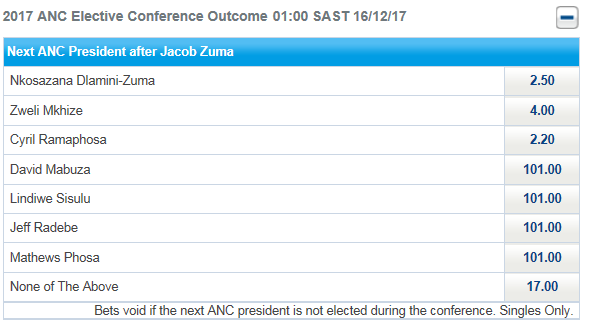
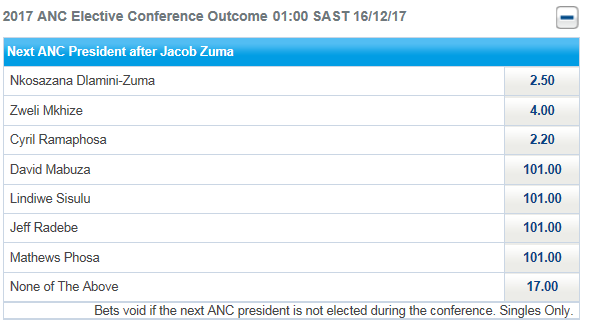
A still more direct measure of the probabilities of one or other candidate being first past the post is provided by online sportsbook operator Sportingbet (https://www.sportingbet.co.za).

When their books first opened the odds on the various potential candidates – or those not yet identified were as shown below. The favourite was Nkosazana Dlamini-Zuma with a 42% chance of winning (1/2.4) while Cyril Ramaphosa was given only a 27% probability of winning, less than the chances of Zweli Mkhize.

The decimal odds are now as shown below. Ramaphosa is the firm favourite, given a 57% chance of winning compared to a 33% chance for his closest rival Dlamini-Zuma. The odds on any other outcome have blown out.

The volume or value of bets cast is not disclosed, but we are informed by Sportingbet that 65% of the bets and 61% of the stakes have been cast for Ramaphosa, while 21% of the bets have been placed on Dlamini-Zuma and a larger proportion (36%) of the stakes cast for her. These books will close on Saturday 16 December and we are informed by the firm, who describe themselves as operator of South Africa’s largest online sportsbook:

“Unfortunately, as part of our trading risk management policy, and as a company policy, we never disclose amounts wagered, numbers of bets, or users on any single event. I can share however that considering it’s a “novelty” (or non-sporting event) market, the bet activity and interest on this is impressive. “

There is a great deal at stake for the economy in the ANC race for the top. Clearly, judged by the markets and the odds and the politically savvy involved, there are no certain outcomes. Were therefore the favourite to win and the more decisive the victory, the stronger the rand and the lower the risk spreads – and so the chances of a strong SA economic recovery. Perhaps something those casting their votes might bear in mind. 15 December 2017

Hail to the SA consumer

The South African economy cannot be said to be performing to its potential. But in one important sense it is performing well – for consumers. Those with income or borrowing capacity will not find the economy wanting when they come to exercise their spending choices over the holiday season.

The shops will be well stocked and able to meet their every demands and desires, be it for essentials or luxuries supplied from all parts of the world. They will not lack for bread or toilet paper or for wine, beer or spirits. Or lack for wonderful world class entertainment at the theatres and movie houses. The book shops will be well stocked for those who still regard reading as entertaining and valuable. Excellent restaurants of all ethnic persuasions will be open to them, but may require an advance booking, given the competition from foreign tourists, who are showing their increased appetite for what we enjoy at the prices we pay.

This is as it should be. Successful economies gained their cornucopias by putting the demands of consumers in first place. That is preventing producers, farmers or factory owners or avaricious rulers or ecclesiastical orders or soldiers to decide what is to be produced. And when consumers largely rule the economy and producers are required to respond to them, economies flourish. Doing it the other way round – for the state to put the interest of producers, including those employed by them – whose own well-being is always threatened by competition – is a recipe for economic failure and for stagnation and corruption and the waste of the opportunity to consume more.

A consumer-led economy need ask very little of the state. The State and its officials will not be called upon to design industrial policy or determine development plans, policies that require foresight that is simply not available to even the best informed and least self-interested official. What the effective State has to provide is the protection of contracts freely entered into and the capital of those who have saved and puts their capital and skills to work, hoping to satisfy their customers and be rewarded for doing so.

The state should also ensure that the success or failure of businesses, large and small, is determined by their sales to customers and the costs of doing so. Not where financial success is dependent on an ability to negotiate a morass of regulation and relations with powerful officials. This system inevitably advantages bigger business over their smaller rivals.

A consumer-led economy is a continuous process or trial and error, of firms learning and adapting to unpredictable circumstances. The winners and losers for the consumers’ spending power emerge – they are not chosen by planners. South Africa incidentally, since 1994, has spent hundreds of billions of rands – perhaps over 400 billion rands of them – in subsidising industries of one kind or another with taxpayers’ money or tax concessions, money that could have been put to much better effect by consumers, especially poor ones.

The South African government alas appears only too willing to continue to put producers and officials first. For example competition policy is directed to serve industrial and labour policy rather than protect consumers.

More important for economic development, given that education and training precedes the ability to produce, earn and consume more, it is tragically the educators, the producers, who are first in line when the huge government budgets for such purposes are allocated. Were the taxpayer to pay the fees to enable all those desperately seeking education and training to attend private schools, universities and training establishments, of their own choosing, the valuable customer would come first. And the outcomes in the form of additional employment and incomes would be far superior.

The market for jobs in South Africa – why it performs so poorly and what can be done to improve it

Piece written for the Free Market Foundation: http://www.freemarketfoundation.com/publications-view/the-market-for-jobs-in-south-africa-%e2%80%93-why-it-performs-so-poorly-and-what-can-be-done-to-improve-it-

A pdf version is also available here.


Exchange rate risks for international businesses and investors: why South Africa is not unique

The global economy remains hostage to a volatile US dollar

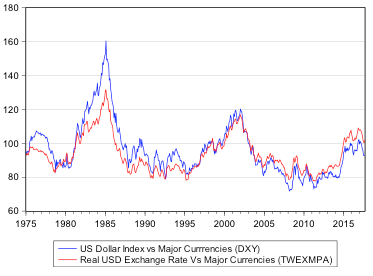
The US dollar continues to serve as the primary international unit of account and as the pre-eminent reserve currency held by central and other banks, yet the rate at which the US dollar is exchanged for other currencies remains vulnerable to large moves in both directions, so adding risks to all financial transactions that make reference to it. In figure 1 below, we show the performance of the US dollar against its developed market peers (The US dollar index or DXY). We also show the real dollar exchange rate against the same major trading partners. The real exchange rate adjusts the nominal trade-weighted exchange rate for differences in inflation rates. We discuss the economic importance of real exchange rates further below. However, it should be noted that the real and nominal US exchange rates have followed a similar pattern.

Figure 1: The trade-weighted real and nominal exchange value of the US dollar (1975=100)
p1

Sources: Bloomberg, The Federal Reserve Bank of St. Louis (Fred Data Base) and Investec Wealth & Investment

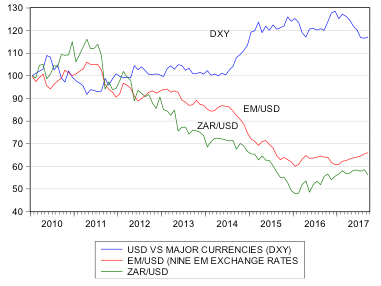
In figure 2, we show the performance of the US dollar against its developed market peers, an index of emerging market exchange rates since 2010 that excludes the rand, and the rand/US dollar rate.

Figure 2: The US dollar vs. major currencies, an emerging market currency basket and the rand (higher numbers indicate exchange rate strength), monthly data (2010=100)
p2

Sources: Bloomberg, The Federal Reserve Bank of St. Louis (FRED database) and Investec Wealth & Investment

The extraordinary strength of the US dollar in 2014 was associated with a high degree of emerging market (and rand) exchange rate weakness. Also note that a degree of US dollar weakness that begins in mid-2016 has been associated with a recovery in the emerging market basket (and the rand). US dollar volatility poses particular challenges for monetary policy in emerging economies. We return to this important issue below.

The real exchange rate is what matters for real business activity

Inflation can make a producer or distributor of goods or services less competitive in home and foreign markets. However, a weaker exchange rate can protect operating margins against those rivals subject to less inflation. What may be gained or lost in the ability to compete on price – when expressed in any common currency – can be offset by changes in the rate of exchange.

When the offset is complete, the exchange rate will have weakened or strengthened by the percentage differences in inflation in the home country and that of its trading partners. If such circumstances, the exchange rate would be said to conform to purchasing power parity (PPP). Thus, PPP is regarded as a theoretical equilibrium to which exchange rates will converge in time.

The deviations from PPP-equivalent exchange rates are used to calculate a real exchange rate. It is this real exchange rate that defines the competitiveness of prevailing market-determined exchange rates. A real exchange rate with a value of more than 100 indicates an overvalued exchange rate and a value less than 100 indicates a competitive or undervalued exchange rate. The direction of the real exchange rate towards or away from 100 shows whether domestic producers have become more or less internationally competitive.

The calculation of a real exchange rate can include multiple exchange rates and an equivalent number of inflation rates – weighted by the share of imports and export held by different trading partners. The prices of relevance for the calculation of inflation and the real exchange rate are usually derived from prices charged for the manufactured goods that are presumed to dominate international trade.

The history of flexible exchange rates in SA shows that, the USD/ZAR exchange rate as well as the trade-weighted rand exchange rate, have consistently deviated from PPP-equivalent exchange rates and in varying degrees (see figures 3 to 5). This indicates that when SA firms engage in foreign trade and have to compete on the domestic market with imports this is a risky activity, given the variability of the real exchange rate and operating margins.

Measuring real exchange rates – a focus on South Africa

These divergences from PPP-equivalent exchange rates, i.e. fluctuations in the real rand exchange rate, are large and variable. This real rand exchange rate volatility for the rand is linked to the removal of exchange controls on foreign investors that were effectively withdrawn in 1995. There was a brief period of real exchange rate volatility, between 1983 and 1985, when foreign investors were also free to move funds into and out of South Africa. A further source of capital flows has been the progressive relief on the exchange controls applied to South African residents.

Freer capital flows rather than trade flows have dominated the demand for and supply of rands exchanged for US dollars and other currencies, and has introduced significantly more rand exchange rate volatility . It is the flow of global capital that has similarly dominated exchange rate trends in all economies that are open to this free flow of capital.

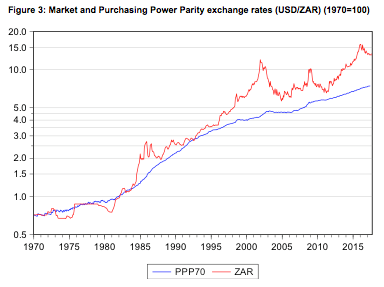
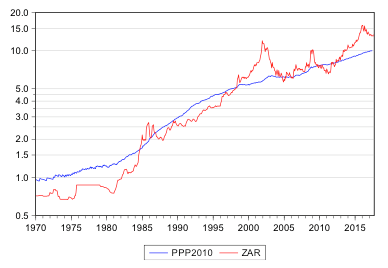
As we show below, using January 1970 as the starting point, the USD/ZAR exchange rate diverged significantly from PPP in 1985, then conformed to PPP between 1988 and 1995, whereafter the divergence has been continuous, though still highly variable. Heavy shocks to the USD/ZAR exchange rate are to be observed in 2001-02, 2008 and 2014. These sharp deviations from PPP have been followed by movement back towards PPP.

Sensitivity to the base year

Notice too that the PPP calculation is sensitive to the base year used to calculate the price indices. When 2010 is taken as the starting point for the calculation, the absolute deviations from PPP exchange rates are of a different magnitude. However, the movement away from or back towards PPP-equivalent exchange rates takes the same direction in both versions of PPP-equivalent exchange rates.

The starting point for any such calculation should be when the actual exchange rate approximates PPP, as it did in 1970. By 2010, the base year for calculating the current real exchange rate, the USD/ZAR exchange rate had moved far away from PPP, using a 1970 base year. When the base year is taken to be 2010, the rand appears as less undervalued generally and even as overvalued in 2010 – when the USD/ZAR traded at less than its PPP equivalent (2010 prices).

Figure 3: Market and Purchasing Power Parity exchange rates (USD/ZAR) (1970=100)
p3

Sources: Stats SA, Federal Reserve Bank of St. Louis (FRED Data Base), Investec Wealth & Investment

Figure 4: Market and Purchasing Power Parity exchange rates (USD/ZAR) (2010=100)
p4

Sources: Stats SA, Federal Reserve Bank of St. Louis (FRED database) and Investec Wealth & Investment

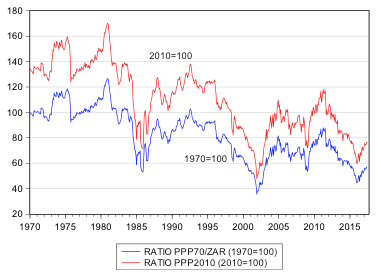
In figure 5 below we show the ratio of the PPP-equivalent USD/ZAR exchange rates to the market-determined USD/ZAR, using 1970 or 2010 as the base year. This ratio may be regarded as representing the real USD/ZAR exchange rates. Values above 100 indicate an overvalued (less competitive) nominal exchange rate and values below 100 indicate the opposite – the nominal exchange rate has changed by more than the difference in inflation in SA and the US.

Using 2010 prices and exchange rates, the rand was overvalued for much of the period from 1970 to 1995 and for some years afterwards. The strong real rand was supported in the 1970s by rising gold and metal prices in US dollars. The picture using 1970 prices as the basis of the calculation is different, revealing a consistently undervalued rand after 1985.

Figure 5: USD/ZAR – the ratio of PPP to market exchange rates; a measure of the real exchange rate using different base years
p5

Sources: Stats SA, Federal Reserve Bank of St. Louis (FRED database) and Investec Wealth & Investment

Real exchange rates considered more widely – the international evidence

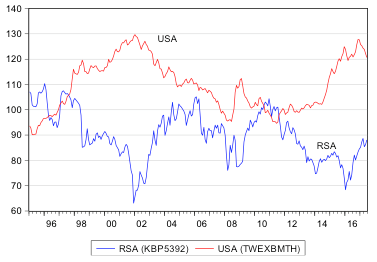
In the figures below, we show a variety of trade-weighted real exchange rates for the period 1995-2017, as calculated by the Bank for International Settlements and the SA Reserve Bank. All these real exchange rates are highly variable, including those of the US. The real US dollar demonstrated continuous strength between 1995 and 2002, then weakness to 2008, whereafter the safe haven status of the US dollar in a time of crisis added some real strength to the trade-weighted exchange rate. A further period of pronounced real dollar strength ensued after 2014. Not coincidentally, the real trade weighted rand moved in very much the opposite direction, as seen in figure 6.

It should be recognised that the real rand, for all its volatility and the risks to which it has exposed SA business, has not in fact been more variable than the real dollar. As a relatively small economy that is very open to foreign trade, real exchange rates are, of course, more important for the South African economy. The value of exports and imports for South Africa is equivalent to about 50% of GDP. The exposure to imports and exports in the US is equivalent to about 30% of GDP.

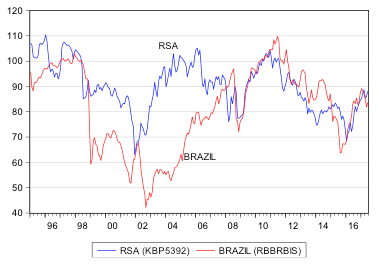
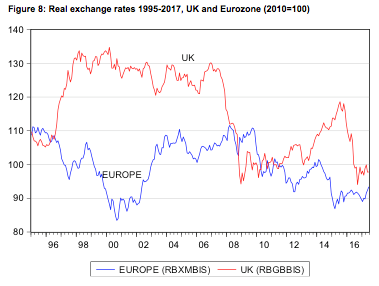
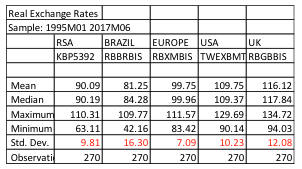
As may be seen in the figures below, the real euro and real sterling have also been highly variable since 1995, while the Brazilian real has been more variable than most. The summary statistics for these real exchange rates are provided in Table 1.

The conclusion, therefore, is that the volatility of the real rand that so complicates the business of exporting from and importing to SA is not exceptional. The same complications and risks of doing business across frontiers, or rather exchange rate regimes, apply across the modern world of flexible exchange rates. It should be recognised that flexible exchange rates have added generally to the risks of doing international business everywhere. As such, these risks are presumed to have increased the required returns on capital invested in servicing global markets.

One can also determine whether there is a general tendency of exchange rates to revert to PPP and foreign trade-neutral real exchange rates. In other words, can one conduct a statistical test of whether real exchange rates are mean reverting?

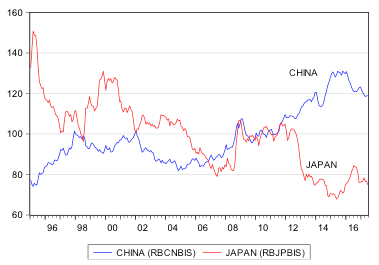
The answer is that they don’t pass this statistical test with any degree of statistical confidence. The Chinese and Japanese real exchange rate trends since 1995 are most conspicuously not mean reverting to the theoretical 100 as may be observed in figure 9. The real yuan has a distinct and persistently stronger trend while the real yen moves persistently weaker.

Figure 6: Real exchange rates 1995-2017, South Africa and the US (2010=100)
p6

Source: SA Reserve Bank, Federal Reserve Bank of St. Louis (FRED database) and Investec Wealth & Investment

Figure 7: Real exchange rates 1995-2017, South Africa and Brazil (2010=100)
p7

Source: SA Reserve Bank, Federal Reserve Bank of St. Louis (FRED database) and Investec Wealth & Investment

Figure 8: Real exchange rates 1995-2017, UK and Eurozone (2010=100)
p8

Source: SA Reserve Bank, Federal Reserve Bank of St. Louis (FRED database) and Investec Wealth & Investment

Figure 9: Real exchange rates 1995-2017, China and Japan (2010=100)
p9

Source: SA Reserve Bank, Federal Reserve Bank of St. Louis (FRED database)and Investec Wealth & Investment

Table 1: Real exchange rates summary statistics
t1

The importance of capital rather than trade flows in determining nominal and real exchange rates

The notion that exchange rates will trend, over time, back towards some kind of competitive equilibrium, as imports and export volumes adjust to the real exchange rate effects on operating margins, therefore does not hold. The volatile behaviour of both nominal and real exchange rates is driven by unpredictable capital flows rather than by flows of currencies generated by the international trade in goods and services.

These capital flows that are based upon changing expectations of future returns, move the rate of exchange stronger or weaker. Inflation rates then react, but not rapidly or sufficiently enough to sustain PPP.

The exchange rate therefore leads inflation and the nominal exchange rate leads the real exchange rate – because inflation rates are much more stable than exchange rates. This stability is partly the result of the convention that measures inflation as the year-on-year change in consumer or other price indices, rather than as price moves over shorter periods of time. For example, a one or three month trend in consumer prices would indicate much more variability. The variability of real exchange rates has, in practice, almost everything to do with shocks to nominal exchange rates rather than price.

The shocks to the real exchange rate observed in the charts above therefore have very little to do with shocks to inflation rates. The openness of an economy to imports of staple commodities reduces the impact of harvests that are subject to unfavourable climatic conditions. Droughts and famines might otherwise have pushed prices temporarily much higher, providing a price shock to the economy.

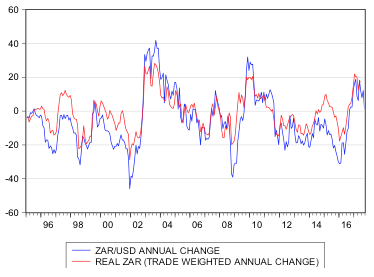
As we show in figure 10 below, annual moves in the nominal ZAR/USD exchange rate dominate the moves in the real rand exchange rate that are so important for operating businesses and their operating profit margins. Similar results could be found for many other economies and their currencies as was found to be true of the US demonstrated in Figure 1

Figure 10: Annual changes in the USD/ZAR nominal and real exchange rates
p10

The impact of exchange rates on prices and inflation

Exchange rate shocks will have implications for the domestic price level. Other things being equal, the price of imported goods and the prices realised for exports in the local currency will rise or fall with the price of a US dollar. Other things may not remain unchanged and may also effect the prices charged domestically. For example, the US dollar price of imported oil may be rising or falling as might other imported commodities.

Dollar strength might well mean downward pressure on prices set in US dollar and dollar weakness might have the opposite effect. The state of the domestic economy will also have an influence on prices. The more or less buoyant domestic spending is, the greater or lesser the pressure on domestic prices will be. However a weaker exchange rate and the higher prices that are likely to accompany it will, in themselves, act to reduce spending power. They may also undermine the confidence of households and firms in their economic prospects, and their willingness to spend more or less of their incomes.

How should monetary policy react to exchange rate shocks?

How then should monetary policy and interest rates react to exchange rate shocks that are so difficult to anticipate? We would argue the best approach to exchange rate shocks is not to react to them at all. This is because such shocks are temporary rather than persistent. If such exchange rate shocks really are temporary – even perhaps rapidly reversible – the impact they have on inflation will be as temporary. They therefore will not be expected to permanently add to inflation and therefore will not add to expected (forecast) inflation.

It should nevertheless be recognised that dollar strength and other currency weakness can persist for an extended period of time. Persistent US dollar strength – against its developed economy peer currencies and against most emerging market currencies – explains much of the nominal and real rand weakness observed between 2014 and 2016.

The difference between rand weakness against the dollar and the weakness of other emerging market currencies vs. the US dollar represents additional SA specific risks to the returns expected from SA domiciled assets. We show these global and SA influences on the rand in the figure below. The USD/ZAR and the equally weighted Index of nine other emerging market currencies generally move in the same direction. The ratio of the USD/ZAR exchange rate to the USD/EM basket indicates South Africa-specific risks at work. These South Africa-specific risks spiked significantly in 2001, 2008 and 2015, when they added to rand weakness for global reasons. In other words, a weakness against the US dollar was shared by the other emerging market currencies.

Figure 11: The US dollar vs the rand and the EM Basket (LHS); and the Ratio rand/EM (RHS)
p11

Source: Bloomberg and Investment Wealth & Investment

Thus, much of the persistently high rates of inflation over the period between January 2014 and June 2016 (an average of 5.5% per annum) can be explained by dollar strength and its impact on the rand prices of imports, exports and alternatives for both in the production and price choices firms make. Inflation remained at these levels despite increases in interest rates and near recessionary conditions.

South African inflation over this period cannot be explained by the extra demands exercised by local households or businesses. Aggregate spending remained highly depressed over this period, which was also due to the inflation of prices charged to them. A drought proved to add another supply side shock to the rand prices of staple foods.

Only persistent and permanent increases in the demands for good and services, fueled by persistent increases in the supply of money and credit, will lead to continuous increases in prices and, sooner or later, increases in the price of foreign exchange. Interest rate expectations and capital flows will, in such circumstances of highly accommodating monetary policy settings, come to anticipate more inflation and help weaken the exchange rate.

A central bank charged with securing permanently low inflation would have to react to demand side pressures of this kind on prices. But they are strongly advised not to react to exchange rate shocks, especially when they occur in the absence of excess domestic demand over domestic potential supplies.

To react this way is to make monetary policy hostage to the variable and difficult to predict, nominal and real US dollar exchange rate. It is a risky exposure that businesses engaging in international trade cannot easily avoid. But monetary policy would do well to do what it can to moderate the shocks that emanate from the foreign exchange market. Unfortunately, the SA Reserve Bank added higher interest rates to exchange rate misery over the 2014-2016 period. We regard these as errors of monetary policy that reduced growth rates without any obvious reduction in inflation rates or inflation expected.

The implications of exchange rate volatility for investment portfolios

The volatile dollar can easily lead to such monetary policy errors of judgment – as in the case of South Africa. Emerging market economies, particularly those with significant exposure to foreign trade, are especially vulnerable to fighting exchange rate shocks, that is US dollar-driven shocks, with higher interest rates, which further damage the prospects for local businesses.

These are errors the US is much less likely to make, given that the dollar is likely to be the source of the exchange rate shocks. Monetary policy in the US understandably does not react to the exchange value of the dollar. Therefore, when investing abroad, a bias in favour of dollar based investing seems appropriate.

It may be concluded that the volatility of the real rand (that so complicates the business of exporting from and importing to SA) is not exceptional. The same complications and risks of doing business across frontiers and exchange rate regimes apply across the modern world of flexible exchange rates. It should be recognised that flexible exchange rates have added generally to the risks of doing international business everywhere.

The alternatives to fiduciary currencies and flexible exchange rates

The alternative to flexible exchange rates is fixing the rate at which a domestic currency may be converted into another currency. For example, the Hong Kong dollar has been fixed at 7.8 to the US dollar for many years. This fixed exchange rate link demands that inflation and interest rates in the two currencies will be very similar, to protect the sustainability of the fix. However, this also means that the real USD/HK exchange rate has been as variable as the real USD exchange rate.

An alternative form of fixing an exchange rate that was practiced widely before 1970 elsewhere including in the US, would be to fix the rate of exchange to the price of gold or silver at some predetermined local currency price of gold. For example, between 1933 and 1970 the dollar could be converted into gold at 35 US dollars per troy ounce.

This gold convertibility requirement restrained central banks from increasing the supply of cash issued to banks – held mostly in the form of deposits with the central bank – that could be converted into gold in the days of the gold standard. Constraints on the growth in the supply of central bank cash in turn helped to sustain low rates of inflation in normal times.

In abnormal times of large balance of payments outflows, this convertibility of local currency deposits into gold (that could be exercised by foreign central banks after 1945) might break down, as it did for the US in the early 1970s. This breakdown, or not enough central bank stocks of gold to meet the demands for gold by other central banks, might lead to either a new fix of the rate of exchange of gold for the local currency, or lead to inconvertible currencies. This would be a move to flexible exchange rates and the abandonment of the gold standard.

This is what the US chose to do in 1971 under pressure to convert dollar liabilities into gold that came from the French government particularly. The French strongly objected to the reserve currency role played by the US dollar that increased demands for dollars that they argued added to the economic power of the US.

It might be recalled that the IMF, established immediately after the end of the Second World War to assist a global economic recovery, effectively restored the gold standard and reaffirmed the convertibility of US dollar into gold. The IMF, however, also allowed for and supported orderly adjustments to fixed exchange rates under conditions of “fundamental disequilibrium”.

The intention was to avoid a series of competitive devaluations and ‘beggar your neighbour’ policies that were such a damaging feature of international economic relations in the depressed 1930s.

The problem that fixed exchange rates after 1945 could not resolve, was when a global shortage of dollars became a surplus of dollars. In effect, the US as the dominant economic power that supplied the reserve currency was unwilling to play the gold standard game and limit the supply of dollars to sustain convertibility at a fixed rate. And so the global economy has had to cope with flexible exchange rates that do not necessarily trend to PPP-equivalent exchange rates. The price paid for allowing flexible and market-determined exchange rates to absorb the shocks caused by highly variable capital flows, has been to add to the risks of cross border trade flows

The market and the bookmakers inform us about the ANC succession battle (Update)

Below follows an update on this piece from Monday. 

The immediate outlook for the economy depends on who governs SA after December 2017. Will it be the Zuma faction or some other ANC coalition calling the shots? That is the essential question for the economic outlook and the value of the financial claims on it.  The market in SA assets has made its preferences for much less of President Zuma very clear. RSA risk premiums rise and fall as the expected Zuma influence on policy gains or loses momentum.

On Thursday and Friday last week the market suddenly came to reverse recently very unfavourable trends to register less SA risk. The rand strengthened, not only against the USD, but more meaningfully, also gained against other EM exchange rates.[1] Furthermore not only did RSA bond yields decline late last week – they declined relative to benchmark US yields. Still less SA risk has been registered this week in the foreign exchange markets. The ratio of the USD/ZAR to the USD EM basket (Jan 1st 2017=1) had moved out to 1.104 on the 13th November is 1.065 a relative SA gain of 3.6%

The behaviour of these foreign exchange indicators in 2017 is shown in figure 1 below. As may be seen, despite this recent improvement in sentiment, 2017 has not been a good year for the ZAR. The USD/ZAR weakened relative to its EM peers when Finance Minister Gordhan, in public dispute with the President over spending plans, was sacked in March 2017. It also suffered in response to the Budget statement presented by his successor, Milusi Gigaba in late October, as may also be seen.

The budget disappointment was perhaps not in the details about the revenue shortfall  – this was well telegraphed – but that no revised plan to address the widening fiscal deficit was offered. The concern was presumably that Zuma and his cohort would soon announce more government spending, on nuclear power or students, rather than less,  regardless of the fiscal constraints.

Fig.1; The USD/ZAR and the USD/EM exchange rate basket in 2017. Daily Data January 1st=100 to November , 23rd  OR ratio (LHS) =1

b1Source; Bloomberg and Investec Wealth and Investment

Though perhaps a little longer perspective on SA risk indicators is called for, as is provided in figure 2 below. There it may be seen that the ratio of USD/ZAR exchange rate to the USD/EM currency basket, weakened significantly in December 2015, when Finance Minister Nene was so surprisingly sacked. However as may be seen in the figure, the rand in a relative and absolute sense did very much better in 2016. Perhaps because the decision Zuma made under pressure from colleagues and the business community to immediately reappoint Pravin Gordhan, indicated less rather than more power to the President. A sense perhaps that the market had gained of Zuma overreach and a degree of vulnerability.   Just how vulnerable is President Zuma remains to be determined- hence market volatility.

Fig 2; The ratio of the USD.ZAR to the USD/EM currency basket (January 2017=1) Daily Data

b2Source; Bloomberg and Investec Wealth and Investment

The indicators derived from the Bond market make the same statements about SA risk. As shown in figure 3 below the spread between RSA and USA government bond yields, the so called interest rate carry that reveals the expected depreciation of the USD/ZAR exchange rate, widened sharply as the rand weakened in late 2015. They then narrowed through much of 2016, stabilized in 2017 until the Budget disappointment pushed them higher. The difference however between RSA rand bond yields however has widened gain to 7.2% p.a. and is back to levels recorded on the 14th November. The default risk premium attached to five year RSA dollar denominated bonds though has declined further from 208 b.p on the 14th November to 187 b.p on the 23rd November

In figure 4 it may also be seen how the RSA sovereign risk premium has behaved in 2017. Sovereign risks are revealed by the spread between the yield on a USD denominated RSA (Yankee)  Bond and its US equivalent. As may be seen this spread has been variable in 2017 – that it increased by 40 b.p. in October – and then declined sharply in the week ending on November 17th.  These spreads indicate that SA debt is already being accorded Junk Status by the market place, ahead of any such ruling by the rating agencies. The spread on the lowest Investment Grade debt would be of the order of 1.6%.

In figure 5 we show the interest carry- the rate at which the USD/ZAR is expected to weaken over the next ten years and inflation expectations. These are measured as the spread between a vanilla bond that carries inflation risk and an inflation linker of the same duration that avoids inflation risk. As may be seen more inflation expected is strongly connected to the rate at which the ZAR is expected to weaken. It should be recognized that the weaker the rand the more it is expected to weaken further. It will take a stronger rand to reduce inflation expected- a welcome development that is beyond the influence of interest rates themselves.

Fig.3; The USD/ZAR and the Interest Rate Spreads. Daily Data 2015 to November 23, 2017

b3Source; Bloomberg and Investec Wealth and Investment

Fig.4; The RSA sovereign risk premium and the interest carry. Daily Data 2017.

b4Source; Bloomberg and Investec Wealth and Investment

Fig.5: The interest rate carry and inflation compensation in the RSA bond market. Daily Data 2017.

b5


The market place, as well as the bookmakers, will continuously update the odds of one or other candidate for the Presidency of the ANC ( now very probably) being determined in December 2017.  The odds offered by Sportingbet at 13h00 on November 20, 2017 are shown in the Table below. (www.sportingbet.co.za ) They have not changed since- indicating perhaps a lack of betting activity. These odds imply a 40% chance of Dlamini-Zuma winning the nomination and a 45% chance for CR. As they say in racing circles- the favourite does not always win- but don’t bet against it.

Lower South African risks and the stronger rand and lower interest and inflation rates associated with rand strength are good for the economy and all the businesses and their stakeholders dependent on the economy. One prediction can be made with some degree of conviction. That is without less SA risk any cyclical recovery in the SA economy is unlikely.

b6


Additional Figures

Equity performance in 2017 to November 17th Daily Data

b7

Credit Default Swap Spreads over US Treasuries 5 year;  Daily Data 2015-2017

b8

Credit Default Swaps over US Treasuries, 5 year Daily Data to November 17th 2017.

b9

[1] Our construct for Emerging Market exchange rates that exclude the ZAR  is an equally weighted nine currency basket of the Turkish Lire, Russian Ruble, Hungarian Forint, Brazilian Real, Mexican, Chilian and Philippine Pesos, Indian Rupee and Malaysian Ringit


The market tells us about the ANC succession battle

 The outlook for the SA economy depends on who governs after December 2017. Will it be the Zuma faction or some other ANC coalition calling the shots? That is the essential question for the economy and the value of the financial claims on it.  The market in SA assets has made its preferences for much less of President Zuma very clear. RSA risk premiums rise and fall as the expected Zuma influence on policy gains or loses momentum.

On Thursday and Friday last week the market registered less SA risk as the rand strengthened, not only against the USD, but more meaningfully the rand also gained against other EM exchange rates.[1] Furthermore not only did RSA bond yields decline late last week – they declined relative to benchmark US yields. The political developments that actually moved the market are however not that obvious.

The behaviour of these indicators in 2017 is shown in figure 1 below. As may be seen 2017, despite this recent improvement in sentiment, has not been a good year for the ZAR. It weakened relative to its EM peers when highly respected Finance Minister Gordhan was also sacked in March. It also suffered in response to the Budget statement of his successor in late October, as may also be seen.

The budget disappointment was perhaps not in the details about the revenue shortfall  – that were well telegraphed – but that no revised plan to address the widening fiscal deficit was offered. The concern was presumably that Zuma and his cohorts would soon announce more rather than less government spending regardless of the fiscal constraints.


Fig.1; The USD/ZAR and the USD/EM exchange rate basket in 2017. Daily Data January 1st=100 or ratio (LHS) =1


a1


Source; Bloomberg and Investec Wealth and Investment


Though perhaps a little longer perspective on SA risk indicators is called for, as is provided in figure 2 below. There it may be seen that the ratio of USD/ZAR exchange rate to the USD/EM currency basket, weakened significantly in December 2015, when Finance Minister Nene was so surprisingly and ignominiously sacked. However as may be seen in the figure, the rand in a relative and absolute sense did very much better in 2016. Perhaps because the decision Zuma made under pressure from colleagues and the business community to immediately reappoint Pravin Gordhan, indicated less rather than more power to the President. A sense perhaps that the market had gained of Zuma overreach and a degree of vulnerability.   Just how vulnerable remains to be determined- hence market volatility.

Fig 2; The ratio of the USD.ZAR to the USD/EM currency basket (January 2017=1) Daily Data

a2Source; Bloomberg and Investec Wealth and Investment


The indicators derived from the Bond market make the same statements about SA risk. As shown in figure 3 below the spread between RSA and USA government bond yields, the so called interest rate carry that reveals the expected depreciation of the USD/ZAR exchange rate widened sharply as the rand weakened in late 2015. They then narrowed through much of 2016, stabilized in 2017 until the Budget disappointment pushed them higher. In figure 4 it may also be seen how the RSA sovereign risk premium has behaved in 2017. Sovereign risks are revealed by the spread between the yield on a USD denominated RSA (Yankee)  Bond and its US equivalent. As may be seen this spread has been variable in 2017 – that it increased by 40 b.p. in October – and then declined sharply in the week ending on November 17th.  These spreads indicate that SA debt is already being accorded Junk Status by the market place, ahead of any such ruling by the rating agencies. The spread on the lowest Investment Grade debt would be of the order of 1.6%.

In figure 5 we show the interest carry- the rate at which the USD/ZAR is expected to weaken over the next ten years and inflation expectations. These are measured as the spread between a vanilla bond that carries inflation risk and an inflation linker of the same duration that avoids inflation risk. As may be seen more inflation expected is strongly connected to the rate at which the ZAR is expected to weaken. It should be recognized that the weaker the rand the more it is expected to weaken further. It will take a stronger rand to reduce inflation expected- a welcome development that is beyond the influence of interest rates themselves.


Fig.3; The USD/ZAR and the Interest Rate Spreads. Daily Data 2015-2017

a3Source; Bloomberg and Investec Wealth and Investment
Fig.4; The RSA sovereign risk premium and the interest carry. Daily Data 2017.

a4Source; Bloomberg and Investec Wealth and Investment 

Fig.5: The interest rate carry and inflation compensation in the RSA bond market. Daily Data 2017.

a5

The market place, as well as the bookmakers, will continuously update the odds of one or other candidate for the Presidency of the ANC ( probably) being determined in December 2017.  The odds offered by Sportingbet at 13h00 on November 20, 2017 are shown in the Table below. (www.sportingbet.co.za ) As they say in racing circles- the favourite does not always win- but don’t bet against it.

Lower South African risks and the stronger rand and lower interest and inflation rates associated with rand strength are good for the economy and all the businesses and their stakeholders dependent on the economy. One prediction can be made with some degree of conviction. That is without less SA risk any cyclical recovery in the SA economy is unlikely.

a6


[1] Our construct for Emerging Market exchange rates that exclude the ZAR  is an equally weighted nine currency basket of the Turkish Lire, Russian Ruble, Hungarian Forint, Brazilian Real, Mexican, Chilian and Philippine Pesos, Indian Rupee and Malaysian Ringit

The inflation news has become out of date

Inflation in SA rose to 4.8in August- up from 4.6% in July 2017. However in August 2017 prices were largely unchanged, rising by a mere one tenth of one per cent in the month. The statistical anomaly is that a year ago Consumer Prices had actually fallen by about the same 0.1 per cent. And so a monthly increase in August this year of 0.1% was enough to raise the year in year increase in Consumer Prices by 0.2%.

Of further and greater importanc% e is that the Consumer Price Index has been largely stable since April 2017. In April prices increased by 0.1%, in May by a still minimal  0.3%, in June by 0.2% and in July by 0.3%. Helped by a consistently stronger rand compared to a year before, and stable food prices following the drought of last year, the direction of inflation has been decidedly lower. Thus as we show below the increase in prices, measured over consecutive three month periods, has declined sharply. Were such trends to continue headline inflation would fall to three per cent. A time series forecast indicates a much lower rate of inflation next year of about 3%.


Picture1
Figure 1: Inflation in South Africa and the underlying trends in consumer prices


The Reserve Bank forecasting model of inflation, upon which it will determine its interest rate settings, is not a time series extrapolation of recent trends. It will have the trade weighted rand and food prices as amongst its more inputs. Chris Holdsworth of Investec Securities runs a simulation of the Reserve Bank model that suggest that the forecast rate of inflation for Q1 2018 will have declined marginally and would imply a further reduction in interest rates .[1] He remarks as follows

  • Since the last MPC meeting CPI inflation has dropped from 5.1% in June to 4.6% in July. The MPC’s previous forecast was for CPI inflation to average 4.8% for Q3. The slightly lower than expected print should marginally lower the MPC’s estimate of the inflation trajectory.
  • PPI has dropped from 4.8% in May to 3.7% in July. The fall in PPI inflation should further lower the inflation trajectory.
  • We don’t expect the MPC to make meaningful adjustments to its ZAR and oil price assumptions.
  • Subsequent to the last MPC meeting SA GDP growth for Q2 has come out at +2.5%, up from -0.6% in Q1. Given our understanding of the MPC’s macro-economic model, that should imply a small upward revision to the MPC’s growth assumption for the year (currently 0.5%). This should see a reduction in the expected output gap and an associated increase in the inflation trajectory but we expect the effect to be minimal.
  • The net result is that we expect a minor reduction to the SARB’s inflation trajectory over the medium term. We expect that the SARB will forecast inflation to reach 4.4% in Q1 next year.

A further reduction of 25 basis points in the repo rate therefore seems likely. Especially given the continued absence of any demand side pressures on prices. And so given to the near recession state of the economy. And were the stability of the rand to be maintained and a normal harvest delivered in 2018 the current underlying trends in consumer prices in SA  would be sustained and lead to further reductions in headline inflation and forecasts of it and be accompanied by still short term interest rates. Rates that could fall further and until very welcome strength in spending by households and firms becomes manifest. The conditions for a normal cyclical recovery are falling into place. One can only hope that political developments do not reverse the direction of the rand and the SA risks spreads that have also been receding. Presumably on the belief that better government is in prospect.

It is perhaps worth making an observation about inflation – measured as a year on year increase in prices and – and the advantage in identifying underlying trends in prices within a twelve month period that may be much lower. And portend lower headline inflation to come. The problem for inflation watches and commentators on it – and drawing implications for interest rates- is that 12 months is a long time in economic life. That much of importance can happen to prices or any monthly series within a year that makes year on year comparisons out of date. This is illustrated in a hypothetical example shown below. We show a case of a sharp increase in the price index after a period of stability and low inflation and how this may lead to more and then sharply lower inflation after twelve months.

In the figure below we show a sharp 5% increase in the CPI in early 2016. An increase in the VAT rate or a collapse in the ZAR might be responsible for such a sharp increase.  Thereafter prices are assumed to stabilise for an extended period of time. Perhaps this is because he exchange rate recovers somewhat and the VAT and other tax rates do not increase further. As we show inflation – measured as a year on year increase in prices – initially increases sharply to about 6% p.a and remains at these elevated levels for a full twelve months- where after it collapses back to about zero inflation.

Thus the impact on inflation of an inflation shock will be very temporary provided the underlying trend in prices is a very stable one. Presumably also inflationary expectations as well as models of inflation are fully capable of see through a temporary price shock.  One would hope that monetary policy settings can also see beyond temporary year on year changes in prices. As we hope the SA Reserve Bank is looking ahead rather than behind and will take the opportunity to help stimulate a recovery in spending that is desperately needed.


Figure 2: A hypothetical example of price shocks and underlying trends in prices


[1]

Forecasting the MPC’s forecasts; Quantitative Strategy, Investec Bank September 18th 2017


What the dollar means for the SA economy

The most important single indicator for the future direction of the SA economy is the value of the US dollar compared to the euro and other developed market currencies. When measured this way, and helpfully for SA and the emerging market world, we see that the US dollar has lost nearly 4% of its exchange value this quarter. Dollar weakness has brought a small degree of strength to emerging market (EM) currencies, including the rand, and to metal prices that make up the bulk of SA’s exports.

Dollar strength put pressure on the rand and EM exchange rates for much of the period between 2011 and mid-2016. This was when something of a turning point in dollar strength, weakness in metal prices (in US dollars) and rand and EM exchange rate weakness, was reached. Over this period, the US dollar gained as much as 30% against its peers, while the EM currency index lost about the same against the US dollar, while industrial metal prices and the trade weighted rand fell to about half their values of early 2011 in 2016. (See below)

The dollar has weakened and industrial metal prices have improved since 2016 because the rest of the industrial and emerging market world has begun to play catch up with the revival of the US economy. A stronger Europe and Japan imply more competitive interest rates and returns outside the US and hence less demand for dollars and more for the competing currencies and for metals.

The rand and dollar-denominated RSA bonds have benefited from these trends – despite it should be emphasised – less certainty about the future direction of SA politics and economic policy and a weaker rating accorded by the credit rating agencies. The rand exchange rate since lost more than 50% of its average trade weighted exchange value between 2011 and early 2016. The cost of insuring five-year US dollar-denominated RSA debt had soared to nearly 4% more than the return offered by a five year US Treasury Bond by early 2016. (See below)

Today this risk spread has declined to less than 1.8%, while the rand since early 2016 has gained about 15% on a trade weighted basis and 17% against the US dollar. This improvement has, as indicated, come with general dollar weakness and EM exchange rate strength. But it has also been strong despite the continued uncertainty about the direction of SA politics. The markets, if not the rating agencies, appear to be betting on a better set of policies to come.

It is to be hoped that the markets are right about this. The recent strength of the rand and metal prices offers monetary policy its opportunity to do what it can to help the economy – by aggressively reducing interest rates. Inflation has come down and will stay down if the rand maintains its improved value – and the harvests are normal ones – and the dollar remains where it is. Lower interest rates will lift spending, growth rates and government revenues.

Interest rates were raised after 2014 as the rand weakened and inflation picked up, influenced also by a drought that drove food prices higher. These higher interest rates and prices further depressed spending by South African households and firms and GDP growth. Consistently, interest rates could and should now be lowered because the rand has strengthened and the outlook for inflation accordingly has improved. Does it make good sense for interest rates in SA to take their cue from an exchange rate and other supply-side shocks that drive inflation higher or lower but over which interest rates or the Reserve Bank have no predictable influence? Their only predictable influence seems to be to further depress spending and growth rates. 15 September 2017

Is the SA economy glass half full?

The SA economy has begun to offer a few glimmers of cyclical light. Of most importance is that industrial metal prices have continued to recover from their depressed levels of mid-2016, as we show below in figures 1 and 2. The London Metal Exchange Index, in US dollars, is up 20% on its levels of January 2017 – a helpful trend for SA exports and manufacturing and mining activity. Less helpful to the SA economy is that the oil price has also sustained a muted recovery, influenced no doubt by the same pick up in global growth.

Further encouragement for the economy has come from a stronger rand: it has more or less maintained its US dollar value when compared to its emerging market (EM) peers. The US dollar exchange value of the rand has moreover remained consistently ahead of its values of a year ago, as is shown in figure 3.

The stronger rand has helped to reverse the headline rate of inflation, which is now well down on its peak levels of mid-2016 and could easily fall further, as we show in figure 4, where currently favourable trends are extrapolated. Over the past quarter, the consumer price index has risen at less than a 3% annual rate.

The prospect of significantly lower short-term interest rates, which would be essential to any cyclical recovery, has therefore now greatly improved, given prospects of lower inflation. The demand for and supply of cash, a very useful coinciding business cycle indicator, has been growing ever more slowly in recent months and, when adjusted for inflation, has turned significantly negative. Somewhat encouraging therefore is that the cash cycle appears to have reached a cyclical trough (see figure 4). A reversal of the cash cycle is an essential requirement for any cyclical recovery.

Two other activity indicators, retail sales volumes and new vehicle sales, provide somewhat mixed signals about the state of the economy. Retail volumes, as can be seen in figure 5, have continued to increase, albeit at a slow rate, while new vehicles sold in SA have declined sharply since early 2016. However the latest vehicle sales trends as well as retail volumes suggest that the worst of these sales cycles may be behind the economy. The sales trend however remains very subdued and will need all the help it can get from lower interest rates over the next 12 months.

We combine two recent data releases, new vehicle sales and the cash in circulation in July 2017, to establish our Hard Number Index (HNI) of the immediate state of the SA economy. As we show in figure 7, the HNI of economic activity turned decidedly down in mid- 2016 but now appears to have levelled off. The HNI can be compared to the coinciding business cycle measured by the Reserve Bank as we do in Figure 7. Extrapolating this Reserve Bank business cycle indicator also indicates that the worst of the current business cycle may be behind us.

The economic news therefore is not all negative. However essential for an economic recovery is further rand stability and the lower inflation and interest rates that would accompany a stable rand. A combination of better global growth and so higher metal prices would help. So, presumably, would any confirmation of the end of the Zuma regime – a view seemingly already incorporated into the current strength of the rand as well as by the reduction in SA risk premiums. Both the strength of the rand, relative to other EM exchange rates, and the spread between RSA Yankee (US dollar) bond yields and US Treasuries indicate that the market expects the Zuma influence over economic policy to be over soon. For the sake of the rand, the economy and its prospects, one must hope the market is well informed. 25 August 2017