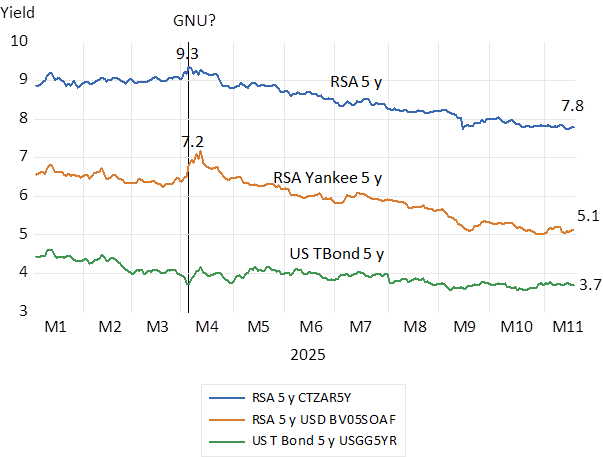
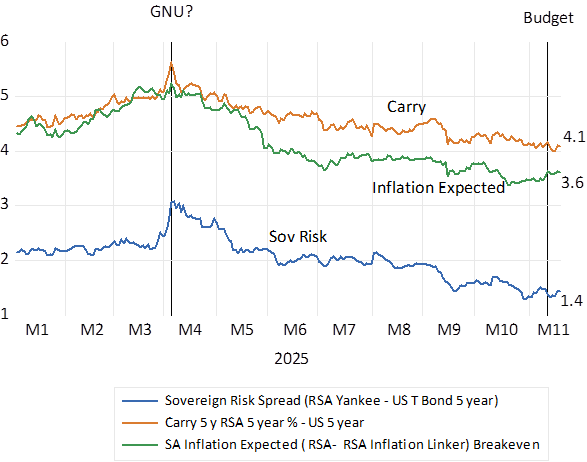
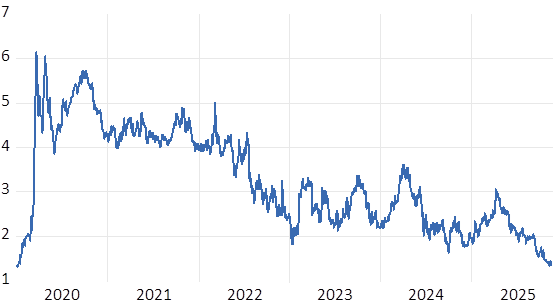
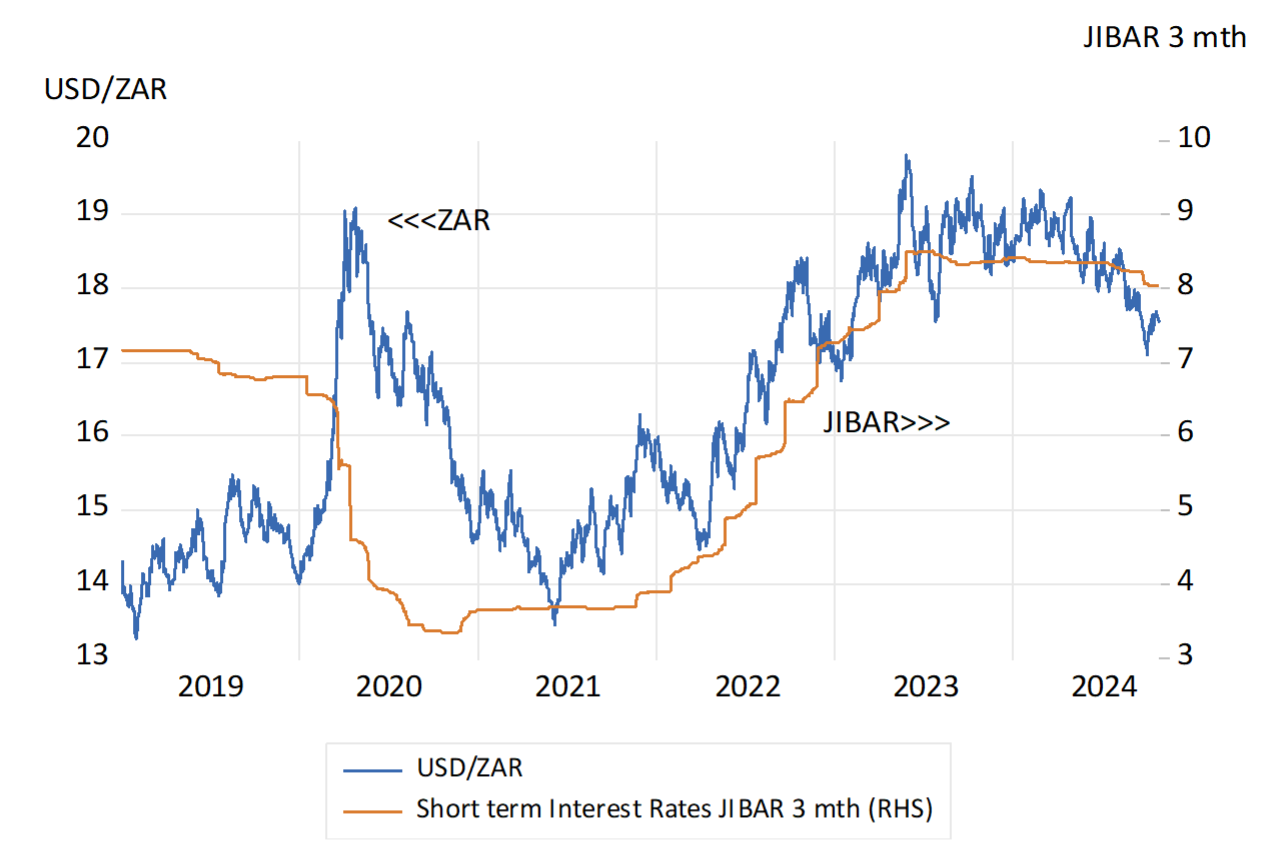
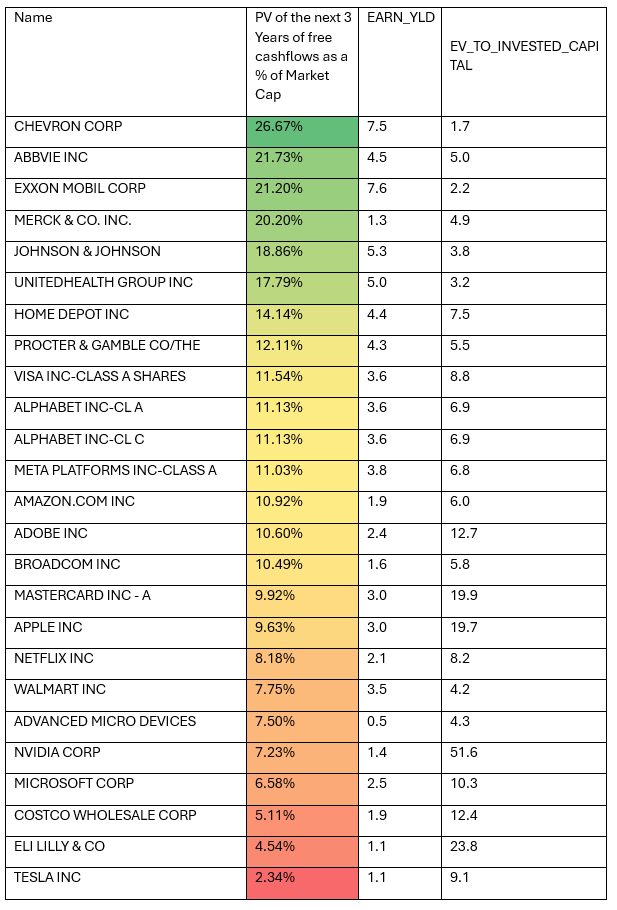
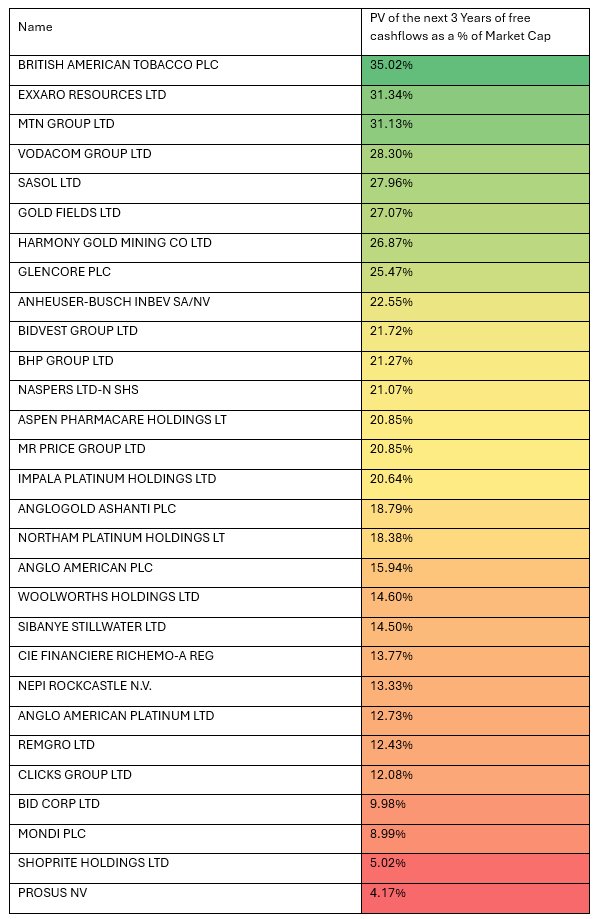
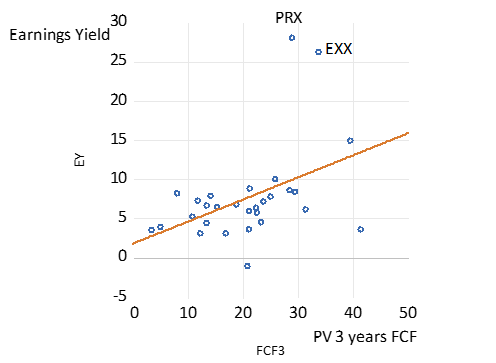
The update on the RSA Budget released on November 12th was well received in the Bond, Currency and Share markets. The yield on the benchmark 10 year RSA Bond gained 12 bp on the day to continue an extended bull run in RSA Bonds that began in April 2025. When doubts about the endurance of the government of national unity (GNU) were most pronounced. The yields on conventional RSA bonds of five year’s duration have fallen consistently from over 9% p.a. to 7.8%. since April. The republics cost of borrowing dollars has fallen even more significantly from 7.2% p.a. in April to the current 5.1% p.a. Representing a sovereign risk spread of 1.4% p.a. and less than half the risk spread of early April.
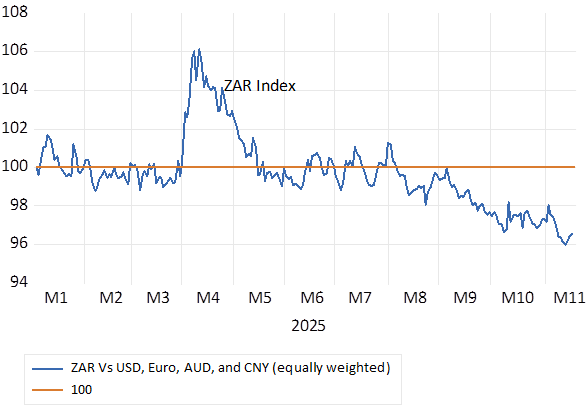
The difference between RSA and USA five-year yields – the carry or the cost of hedging dollars over the next five years, or equivalently the compound rate at which the ZAR is expected to weaken against the USD over the next five years, has fallen in line, from over 5% p.a. to the current 4.1%. The bond market is now factoring in an average rate of inflation of 3.6% p.a. over the next five years. Down impressively from over 5% p.a. inflation expected in April 2025. And the mighty ZAR since April has gained about 10% against an equally weighted Index of the USD, Euro, Aussie, and the Chinese Yuan since April 2025. The GNU has surely produced a kind of very welcome economic magic.
Long term interest rates in 2025. Daily Data.
Source; Bloomberg and Investec Wealth & Investment
Interest rate spreads in 2025 (Daily Data
Source; Bloomberg and Investec Wealth & Investment
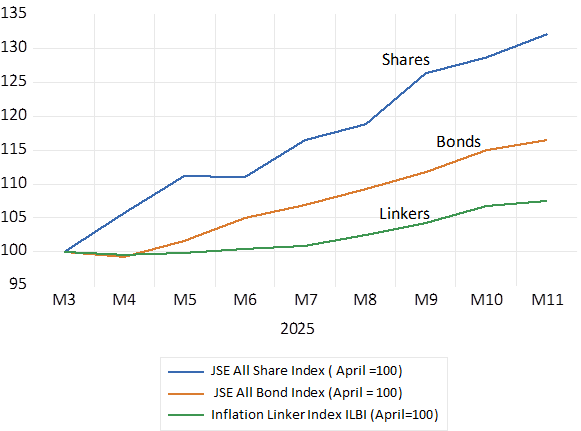
JSE Stocks and Bonds (April 2025=100)
Source; Bloomberg and Investec Wealth & Investment
The mighty rand in 2025 Vs USD, Euro, AUD and CNY. Equally weighted (2025=100) Daily Data
Source; Bloomberg and Investec Wealth & Investment
The Budget update confirmed that South Africa could reverse unfavourable fiscal trends and contain the growth in government spending and so avoid monetising the considerable national debt. And a further favourable force was that the target for inflation of 3% p.a. while accepted by the Treasury, was helpfully qualified by a one per cent band around 3% p.a. and accompanied by a phasing in period. Thereby improving the outlook for lower short-term interest rates and growth. The GNU cannot claim all the credit. The rise in precious metal prices plus the stability in industrial metal prices has helped to add to government revenues and improve the balance of trade – to improve further the fiscal and growth forecasts this year and the case for SA bonds the rand and the JSE.
Faster SA growth would be boosted by lower short- and long-term interest rates. There is growth enhancing scope for declines at both ends of the yield curve should the expected rate of inflation decline further. Which it could but only were the ZAR to continue to hold its own with its low inflation trading partners.
The supply side of the SA economy has been boosted by the strength of the ZAR in a low inflation world. The demand side of the economy has remained depressed by the high cost of bank and other credit. Lower inflation means more expensive credit and less demand for and supply of it from the banking system. Lower short-term interest rates would predictably stimulate spending by SA households and firms and raise growth rates.
Would such welcome trends mean more inflation? Not necessarily – inflation in the future would as in the past depend on the ongoing behaviour of the ZAR. Faster growth would mean increased demands for imported goods and foreign currency. But it would also simultaneously encourage inflows of foreign capital including to the bond market and discourage outflows of SA savings. The larger deficits on the current account of the balance of payments (extra demands for USD) would be matched by larger net inflows of foreign capital willing and to participate in faster SA growth (extra supplies of USD). If so, the rand could be well supported and the inflation rate contained. Faster growth with no more inflation is a virtuous cycle that we can only hope will be put to the test over the next few years. Reserve Bank permitting.
The immediate task for the Treasury is to fulfil its plans for containing government debt. But it should help taxpayers in two further essential ways. Firstly, to show belief in its own inflation targets and to borrow for shorter rather than longer periods and roll over short term debt for longer term debt as inflation and interest rates recede. The Treasury concern with so called roll over risk (a possible inability to borrow short to retire longer term debt) has been a very expensive fear not in fact shared by the rating agencies.
And another task for the Treasury, that it has long been aware of, and has egregiously failed to deal with, are the huge and unaffordable national liabilities of the disgraced Road Accident Fund. Claims on it must become realistic given taxpayers ability to pay and the responsibility for insuring against road accidents devolved, as is all other insurance, to the private sector.
The slope of the RSA yield curve. Ten-year less one year RSA yields 2020-2025 (Daily Data)
Source; Bloomberg and Investec Wealth & Investment
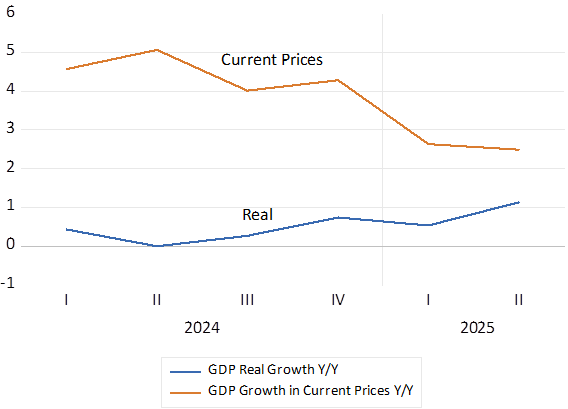
There is a welcome spring in the step of the SA economy. As revealed modestly by the latest National Income accounts released this week. The GDP in Q2 2025 was estimated as 0.8 per cent higher than in Q1. Slightly ahead of consensus and about one per cent up on the same quarter a year before. On a seasonally adjusted annualised basis equivalent to 3.5% p.a. growth, Which, if sustained would be most surprising, and politically consequential, given next year’s municipal elections.
Growth in SA GDP- (Y/Y) in Real and Current Prices. Quarterly Data.
Source; Stats SA and Investec Wealth and Investment
Is faster growth anything like this order sustainable? Supply side reforms work gradually. But to immediately improve the performance of the economy incomes there is a simple remedy easily implemented. That would be to significantly lower the cost and availability of credit for households and firms. The impact of small declines in these costs may in fact already be helping to advance household spending. The stronger growth in household spending to date was one of the GDP positives in Q2 and perhaps beyond.
The seemingly obvious case for lower interest rates, given their current levels relative to sharply declining inflation rates and given the very slow growth in the demand for and supply of bank credit by the private sector, is being strongly resisted by the Reserve Bank, in its efforts to permanently lower inflation to no more than 3% p.a.
Will lowering interest rates be more inflationary should spending and so growth rates improve, that is causing not only increases the demand for but also increases in the supply of goods and services? I would suggest that prices in SA including the CPI it will depend in the future, as inflation always does in South Africa, on the behaviour of the rand. And so on the cost of imports and the prices of exports that together play such an important role in our economy that is so open to trade. In Q2 2025 exports and imports together were equal to 60% of GDP – with exports 6% larger than imports in Q2. Clearly the exchange rate must matter a great deal for the path of prices in general, as it has so conspicuously influenced the direction of prices in SA recently.
The impact on prices facing consumers and firms along the supply chain encouraged by stronger demands would depend on the dollar and rand prices attached to these imports and exports, that is significantly on the exchange rate. Given a stable exchange rate, more growth with more goods and services imported and less exported becomes distinctly possible – without more inflation. And the feed back of faster growth to improved tax flows would also help improve the outlook for fiscal sustainability. The possibility of more growth with no more inflation, given rand stability, is surely a risk well worth taking. It is this vote gaining possibility the Minister of Finance is presumably pursuing with the Reserve Bank.
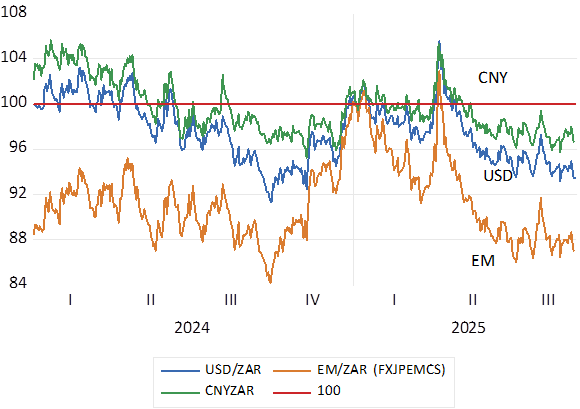
The surprising and most helpful of recent economic developments has been the strength of the ZAR. Strength against the weaker dollar but also against most of our important trading partners, including China.
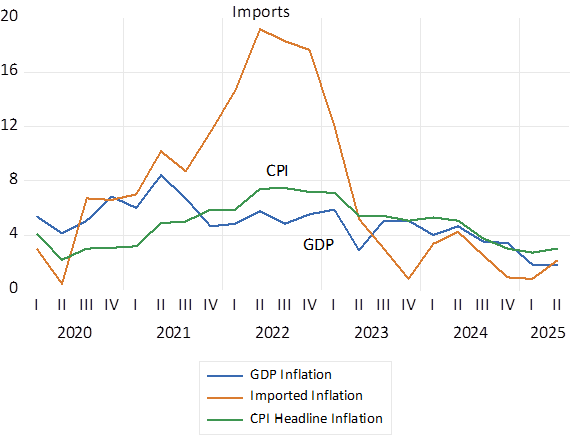
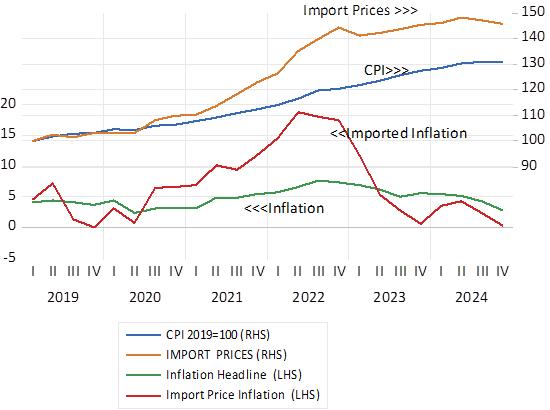
The post covid rand weakness forced import prices much higher to a peak year on year inflation rate of close to 20% in early 2022. The increases in prices charged have rapidly fallen away since with the recovery of the ZAR and have stabilised CPI inflation and the inflation of the prices of goods and services included in GDP- in the GDP deflator. So much so that GDP – measured in current prices rose by only 2.5% in Q2 – a mixed blessing because the much-watched ratio of Debt to GDP has accordingly risen. We are not inflating away our debt problem- rather the opposite – to the apparent approval of the bond market.
Inflation; Year on Year Changes in the Price Index for Imports, GDP and the CPI. Quarter End Data
Source; Stats SA and Investec Wealth and Investment
The ZAR Vs the USD, the EM Basket and the Chinese Yuan (January 2025=100) Daily Data 2025.
Source; Bloomberg and Investec Wealth and Investment
Yet the lower realised rates of inflation have helped to reduce inflation expected and the level of long-term interest rates. The yields on long dated RSA bonds – both rand and dollar dominated – have moved smoothly lower – as they have for other EM borrowers – despite the volatility in the US Treasury Bond market. This has made for highly satisfactory returns on investors in long dated EM, including RSA debt. Yet the SA economy plays on the JSE have had to struggle on, given the interest rate repressed, weakness of demand for their goods and services. A little TLC from the Reserve Bank would make a large difference to their valuations and all dependent on the SA economy. And to SA politics.
Bond Yields; RSA and USA. 5 year % p.a. Daily Data 2025
Source; Bloomberg and Investec Wealth and Investment
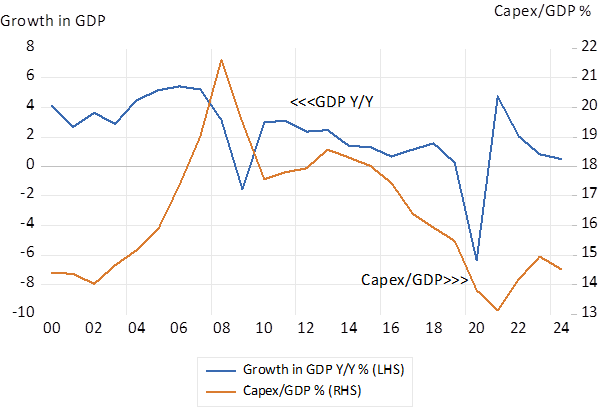
It is common cause that expenditure on capital goods in South Africa is not nearly high enough to sustain faster economic growth. Capex now runs at about 15% of GDP. It was 21% in 2008 after the economy had enjoyed a period of strong growth- averaging close to 5% p.a.
These broad trends – growth and capex rates rising and falling in the same direction – indicate that growth in household spending and incomes, especially in corporate incomes, leads and capex follows. We need faster growth to gain more capex and vice versa.
SA; Growth in GDP and the Capex to GDP Ratio 2000-2024. Annual Data
Source; SA Reserve Bank and Investec Wealth and Investment
Moreover, the most important source of domestic savings with which to fund capex (over 100% of all gross savings given government dissaving on a large scale and household saving largely offset by household borrowing) are made in SA by profitable businesses themselves. Savings in the form of cash retained by them rather than paid out in dividends or shares bought back. For society more capex more growth to come, rather than cash paid out is the preferred outcome.
Raise demand, raise incomes and profits and so business savings and increased capex will follow to sustain faster growth in spending. And should domestic savings be insufficient to fund the capex foreign savings attracted by the same growth in profits and improved returns can fill the gap. And fund the increase in imports that will accompany faster growth and add supplies of goods to help match increased demands for them.
The current account of the balance of payments goes into deficit that net capital inflows automatically match. And help to stabilise the exchange value of the ZAR. This is the virtuous cycle of growth that sustained the economy in the first decade of this century. Faster growth without more inflation.
The Current and Capital accounts of the Balance of Payments
Source; SA Reserve Bank and Investec Wealth and Investment
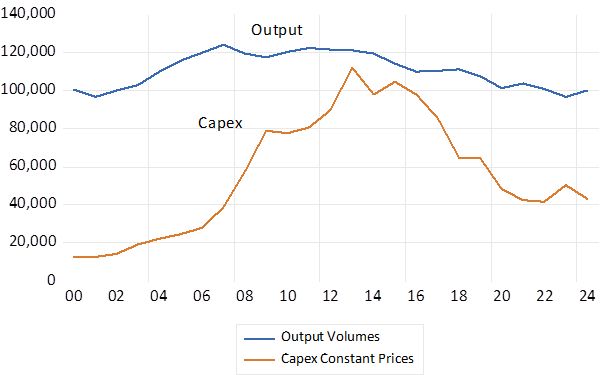
Alas much of the extra capital raised and invested in South Africa over the past 20 years was wasted on a large scale. Returns on capital invested by Eskom and Transnet have returned less than one per cent per annum on average. (See Business Day April 4th 2025) The huge capex programmes undertaken by Eskom in the early 2000’s have been accompanied by declines in the output of electricity –insufficient rather than excess capacity – with demand forced lower by growth destructive increases in the price of electricity.
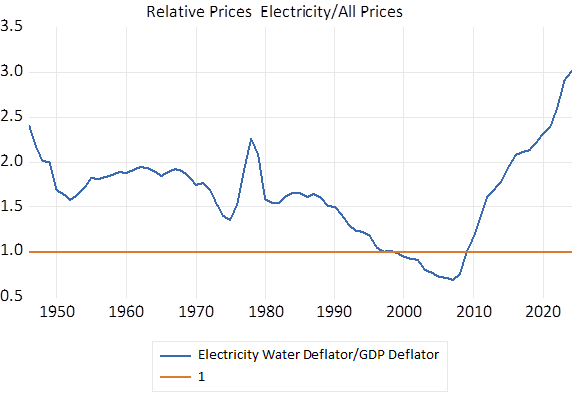
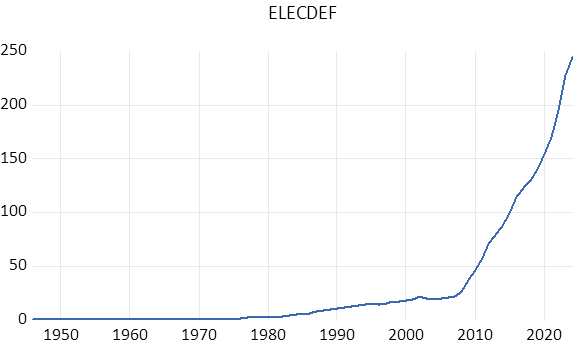
Capex on electricity and water- mostly electricity- Kusile and Medupi- in constant prices- grew by more than five times in real terms while the output of electricity and water in the same constant prices, peaked in 2008 and has been in decline ever since. As has capex. The price of electricity has increased three times faster than prices in general since 2000- to cover the inflated costs of construction and operations – up by over 14% p.a. on average. A growth destroying combination of wasted capital, bloated operating costs and much higher prices, that was a high additional tax on disposable incomes.
Electricity and Water; Output Volumes and Real Capex; 2015 Prices Annual Data. R millions
Source; SA Reserve Bank and Investec Wealth and Investment
The Price of Electricity and Water- Ratio to GDP Price Index (Deflators)
Source; SA Reserve Bank & Investec Wealth and Investment
The Electricity and Water Price Index.
Source; SA Reserve Bank & Investec Wealth and Investment
The growth rates achieved between 2003 and 2007 now seem like an impossible dream. Dreams or nightmares to come will depend not on the volume of capex to come but more so on the quality of the capex undertaken. Quality as measured by realised returns on capital.
The waste of capital to date and the outcomes in the public sector more generally has not been accidental. Just follow the money to understand why it is what it is. The actions of the managers of South Africa’s public sector and their governing boards have not been driven by return on capital. As we learn they have seen their income earning potential derived from generous salaries and bonuses and other benefits of employment, armed guards perhaps, and including expensive travel allowances and payments for attending unnecessary meetings. Added to the huge temptation, often exercised, of perverting the very valuable contracts signed with service providers.
KPI’s that emphasise bottom lines or better still on returns on capital realised are essential to the purpose of improving the quality of the capital employed. It is indispensable for any business hoping to survive the threat of competition. Raising additional capital to be employed in SA, absent the discipline of required cost of capital beating returns, is very likely to be wasted.
It may be possible to introduce private sector style incentives to the public sector. But absent the forces of competition constraining the price setting power of public sector monopolies, it remains something of a dream. The alternative to economic stagnation is the firm recognition that only private ownership of capital and private production, imbued with the right incentives, can help improve the performance of the SA economy. Surely the evidence points overwhelmingly to this wake-up call.
The Road Accident Fund (RAF) has been much in the news, for the usual dispiriting reasons. The RAF is a very important, tax funded spender. It manages great complexity with over R50 billion of revenue and expenditure a year. A formidable amount that the Treasury expects to increase at an annual average rate of 19% p.a. over the next three years, from R53.1 billion in 24-5 to 89.7 billion in 2027/28.
The RAF, as a social service, and its 50 plus billion bill can be compared favourably, or is it unfavourably, with other kinds of tax funded expenditure. The old age grant now runs at 117bn, and the child support grant at R90.4b in a Social Development Budget of R422b. The RAF is estimated by the Treasury to have a negative asset value (liabilities over assets of R370b – rising to R423b by 27/28) Can South Africa afford such largesse? Could not other spending make a better claim? Or lower taxes be a better idea and win more votes than the RAF?
Fall off your bike or the mountainside, get bitten by a shark or a snake, drown in the sea river or lake and society commiserates and hopes your damages are covered by some insurance. Society cannot hope to do much more for the victim given a lack of resources. But, get unlucky on the road, have a car push you off your bicycle, or the pavement, and SA society comes to the rescue- very expensively.
The payments by the RAF are funded by a levy on the price for petrol and diesel, set at R2.18 rands per litre of unleaded petrol. That is now about ten per cent of the price paid at the pump. A stealth tax paid for benefits the wider public surely does not recognise very well. How many drivers/taxpayers are aware of how much they are paying for the RAF when they fill up. And who, other than the successful claimants on the fund, are aware of the scale of the benefits provided? Bad luck is not expected. It sadly just happens
Compulsory third party insurance elsewhere is typically covered by private insurance companies and the premiums they raise from vehicle owners. As it was once long ago in South Africa until superseded by the RAF – mistakenly surely.
According to the report of the RAF for 2023- 04, there were 79,377 new claims registered that financial year, and 63,015 claims settled. The average claim on the Fund had grown by 9.5% to R287,000. 159,122 such claims were made in 23-24, a sharp decline from the 374,000 claims made in 2019.
Total outlays of the RAF were R45 600 million in 2023-04, of which payments made to compensate for incomes lost were R21.6b, or a chunky 47% of all payouts. The average claim for earnings lost was R1.2m, So called general damages paid amounted to R12.7b or 28% of total payments made.
The Fund, out of financial necessity, has succeeded recently in reducing the number of personal claims made and improving the rate at which claims are paid out. And in reducing legal fees incurred. The sums paid out have increased at a slower rate from R42b in 2019 to R45.6b in 2024.
Further slowing down the growth in payouts is essential. A first step would be to ensure that the loss of future income, inflation adjusted, was appropriately discounted by the high after realised inflation yields available from the RSA available to any beneficiary with a lump sum pay out. Somewhere close to a real and certain 5% p.a. for ten years.
On a claim for the allowed maximum R350,000 of annual income lost, for say an agreed ten years, to which an agreed inflation rate of say 5% p.a. were added each year, the payout, equal to the present value of the future agreed income losses would be R3.4m when applying an 8% discount rate (5% inflation + 3% real) or close to R3m, R400,000 less when using a higher discount rate of 5 % p.a. above inflation.
Still much less would have to be paid out were the years of lost income more strictly limited, and the income inflation rate were assumed to be much lower. The accident victim could moreover be forced to buy a monthly annuity in exchange for the larger lump sums agreed. A regular source of income would be more socially desirable than a lump sum easily squandered. Insurance companies could compete for the lump sum provided by the RAF offering an annuity to be administered by them on behalf of the client. And collect the income tax due, as they do with any administered pension. A further way to reduce the net cost of the RAF.
The liability for the annuity offered would likely be matched by the insurer purchasing a government bond of similar duration. Hence helping to fund government debt, perhaps less expensively. Most important, vehicle owners could be encouraged to substitute private accident insurance for the RAF. It would need tax incentives to have them convert. The savings for the taxpayer of private third-party insurance could be immense. The RAF law would have to be amended to allow some of these changes essential for fiscal sustainability.
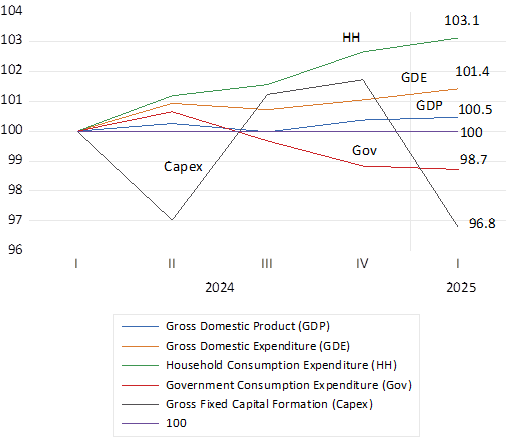
The real economy continues to make little progress, according to the latest National Income estimates for Q1 2025. Output (GDP) has stagnated, higher by a mere half of one per cent since Q1 2024. The expenditure side of the economy (GDE) has consistently fared as poorly, up by 1.5% since then helped to a small degree by a 3.1 per cent increase in household consumption. Government consumption expenditure, that excludes the welfare grants in cash that find their way into household spending, has also been a drag on the economy. Down by 1.3%, while a bigger drag on growth has been capital expenditure by firms and the government that is now 3.2% lower than it was in early 2024. A baleful reality that seems to resonate everywhere except at the Reserve Bank.
South Africa; National Income Flows Quarterly Data 2024-2025 (2024=100)
Source; SA Reserve Bank, Investec Wealth & Investment. (Quarterly seasonally adjusted data at constant prices)
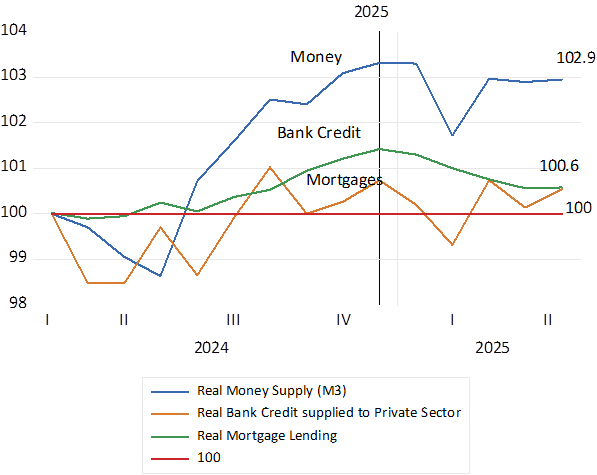
The lack of demand is easily explained by the money supply (bank deposits) and the credit supplied by the banking system. In 2025 the money supply and supplies of bank credit and mortgages, adjusted for inflation, have been in retreat and are barely above levels of early 2024. Clearly the lack of demand for money and credit can be explained by their high real costs.
Money Supply and Bank Credit Adjusted for Inflation; Monthly Data (2024=100)
Source; SA Reserve Bank, Investec Wealth & Investment.
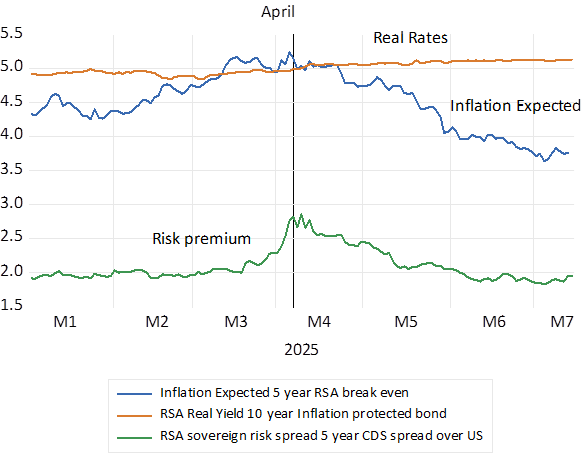
One notable improvement in financial conditions has been the decline in the inflation rate to below 3% p.a. Perhaps even more worthy of notice is the decline in longer term interest rates since April, when the anxieties about the Budget and the survival of the GNU were at their most intense. The 10, 5 and 1 year bond yields are off by 128, 89 and 25 basis points respectively. Truly big moves at the long end. Largely because expectations of inflation in SA have been revised significantly lower.
Inflation expectations are implicit in the differences in the yield on an inflation exposed bond and its inflation protected equivalent. These differences in nominal and real yields for five-year RSA’s have declined impressively from 5.14% p.a. in April 2025 to 3.75% this week. Perhaps because the Reserve Bank has committed itself to a 3% inflation target. But more likely because inflation itself has receded so sharply. Inflation leads and inflation expected follows – not the other way round – as the Reserve Bank likes to contend.
However, the SA specific risks explicit in bond yields, while 50 bp lower than they were in April are still highly elevated, now just under 2%. For five year RSA’s. And the fully inflation protected RSA 10 year bond yield remains above a risk infused real 5% p.a. This implies a very high real cost of capital for SA business that suffocates capex spending, especially when demand for the goods and services they produce remains so depressed – and is expected to remain so. And when short term borrowing costs are not expected to decline by more than 25 bp over the next 12 months.
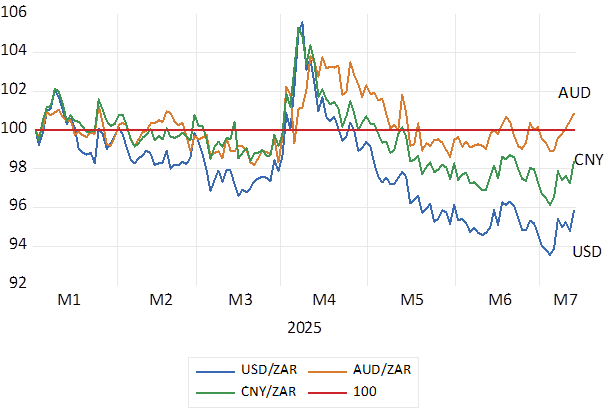
Inflation is down because demand for credit with which to buy is severely repressed. And because the rand has maintained its strength against most currencies. And in line with the bond market the ZAR has strengthened significantly since April 2025 for GNU related reasons. It is noticeable that the rand has weakened against the Chinese Yuan (our largest trading partner) at no more than an average about 1% p.a. rate since January 2021. One reason why Chinese motor cars are as cheap as they are. (despite Tariffs)
The ZAR Vs the USD, the Aussie and the Chines Yuan. (2025=100) Daily Data to 14th July 2025.
Source; Bloomberg, Investec Wealth & Investment
Real Rates, Inflation Expected and the RSA risk premium. Daily Data 2025
Source; Bloomberg, Investec Wealth & Investment
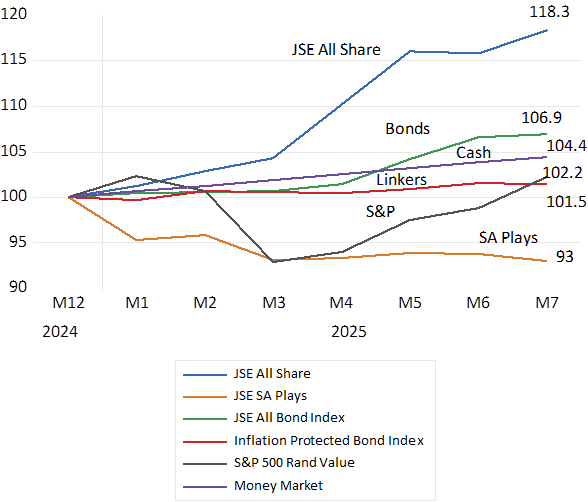
The stock market has nevertheless brought some welcome cheer. The JSE All Share Index has returned a whopping 18% this year. This run has everything to do with precious metals- platinum and gold in that order. Though the performance of the SA Economy Plays on the JSE reveals the dismal reality of a stagnant economy. The return on my constructed Index, market value weighted, of SA plays that includes the slow growth defying Clicks and Capitec, is down by seven per cent this year.
Growth can improve with governance and supply side reforms and less SA risk. Including reforms that can get more gold and other minerals legitimately out of the ground. Common cause surely. But faster growth needs the essential accompaniment of a more sympathetic monetary policy. That would hence reduce SA risk, sustain a stronger rand and lead to less inflation. Three per cent inflation is possible without squeezing further life and growth out of the demand side of the economy.
Total returns from the different SA Asset Classes in 2025. Month end data. (January 2025=100)
Equity equivalence is a better alternative to giving away a significant chunk of equity in a good business to some undeserving party with the right lucky credentials, racial and or political. It has been used in SA before Starlink, as in the allocation of the original casino licences in the Western and Eastern Cape in the late nineties. Bidders competing for the limited licenses were required to qualify for them by offering the wider community valuable add-ons of their own invention. The support of Sun International for the establishment of the Cape Town Convention Centre helped win them the valuable right to operate the only Casino in Metropolitan Cape Town.
The same opportunity for the Gauteng Government to establish what could have been a highly profitable monopoly Casino in downtown Johannesburg, with an accompanying and competitively determined large contribution extracted for the renovation and sustainability of the precinct, was proposed at the time. And rejected as politically unacceptable given competing and powerful empowerment interests. En kyk hoe lyk dit nou.
Presumably Starlink has attached value for its shareholders in the opportunity to supply its internet connections to rural South Africa. And is willing to pay up in advance in the form of conspicuous public benefits for the opportunity to earn these potential profits.
The same principal of equity equivalence could be or could have been applied to the award of the right to operate the State Lottery. Clearly this right is a valuable one judged by how much the contending parties have been willing to spend challenging the award in the Courts. How much better it would have been for the SA public and its taxpayers if the Minister could choose between the contending and technically and racially qualified partners simply on how much cash, or better, in equivalent benefits, they would have been willing to pay up for the lottery license?
Though the ratio of the lottery revenue to the cash paid out by the lottery to its winners, merely 50%, the lottery is a very poor gamble. Though the charities and others who receive the grants paid for by the lottery, part of the 50% retained after salary and other expenses, can be regarded as a compensating public benefit that the mostly low-income lottery players are paying for. Provided that is the lottery grants are awarded on merit; which it appears sadly, may not be the case.
The value of a license to operate a Casino, or a gambling machine in SA, has surely been competed away. By internet-based gambling houses supplying a convenient phone based and easily scalable service to gamblers with essentially very low fixed costs. And with minimal operating costs in the form of a few programmers using probably codes taken off the shelf. And games that now presumably are even more easily enhanced with the aid of AI. The internet does not require an expensive to build and maintain a physical Casino. Or pay its croupiers, clerks and security officers. Or provide prize money to keep horses racing so that gamblers can bet on them.
The gambling market in SA appears as highly competitive judged by the barrage of adverts directed at gamblers watching sporting events encouraging them to join the action so easily through their cell phones and gambling accounts. By a variety of licensed operators. Highly profitable businesses usually see their profits competed away. I am confident this will prove the case in time for the rapidly growing sports betting industry.
The competition for the bets made by the gambler takes place in part through the odds offered. Improve the gamblers odds of winning or losing less, reduce the share kept by the house, and the bets placed with a house will tend to increase. The highly competitive casino market in Las Vegas proves the point. Casinos there compete publicly on the odds offered.
Yes, the average gambler must lose to keep the house in business. But the average loser is surrounded by a presumably normal distribution of above average winners and below average losers, per day, year, or even over a lifetime of what some presume is irrational gambling. You may just get lucky. And there is fun to be had in playing the odds, win or lose, as ever larger number of betters on sporting events confirm. Though gambling and losing more than can be afforded can become dangerous to the addict.
For the internet gambling houses their most important cost will be advertising and promoting their plays on TV. It may be of some consolation to the non-gamblers to recognise that this spend on TV is in fact paying for the sport they are watching. It is the competitively determined – and rising value of the TV rights to broadcast the games and to advertise betting opportunities on them, that pays the wages of the players and determines the value of the clubs that hire them. And reduces the profits of the internet gambling house. Provided there is no licensed monopoly to limit competition.
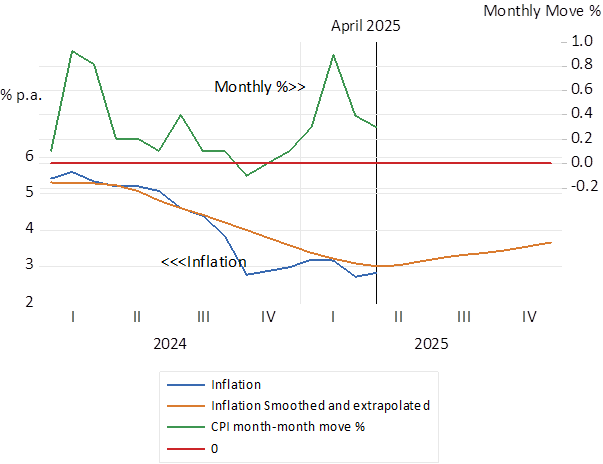
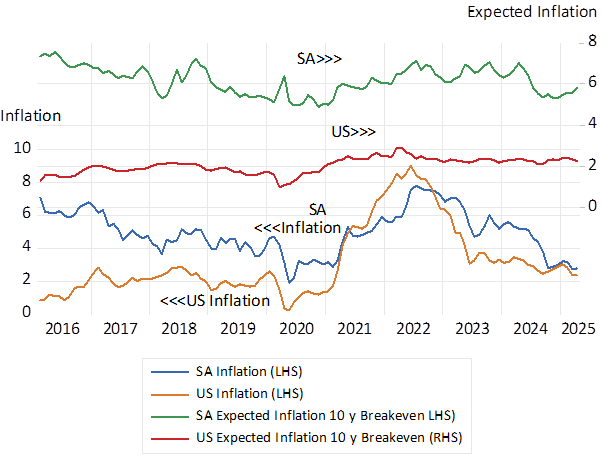
Inflation in SA has declined sharply from a 5% plus rate in early 2024 to 2.8% p.a. (see below) If current trends persist the rate of inflation will rise to about 3.5% by year end. We consider the reasons for the recent decline in inflation and the conditions that could give rise to persistently low inflation in SA, that is 3% p.a. or lower inflation sustained over an extended period.
South African Inflation (2016 – 2025) Monthly (Annual % change in CPI Index)
Source; Bloomberg, SA Reserve Bank and Investec Wealth & Investment.
South Africa Inflation (2024-2025) Monthly (Annual % change in CPI Index)
Source; Bloomberg, SA Reserve Bank and Investec Wealth & Investment.
The reason for this welcome relief from rising prices seems clear. The demand for goods and services has been growing very slowly, thanks to highly restrictive monetary policy. And the supply side of the economy given rand stability helped further recently by a degree of absolute ZAR strength has meant moderate increases in the CPI. Weak demand and increased supplies- lower price imports – have meant modest pressure on prices.
The demand side
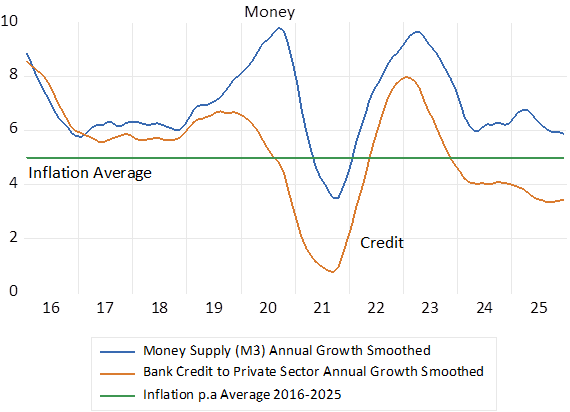
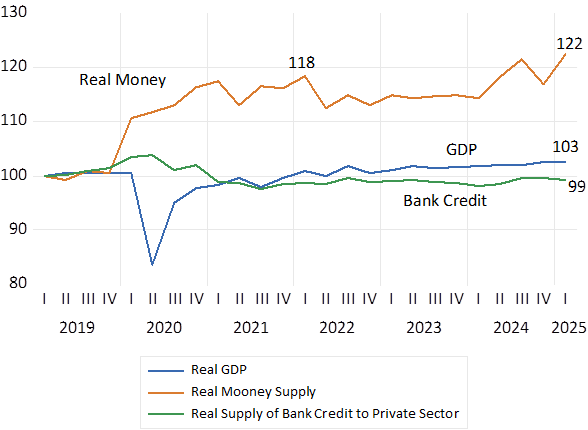
The growth in the money supply and bank credit, that influence spending in a direct way, has remained highly restrained for an extended period- going back to 2016. Money supply (bank deposits) have grown by an average 7% p.a. since 2016 and bank credit supplied (accounting for a large majority of the asset side of the bank balance sheets) has grown by an average 5.3% p.a. Inflation has averaged 5% p.a. over these years, implying real growth rates of the supply of money and credit, in line with the slow rates of growth of output(GDP) and national incomes.
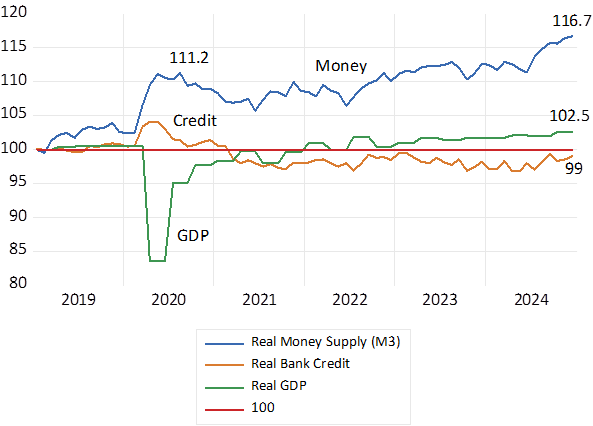
Reactions by the Reserve Bank to the Covid lock downs led to a brief spurt in money supply growth in 2020-2021. Money and credit growth picked up again in 2022-23 as commodity and metal prices recovered but then as abruptly fell away. Both money and credit growth have declined consistently since then. Real bank lending to the private sector is below pre-Covid levels as is GDP. The money supply- that is mostly bank deposits, is barely up (by a mere 4%) since 2020. Given such financial repression, any upward pressures on prices from extra spending – from the demand side of the price equation, were surely not possible. Furthermore, this lack of demand itself would have been inconsistent with real GDP or GDE growth of more than one per cent p.a. since 2023- as has been the case. Growth as well as prices respond to a mixture of supply side and demand side forces. When real demand grows very slowly as it has in South Africa, real income growth cannot advance at a much faster rate. Regardless of what may well have been faster potential growth. One can never know what might have been with less austere monetary policy settings.
The money supply and credit cycle 2016- 2025. Monthly data annual growth rates
Source; Bloomberg, SA Reserve Bank and Investec Wealth & Investment.
Real Money Supply (M3) and in Bank Credit supplied to private sector. (2019=100)
Source; Bloomberg, SA Reserve Bank and Investec Wealth & Investment.
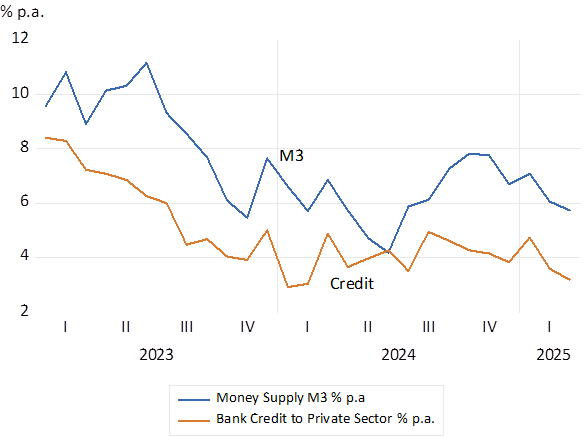
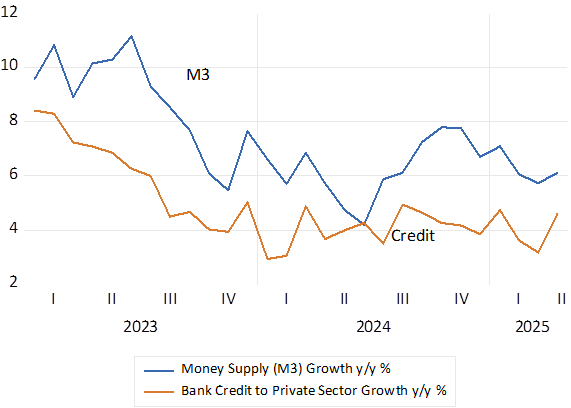
Since early 2023 the growth in the money supply and bank credit- at current prices- has declined significantly as is shown below. The trends, especially when adjusted for (lower inflation) have continued to restrain spending.
Growth in Money Supply and Bank Credit 2023-2025. Monthly % p.a.
Source; Bloomberg, SA Reserve Bank and Investec Wealth & Investment.
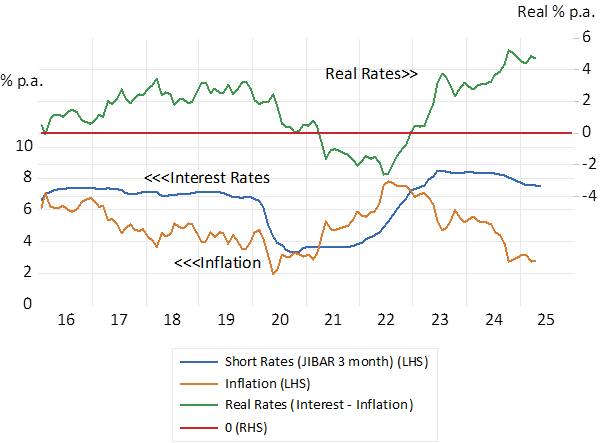
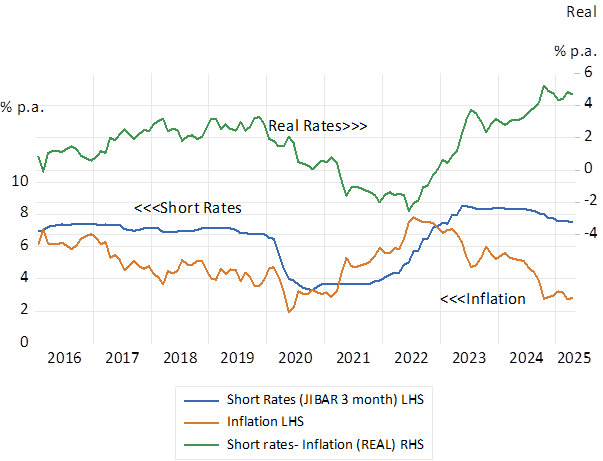
Monetary policy must also be judged as highly restrictive by observation of policy determined short term interest rates. When interest rates are adjusted for falling rates of inflation, to approximate the real cost to borrowers of raising credit it may be seen that real interest rates are at a post 2016 peak. The Reserve Bank does not target money supply or credit growth rates. The instrument of policy is its interest rate settings. Policy determined short term interest rates were hiked sharply in response to higher inflation, post Covid. This represented a highly predictable SARB interest rate response to a supply side shock to prices. A shock linked to the Ukraine crisis, combined with a weaker rand. Borrowing costs are now lagging well behind the more recent decline in inflation sending real rates to very high demand suppressive levels. Clearly borrowing from the banks to fund working capital or a mortgage on a home loan has been strongly discouraged by the high real costs of or rewards for money and credit. And the demand for and supply of bank credit have accordingly grown at a very slow rate.
Significant relief for borrowers is not expected any time soon. The forward rates of interest on May 25th indicate a mere 25 bp reduction in short rates over the next twelve months. Without significantly lower interest rates to encourage the growth in demand for bank credit and spending by households and firms, GDE will not grow beyond forecast GDP growth rates of less than 2% p.a. And too little rather than too much spending (relative to potential supplies of goods and services) will continue to weigh heavily on the pricing power of domestic producers.
That is without pressure on prices emanating from the supply side of the economy that could independently force prices higher- and demand still lower in response to supply side driven higher prices. Especially should higher interest rates follow supply side shocks- as has so often been the been the case in SA. The Reserve Bank has predictably increased interest rates, whatever the cause of higher prices, less supplied or more demanded. Though the pressure on prices has almost always come from the supply side – from exchange rate weakness. shocks. As was the case most recently in 2022. Ideally temporary supply shocks on the price level should be ignored by monetary policy.
Short term interest rates before and after inflation. 2016-2025.
Source; Bloomberg, SA Reserve Bank and Investec Wealth & Investment.
The Supply side
The supply side of the SA economy is dominated by the exchange value of the ZAR and the impact it has on the prices of imported and exported goods. The SA economy is heavily dependent on imports and exports- equivalent together of about 60% of GDP – and usually well balanced. The cost of an average imported good or service, and the value of an export depends on global price trends- usually expressed in USD . Their translation into rand prices is via the exchange rate. With something of a lag – as prices adjust gradually to higher exchange rate related costs of supply- higher or lower depending turn on the hedging strategies adopted. For an important influence of this kind, we can refer to the USD price of a barrel of oil that finds its way into petrol and diesel prices and the CPI will be a combination of world market prices in USD and the exchange value of the rand.
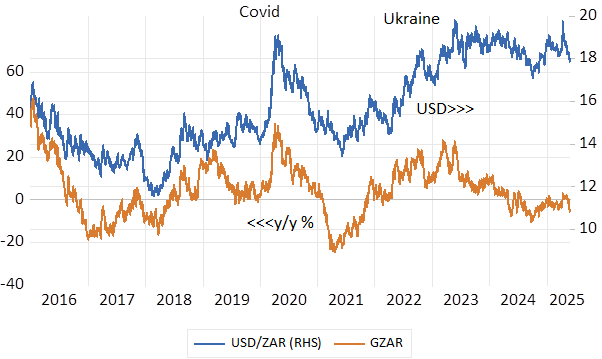
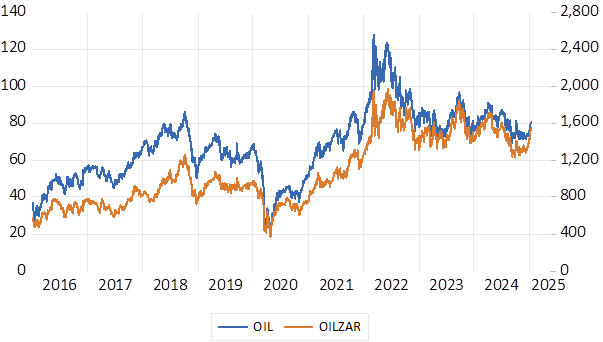
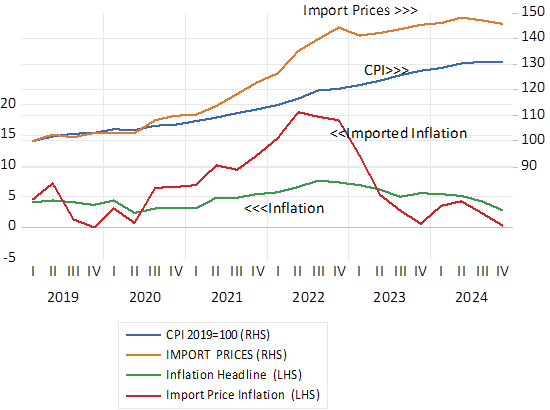
It should be recognised that the exchange value of the ZAR has remained unusually stable over recent years. As a result, the supply side of the economy, has generally benefitted from a degree of rand stability, helping to contain inflation about the 5% p.a. mark until the recent improvement. This degree of rand exchange rate stability came after the Zuma inspired, significant degree of rand weakness, of 2015, And absolute strength in the ZAR over the past year and a half has helped take the inflation rate to 3% p.a. Helpfully also the price of oil in USD and in ZAR has been in retreat for most of the period since 2022, having spiked between 2020 and 2022 in response to the invasion of Ukraine and the sanctions imposed on Russian oil. The prices of all imports to SA have stabilised and the inflation of imported goods was close to zero by year end 2024. Recently oil price trends in USD and ZAR have been very helpful in containing upward pressure on costs and prices.
The USD/ZAR exchange rate and annual movements in the USD/ZAR (y/y % p.a.)
Source; Bloomberg, SA Reserve Bank and Investec Wealth & Investment.
The price of Brent Crude Oil USD per barrel (LHS) and ZAR per barrel (RHS)
Source; Bloomberg, SA Reserve Bank and Investec Wealth & Investment.
Price Indexes SA CPI and Import Price Deflator (2019=100) and annual % changes in Indexes. Quarterly Data
Source; Bloomberg, SA Reserve Bank and Investec Wealth & Investment.
Supply and demand working together
Inflation in SA has receded because of a combination of weak demand and an improving supply side – led by a more stable exchange rate and helpful oil prices. Inflation can stay at low levels if these supply and demand side forces are sustained.
Slow growth threatens fiscal sustainability. It raises the risk of a SA government resorting to creating money to fund government spending for want of revenue and under the pressure of a growing interest rate bill on a budget- that seriously constrains other more popular spending plans. Slow growth and the money supply responses that may accompany slow growth increases the expected rate of inflation over the long term. These expectations lead in turn to higher long-term interest rates on government debt to compensate lenders for more inflation expected. So adding to the interest costs of servicing government debt and putting further strains on government budgets.
Slow growth may restrain incomes and spending and so, absent supply side forces lead, to lower rates of inflation. But slow growth threatens fiscal stability, it discourages domestic capex and capital inflows to fund them that might have improved longer term growth prospects. Thus, weakening the exchange rate and despite weak demand putting upward pressure on prices. The relative strength of the ZAR has had very little to do with recent demand destroying interest rate settings and the consequently slow realised rates of growth since 2020 and indeed since 2016. It is almost all a supply side story – the prospect of somewhat improved growth prospects given the GNU.
The dependence of the outlook for economic growth on political developments in South Africa and therefore for the exchange value of the ZAR has been very clearly illustrated recently. More growth expected leads to a stronger rand as capital tends to flow more to than away from South Africa and vice versa, slower growth expected frightens capital away and tends to weaken the rand- and raise inflation rates.
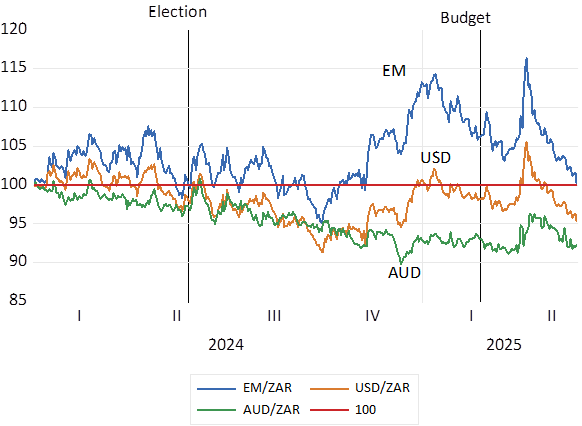
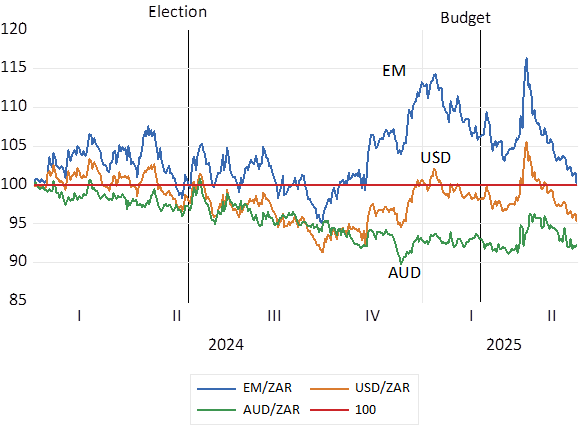
The Government of National Unity (GNU) formed after the elections of May 2024 were regarded as more growth friendly. And the rand strengthened accordingly. Dounts that the GNU would survive the arguments over the 2025-26 Budget proposals led to rand weakness. The agreements on the Budget reached finally in May 2025 have reinforced the GNU and added too rand strength (see below) For the ZAR it is the supply side – the outlook for growth that matters most. The demand side and interest rate settings matter much less. And unaccommodating interest settings and slow growth in money and credit that slow down growth lead to rand weakness rather than rand support.
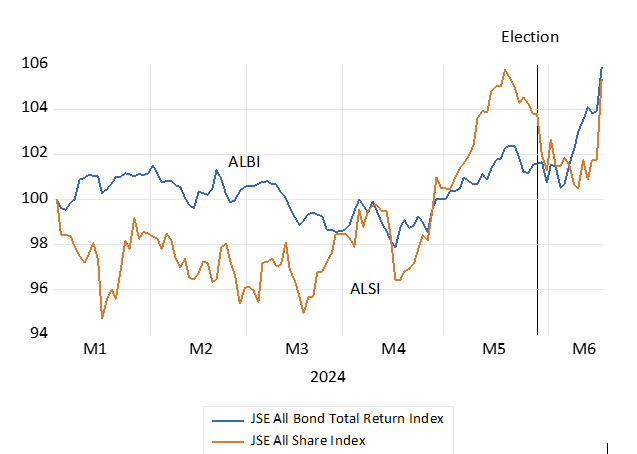
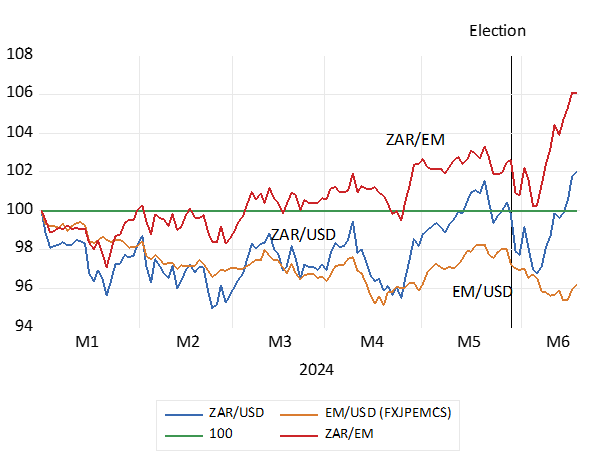
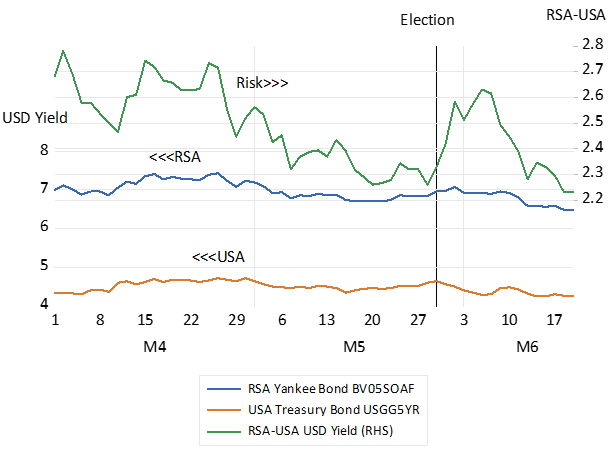
Political developments and the ZAR in 2024-2025. Daily Data. Lower numbers indicate rand strength.
Source; Bloomberg, SA Reserve Bank and Investec Wealth & Investment.
A firmer rand responding to what the markets decided would be growth improving economic policy settings has meant less pressure on inflation. Combined with sustained negative pressure on the demand side of the economy the prospect of low rates of inflation over the long run becomes more likely with supply side reforms that raise potential growth rates.
Ideally the prospect of more growth and less inflation would be recognised early by the bond and currency markets. In the form of lower interest rates and a narrower risk spread between RSA and USA interest rates. That is in the form of a narrower carry and therefore a lower cost buying dollars for forward delivery.
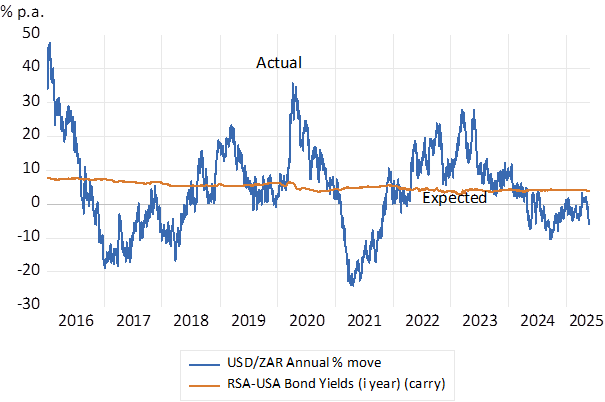
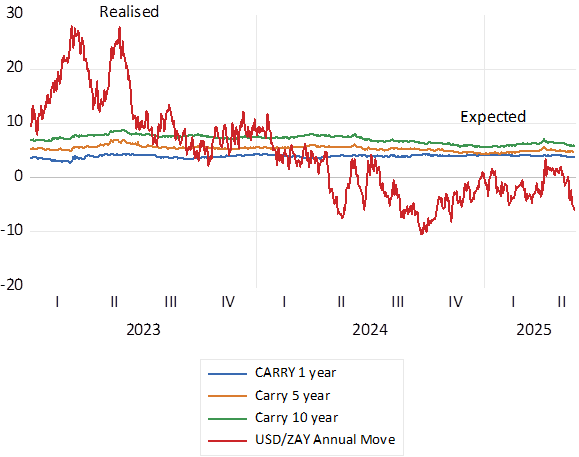
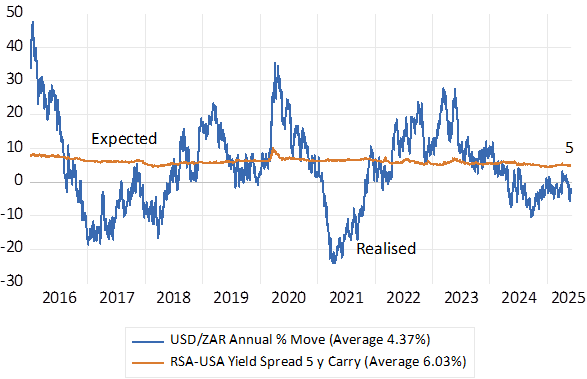
SA Interest rates, their levels and differences with US rates have still to register any marked change in sentiment about the outlook for SA growth and inflation. Forward exchange rates still consistently expect the rand to weaken, compounding at about 5% p.a. Since 2016 the difference between one year SA and US government bonds has averaged 5.1% p.a. with very little deviation about this average. The actual market movement in the rand over one year averaged less over the past 15 years by 4.4% p.a. with very wide fluctuations about the average (see below) Currently the difference between one year SA and US Treasury yields has declined to less than 4%. The carry for five year and ten year money has remained above 5% p.a.
Inflation expected in South Africa is not only reflected in longer term interest rates. It is also revealed by differences between RSA rand rates of interest and USD interest rates for securities of the same duration. These differences in interest rates indicate the expected direction of the ZAR. The greater the difference, the more the ZAR is expected to weaken over time, by application of the interest parity condition. The difference in yields is equal to the difference between the spot and forward rates of exchange. Arbitrage maintains this equilibrium condition.
This yield difference -the so-called carry- represents the cost of hedging the rand against the US dollar. The difference in yields may also be regarded as the reward for or the cost of expected exchange rate weakness or strength. What is gained on the interest rate spread is offset by (expected) ZAR exchange rate weakness. And vice versa for holders of USD receiving lower interest rate income but offset by a stronger dollar.
The wider the difference in interest rates the more expensive in ZAR will be dollars to be delivered in a year or more ‘s time. This cost of hedging will also find its way into the prices of imported goods and services. Rand weakness expected adds to inflationary pressures. To hope to sustain inflation at low rates, these interest rate differences must narrow to simultaneously reduce expected rand weakness and so ease the supply side pressures on prices especially the prices of goods or services imported.
The expected and realised move (% p.a) in the USD/ZAR over one year (Daily Data 2016-2025
Source; Bloomberg, SA Reserve Bank and Investec Wealth & Investment.
Source; Bloomberg, SA Reserve Bank and Investec Wealth & Investment.
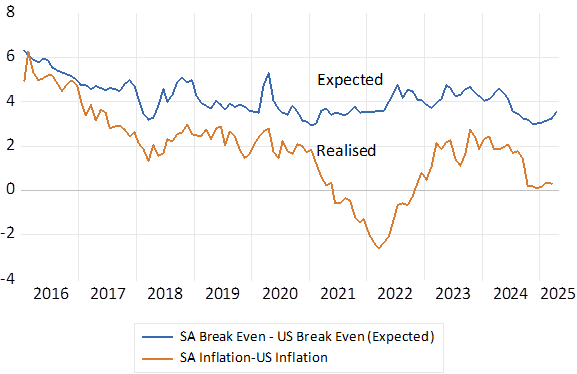
Yet not only is the rand expected to depreciate at a compounding rate of close to 5% a year over the next five years and more, the rand, is also expected to weaken by more than the difference in inflation in SA and the US. As it has done in the past. The ZAR has weakened over the years at a significantly faster rate than past differences in inflation between SA and the US. It is expected to continue to do so at about 2% a year faster than the expected differences between SA and US inflation.
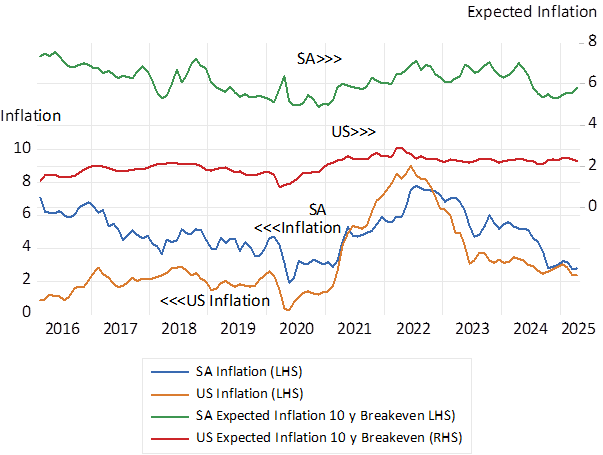
We show the differences between actual inflation in the US and SA and the differences between expected inflation in the two economies. Expected inflation in SA over the next ten years is expected to average 6% p.a. Expected inflation over the same ten years is expected to average about 2.2% p.a. A difference of close to 4%. Yet a dollar delivered in ten years’ time would cost over 6% a year more p.a. (see below) Put differently the ZAR/USD exchange rate has not conformed to Purchasing Power Parity, it is expected to deviate still further away from PPP in the future. Inflation expected in the Bond market is calculated objectively as the difference in yields between a vanilla bond and an inflation protected bond of the same duration, the so-called breakeven rates.
SA and the USA Actual inflation and Expected Inflation 2016-2025
Source; Bloomberg, SA Reserve Bank and Investec Wealth & Investment.
SA and USA Differences in Inflation and Inflation expected
Source; Bloomberg, SA Reserve Bank and Investec Wealth & Investment.
There is much to be done to raise the growth in SA output and incomes. There is as much to be done to convince investors in and outside SA that faster growth and less inflation and less exchange rate weakness over the long run is to be expected. Setting a lower target for inflation will not be sufficient to the purpose. A stable ZAR will be essential. Changing the long-term growth trajectory would be very helpful to the purpose of faster growth with less inflation to accompany a stronger ZAR. And as important for immediate improvement in the growth and inflation outcomes would be less inflation and exchange rate weakness expected.
It would also be helpful that should the economy suffer from another shock to the ZAR for global or SA specific reasons, the Reserve Bank could refrain from raising interest rates. To let the price shock work its way through without incurring further damage to the growth prospects of the economy and the demand side of the economy, when already under pressure of higher prices, with higher interest rates. Judged by past performance the danger to the economy will be policy determined interest rates that are too high rather than too low for the good of the economy. It is to an improved supply side of the economy we should look for permanently low inflation. The danger of demand led inflation, given the prevailing Reserve Bank culture, is a small one.
Inflation in SA has declined sharply from a 5% plus rate in early 2024 to 2.8% p.a. in April 2025 – for the usual supply and demand reasons. The demand for goods and services has been growing very slowly, and the supply side of the economy, given rand stability, recently even absolute ZAR strength, has brought moderate increases in the CPI.
Bank lending to the private sector has been growing very slowly. Adjusted for prices, bank credit was still below pre-Covid levels and the real money supply after a spurt during Covid had grown by only 4.2% between 2021 and the first quarter of 2025. Recent growth rates in money and credit have trended lower. A financial state that can be described as severely repressive. Given the weakness of demand for goods and services it is unsurprising that real incomes and output (GDP) were but 3% higher in q1 2025 than they were in early 2019. When real demand grows as very slowly as it has in South Africa, real output could not have advanced at any faster rate than it has, meaning an expensive waste of a somewhat better growth opportunity.
Real Money Supply (M3) and in Bank Credit supplied to private sector. (2019=100) Monthly data to 2025 q1.
Growth in Money Supply and Bank Credit (January 2023-2025 April) Monthly % p.a.
The lack of demand for and supply of credit and money is explained by short term interest rates set by the Reserve Bank. As inflation has come down the real cost of borrowing for overdrafts or mortgages has risen to very high, near record levels. Despite two 25 bp, highly delayed, reductions in the policy determined rate. The money market now predicts but a mere 25 bp further reduction in short rates over the next twelve months.
Without significantly lower interest rates to encourage the demand for bank credit and spending by households and firms, frustratingly poor GDP growth rates of less than 2% p.a. should be expected. And the prospect of too little rather than too much spending (relative to potential supplies of goods and services) is likely to continue to weigh heavily on the pricing power of domestic producers. The demand side of the economy is very unlikely to threaten higher prices for the foreseeable future without an unlikely change of mind set at the Reserve Bank.
Short term interest rates before and after inflation. 2016-April 2025. Monthly Data
Yet the unpredictable supply side of the SA economy, perhaps accompanied by a sharp reduction in the exchange value of the ZAR could always drive prices higher. And judged by past performance the Reserve Bank would then then drive interest rates higher to further depress demand that would come under pressure from higher prices. Imports and Exports account for a combined 60% of GDP. Their translation into rand prices depends on the exchange rate. That recently has been strong against the USD, the Aussie dollar and the EM basket. The Import Price Index (with a large oil component) was falling in 2024.
Price Indexes; SA CPI and Import Price Deflator (2019=100) and annual % changes in the Indexes. Quarterly Data
Slow growth aided and abetted by aggressive monetary policy while disinflationary, threatens growth and fiscal sustainability. It discourages domestic capex and capital inflows to fund them that might have improved longer term growth prospects. Slower growth expected frightens capital away and tends to weaken the rand- and raise inflation rates. Doubts that the GNU would survive the arguments over the 2025-26 Budget proposals led to some rand weakness. The agreements on the Budget reached finally in May 2025 have reinforced the GNU and added rand strength (see below) For the ZAR it is the supply side – the outlook for growth that matters most for the rand and in turn inflation.
Political developments and the ZAR in 2024-2025. Daily Data. Lower numbers indicate rand strength.
Long term interest rates, their levels and differences with US rates have still to register any marked change in sentiment about the outlook for SA growth or inflation. Forward exchange rates still expect the rand to weaken at about 5% p.a. over the next five years. (see below) And bond market yields- the difference between high vanilla bonds and elevated inflation protected RSA interest rates – indicate that inflation is still expected to average over 6% p.a. over the next ten years. Meaning expensive debt to add to fiscal strain.
Expected inflation and the cost of hedging the ZAR will not narrow, nor borrowing costs decline meaningfully, absent any significant improvement in the SA growth outlook. But nonetheless a welcome 3% p.a. inflation in SA could be sustained absent any exchange rate shocks initiated by politicians, local and foreign. Would setting a 3% inflation target mean more growth sensitive management of the demand side of the economy? Would it secure rand stability? Only possibly. It might however encourage the worst, anti-growth instincts of the Bank to prevail, especially when the supply side of the economy, the exchange rate, does not play ball.
The five-year RSA-USA carry and the realised annual move (% p.a) in the USD/ZAR (Daily Data 2016-2025 June)
SA and the USA; Actual inflation and Expected Inflation over the next 10 years (2016-2025)
Well maintained homes in my neighbourhood continue to be demolished at an impressive rate. Demolition in is being ordered so that the land released can be converted to a new residential unit or two or more. A process also well under way widely in the Western Cape. But conspicuous by its absence in much of the rest of SA.
If the demolition is to make economic sense the to be realised market value of the new units constructed must be expected to exceed the purchase price of the old building, the significant costs of constructing the new units, the demolition costs and the interest income sacrificed on the working capital tied up in the project would have to be covered as would the price paid for the established building demolished or expensively redeveloped. The purchase price paid will be approximately equal to the present value of the future rentals being sacrificed on demolition.
Any extant building survives because a potential re-development of it does not meet this profit test. Most buildings (slowly) survive the test of time. Look around you. It takes rising rentals, or rental income effectively sacrificed by owner occupiers, to encourage re-development. Escalating rentals add value to homes or commercial buildings and encourage owners to sell up and move on. And add value, that is additional wealth and spending power for their owners. It takes a growing economy to change the face of the nation.
Sadly, for the average home or building owner in South Africa, or those owning commercial property, the rental tide has been receding, outside of the Cape. The legitimate dreams, based on past performance, of millions of homeowners and landlords of buildings generating hoped for wealth for them, has been frustrated. They should blame the national government for the economic policies that have failed. And moreover, blame local governments who, egregiously, have raised taxes on their homes to deliver far inferior services in exchange. Terrible wealth destroyers they have proved to be.
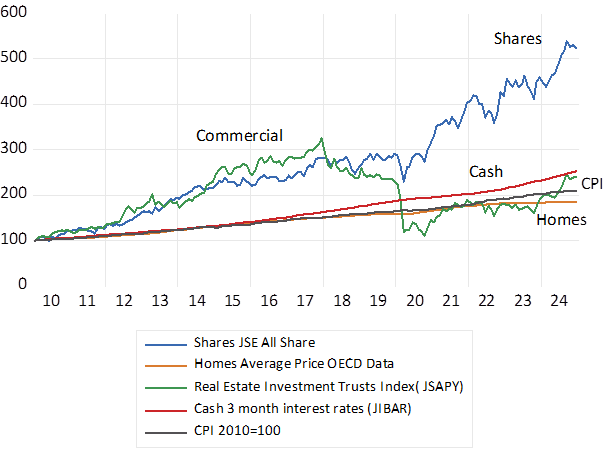
Between 2010 and 2024, annual returns calculated from owning the average home, including rental income, assumed to have increased at the rate of inflation, and reinvested or used to pay down mortgage debt, was on average 4.2% p.a. Annual average returns from the listed REITS have been an average 5.6% p.a. while the JSE delivered much more, 11.7% p.a. on average, also including dividends reinvested. Even the low-risk money market returned more than homes or listed real estate. Some 6.2% p.a. on average. Inflation averaged 5.1% over the fifteen years. A million rand invested fifteen years ago in the stock market would be worth R5.3m today, the average million rand home then would fetch but R1.84m and an average R1m portfolio of commercial and industrial property would by now have compounded to about R2.5m. That is by about the same increases in the prices of the average basket of consumer goods, up by about 200% in the fifteen years.
Investment Returns; Shares, Real Estate. Cash (Income reinvested) and the CPI. 2010-2024 (2010=100)
Source; OECD, Reserve Bank of South Africa and Investec Wealth and Investment
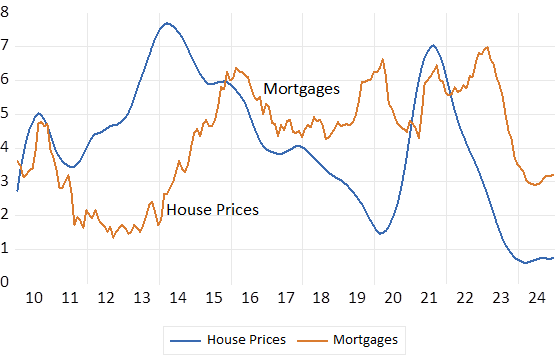
Consistently, the average increase in mortgage advances since 2010 has averaged but 4.3% p.a. close to the average increase in house prices. Recently this growth rate has fallen further to about 2% p.a. The housing market has not been particularly good for banks- or might one say the banks, especially the Reserve Bank, has not been very good for the housing market, given very expensive mortgage loans.
Annual growth in house prices and mortgage advances (2010-2024)
Source; OECD, Reserve Bank of South Africa and Investec Wealth and Investment
If, a big IF, you could have rented your dream home fifteen years ago you would have done better renting than owning. Especially if you had saved the difference between the cash rent paid and the mortgage interest rate – say a 5% p.a average yield gap – into the share market.
The total internal investment return on a property is the sum of the initial year one rental yield plus the rate at which the rents are expected to escalate over say the next 15 years. For much of the past 15 years the expectations of rental escalations and consequent capital gains must have been disappointed (outside the Cape) Thus renters rather than owners would have been favoured by the persistent gap between lower rental yields and higher mortgage rates.
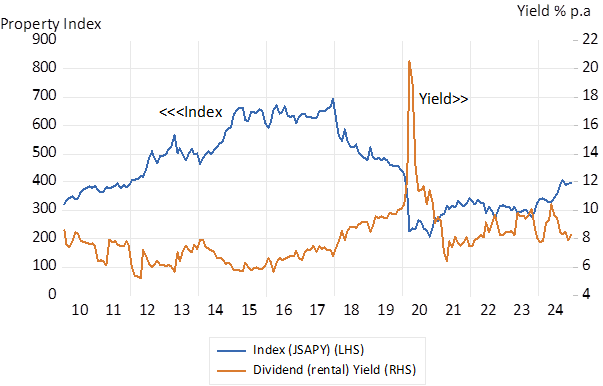
What comes next for renters or owners of real estate will depend on the state of the economy and the competence of municipal authorities. If property prices and rentals continue to rise at their recent pedestrian price, rental yields will rise to compete with punishingly high borrowing costs. Initial rental yields, (Rents/Value) will rise as the expected capital gains owning property fall away. Though rentals themselves may not rise much, given a depressed lack of demand for the space available. As has clearly happened with commercial property and the REITS. Much of the return from their shares is coming in the form of dividends paid.
Real Estate Investment Trusts on the JSE. Index values and Dividend (net rental) Yields (2010-2024)
Source; OECD, Reserve Bank of South Africa and Investec Wealth and Investment
A revival of the economy and the property market with it could change the trajectory of real estate values, and help create income and wealth for many homeowners. And revive the construction sector in the old-fashioned way. By turning the old into the new to revitalise our cities and suburbs. It can happen with a clear vote for better governance, better policies and their execution. Surely very much possible – as the Cape proves.
You are only wealthy if you have saved a good proportion of your income over the years and not consumed it all, to sustain an extravagant lifestyle. It is however your wealth that makes your large incomes and consumption tolerated by the wider society. Thus making it possible for the talented and diligent and hard-working and, most important for a growing economy, the enterprising and innovative successful risk takers, to earn their high incomes legitimately and enjoy their consumption and also help create their most useful wealth.
The savings that add to wealth and most important are invested productively by the income seeking business organisation that also saves and borrows and undertakes capex on behalf of their owners. These firms are given the responsibility to manage the capital stock and all the complementary scarce resources that are entrusted to them. Including employing workers and managers whose wages and rewards will depend on the good returns on capital (savings) their employers are able to realise to sustain their enterprise.
The more such capital is created and made available to the economy in the form of plant, equipment, dams, roads and ports etc and the more efficiently they are managed, the higher will be the incomes earned by the poorer households. More capital raises the relative scarcity of labour and improves productivity and incomes. Which makes the people understandably willing to protect the wealth that funds real assets against damage or theft or violent expropriation by local or foreign invaders. The protection and respect for property, that is for capital or wealth, in turn encourages the potentially higher income earners to venture more, to earn more and to save and invest more in the capital stock. Thus serving the essential interests of the wider community.
The consumption of others is not helpful to you- it adds to the competition for scarce resources. Saving, accumulating wealth to fund an investment in real assets is very helpful for the many without much wealth. It is the large-scale waste of capital, extracted by taxes, as has been the case with our SOE’s, that should be condemned.
Such essential willingness to protect property is to be found in the Bible and the rabbinical commentaries on it. As I was pleased to discover at a recent joyous barmitzvah. The substance of the readings that day were the laws and regulations governing the protection of property and compensation for its damage, intentional or accidental. And about laws that also regulated the rights and obligations to an important asset class of those times, the slave. All food for my economist soul.
There was little more I could read that morning about the creation and purpose of wealth. I thought I would ask this question of the Torah and Rabbinical commentary, the Talmud using AI. Rab AI so to speak. Here is a summary of the responses received, with my reactions indicated between brackets.
“The Talmud places a strong emphasis on the importance of hard work and diligence. It acknowledges that while effort and work are important, ultimately, one’s success may also depend on divine blessing. (Unbelievers will call this luck) The Talmud establishes the principle that those who are wealthy have a responsibility to support the less fortunate. The act of giving is seen as a valuable pursuit, and generosity is highly praised. Wealth is viewed as a trust that comes with significant responsibilities – that one should use their wealth not just for personal pleasure but also for the betterment of society. This includes supporting community needs and contributing to public welfare. (My point about the social purpose of wealth being the creation and preservation of the productive capital stock for the benefit of the greater society, has not apparently been recognised)
The Talmud warns against excessive attachment to wealth. A person should not let the pursuit of wealth dominate their life to the detriment of their spiritual and ethical responsibilities, that through work and the creation of wealth, one can achieve personal and communal fulfilment.”
(Ancient wisdom that is clearly consistent with human aspiration and economic development that implicitly recognises inevitable differences in economic outcomes as socially helpful)
A large threat to the long-term growth prospects of the SA economy is the loss of essential skills to emigration. Such losses have been a continuous drain on the growth potential of our economy both pre and post our democracy. That Trump saw fit to take the back of white South Africans could be even more damaging to South Africa than he imposing higher tariffs or denying aid. What if the US decided that badly treated South Africans with skills and the right aspirations would be very welcome in the US? A drain of emigration could become a flood. A severe potential loss that could be avoided by seeking the friendship and support of the US rather than so gratuitously incurring its ire and enmity.
How could this be done to the great benefit of South Africa and its growth prospects? I would suggest by doing in SA what Trump aspires for the US. That is for SA to become a truly colour blind and meritocratic society and economy. Which it is not. Our policies have focused on restitution for a black South Africans rather than stimulating growth. Understandable perhaps but self-defeating- making growth that would benefit the many so hard to realise.
Growth rates would surely be greatly enhanced by unfettered competition for jobs and for contracts to supply the State and its agencies. A process that would be particularly helpful to the least advantaged poor of South Africa. In the form of many more well-paid jobs and indirectly in the form of better education and health care that only a prosperous and competitive economy could afford. BEE clearly does not benefit them. There must come a time when the highly educated and talented black elite of South Africa are willing to compete on their own considerable merits with all the competition for the commanding heights of the economy and its governance. The sooner the better for growth and our international standing.
Faster growth may not reduce inequality and moreover, should not be expected to do so. To them that have may well be given. And be resented accordingly when it has a racial or ethnic connotation. But envy should not be allowed to frustrate the realisation of the greater good as it has to date. Higher incomes earned fairly by providing superior service to customers and employers should be applauded not resented. Growth is a positive sum game.
How badly has the South African economy been doing? According to the recent extensive Survey of Income and Expenditure and Income (PO100) of 19,940 SA Households conducted by Stats SA so much worse than could ever have been imagined. It has come up with a literally unbelievable estimates of household income and expenditure and their distribution by race. These estimates of household expenditure and income are also widely different from the national income estimates. And should be rejected.
Between 2006 and 2023, inflation adjusted household consumption expenditure of all SA households is estimated to have declined absolutely by a real 1.9%. Real Black household expenditure, with a 62% share of all spending, is estimated to have risen by an impressive 36.2% over these years. While the household spending of increasingly poor white SA households is estimated to have declined by 21%. Households headed by those with a tertiary qualification did even worse- they apparently saw their expenditures decline by 29.2% between 2006 and 2023. No case for envy here if it were so.
The income story told is less depressing. Black headed households are estimated to have seen their incomes rise by 46% between 2006 and 2023. While white incomes declined by only 7.7%. All household incomes are estimated to have grown by 5% since 2006. Suggesting a completely implausible and unobserved increase in real household savings – the difference between incomes and expenditure.
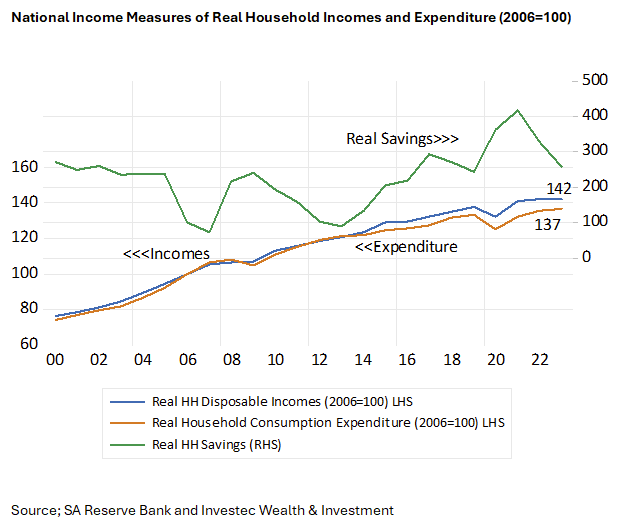
By contrast the National Income Statistics record that real household disposable income rose by 42% between 2006 and 2023, while real household consumption expenditure increased in line by 37% over the period (see below) Such inexplicable differences in the measures of income and expenditure need reconciliation. And what does it all imply for the reconstruction of the weights in the CPI that depend on the Survey? And for our measures of inflation?
We hear frequent complaints from state-owned enterprises (SOEs) that they are struggling to meet their debt obligations and need to be recapitalised. Yet the SOEs are simply not generating enough return on capital invested (ROIC) to justify allocating more capital to them.
Let’s take Transnet as an example. Transnet’s return on invested capital (ROIC) was 1.0% in 2024, which is lower than the miserable ROIC of 1.5% posted in 2023. The cost of debt on long-term South African government debt is 11%. This is the bare minimum cost of capital Transnet should meet. Transnet is destroying over 30 billion rand in economic profit every year when the difference between its return on capital and its opportunity cost is considered. A terrible unaffordable waste.
There are two key value drivers that feed into ROIC: operating margin and asset turns. To improve the operating margin, Transnet needs to increase revenue AND bring down operating expenses. To meet an 11% cost of capital, Transnet needs to generate 47 billion rand in annual operating profit on its invested capital. Its profit from operations was 4.3 billion in 2024 (operating profit is before interest expenses). Assets need to be run more efficiently or sold to private parties that can do so.
The large SA state owned enterprises, Eskom and Transnet, among other SOEs including the Post Office and the trading divisions of most municipalities have not remotely met the requirement for an investable credit rating. They have not been able to contain their costs well enough to cover their interest bills let alone their true opportunity cost of capital. Nor have they properly maintained their Plant and Equipment. Fundamentally they have failed because the bottom line, that is an adequate return on invested capital, has had little influence on their behaviour. Without many eye-watering billions of maintenance capex, their ability to continue to supply essential services, indispensable for economic growth, is severely compromised.
The SA government now recognises that the only practical way to secure the supply of these essential services is to raise large investments of private capital. Of which there is no shortage, provided the terms are regarded as acceptable.
And it would only be a private company, with a bottom line that requires a risk-adjusted return on capital, that could realistically hope to control costs and preserve and improve the capital stock, to reliably supply essential services in the future. Any imaginary mythically reformed SOE –capable of containing costs and operating efficiently – but without the right private incentives- is not a viable option. We’ve been down this track too many times.
The agreed terms for private sector engagement would have to recognise the true market value of the plant (PPE) taken over by the new operator of a network or part of it. Given years of neglect, existing assets might have very little value to any new operator. The potential market value could be exchanged for equity held by the government in the new privately controlled suppliers.
The private operator would have to commit the extra capital required to guarantee a flow of essential services over the long run. And such extra capex, would have to be recognised in the tariffs and or charges made for what could be valuable access to the networks.
Complicated calculations or regulations of appropriate charges or tariffs do not have to be a barrier to private entry. Any private company that won a tender to enter a network, with a degree of monopoly power, would be highly conscious of the impact of the prices it could charge on demand, sensitive to degrees of capacity utilisation and so its bottom line. And would be very considerate of its growth prospects. Becoming a reliable supplier at a competitive price with market-related returns would be a valuable outcome for all stakeholders.
The purpose of any private- public partnership or initiative is a simple one. That is to secure the future supply of essential services for SA users without which SA incomes and output must stagnate or decline. This all-important objective, viewed realistically, must be top of officials’ minds engaged in any negotiation with potential private partners.
The differences in the value of residential property in Cape Twon and Gauteng – and in Durban and the upper market suburbs of all the other SA cities are most striking. I learn anecdotally of a modern multi-bedroomed home in a gated estate near Johannesburg, largely grid free, that is municipality free, that has been on the market for six months for an asking price of not much more than three million rand with no takers. The owner wants to move to Cape Town as do so many and the market is flooded with like homes. Palaces that would take R10m or more to build. The same 3 million would have difficulty in securing a well appointed two-bed roomed apartment in Sea Point.
The differences in property outcomes are easily explained. In the Cape property owners in the towns and suburbs get reasonable value for the wealth taxes and service charges they are forced to pay. This adds to rather than subtracts from property values. Unlike the abject failures of service delivery almost everywhere else that destroys demand for homes and valuations.
The sad news is that the hopes of many have been dashed. Those who have responsibly been saving, paying off their mortgages each month expecting that the growing equity in their homes would help fund their retirements when they downsized and cashed in. The expectation now is that the value of their homes has not and will not keep up with inflation.
I am informed by a leading property appraiser that on average commercial real estate in Cape Town is expected to increase in capital value by 6.5% p.a. – ahead of inflation expected – while equivalent property in Johannesburg is expected to gain but 3% p.a. Furthermore, the so-called capitalisation rate at which future rental incomes are discounted is lower for Cape Town property that a similar building in Johannesburg. A value adding 1.25% margin in favour of Cape Town discount rates is estimated.
Recent property transactions confirm this difference. The Table Bay Retail Mall was sold for an initial yield of 7.75% to Hyprop. The Mall of the South in Johannesburg was sold to RMB at a significantly higher initial rental yield of 9.5%. For landlords of residential property in Cape Town initial rental yields (net rents/Market Value) range from about 3% in the most favoured suburbs to about 5-6 percent where there is less competition. All consistent with expensive real estate.
It should be assumed that the total return expected by investors in real estate will be similar everywhere in SA. Flows of mobile capital make it so. But total returns come in two parts- an initial yield – in dividends or net rental income and in capital growth. Thus the more growth expected in net income the lower will be the initial yield for homes of similar quality. For cash strapped migrants relocating to the Cape it may seem easier to rent rather than buy- with expected capital growth conceded to the investor.
The good news for our cousins in the North is that their cost of living is dramatically lower than ours in Cape Town. The bigger and better the home the more consumption power it delivers and such delivery comes much less expensively in Joburg.
The opportunity to live in an inexpensive palace rather than a crowded bed-sitter for the same modest outlay, either in rentals paid or sacrificed by owner- occupiers, should surely be an attraction not to migrate. And enough of a saving to help owner-occupiers go off grid and behind gates. And to run a four by four to negotiate the potholes when off to their bushveld retreats.
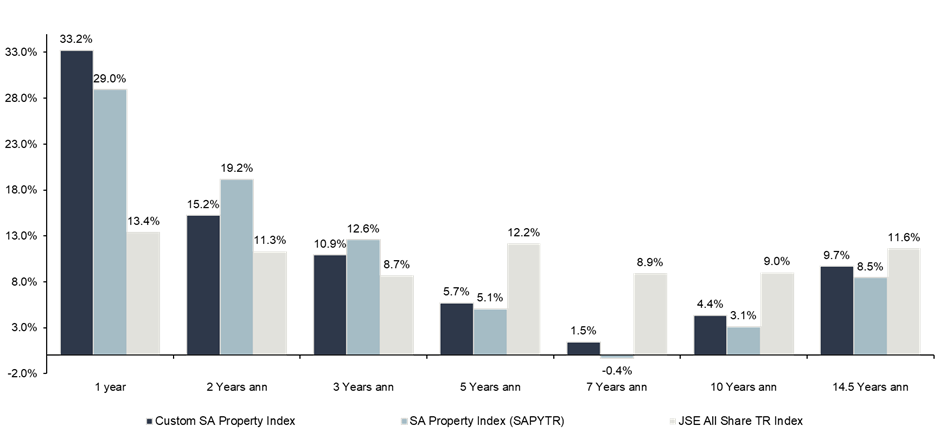
My New Year advice therefore is to buy more of what is cheap. To house up and take advantage of the bargain basement offers. And hope that all the bad news about service delivery is in the already low prices. The best performing asset class in SA in 2024 has been listed property. Residential property might just enjoy a similar rebound should service delivery unexpectedly improve rather than deteriorate further. (see below)
Total Return To end Dec 2024. Property Vs The All Share Index
Source; Bloomberg and Investec Wealth & Investment
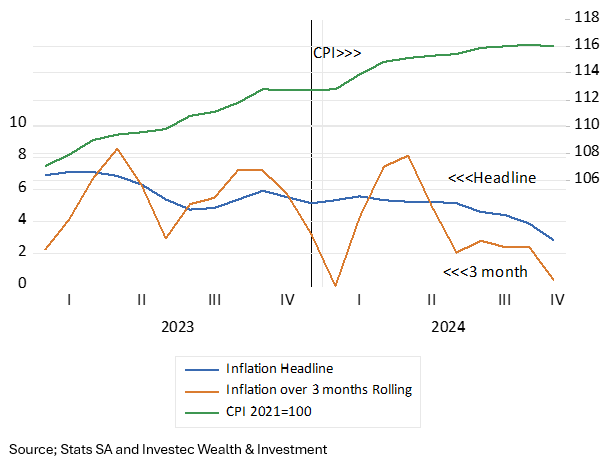
Inflation in SA has nearly halved since June. From 5.1% p.a then to 2.8 in October. Indeed average consumer prices have hardly risen at all since June. In October they fell marginally, and over the past three months the CPI has hardly budged, and price increases were close to zero.
Inflation and the SA CPI; Monthly Data
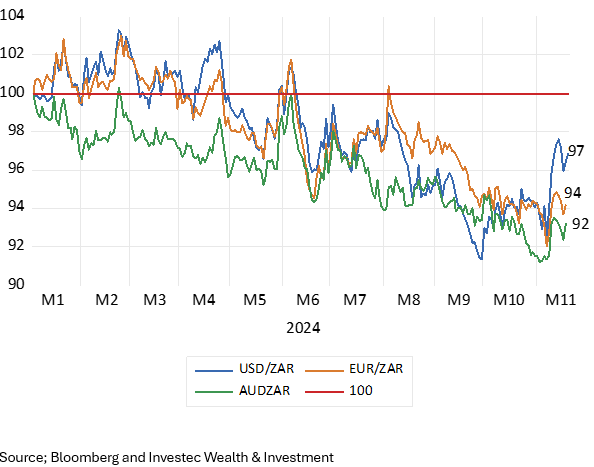
One observation that one can make is that such price stability could not have occurred without a very strong rand. A rand that has gained value against a range of low inflation currencies. This year to date the rand is worth four per cent more USD, can buy six per cent more Euros and seven per cent more Aussie dollars. The year before the rand had weakened VS these currencies by over 10%. Its surely no surprise that inflation in SA accelerated in 2023 and has sharply decelerated this year.
The ZAR Vs the USD, the Euro and the Aussie Dollar. Daily Data (2024=100)
One can also conclude that the exchange value of the ZAR drives the direction of prices in SA – rather than the other way round. SA is a very open economy. Flows of exports and imports account each for about 30% of GDP- of total supply and demand in the economy. What we pay in rands for imports and receive for exports helps determine all prices in a systematic way. You can tell as much at the petrol pump.
And so how then can SA achieve currency strength and low inflation? The answer would also seem obvious enough. Form a government of national unity that is expected to raise growth rates, improve the outlook for SA bonds and equities and so more capital will flow in more than out leads to less rand weakness and inflation expected in the future. Lower long term bond yields, lower costs of capital generally, all reinforce the growth momentum. And with lower inflation short term interest rates decline just as predictably, as they can be expected to rise with rand weakness. Yet expectations of faster growth have to be reinforced with consistent growth enhancing actions. Investors can be encouraged, they can as easily be disappointed.
It is not only in South Africa that politics and the economic policies and outcomes associated with a change in leadership drive the direction of the exchange rate. And depending on the degrees of openness to foreign trade that will then drive the direction of all prices. The exchange rate leads and prices follow, and the exchange moves in response to changes in expectations of returns in the capital market. The exchange value of the USD, the essential reserve currency, is subject to large changes in direction, persistently so, that have little to do with differences in inflation between the US and its principle trading partners. And everything to do with expected returns on capital invested. But will have a significant impact on the profits and growth prospects of businesses that engage in foreign trade.
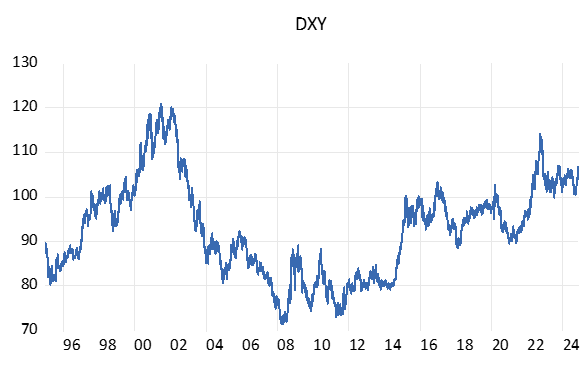
The DXY is a weighted Index of the exchange value of the USD Vs the major currencies, the Euro, Yen etc.. It gained nearly 50% additional exchange value between 1995 and 2000. It then declined from an Index value of 120 to 70 by the time of the Global Financial Crisis. The dollar since has been on a mostly upward tack since and clearly has received a boost from the Trump ascendancy. From which the ZAR has not be immune but has behaved broadly in line with all other currencies. Dollar strength will be far more easily managed provided the ZAR holds its own with the other low inflation currencies, as it has been doing.
But for the Trump administration the impact of the potentially stronger dollar on trade flows may be far more important than the impact of higher tariffs on imports and the retaliation that may follow and on prices US consumers will pay. The unpredictability of exchange rates, despite low rates of inflation in the developed world, especially of the exchange value of the USD, is a fundamental flaw of global trade and finance that all economies including SA have to cope with.
Looking back at the economy reminds how tough it has been in recent years for households and businesses dependent on the state of the SA economy. Since those pre-Covid days the economy has hardly grown at all. Compared to Q1 2019 GDP by June 2024 had gained a mere 5% over the five and a half years. (growth of less than 1% p.a) Households are spending but 6% more than they did then and capital formation is down by about 14% in real terms. How could such a deterioration be allowed to take place?
Vital SA Economic Statistics. Supply and Demand. (2019=100) Quarterly Data.
Source; SA Reserve Bank and Investec Wealth and Investment.
Clearly the supply side of the economy performed poorly – led by the well documented, confidence sapping failures of the State-owned enterprises and of government generally, including those of the provinces and municipalities. But demand management by the Reserve Bank can also be held responsible for at least some of the weakness. Much of the period since 2021 has been accompanied by much higher interest rates both absolutely and relatively to inflation. That is despite the grave weakness of demand for goods services and labour.
The Reserve Bank’s Monetary Policy Committee provides a full explanation on a regular basis for these interest rate settings. It has been fighting inflation and only inflation that rose after 2021 as the rand weakened so significantly after 2021. The idea of a dual mandate of the US Fed kind – low inflation and employment growth being the combined objective of monetary policy – has been anathema to our determined inflation fighters.
Shocks to the price level caused by exchange rate weakness – unrelated to immediate monetary policy settings and inflation trends – are clearly not ignored when interest rates are set. Yet such shocks- decidedly not of the Reserve Bank’s doing- lead inevitably to more inflation – then higher interest rates – and in turn still weaker demand – already under pressure from higher prices. Higher prices have their complex causes- but they also have (rationing effects) on the willingness to spend more- given minimal growth in income
The problem for SA and the Reserve Bank was that the ZAR weakened decidedly after 2021- and weakened against not only the US dollar but also vs other EM and commodity currencies. It was SA specific in nature clearly linked to the failures of government and the failure of the economy to grow that added to SA specific risks. The USD/ZAR, as had the average EM/ZAR and AUD/ZAR had recovered well from the Covid linked risk aversion that brought pressure on the ZAR and the market in SA Bonds. SA appears particularly vulnerable to Global Risk aversion. It may be recalled that the USD/ZAR had recovered to as little as R14 in early 2021. But then the sense of South African failures to realise economic growth took over the currency and Bond markets . And the weaker rand inevitably forced prices higher at a faster rate. Given the MO of the Reserve Bank.
The ZAR Vs the USD, the EM Basket and the Aussie Dollar. Daily Data 2019-2024 (2019=100)
Source; Stats SA, Bloomberg and Investec Wealth and Investment.
Interest rates and the USD/ZAR 2019-2024. Monthly Data to September 2024
Source; Stats SA, Bloomberg and Investec Wealth and Investment.
The ZAR and Short-term Interest Rates. Daily Data (2019-2024)
Source; Stats SA, Bloomberg and Investec Wealth and Investment.
The connection between the foreign and domestic exchange value of the ZAR and the outlook for the SA economy has never been clearer. The GNU has raised the prospects for growth and the ZAR and the bond and equity markets have responded accordingly. Inflation is therefore on the way down. Over the past three months it has averaged but 2.4% p.a. Interest rates at the short end of the market have come down and will come down further provided the ZAR holds up. Not so much vs the US dollar, that may be getting a Trump boost, but also against the other currencies similarly affected by the USD. We should not expect the Reserve Bank to change its pro-cyclical approach. We should but insist and hope that the supply side weaknesses of the SA economy are well addressed. Raising the GDP growth rates to a modest 3% p.a. will not only promote economic and political stability, it will bring lower interest rates and less inflation.
I like to visit the local supermarkets. And not only for the usual reasons. It helps confirm my faith in the power of market forces. Fully evident in the impressively wide range of goods and services on offer.
The SA retailers very adequately fulfil the all-important task that we have delegated to them. That is to deliver a wide range of goods, including food and medicine essential to life and happiness. The retailers are left mostly alone to manage a highly complex supply chain that involves, farms, ports, roads, trucks and ships, factories and warehouses, banks, landlords and regulators. And they manage the always complicated relations with workers and their supervisors to pack the shelves and fill the checkout counters and increasingly to deliver directly to homes.
They are serving us well for highly robust reasons. That is to make a living. Mostly modest but some very impressive. Generating incomes for the owners and staff that will bear a close relationship to the difference between the costs of providing the essential service and the revenues generated. To generate profits they will have to prevent the corruption of the supply chain.
Such profits will also depend on how well the retailer manages the promotion or demotion of managers and workers- including the succession plans for senior executives. The retailer as must any business manage successfully the relationship between the efforts of and rewards for the work force. Providing the right incentives to work harder or smarter remains highly relevant for containing costs, enhancing revenues, and the margins between them. Without which the firm would not survive the competition for the household budget.
The apparent “chasm” between the pay of the CEO and the average worker should be regarded as an important part of the market in action. To be admired rather than resented as representing the natural outcome of the supply and demand for very different capabilities and talents at work. As explaining the wide difference between what Taylor Swift and her hair stylist takes home after a show, given their very different contribution to the bottom line. Such inequalities of rewards are part of the necessary incentives for the best and brightest to ascend the highly competitive and greasy corporate poles to make a better fist of it. We can’t all hope to be as good as a Taylor Swift, or an exceptional CEO. Yet whose contribution to the bottom line will never be as obvious as that of a Prima Donna.
Moreover, the resulting flow of profits realised will largely be retained by the owners and invested in the firm to improve the offers to households. Profits are good for customers. But the profits they realise are not fully under the control of the retailer. They depend heavily on the purchasing power of their customers, their incomes, that in turn depend on how well the economy at large is being managed. The SA economy has acted as a serious headwind for the retailers and even more so for their local suppliers. A headwind revealed in the form of declining returns on capital employed, and in goods that move more slowly off the shelves for want of demand. And call for more working capital to back up delays in the ports and distribution centres and by load shedding. The result of which are poorer returns on all the extra capital employed and less invested in new plant and equipment and in the work force.
The failures of the SA economy have much to do with the unwillingness of the economic power brokers to follow the example of the retail sector. As in the persistent but unrealistic, given past performance, faith in a reformed SOE’s and government departments to raise their games. Rather than contracting out much more of production to the private sector- honestly selected and helpfully incentivised to deliver as are our retailers.
They refuse to do so for their selfish reasons, as well as misguided notions of how an economy works best. Yet they must know that the slow growth outcome is a consistent threat to their influence. “As hulle net geweet het wat ek geweet het…” (if only they knew what I know) learnt shopping with eyes and minds open to the evidence, SA would be, could still be, in a much happier state for retailers and their customers.
Much of the value of any company can be attributed to profits expected over the long run. If we discount the next three years of Microsoft’s (MSF) free cash flow- cash flow after capex- (FCF) as estimated by Bloomberg- discounted at 8% p.a. – we can explain only 6.6% of its current value. Nvidia has 7.2% of its present value explained this way. The 97% dependence of Tesla on growth beyond the next three years is greater still. By contrast 27% of oil producer Chevron and 22% of Exxon Mobile can be explained by the immediate short-term outlook. They are clearly value stocks.
Most of the Top 40 stocks listed on the JSE, fall into the value category. A relatively high 32% of MTN and 28% of Vodacom, depend on the next three years of FCF – discounted at a much higher 14% p.a. While about 21 per cent of Mr Price and Bidvest can be explained this way. Anglo at 16.13% is therefore expected to deliver on its restructuring plans.
Table; Share of Market Value (July 2024) explained by Present Value of next 3 years of Free Cash Flow (FCF)
US Companies – FCF discounted at 8%
JSE Listed Companies. Discounted at 14%
A scatter plot for the JSE Table. Earnings Yield and PV of FCF. Sample 29 companies in Table.
But as may be seen there are notable exceptions on the JSE that are priced for growth. The value of Clicks registers a mere 12% dependence on the next three years of performance while Shoprite with a 5% ratio, is even more of a growth stock by this measure. There is a strong link on the JSE between the PV of the FCF over the next three years and the initial earnings yield- the reciprocal of the P/E ratio as shown in the scatter plot.
Note, a 100 dollars or rands expected in 20 years’ time is worth 21.5 today at a discount rate of 8%. And worth only a third as much (7.28) if we raise the discount rate to 14%. The way to raise the value of SA economy facing companies is to lower the discount rate. As would follow faster economic growth. With a stronger economy the numerator of the SA Present Value calculation- operating profits – would rise and the denominator, the discount rate would fall, to provide a double whammy for present values.
Clearly the share market takes a long-term view. The observed day to day volatility of share prices is explained by the difficulty of forecasting profits or earnings or cash flows over the long run. And the longer the run, the more dependence of present value on future growth, the more that can go wrong or right for shareholders.
There is always the danger that investors will overestimate the growth potential of a growth company and the disappointment will reveal itself in much lower valuations. But even a very expensive growth company, by the usual metrics, can prove to be a great buy. Take the extraordinary case of MSF itself. It is a hugely successful company that transformed itself after 2010. And was rerated accordingly. In January 2010 MSF was worth $247 billion with a price to earnings ration of 11. By early 2019 the value of MSF had grown to over $800 billion and was then valued expensively and demandingly of growth at 26 times current earnings. The company is now worth over $3.3 trillion, an increase of 142% or by an average 25% p.a. since 2019.
And MSF is now trading at about 38 times earnings after it reported yesterday 30th July. Is it still a buy? The answer will depend on just how well its extraordinary growth in Capex continues to transform into profits – by filling the cloud with data centres powered by microchips and by charging for generative IT. How well will this extra capex be monetised is the essential question? MSF Capex is now 25 times higher than it was in 2010. MSF Capex increased from $8943b to 13873b or 43%, this quarter compared to a year ago. While net cash from operations was up impressively by 29%. And accompanied by a large value adding margin between the return on Capital Invested by MSF – now 28% p.a. The largely unchanged MSF share price (down today by about 1%) indicates that MSF has satisfied very demanding expectations. The expectations of fast and profitable growth remain as they were. The same question is being asked of all the IT companies and not only the Magnificent Seven [1] that are adding aggressively to their plant and equipment.
[1] The original cast of the 1960 production of the Magnificent Seven included Yul Brynner Eli Wallach Steve McQueen Charles Bronson Robert Vaughn Horst Buchholz James Coburn
That the Government of National Unity would include the Liberal DA and exclude the EFF (extreme left or is it extreme right?) has been well received by investors. That this would be the new shape of government in SA was only known late on Friday 14th June after the markets were closed and that were only to reopen on Tuesday 17th June. The run up to the election had seen SA listed shares and bonds and the ZAR well up from their mid-April lows. On the presumption that the ANC would be able to do business as usual with the assistance, if necessary, of one or two minor parties. A sense of better the devil you know seemed to characterise market sentiment. That the ANC collected a surprisingly low 40% share of the votes cast, rather than 45-47 per cent expected, raised more uncertainty about the future course of economic policy. The markets in SA assets reacted typically to the new dangers by falling back from pre-election valuations.
Early days surely yet the share and bond markets are now ahead of their immediate pre-election highs and have both gained about 7% in USD’s from the post-election aftermath. The ZAR has gained ground against the stronger USD and against the other EM currencies, the true measure of rand strength for South African, rather than US reasons. Of further encouragement is that the risks foreign investors attach to their SA assets have also narrowed. These sovereign or country risks are best measured by the spread between the yields on a RSA dollar denominated bond and those offered by a US Treasury Bond of the same duration. The spread between a five-year RSA Yankee bond had narrowed to 2.3% p.a. from 2.7% in the run up to the election. Then post-election the risk spread had widened to 2.6% p.a. and is now helpfully lower at about 2.2%. A good first impression but much more is called for the move the markets higher (see the charts below)
South African Stocks and Bonds in 2024. Daily Data to June 18th (January 2024=100)
Source; Bloomberg. Investec Wealth&Investment
The ZAR in 2024. Daily Data to June 18th January =100
Source; Bloomberg. Investec Wealth &Investment
Interest Rates – Dollar denominated Five Year RSA’s (Yankees) and US Treasury Bonds and the Risk Spread. Daily Data; April to June 18th 2024.
Source; Bloomberg. Investec Wealth &Investment
The DA will now carry a heavy responsibility for realising faster growth. Will the party and its leaders and followers be up to the task? Will they be able to manage change in an environment where the support of senior officials may not be fit for purpose? And when time spent in parliamentary debate and on the hustings may not have been the best possible preparation for expertly and vigorously executing the tasks at hand?
What specific government departments will be allocated to the DA members of the cabinet remains to be revealed. The DA should not be at all shy in coming forward to serve and be accorded a heavy responsibility for executing economic policy. There is apparently agreement on the initial economic policy reforms to be pursued, not surprisingly, given the weaknesses of government departments obvious to those who have sat for so long on the opposition benches and in parliamentary committees.
The Treasury and its Budget is in safe hands and can be supported by the DA in cabinet. It is the other economically vital Ministries that offer great scope for much improved governance and in executing policy and delivering value for the sacrifices taxpayers make to fund their government. The management role to be played by the Ministers to be held responsible for Mining, Industry, Energy, Transport Water and Municipal Services, in and out of Parliament, will be all important promoting economic development. That is the essential growth stuff to truly add value to SA capital from which all South Africans will benefit, those in and out of work.
Will the new appointments be up to the task? Businesses in South Africa can surely be a source of managerial talent. And a source of technical and financial advice to help fashion public-private partnerships to attract the necessary and available capital to revive the infrastructure. The best and brightest will be needed and will not be found wanting. A government that regards SA business as a partner in progress rather than a threat to its power and privileges will be a huge asset value and growth promoter.
How much better would the governing ANC have been received by the voters everywhere had they been supported by a rising tide of incomes and jobs, painfully absent since 2019? Including a scarcity of good jobs in the public sector (teachers, nurses, doctors) that have proved unaffordable, absent the growth in government revenues that comes painlessly with growth?
Yet even impressive and necessary fiscal austerity has not soothed the investors in SA government debt that have to cover our lack of tax revenue. They continue to demand high nominal and after inflation returns funding the RSA for fear that slow growth in the economy and in tax revenues makes printing money and more inflation much more likely sometime in the future.
And households have had to ante up the extra taxes needed to pay the extra interest on their national and on more costly personal debt. And to support a growing dependence on poverty relief provided to half of all SA households. Leaving less spending power available to households to encourage businesses to supply them with more of goods and services they much desire. And businesses, largely bereft of growing markets, have hired fewer workers and added to their growth enhancing plant and equipment, at a slower pace. High interest rates have meant high costs of funding businesses- that further discourage the essential work providers.
Welfare rather than work has been the SA poverty relief programme – and unintendedly but inevitably -discouraged the supply of labour. With regulated minimum wages adding further dis-incentives to the demand for and supply of labour. A potentially very valuable economic resource thus goes wasted and potential workers become highly frustrated. 11 million South Africans are formally employed outside of agriculture, out of an adult population of 40 million. Many middle income participants in formal employment with access to excellent privately supplied medical benefits, apparently were put off by the promise of equally good health care, provided publicly. Their trust in effective government delivery has understandably been lost and will not be easily regained. A fact of SA political life that any political party, that depends existentially on support from the centre, should recognise.
Slow growth has its own vicious spiral downwards and faster growth lifts all boats including those piloted by government agencies. And any governing party chastened by their electorate would surely look to the economy to improve their own re-election prospects next time, as well as the prospects of the citizenry. They would put both Party and SA in joint first place encouraging a stronger economy. The ANC government, recently, especially it’s Treasury, has not wanted for plans for reform. Private-public partnerships to invigorate the failing infrastructure feature prominently and are welcome. And its Budget deserves support from the economically literate. Being allowed to proceed on its announced path, with the hope they could do much better in executing its plans, would clearly be a relief to SA business and its funders. The largely stable stock, bond and currency markets suggest that it will be so allowed.
The essentially market friendly DA party and its fellow travellers, with about 120 of the 400 MP’s under its wing, would offer the much preferred partner for the ANC in government were growth and re-election prospects front of the ANC mind. The EFF and the MK do not offer or even promise faster growth -they have other growth destroying re-distribution objectives.
The very different approaches to racially biased interventions in the labour market, rather than merit based value for money contracts for labour, goods and services, is a serious difference between the ideologically interventionist ANC and the instinctively more market friendly DA. Yet the interference in the SA markets based on racial identity and preferments of one kind and another has been a primary contributor to persistently slow growth. Both by making business less efficient and confident and less valuable than they would otherwise have been. And indirectly when the economic agenda- what government does – is set by rent seeking opportunists – rather than determined by a national interest in value for tax money. Any political development in SA that leads to more meritocratic efficiency and less crony capitalism would be growth and vote gathering.
Chairman Trevor Manuel is “very proud” that Old Mutual has raised the minimum it pays employees to R15,000 a month, “so taking a decisive step towards narrowing the wage gap” One presumes that this minimum does not apply to the cleaners, security guards and canteen staff contracted to supply such services. Fortunately because, if so extended, it would mean many fewer of them would be employed in these humble categories.
I would be much more inclined to share the pride in firms paying more if it was accompanied by a growing pay roll. An outcome difficult to realise when improved rewards must be accompanied by improved performance– if the firm is to survive – productivity augmented by computers, robots and AI and on the job training. The true employment heroes are the firms that can grow salaries and the numbers employed, especially at entry level, enabling the young to begin a lifetime journey up the salary scales.
It appears that this new Old Mutual minimum is very close to industry wide practice, sensibly so. It is reported that the equivalent minimum at Standard Bank is a cost-to-company salary in 2023 was R231,050 (R19,254 a month). Santam, another insurer, has also announced a comparable minimum wage of R15000 per month, noting that its “….remuneration policy has ensured that we remain competitive against market salaries, so as a result of this policy we had a very low number of employees below the living wage. However, as part of our commitment to fair pay, we formally adopted the principle of paying a living wage at minimum.”
It makes good sense for a business to be competitive for all the skills it requires, including how it rewards its senior management and also the Board of Directors who appoint the CEO’s and approve their packages. The more competitive the packages on offer, the more selective the company can be in hiring the best and the brightest. And in firing. Paying market related wages and salaries and bonuses, is not an act charity, at least in the private sector. They must be earned and continuously justified. Though proving the point to those who have never had to meet a payroll, or survive a performance review, and who may not be especially well rewarded, despite their superior intelligence, may be very difficult. Think of convincing envious academics with tenure.
The notion that there will be some gap or ratio between the rewards of those at the top and the bottom of the ladder acceptable to public opinion, is an economic nonsense that needs to be resisted in the interest of any company with an eye to the bottom line. That is given the very different supply and demand forces, sometimes global (visas permitting) that apply to top managers and entry level employees alike.
South Africa’s problem is not the lack of benefits earned by those employed in the formal sector. It is the absorption rate in SA (employed/ population) a tragic 40.8% and lower for the youngest cohorts. Absorbing the entrants to the labour force is the huge challenge for economic policy. But it will surely not be solved paying those in good jobs ever more, after inflation, as has been the practice. And thinking how wonderful it all is to do so.
There are many potential workers who might accept the minimum wage –that is not offered to them or accept even less if allowed to do so. These regulated minimums however exceed the contribution they are thought likely to make to potential employers. Because many potential workers are just poorly equipped by training or education to do so. Yet others, classified as unemployed, might find the minimum wage below their reservation wage. That is below the wage that makes it sensible for them to go to work, that will not exactly be fun, and possibly expensive to get to. That is given benefits in kind, perhaps occasional work, perhaps only a bare subsistence, provided for by an extended family.
Such potential workers are not unemployed, they are just not working – for their own good And foreign workers, with a lower reservation wage, in unknown numbers, take up the employment opportunities.