Some lessons from share market history

Shorter version published in Business Day, Friday 15th November

The market value of any business will surely  be determined by its economic performance. The most commonly applied and highly accessible proxy for performance are the earnings reported by its accountants and auditors. Cash dividends paid might be a superior indicator given how the definition of bottom line earnings has changed over time. Cash flows may be better still but are less readily available.

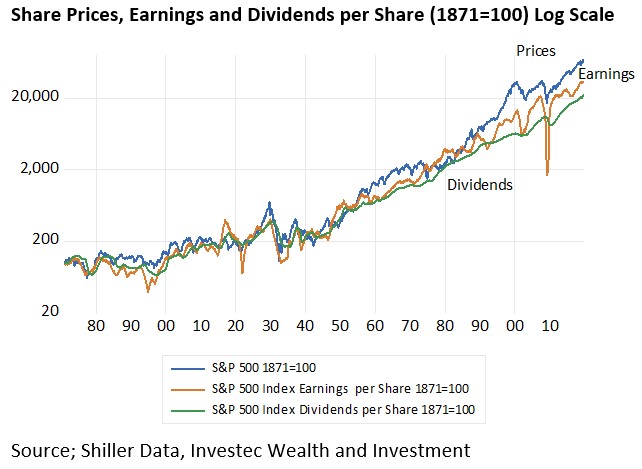
Robert Shiller provides 148 years and 1776 months of US stock market data. US S&P Index values, index earnings and dividends per share have followed a very similar path. The correlation between monthly prices, earnings and dividends, all up nearly 20,000 times since 1871, is close to one. [1]

Share Prices, Earnings and Dividends per Share (1871=100) Log Scale
f1

Source; Shiller Data, Investec Wealth and Investment


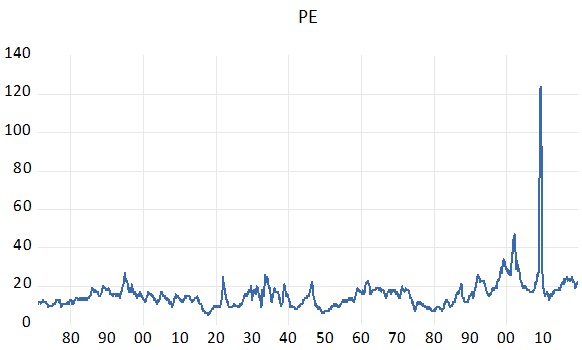
The P/E ratio for the S&P has averaged 15.76 over the long period with a low of 5 in 1917 and a high of 124 after earnings had collapsed in May 2009 while the Index held up to a degree. And dividends held up much better than earnings.
f2

Source; Shiller Data, Investec Wealth and Investment


If we run a regression equation relating the Index to earnings or dividends per share the residual of these equations (that what is not explained by the model) has a strong tendency to trend to zero- given enough time. Or in other words the price-earnings ratios have tended to revert to their long-term average of 15.8  over time but with variable lags.

The higher the P/E multiple the faster earnings must be expected to grow when they to make up for the low initial yield E/P and vice versa. Expected earnings drive current market prices. Surprisingly higher or lower revealed earnings will tend to move prices in the opposite direction. Earnings may catch up with prices or prices follow earnings. The move to any long-term equilibrium can come from either  direction, with advantage or disadvantage to shareholders.

Therefore be warned. Knowing that a PE ratio is above or below a long term average is not going to make you rich or poor speculating in the share market. The correlation of starting PE and returns realized over the next twelve months is close to zero.

The starting PE appears to become more helpful as a guide to investors when returns realized over an extended period are compared to it.  High starting PE’s are associated with generally lower returns and vice versa over three or five year subsequent windows. When we relate starting PE’s 36 or 60 periods before with returns realized three or five years afterwards over the entire period we do get a statistically supportive result. Choosing the right entry point to the market and waiting patiently for the outcomes would have been generally helpful to investors.

Examining the relationship between prices and earnings in the US does reveal some extreme cases. In the late forties and late seventies the market would have appeared as very cheap. But these were not good times for the US. The US was fighting and possibly losing a war in Korea. In the mid and late seventies the US was subject to stagflation- rapidly rising prices and slow growth. Also very un-promising times for shareholders.

However normality returned to the great advantage of those who did not share the prevailing pessimism and stayed in the market.  Between 1950 and 1953 the S&P PE crept up from seven to eleven times helping the total returns on the Index to average 22% p.a. In early 1978 the P/E was 8 times. Over the next three years the S&P delivered over 11% p.a on average as the US got its inflation under control.

By contrast in early 2000 at the height of IT optimism the S&P was trading at an extreme 33 times. Over the subsequent three years the S&P delivered negative twelve returns of -8.7% p.a. The IT bubble was only apparent after the event when expected earnings proved highly elusive.

S&P earnings collapsed during the GFC of 2008-09. From about $80 per index share in 2006 to less than $7 in early 2009. This sent the P/E multiple to 124 even as the Index fell sharply to a value of 757 by March 2009.  According to earnings the S&P was greatly overvalued. According to dividends that held up much better through the crisis, the market appeared as deeply undervalued. The dividend buy signal proved the right one as the economy recovered (unexpectedly) with lots of (unexpected) help from the Fed and the Treasury. The S&P Index since those dark days has that provided returns that have compounded on average at of over 13% p.a.

What is very different about the share market today in the US are the extraordinarily low interest rates- both long and short rates – that have surely helped drive the market higher as competition for shares from the money and bond markets fell away. What may appear as a demanding PE of about 22 times becomes much more understandable given abnormally low interest rates. Is this the permanently new normal for interest rates. Or will interest rates mean revert? And what is normal? Only time will tell.
[1] http://www.econ.yale.edu/~shiller/data.htm

The market and the economy – not a certain relationship

Brian Kantor 3rd April 2019

The state of the US economy gets very close attention from investors in the stock market. The market moved sharply lower in late December on fears of a US slowdown. More recently it has bounced back strongly as the outlook became less threatening as the Fed came to share some of the market anxieties and indicated it would not now be raising short term interest rates.

This raises a question. Could you make a fortune buying or selling shares accurately forecasting US GDP growth rates over the next few years? The answer is a highly qualified yes.  It would take very surprising – to others – very fast growth to deliver well above average returns in the stock market or, as surprising to all but yourself, very slow growth to deliver unusually poor returns.

Such phases of very fast or very slow growth, that presumably could confound the forecasters and investors, have in fact been very rare events. Since 1967 there have only been seven recessions in the US.  There have been about the same number of so-called technical recessions – defined as two or more consecutive quarters when the real GDP declined.

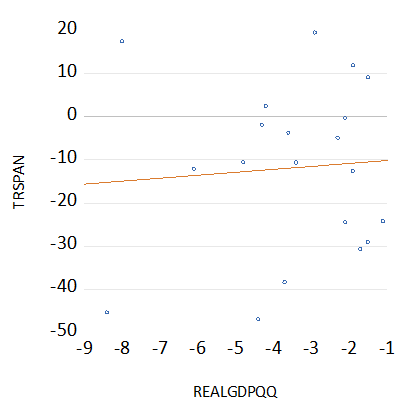
I count 20 quarters since 1967 when growth in the US was less than 1% per annum. Average annual returns on the S&P over these low growth quarters was a negative 11.8%. The worst quarter for shareholders was Q1 2009 when the market was down 47% on the same quarter a year before. However slow growth was not always bad news for investors. In Q2 1981, when growth fell at a 2.9% rate, the S&P 500 Index was up by 19.4% on a year before. Yet the statistical relationship between growth and returns over these low growth quarters was a generally very weak one with a simple positive correlation of only 0.07- not nearly enough  regularity to rely upon as an investment policy.


Slow growth quarters in the US; Scatter plot of Quarterly Growth and Annual Returns

1

Source;  Federal Reserve Bank of St. Louis, Bloomberg and Investec Wealth and Investment


I have also identified 98 quarters when growth in the US was a strong over 3% p.a. On average over these quarters the annual returns averaged an impressive 14.7% p.a. But this high average came with a great deal of variability around this average. The best annual return of 46.7% came in Q3 1982 and the worst -17.7% in Q4 1973. The statistical relationship between strong quarterly growth and annual returns is also very weak with a correlation close to zero.


Fast growth quarters in the US; Scatter plot of Quarterly Growth and Annual Returns

2

Source;  Federal Reserve Bank of St. Louis, Bloomberg and Investec Wealth and Investment


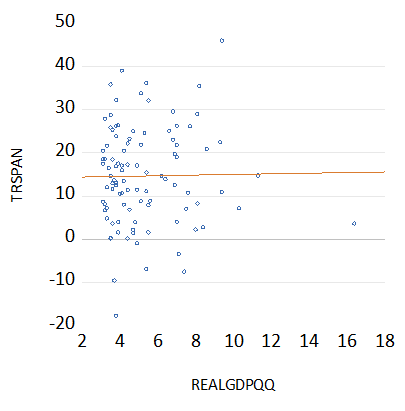
The statistical relationship between quarterly growth and returns over the entire period 1967-2018 is altogether a very weak one. Linear regression equations that explain annual index returns with quarterly growth rates have very little explanatory power. Using smoother annual GDP growth rates in the equation do little better. R squares of no more than 0.16 indicate that there is much more than growth determining annual or even more variable quarterly returns. Generally accurate forecasts of GDP growth are simply not going to cut the returns mustard.

The problem for any reliance on patterns of past performance is that the markets are always forward looking. The well-considered, forecasts of the economy and of the companies dependent on it, will already have helped determine the current value of any company and of any Index average of them. Hence only economic surprises- indeed only large surprises in the GDP numbers can move the market.  But anticipating these surprises is largely beyond the capabilities of the collective of forecasters – who will employ similar methods evaluating the widely available data that anticipates and makes up the GDP itself. Any surprises are going to surprise the forecasters as much as the market

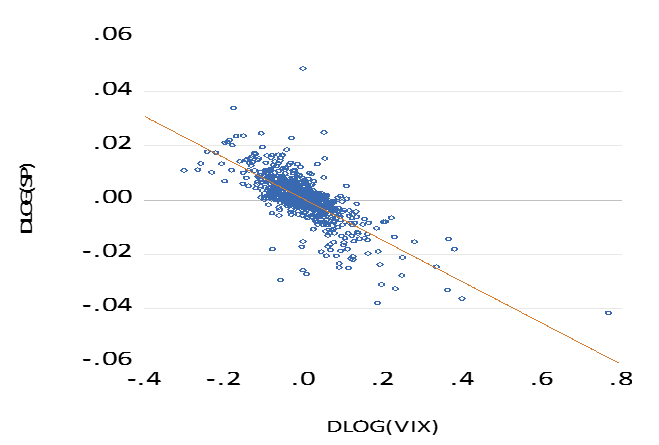
However as recent developments on the share market indicate- down and up with not so much the GDP itself – but with expectations of it- what matters over any short period of time in the markets is not so much the forecasts themselves, but the confidence held in such forecasts. These will never be in a constant state. Any additional uncertainty about the state of the economy (less confidence in the forecasts) adds volatility to the market. That is wider daily moves in the market up and down. And when the market moves through a wider daily range share prices will move in the opposite direction in a statistically very consistent way.


The impact of risk (changes in the VIX) on S&P returns 2016-2019; Daily Data. Correlation (-0.74)

3

Source;  Federal Reserve Bank of St. Louis, Bloomberg and Investec Wealth and Investment


Such changes in sentiment are not easily forecast. If they could be reliably anticipated this would undoubtedly be wealth enhancing to the forecaster or rather the sage. They are however best ignored by long term investors in favour of as good a forecast of the economy over the long run, as you can hope to make or receive.


A New York (retail) state of mind

 New York, November 21st 2018

It is Thanksgiving this Thursday in the US – a truly inter-denominational holiday when Americans of all beliefs, secular and religious, give thanks for being American – as well they should.

This is a particularly important week for American retailers. They do not need not to be reminded of the competitive forces that threaten their established ways of doing business. Nor do investors who puzzle over the business models that can bring retail success or failure.

The day after thanksgiving is known as Black Friday, when sales and the profit margins on them will hopefully turn their cumulative bottom lines from red to black. It has been black Friday all week and month and advertised to extend well into December. Presumably, to bring sales forward, that is to make retailers less dependent on the last few trading days of the year.

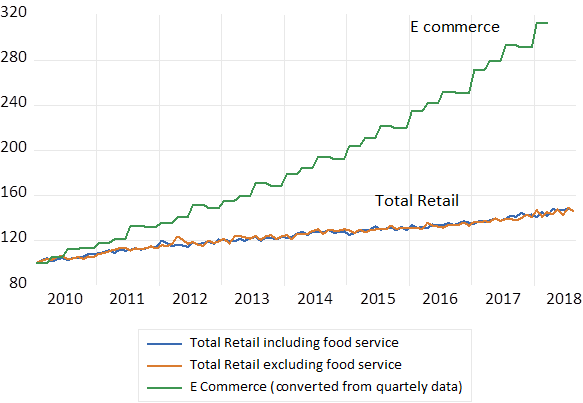
The competition as we all know has become increasingly internet based  from distributors of product near and far, and yet only a day or two away. E commerce sales have grown by over three times since 2010 while total retail sales including E commerce transaction are 50%up since 2010.  Total US retail sales, excluding food service are currently over $440b and E commerce sales are over $120b (see figures 1 below)


Fig 1; US Retail and E Commerce sales (2010=100) Current prices

1

Source; Federal Reserve Bank of St.Louis (FRED) and Investec Wealth and Investment


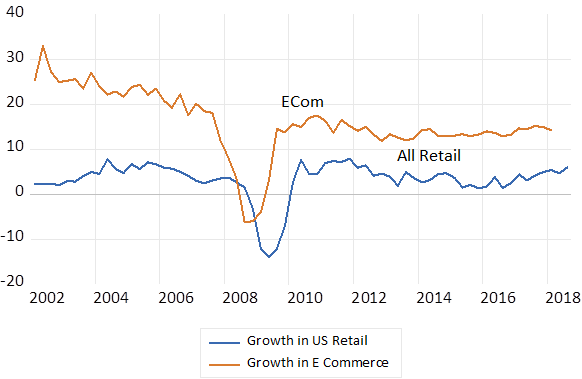
The growth in E Commerce sales appears to have stabilised at about 10% per annum. (see figure 1)

Fig 2; Annual growth in total retail and E commerce sales in the US (current prices)

2

Source; Federal Reserve Bank of St.Louis (FRED) and Investec Wealth and Investment

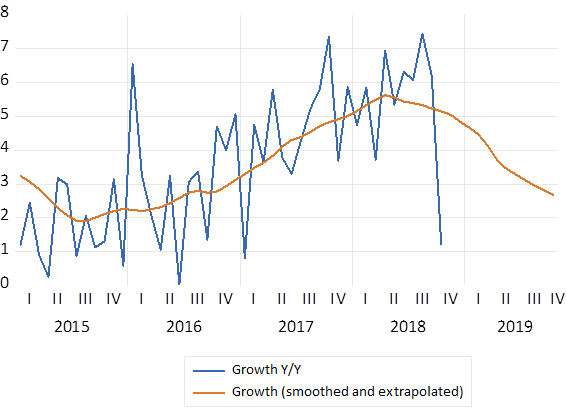
Retail sales of all kinds have been growing strongly – though the growth cycle may have peaked- as may have GDP growth- leading perhaps to a more cautious Fed. How slowly growth rates will fall off the peak is the essential question for the Fed as well as Fed watchers and answers to which are moving the stock and bond markets. (see figure 3)

Fig.3: The US retail growth cycle

3

Source; Federal Reserve Bank of St.Louis (FRED) and Investec Wealth and Investment

The inportance of on-line trade is conspicuous in the flow of cardboard boxes of all sizes that overflow the parcel room of our apartment building. Including boxes of fresh food from neighbouring supermarkets. The neighbourhood stores of all kinds are under huge threat from the distant competition that competes on highly transparent prices on easily searched for goods on offer as well as convenient delivery.  As much is obvious from the many retail premises on ground level now standing vacant on the affluent upper East side of New York. The conveniently located service establishments survive, even flourish, while the local clothing store goes out of business because they lack the scale (and traffic both real and on the web) to offer a credible offering.

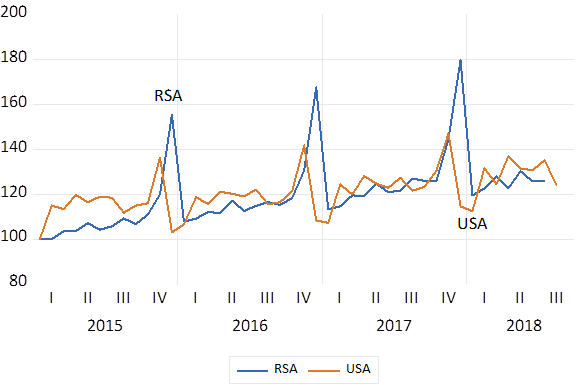
But spare a thought for SA retailers for whom sales volumes in December are much more important than they are for US retailers. November sales for US retailers – helped by Thanksgiving promotions – are significantly more buoyant than December volumes. According to my calculations of seasonal effects since 2010, US retail sales in December are now running at only 90 per cent of the average month while November sales are well above average, at 116% of the average month.  Retail sales in the US however include motor vehicle and gasoline sales that are excluded from the SA statistics. December sales in SA are as much as 137% above the average month helped as they are by summer holiday business as well as Christmas gifts. (See figure 4 below that shows the different seasonal pattern of sales in the US and SA)


Fig.4; The seasonal pattern of retail sales in SA and the US (2015=100)

4

Source; Federal Reserve Bank of St.Louis (FRED) and Investec Wealth and Investment


In the black Friday for SA retailers thus comes later than it does in the US.  And perhaps makes the case for adding promotions in November to smooth the sales cycle and reduce the stress of running a retail business. They may also hope that the Reserve Bank is not the grinch that spoils Christmas- though the answer to this will come on Thanksgiving.


Charts of the Week – The usual suspects

The week saw renewed pressure on emerging market (EM) exchange rates, led by the usual suspects, Argentina and Turkey. The rand did not escape the damage and did a little worse than the JP Morgan EM benchmark, that gives a large weight to the Chinese yuan and the Korean won. But it was much more a case of EM exchange rate weakness rather than US dollar strength.

Source: Bloomberg

The spread between US and German 10-year yields has stabilised (perhaps taking a little away from US dollar strength), while the US term structure of interest rates continues to flatten as the longer term rates fail to respond to higher short term rates. The cost of borrowing in the US beyond two years has not been increasing, despite the Fed’s intentions to raise rates in response to sustained US economic strength.

Source: Bloomberg

The pressure of capital withdrawn from EMs was reflected in a widening of the spreads on US dollar-denominated debt issued by EM borrowers, including SA. The spread on five-year RSA debt widened from around 202bps last week to 230, while Turkish debt of the same duration commands a risk premium of 562 bps – compared to 481 bps the week before. If only in a relative sense, SA’s credit rating has improved even as our debt trades as high yield (alias junk). The rating agencies, however, appear to be in no hurry to confirm this status for SA debt.

Part of the explanation of the weak rand and the decline in the value of the JSE, more in US dollars than in rands, has been the dramatic decline in the value of Naspers – up over 11% the week before last and down 7.7% last week. The Hong Kong market, where Tencent is the largest quoted company and in which Naspers holds over 30%, however returned 0.8% in US dollars last week. it is consistent that it is now among the weakest equity performers going into the new week. China and Chinese internet companies, in particular, have been a drag on emerging markets. More optimism about the Chinese economy is essential to the purpose of any emerging market currency and equity comeback.

Source: Bloomberg

Italy, Europe and beyond

Renewed volatility in bond and currency markets. Learning the lessons of monetary history.

Europe (especially Italy, but also Spain) rather than emerging markets (especially Turkey) has become the new focus of attention in financial markets. Bond yields in Italy and Spain have increased sharply in recent days. The two year Italian bond yield is up from zero a few days ago to the current 2.82% while the spread between 10 year Italian bonds and German Bund yields have risen from 1% to 2.87% in three days.

Rising US interest rates were the proximate cause of some earlier distress in emerging bond markets and now in the past few days have reversed course. From a recent high of 3.12% the yield on the key 10-year US Treasury Bond has fallen back to 2.83%. RSA bond yields have also receded in line with Treasury bond yields. Yesterday they were at 8.59% and about 28 basis points lower than their recent high of 8.87% on 21 May. However the risk spread with US Treasuries has widened marginally, from recent lows.


While long term interest rates in the US have fallen back, the US dollar has strengthened further against the euro and most currencies, including emerging market (EM) currencies like the rand. German Bunds are another safe haven and the 10-year Bund yield has also declined, from 0.64% earlier this month to the current 0.33%. This has allowed the spread between Treasuries and Bunds to widen further – to 2.6%, helping to add strength to the US dollar.


It should be appreciated that RSA bonds have held up well under increased pressure from US rates and now also some European interest rates. In figure 4 we compare RSA dollar denominated five year (Yankee) bond yields with those of five year dollar bonds issued Turkey and Brazil. While all the yields on these dollar denominated bonds have risen and also very recently have fallen back, the RSAs have performed relatively well.
 

The US dollar went through an extended period of weakness against its developed market peers and EM currencies between mid-2016 and the first quarter of 2018, after which the dollar gained renewed strength. Dollar strength can be a particular strength to EM currencies and the recent episode of dollar strength has proved no exception in this regard.

As we show below in figures 5 and 6, the rand performed significantly better than the EM Currency Index from December 2017 and has recently performed in line with the average EM currency vs the US dollar and much better than the Argentine peso and the Turkish lira recently. In figure 6 the declining ratio EM/ZAR indicates relative rand strength.


We may hope that the rand will not be subject to any crisis of confidence. So far so good. But were the rand to come under similarly severe pressure as has the Turkish lira, one would hope that the Reserve Bank would avoid the vain and expensive attempts to defend exchange rates that Argentina and Turkey have made. Throwing limited forex reserves and much higher short term interest rates at the problem can only do further harm to the real economy – and very little to stem an outflow of capital. As has been the latest case with Turkey and Argentina.
It was the mistake the Governor of the Reserve Bank Chris Stals made in 1998 when failing to defend the rand during that emerging market crisis. The best way to deal with a run on a currency – caused by exposure to a suddenly stronger dollar – is to ignore it. That is to let the exchange rate absorb the shock and live with the (temporary) consequences for inflation. Defending the currency provides speculators with a one way bet against the central bank attempting to defend the indefensible. It is much better to let them bet against each other and let the market find its own equilibrium. The renewed volatility in Europe, we may also hope, will continue to hold down US and RSA interest rates – and deflect attention from emerging markets. 30 May 2018

Not so quiet on the interest rate front

Things became more active on the global interest rate front last week, led by an advance of US yields. The key 10-year US Treasury yield was below 3% earlier in the week, but was at 3.12% onThursday before pulling back to 3.05% on Friday (it was ar 3.07% this morning). Not only have yields moved higher, but the spread between US Treasury and German Bund yields have widened further, to 2.5%.

This may be thought to be enough of a carry (enough US dollar weakness priced in, that is) to attract funds to the US and restrain the upward march in US rates and the US dollar. The US dollar has gained not only against the euro and other developed market currencies, it has gained against emerging market (EM) currencies, like the rand, as is usual when the dollar rises against the euro, yen and sterling. A strong dollar is a particular threat to EM currencies. The JP Morgan EM exchange rate index is now at 66.1 while the the US vs developed market currencies index (DXY) is trading at 93.87.

The rand has been among the better EM performers in the face of the advancing dollar as we show in figures 4 and 5 below (all rates in these charts up to 18 May – though the rand did come under motre pressure than other EM currencies on Friday). The ratio of the USD/ZAR to our own construct of eight other EM currencies and their exchange rates with the US dollar, improved significantly between November 2017 and March 2018 and the USD/ZAR has maintained its rating since then. The story of the rand has once more become a story of the US dollar rather than of South African politics. And seems very likely to remain so.

This ratio was 0.917 on the Monday 14 May – it weakened to 0.934 by the Friday. The story of the rand has once more become a story of the US dollar rather than of South African politics, and seems very likely to remain so.

Interest rates in the US have risen (and the dollar has strengthened) because the acceleration in US growth has been confirmed by recent labour market trends and by the strength in retail sales volumes reported last week. The state of economies outside the US, in Europe and even in emerging markets however, appears less certain. Global growth appears, at least for now, less synchronised – making for fewer correlated movements in short- and long-term interest rates.

It is of interest to note that US shorter term interest rates have been rising faster than long rates. The spread between the 10 and two-year Treasury bond yields have narrowed further. This flatter yield curve indicates that the US may be getting closer to the end of the cycle of rising short rates. Or in other words the GDP growth rates that justify higher short rates may well have peaked and are slowing down- which if so will cause short rates to decline from higher levels in the not too distant future. (See figure 6 below)

It is of particular importance to note that the recent increase in US yields have not been a response to more inflation expected. Inflation-protected real yields offered by the Treasury (TIPS) have increased in line with vanilla bond yields. The spread between nominal and real 10-year treasury yields has remained largely unchanged around 2.2%. That is to say, the bond market continues to expect inflation to remain at the 2% level for the next 10 years. So what is driving nominal yields higher is more growth, rather than the expectation of more inflation, thus representing interest rate developments that are less dangerous to equity valuations than if it were only inflationary expectations that were driving yields higher. The more GDP (and so earnings growth) expected, the more it improves the numerator of any present value calculation, perhaps enough to compensate for higher discount rates.

South African bond yields, as well as the USD/ZAR, have moved higher in response to US yields. However the spread between RSA and Treasury yields has remained largely unchanged. The spread, which indicates by how much the rand is expected to weaken against the US dollar over the years, narrowed sharply after November 2017. In other words, as the political news out of South Africa improved. Figure 8 below shows the SA exchange rate risks and the more favourable trends in RSA and US long bond yields, and in exchange rate expectations since January 2017.

Conclusion: how best to react to dollar strength

A stronger US dollar is seldom good news for the growth prospects of emerging market economies, including South Africa. It puts upward pressure on prices and downward pressure on spending. It furthermore raises the danger of monetary policy errors of the kind Argentina has been making: raising interest rates to fight exchange rate weakness and the (temporarily) higher prices that follow. This then slows down economic growth further, without helping and maybe even harming the exchange rate. Slower growth drives capital away and interest rates, become less attractive when a still weaker exchange rate is expected.

The wise policy approach is to ignore of exchange rate weakness that is caused by dollar strength and not by excessive domestic spending. South Africa made such monetary policy errors during the last period of US dollar strength between 2011 and 2016. We may hope that such errors are not repeated. We may hope even that this period of dollar and US strength is a temporary one – and that growth outside the US resumes an upward trajectory. 21 May 2018

Global savings and interest rates- will we see normalisation?


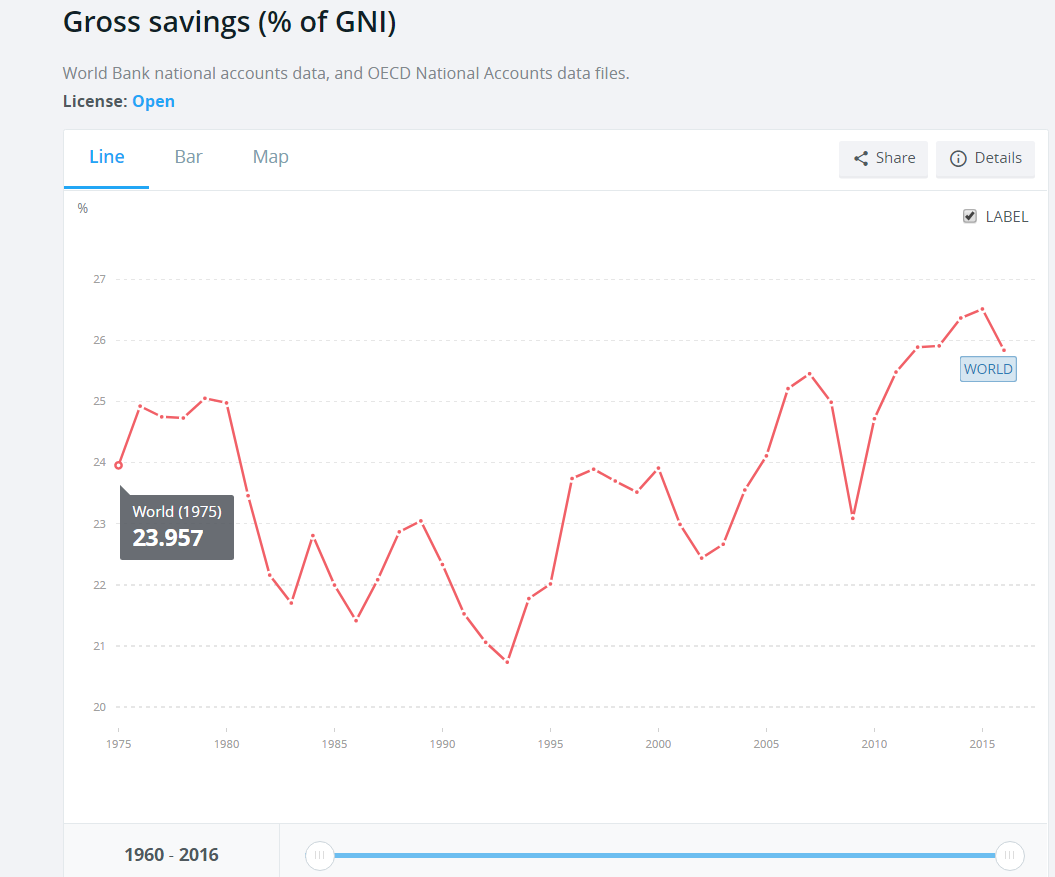
What the world needs now is more than love- there is also too little spending. [1]More of that would also be very welcome. Particularly welcome would be extra spending by business enterprises on capital equipment. This lack of demand, combined with a rising global savings rate, has created an abundance of saving that explains the exceptionally low interest rate rewards for saving in developed economies. This glut of savings followed the global financial crisis (GFC) of 2008-09 that made managers more fearful to spend or lend while additional regulations restricted their freedom to do so.

The story of the global glut of savings can be told in a few pictures provided by the World Bank shown below. When will then consider how the bond market in the US may be indicating some incipient revival of the animal spirits of US corporations. Encouraged, as they attest, by lower tax rates and much more sympathetic regulators.

Figure 1 charts gross global savings as a per cent of gross global incomes. (GNI) As may be seen share of savings of income has been rising steadily over the years. The GFC hit savings even harder than incomes (upon which savings depend) but since then savings have made an ever larger claim on incomes (26% in 2015). The global savings rate was only about 21% of incomes in the fast growing and higher interest rate world of the mid-nineties. It has been on a generally upward trend since, as may be seen.

Gross savings – (savings before amortisation of capital that turns gross into net savings) are dominated by the cash retained by corporations. Households may save – but other households over the same period may be large borrowers and reduce the net contribution households make to the capital market. And most governments are net borrowers- borrowing even more than they spend on infrastructure that is counted as saving.

Fig 1; Gross savings as per cent of Gross Global Income  

1

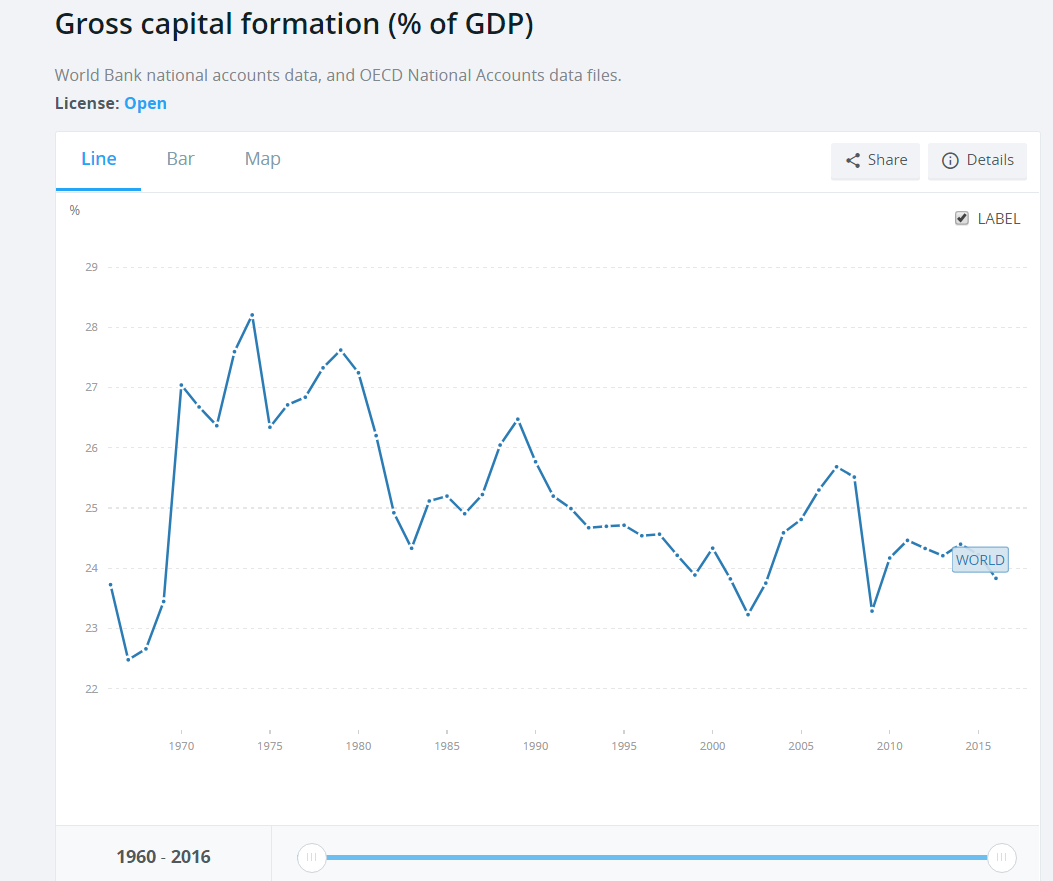
As we show below in figure 2, the rate at which real capital – plant and infrastructure – has been accumulated has been trending in very much the opposite lower direction. There was a brief surge in the rate of capital formation in 2005 – a boom year for the global economy – but this was not sustained and was but 24% of global incomes in 2016- compared to a higher global savings rate of 26%.

Fig.2; Gross Capital Formation (% of GDP)

2

Source; World Bank

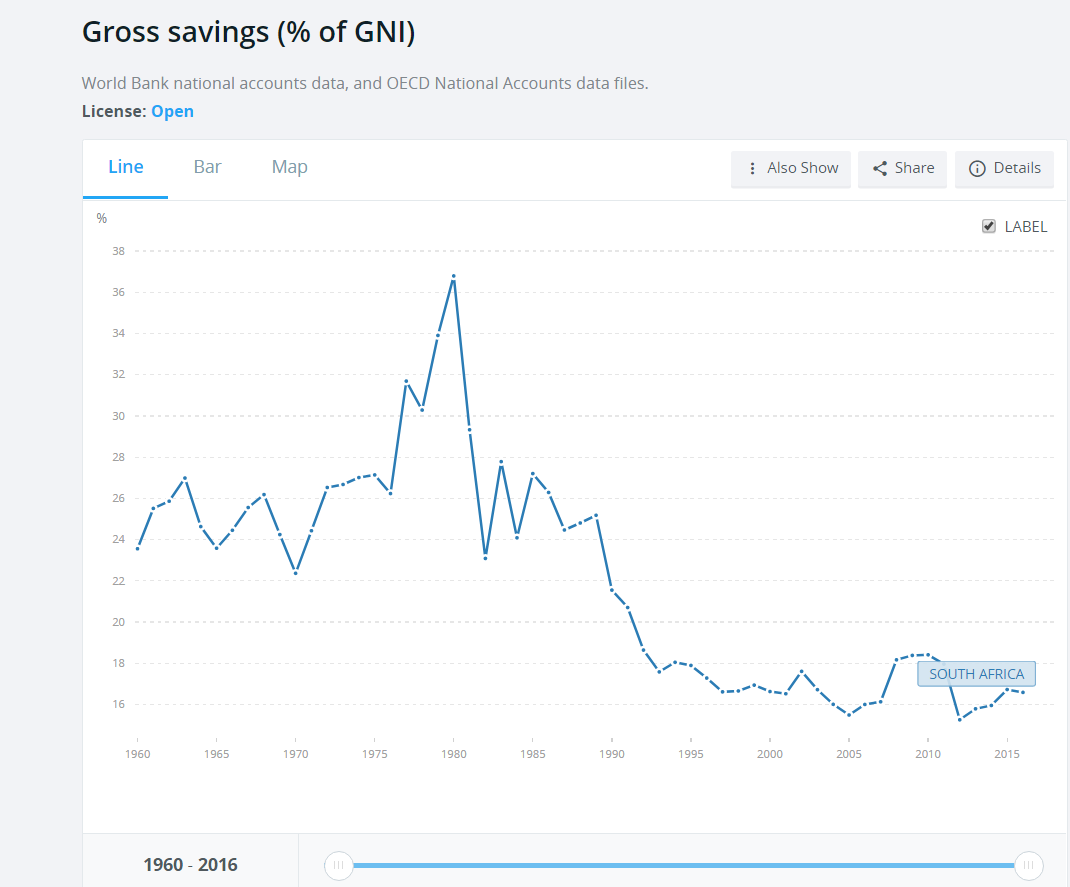
In the case of South Africa, with a lower gross savings rate of less than 18% of GDP, the cash retained by the corporate sector (including state owned enterprises) accounts for more than 100% of all gross savings. The household sector’s net contribution to gross savings flows is barely positive and the government sector is a net dis-saver. We show the trends in the SA savings rate below. The profits from the gold booms of the seventies and early eighties were responsible for the very high savings rates then.

Fig 3; South Africa – Gross Savings Rate

3

Source; World Bank

South Africa cannot realistically hope to raise its savings rate significantly. It can however hope to raise the rate at which capital expenditure is undertaken. That is by reducing the risks of investing in SA- and growing faster and attracting the savings to fund more rapid growth. That would be freely available from the large pool of global savings anxiously seeking better returns- given the right incentives and protections to do so. There is, as indicated, no global shortage of capital – only of attractive investment opportunities that SA could be offering.

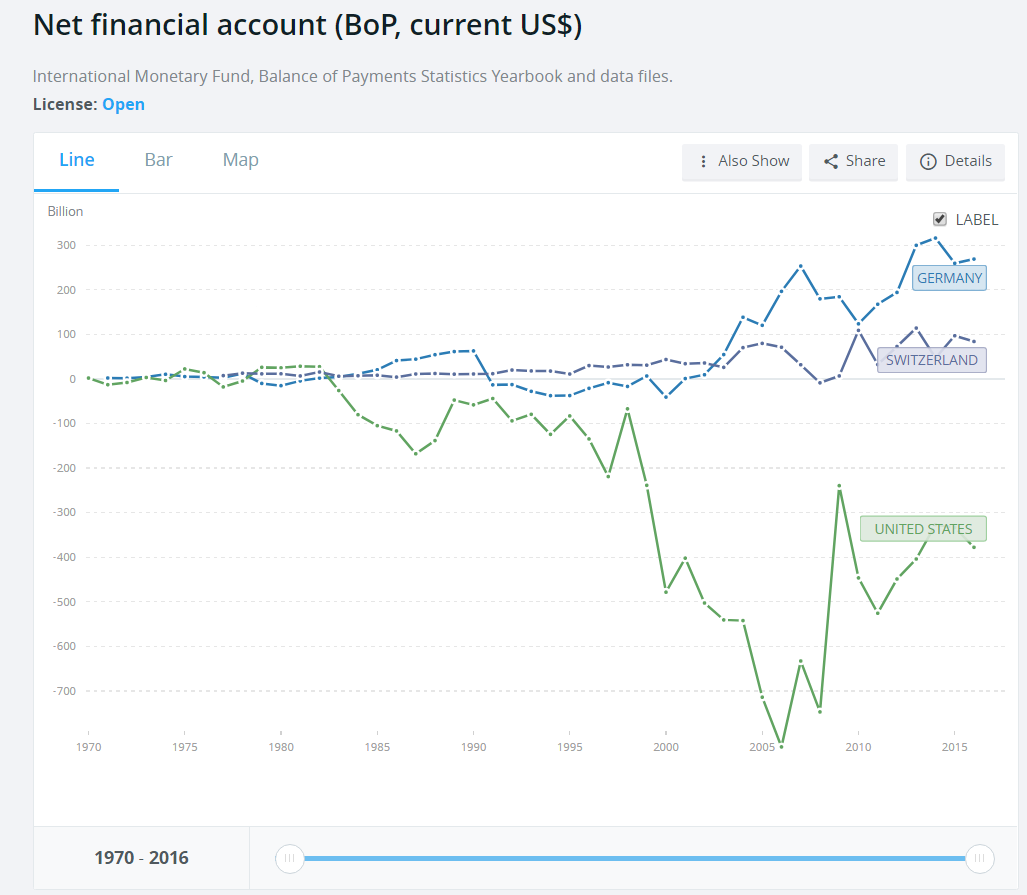
The current rate of capital formation currently in SA is only slightly higher than the low savings rate – hence the small net inflows of foreign capital. The difference between any nation’s gross savings and capital formation is approximately equal to the net capital inflow and so the current account deficit on the balance of payments. The item that balances the current account deficit (exports-imports +debt service) – is the change in forex reserves- usually a comparatively small number.

South Africa could do with much faster growth that would encourage more capital formation and attract the foreign savings to fund this growth. And higher corporate incomes would mean more corporate savings. It is slow growth that is at the core of SA’s economic issues. Not the lack of savings. If we grew faster both the current account deficit and the capital inflows would be larger and the rate of capital formation higher. And a larger capital stock would bring more employment and higher incomes for a more productive labour force.

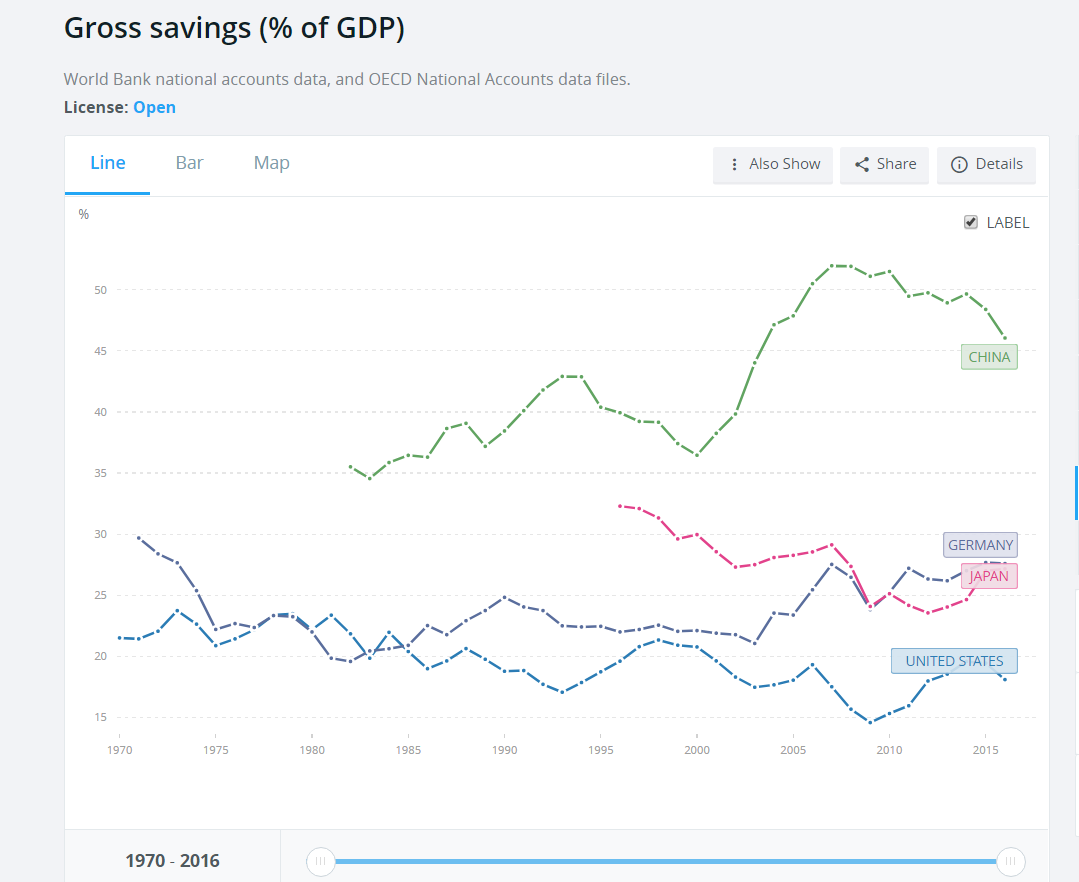
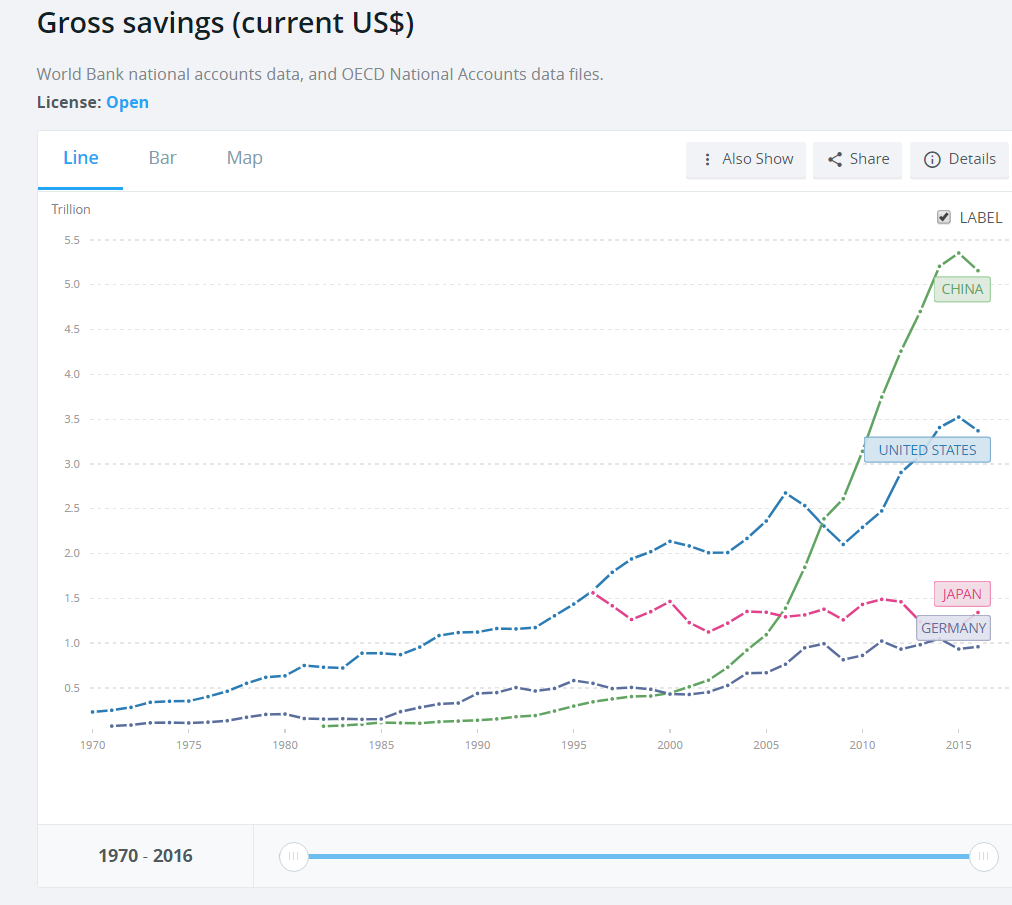
The US despite a relatively low and fairly stable savings rate (currently also around 18% of GNI as in South Africa) is, given the scale of its economy, still a large saver on the global stage. Though the US economy is the largest by far drawer on the global capital market to fund its spending as we show below in figure 8. While the US has been saving absolutely more recently, Chinese savings have now far overtaken US savings in absolute magnitude. Germany is another large saver, adding significantly to global savings in recent years, as we show below.

 Fig. 4; Global Savings Rates

4

Source; World Bank


Fig.5; Gross savings (current US dollars) by economy

5

Source; World Bank

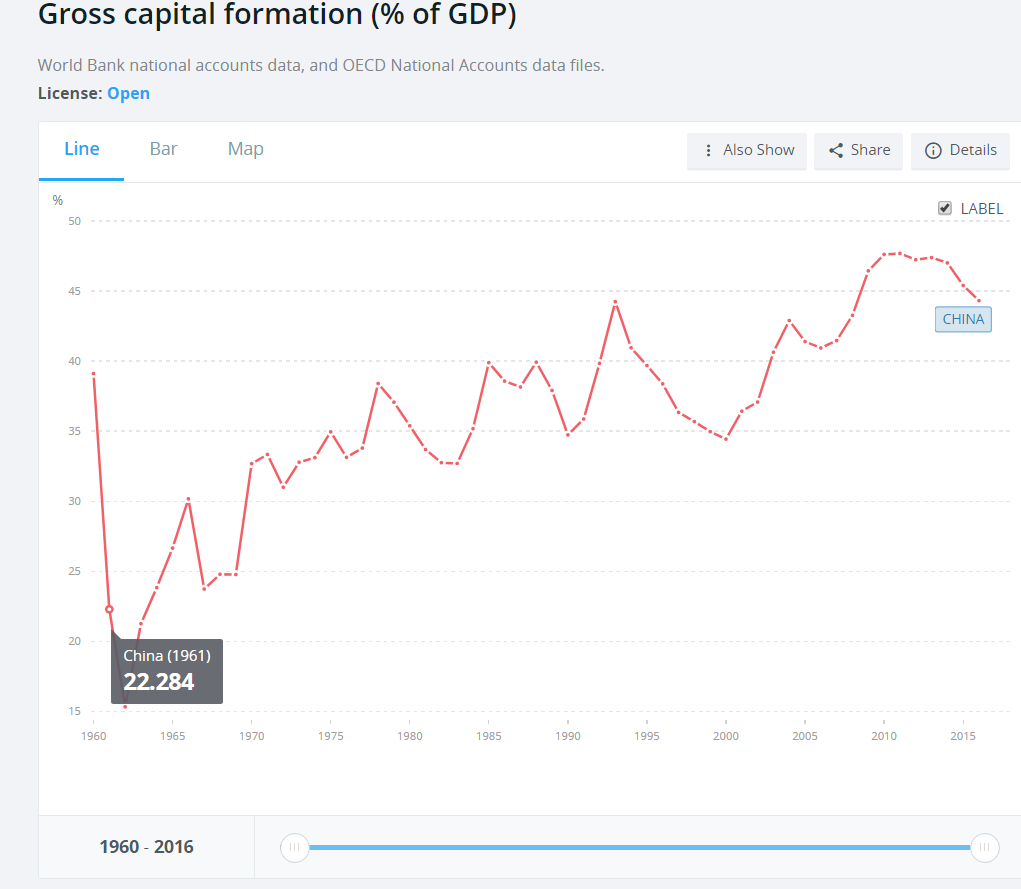
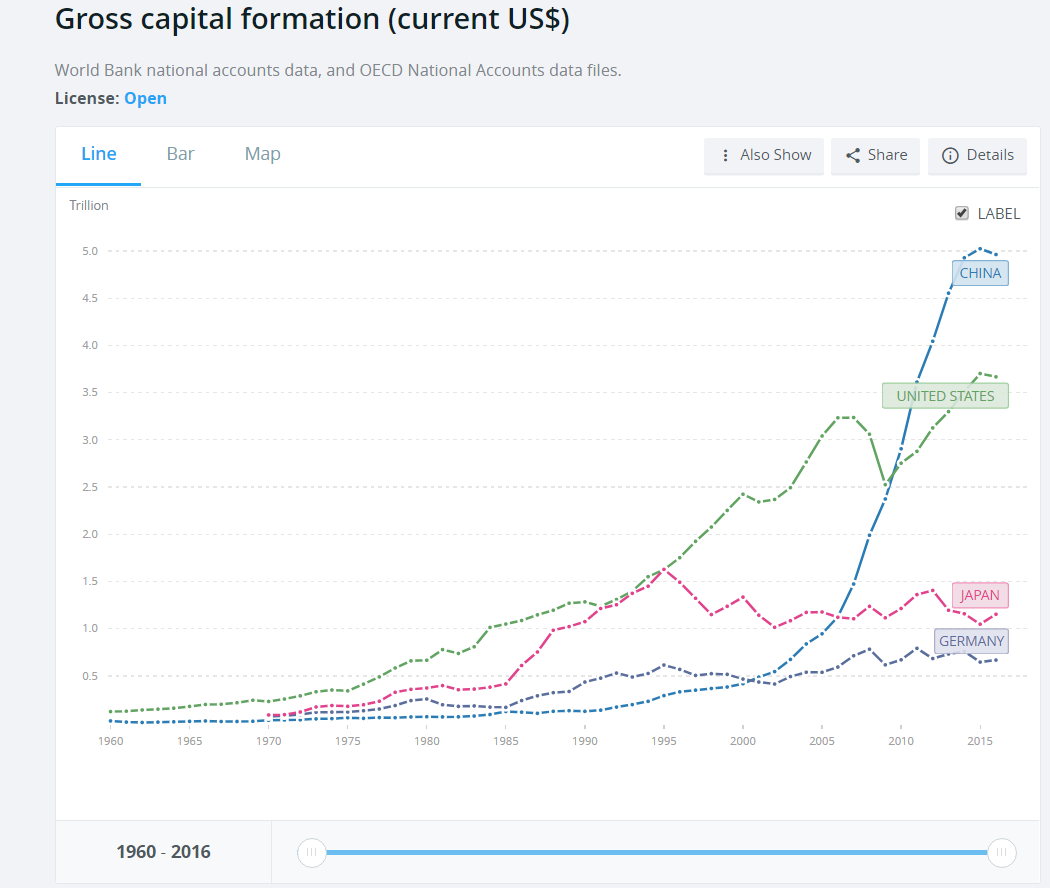
The Chinese are not only the largest contributor to global savings, saving an extraordinary 45% of their GNI – a rate that as may be seen has been declining from above 50%- they are also undertaking by far the largest share of global capital formation. They created plant and equipment – real capital – worth over USD 5 trillion in 2016 or at a rate equivalent to 45% of GNI, similar to the investment rate- meaning that most of the Chinese savings were utilised domestically.

Fig.6; China Gross Capital Formation (% GDP)

6

Source; World Bank

But this raises a very important issue for the Chinese. Given the rate at which they save and invest in real capital the realised growth in Chinese incomes must be regarded as disappointingly poor- even when about a 7 per cent p.a rate. It suggests that much of the capital formed is still unproductively utilised. The full discipline of western style capital markets is surely something still to be introduced to China to improve returns on savings. But for all the relative inefficiency of Chines capital, the sheer volume of Chinese capital formation has made it the dominant force in the market for minerals and metals that are used to create  capital goods.


Fig.7; Gross capital formation by economy – current US dollars

7

Source; World Bank

In figure 8 below we show how The US dominates the demand side of the flows through global capital market- and the thrifty Europeans –  the supply side. As may be seen these trends that made US economic actors the dominant utilisers of global capital are predominatly a post 2000 development.

It is these capital flows that drive the US dollar exchange rate – and by implication all other exchange rates. Trade flows react to exchange rates- rather than the other way round. This is also the case for SA. With one important difference- foreign trade for the US economy is equivalent to about 25% of GDP. In SA imports and exports – valued at unpredictable exchange rates are equal to about 50% of GDP.

Fig. 8, Net Financial Flows from Europe and to the US. Current US dollars

8

Source; World Bank

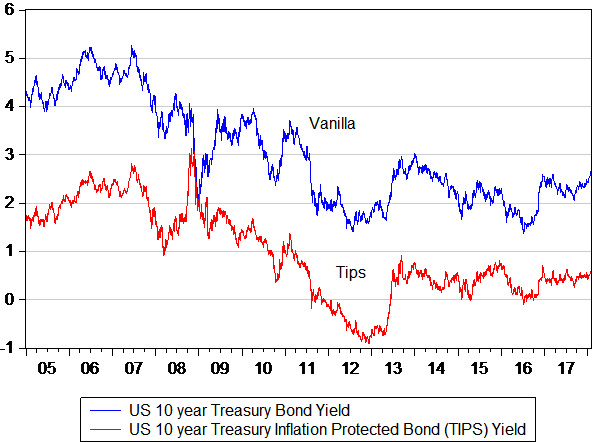
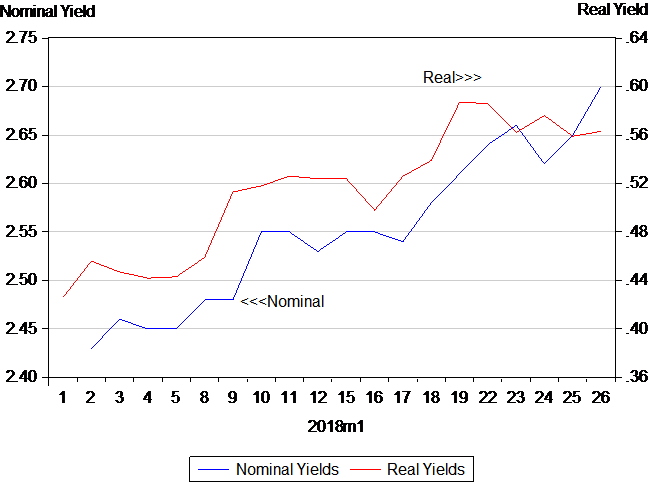
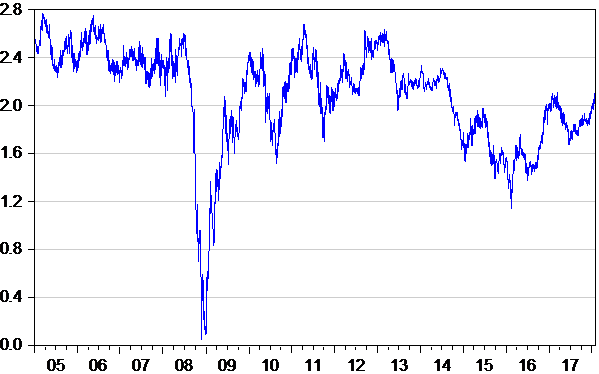
The flows of savings and flows into the US have not only moved the dollar they have moved interest rates. Perhaps the best measure of the global rewards for saving are found in the direction of the real rates of interest offered by an inflation linked bond issued by the US Treasury. Such a bond may be regarded as free of default as well as inflation risk. The risks of inflation are reflected in the yield on a vanilla bond. In the figure 9 below we compare the yield on a 10 Year US Treasury Bond and its inflation protected alternative with the same duration. As may be seen the nominal and real yields have both trended lower. The vanilla treasury bond was offering over 5% p.a in 2005- now the yield for a ten year loan provided the US is about 2.7% p.a. Real yields were over 2%. p.a. in 2005-06. They are now about a half of one per cent p.a. – after a period of negative returns in 2012-2013.

More important these yields have been rising in 2018 indicating some small degree of greater demands for capital. The real and nominal yields however remain very low by historic standards as will be appreciated. Normality – that is any sustained higher global growth rates, must mean much  higher real yields. Higher nominal yields will also depend on how much inflation comes to be added to real yields.

Fig. 9; Nominal and Real 10 Year US Treasury Bond Yields (Daily Data 2005- 2018)

9

Source; Bloomberg and Investec Wealth and Investment

Fig. 10; Nominal and Real 10 Year US Treasury Bond Yields (Daily Data 2018)

10

Source; Bloomberg and Investec Wealth and Investment

In figure 11 below we show the difference between these nominal and real interest rates. These differences represent the extra compensation bond investors receive for taking on inflation risk. It may be regarded as a highly objective measure of inflationary expectations. The more inflation expected the wider must be the spread between nominal and real yields. As may be seen- excluding the impact of the GFC this spread or inflation expected has remained between two and three per cent per annum. It is important to recognise that these inflationary expectations remain very subdued despite a recent increase. Equity investors as well as bond investors must hope that inflation expectations remain subdued enough to hold down nominal interest rates even as real yields rise to reflect a stronger global economy and a revival of capital formation. Low inflation with faster growth is an especially favourable scenario for equity markets.

Fig.11; Inflation compensation in the US Treasury Bond Market – spread between nominal and real 10 year US Treasury Bond Yields

11

Source; Bloomberg and Investec Wealth and Investment

[1] With acknowledgement to Burt Bacharach

A volatility storm – has it passed?

The S&P on Monday lost 4% by its close. The Dow had its largest one day loss in history, over 1000 points. In percentage terms it was the worst day for the New York markets since September 2011.

It is easier to understand what didn’t move the New York markets on Monday than what did. It was not any economic news, which was notably absent on the day. Nor was it interest rates. Interest rates moved the markets on Friday when they rose sharply in response to the impressive employment report. Both real and nominal bond yields closed sharply lower by the close on Monday and have maintained lower levels compared to Friday’s close on early Tuesday morning, even as the equity markets remained under pressure before the markets opened.

The most conspicuously unusual behaviour on markets was registered by the CBOE Volatility Index, the VIX. It closed 20 points higher at 37, the largest point and percentage change in this Index ever. And most of this increase took place in the last two hours of trading: it moved from 10 to over 30 in two hours. It appears that much of the price move and the huge volumes of trading activity associated with it was the result of special funds attempting to close out strategies based upon low volatility. Their attempts to do so forced up the Index and forced share prices lower.

The issue for market commentators before the market opened was how soon, as it is described, the systematic bid for volatility would subside. Judged by the strong recovery of the equity markets (S&P up one per cent as I write on Tuesday evening) in the first hour of trading the danger posed by rebalancing volatility strategies may have passed. Yet volatility – the form of minute to minute movements in share prices and Index averages of them – remains highly elevated. The VIX on 6 February continued to trade at these elevated levels as the market indices gyrate between positive and negative values.

Some economic realities

Perhaps in times when economic fundamentals appear irrelevant to company valuations, it is good to be reminded of just what has been happening at the economic coal face. Though coal is surely the wrong metaphor, the companies we refer to here are moving the frontier of economic activity – of how we work and consume that has changed so dramatically.

Some of the leading new economy companies reported their results for Q4 2017. The scale of their operations and the growth in their revenues is nothing less than very impressive. Apple for example reported quarterly sales of $88.29bn, up 13% on the same quarter in 2016. Amazon reported Q4 sales of $60.5bn, up no less than 38% on the same quarter a year before and up 31% for the year. Facebook grew sales in Q4 2017 to $12.97bn and by 47% and Alphabet generated revenues in Q4 of $32.32bn, up 24%. And Microsoft (in business for much longer) grew its sales in Q4 2017 by 12%, to $25.83bn.

All these companies that are thriving impressively and are being generously valued accordingly – described as the FAAGMS – have a competitive and a regulatory threat. Their success to date is as vulnerable to disruption by competitors – known and unknown – as they have proved to be to what were then established ways of doing business.

However their success and the market dominance it seems to create – of which their approving customers are the arbiters – is bound to attract the attention of regulators and tax collectors. That is of economic agents, with interests and powers of their own, who are philosophically unwilling to concede the race for dominance in a market place is to be determined by consumers and regulate accordingly. They would do well to accept that what constitutes the relevant market place is fluid and incapable of being usefully defined and confined. Competition for the budgets of households and of all the firms that ultimately compete for their favour remains highly intense, as the fast growing sales of the Apples, Amazons, Facebooks, Googles and Microsofts prove. Society should best leave the unpredictable outcomes to this competition. 7 February

Equity markets and interest rates in the US

Equity markets and interest rates in the US – will we avoid inflation surprises?

The equity markets in the US have had an outstanding run. The S&P 500 is up 26% since January 2017 and has advanced with unusually low volatility. Day to day movements in the Index have been very limited by the standards of the past. The fundamentals of the market have been supportive of higher valuations. High operating margins and rising earnings, with upward revisions of earnings to come, combined with still low interest rates, have attracted these higher valuations. The future of earnings and margins has been further enhanced by the income tax cuts for corporates, small businesses and individuals. The animal spirits of corporate leaders are stirring, promising a boost to the economy from a strong pick up in capital expenditure.

The concern is that unexpectedly higher interest rates can offset these benefits, as earnings are discounted to estimate present values. As we show below, US Treasury bond market yields have been rising this year – but from abnormally low levels. Nominal yields for 10-year money have increased this year from 2.45% to current levels of 2.72%. So have real yields – they have risen from a very low half a per cent in early 2018 to over 0.6% now. Furthermore, the gap between nominal and real inflation protected interest rates has increased from 2.45% at the start of 2018 to the current level of over 2.7%. This spread reveals the inflation rate predicted by the bond market. The bond market is anticipating and being compensated for slightly more inflation expected over the next 10 years.

The Fed’s target for inflation is 2% – a target that it is still to meet and is by no means certain of meeting any time soon. The Federal Open Market Committee, reporting this week (31 January 2018) still expects inflation to stabilise around its 2% objective over the medium term in its latest statement. It also repeated its view “that near-term risks to the economic outlook appear roughly balanced, but the Committee is monitoring inflation developments closely…”

The most supportive scenario for the equity market will be one of rising real interest rates – indicating stronger growth in demands for capital – coupled with still very subdued expected inflation that will sustain low nominal interest rates. It is not higher real interest rates that represent danger to equity valuations. It is more inflation expected that would drive nominal interest rates higher that represent the threat to equity markets. Not only the Fed, but the markets, will be watching inflation developments closely. They will also be watching each other closely to avoid inflation surprises. Equity investors must hope that inflation does not surprise on the high side. Low inflation and strong real growth are what equity markets will thrive on, as they have done lately. 2 February 2018

The great taskmaster

The success of any business enterprise is measured by the return realised on the capital entrusted to it. The managers of an enterprise will rationally direct the capital provided them to particular business purposes in the expectation of a return on the capital invested that exceeds its opportunity cost, that is greater than the expected return from the next best alternative project with similar risks of success or failure. The more risk of failure, the greater must be the required (breakeven) return.

Measuring the internal rates of return delivered by an operating enterprise in a consistent way over any short period of time, for example a year or six months, has its own accounting for performance complications. The fullness of time, or until the venture is sold or liquidated, may be necessary for calculating how well the owners have done with their capital. However calculating the risks of failure of any potential project is much more a matter of judgement and sound process, than any precise measurement.

The only returns that can be measured with accuracy are those realised for investors in listed and well-traded companies. Returns come explicitly in the form of capital gains or losses and dividends or capital repayments received. And risks to potential returns are measured by the variability of these (monthly) returns over time that hopefully have a consistent enough pattern. A consistency furthermore that identifies the returns from a company as more or less risky compared to the pattern of average returns realized on the stock market. These measures can then form the basis of a required risk-adjusted return for a company or an investor to aim at.

These so-called betas that compare returns on individual shares to market returns as above or below averagely risky may in fact be quite unstable variables when measured over different time periods. Furthermore, these equations that relate company returns to market returns may or may not explain a great deal of past realised returns. The alpha of the total return equation that reveals company specific influences on total returns may account for much of realised returns.

This may be as well when judging the competence of the managers deciding and executing on projects. If the share market returns are mostly alpha (under the control of manager) and not the result of market wide developments over which managers have no influence, then determining the contribution of managers to realised returns becomes a consistent process.

Those buying a share from a willing seller are mostly gaining a share in the established assets and liabilities of an operating company – a share that the seller is willingly giving up – at a price that satisfies both. They are not providing extra capital for the firm to employ.

By establishing a price for a share they are however providing information about the market value of the company’s operations and so by implication the terms on which the company could raise further share or debt capital, should they wish to do so to supplement the company’s own savings to be invested in ongoing projects. The additional capital invested by operating companies will mostly be funded through cash retained by the firm, that is from additional savings provided by established shareholders.

The secondary share market transactions, through their influence on share prices, converts the internal rates of return realised by and expected of an operating company, into expected market returns. The superior the expected performance of an operating company, the more investors will pay up in advance for a claim on the company. The higher (lower) the share price the lower (higher) must be the expected returns for any given operating outcomes.

In this way through share price action, higher costs of entry into the investment opportunity, companies and their managers that are expected to generate way above average returns on the capital they invest in on-going operations and projects, may in reality only provide market-related average returns to share owners over any reporting period, say the next year or two. The further implication of these market expectations, incorporated into share prices, is that only a surprisingly good or disappointing operating results will move the market. The expected will already be reflected be in the price of a share or loan.

The implications of these expectations and their influence on share market prices and share market returns for managers and their rewards, provided by shareholders, seems obvious. Managers should be rewarded for their ability to realise or exceed the required internally generated returns on capital invested: charged to exceed targets for internal rates of return that are set presumably and consistently by a board of directors, acting in the interest of their shareholders.

Better still, targets set for managers that are made public and well understood and can be defended when exceeded and managers who are then rewarded accordingly. By contrast, share market returns that anticipate good or poor performance, cannot reveal how well or poorly operating managers have done with capital entrusted to them. Rewarding operating managers on the basis of how their shares performed is not a good method. Excellent companies that are expected to maintain their excellence and perform as expected to very high standards may only generate average returns. And poor management can wrongly benefit from above normal returns if expectations and share prices are set low enough. The correct basis for recording the value of managers to their shareholders is to recognise as accurately as possible, the realised internal rates of return on the shareholders capital they have employed.

The managers of companies or agencies that invest in operating companies – be they investment holding companies or unit trusts or pension funds – can however be judged by the changing value of the share market and other opportunities they invest in. Their task is to earn share market beating risk adjusted returns. They can only hope to do so by accurately anticipating actual market developments. They can do so anticipating the surprises that will move the market one way or another and allocating capital accordingly in advance of them.

The managers of a listed investment holding company, for example a Remgro or PSG or a Naspers, are endowed with permanent capital by original shareholders that cannot be recalled. This allows them to invest capital in operating companies for the long run. They, the managers of the holding company, when allocating capital to one or other purpose, must expect that the managers of these operating companies they invest in are capable of realising above average (internal) returns on the capital they invest. If indeed this proves so, they must hope that the share market comes to share this optimism and prices the holding company shares accordingly, to reflect the increased value of the assets it owns. Other things being equal, the greater the market value of their investments the greater will be the market value of the holding company.

But other things may nor remain the same. The market place is always a hard task master. Past performance, even good investment management performance, may only be a partial guide to expected performance. The capabilities of the holding companies’ managers to add value by the additional investment decisions they are expected to make today and tomorrow – not only the investments they made in the past – will also be reflected in the value attached to their shares.

These can stand at a discount or at a premium to the market value of the assets they own. The difference between the usually lesser market value of the holding company and the liquidation value of its sum of parts – its NAV – will reflect this pessimism about the expected value of their future investment decisions.

A lower share price paid for holding company shares compensates for this expected failure to beat the market in the future – so improving expected share market returns. It is a market reproach that the managers of holding companies should always attempt to overcome, by making better investment decisions. And by exercising better management of their portfolios, including converting unlisted assets into potentially more valuable listed assets and also by indicating a willingness to unbundle successful listed assets to shareholders when these investments have matured. And be rewarded appropriately when they succeed in doing so.

21 December 2017

A world of exchange rate volatility – tough on trade and central banks

SA is very open to international trade. The aggregate value of imports and exports in any year is equal to 50% of GDP. Yet all this great volume of trade across borders is subject to highly volatile exchange rates. This volatility adds considerable risks to exporters, importers and those who compete with imports and exports in the local market.

What matters for the operating margins of businesses is exchange rates adjusted for differences in inflation between trading partners. These are known as real exchange rates. An undervalued exchange rate will add to profit margins, while an overvalued one – should the exchange rate change by less than the differences in inflation – will depress margins.

When the offset is complete, or when what is gained or lost on the exchange rate is equal to the difference in inflation rates, purchasing power parity (PPP) exchange rates are said to hold. In such a case, the prices of common goods or services delivered in any market place will be about the same when expressed in any common currency. Real exchange rates above 100 indicate overvalued exchange rates while real exchange rates below 100 indicate the opposite: an undervalued or generally competitive exchange rate.

It is however changes in nominal exchange rates that are the predominant force behind changes in the real exchange rate. In SA and elsewhere, frequent shocks to the exchange rates lead the process and inflation rates follow.

However the SA experience with real exchange rate volatility is by no means unique. The trade-weighted real US dollar exchange rate has been even more variable than the real rand exchange rate. And those of Europe and the UK are similarly variable.

In figure 1 below we show the performance of the US dollar rate of exchange against its developed market peers (DXY). We also show the real dollar exchange rate against its major trading partners. The pattern has been a highly unstable and destabilising one for the global economy, which relies on the US dollar as a reserve currency and unit of account.


We compare below in figure 2 a variety of trade weighted real exchange rates for the period 1995- 2017. As may be seen, all these real exchange rates are highly variable. Not co-incidentally, the real trade-weighted rand moved in very much the opposite direction to the real US dollar. The real euro and real sterling have also been highly variable since 1995. A consistently overvalued, less competitive real sterling between 1996 and 2007 can be identified. More recently, with Brexit in sight, sterling has become much more competitive.


Moreover none of the real exchange rates considered above can pass a statistical test for mean reversion. The Chinese and Japanese real exchange rates trends shown below conspicuously do not revert to the theoretical PPP 100. The real yuan has had a distinct and persistently stronger trend (off what was a very undervalued base in the mid-90s) while the real yen moves persistently weaker off what was presumably a very overvalued base in 1995.


How should monetary policy react to exchange rate shocks?

This global nominal and real exchange rate volatility – as well as the lack of mean reversion to trade neutral purchasing power parity exchange rates – has greatly inconvenienced global trade. It has also greatly complicated the reactions of central banks.

We would argue the best approach central banks should adopt to exchange rate shocks is to ignore them. This is because such shocks are unpredictable and largely beyond their control. They have little to do with competitiveness in international trade and almost all to do with capital flows responding to changes in expected returns across different economies. If such exchange rate shocks are temporary – even perhaps rapidly reversible – the impact they have on inflation will be as temporary. They therefore will not be expected to permanently add to inflation and therefore will not add to expected (forecast) inflation.

It should be recognised that dollar strength and other currency weakness in response to persistent capital flows can persist for an extended period of time. Persistent US dollar strength – against its developed economy peer currencies and against most emerging market currencies – explains much of the nominal and real rand weakness and also emerging market currency weakness observed between 2014 and mid-2016. Ditto the higher inflation rates that followed.

But to react to exchange rate shocks as if they threatened permanently higher inflation is to make monetary policy hostage to the unpredictable US dollar exchange rate. Monetary policy in the emerging market world would do better to moderate rather than exaggerate the shocks to spending intentions and confidence that may emanate from the market in foreign exchange.

Unfortunately the SA Reserve Bank, from early 2014, added higher interest rates to the contractionary forces emanating from a weaker exchange rate. We regard this as an error of monetary policy that unhelpfully further reduced growth rates without any obvious reduction in inflation rates or inflation expected.

The implications of exchange rate volatility for investment portfolios

Monetary policy in the US understandably does not react to the exchange value of the dollar. Thus when investing abroad (investments that always carry extra risks given exchange rate volatility) a bias in favour of US-based investing seems appropriate. Or, in other words, the risks posed by a volatile real and nominal US dollar to monetary policy and real economic activity everywhere else are best hedged by investing in the US rather than in more macro policy error prone economies. 9 November 2017

Reading the markets – a spring update

These are very good times for emerging market (EM) equities and currencies. The MSCI EM equity index continues to power ahead and has gained over 25% this year. This may be compared to a gain of about 10% for the S&P 500 and the average European equity. The JSE All Share Index has also had a good year and is up by about 16% in US dollars (see figure 1).

A degree of perspective on these recently favourable equity trends is called for. As we show in figure 2 this EM outperformance has come after years of underperformance between 2011 and 2016, as is shown in figure 2. The EM comeback is still very much a partial one that dates from the first quarter of last year. Perhaps some encouragement can be taken from this perspective.

The EM equity comeback (measured in US dollars) can be attributed partly to a weaker US dollar and stronger EM exchange rates. In figure 3 below, we compare the performance of the US dollar vs other developed market exchange rates – mostly vs the euro. The US dollar has weakened significantly since January 2017, by about 8% according to the trade weighted (DXY) index, while the index of EM currencies vs the US dollar has shown a similar degree of strength. The EM Currency Index calculated by JP Morgan (JPMEMX) includes a small weight in the rand. The rand/US dollar exchange rate has performed in line with the average EM exchange rate. Note higher numbers in these figures indicate a more favourabe rate of exchange.

This strongly negative correlation between US dollar weakness vs its peers and EM currency strength vs the US dollar is of long standing, as we show in figure 4 below. The correlation coefficient is of the order of a negative (-0.83) using daily data.

Thus much of the recent strength in EM currencies, including the rand, reflects US dollar weakness vs its peers. As we will demonstrate further below, the recent strength of the rand is much more a tale of the US economy vs its developed market peers than of political and economic developments in SA. The rand has performed very much in line with its own EM peers against the USD,

EM economies and their equity and currency markets have clearly benefitted from a recovery in metal and commodity prices that are dependent on global demands. The global economy has grown faster and in a highly synchronised way in recent months. This news about the state of the global economy has become more encouraging for metal producers. The underperformance of EM currencies and equities since 2011 and their recent recovery is closely associated with the recovery in metal prices, as we show in figure 5 below. Metal prices bottomed out in mid-2016 and have enjoyed a strong move higher since mid-2017, as we show in figure 6.

As with the recovery in EM equity markets, the recovery in metal prices should also be understood as a still partial recovery from the heights of the super-cycle and one that has come after an extended period of lower prices.

The strength in the rand and in metal prices bodes well for the SA economy. It implies more valuable exports and more importantly raises the prospects of lower interest rates – essential if the economy is to enjoy something of a cyclical recovery. The market place appears to have recognised some of the better news about the global economy. The RSA sovereign risk spreads have receded, as we show in figures 8 and 9. The yield on RSA five year dollar denominated debt has fallen sharply from the yields and spreads demanded when President Zuma first intervened in the SA Treasury in December 2015. The cost of issuing RSA dollar-denominated debt has fallen significantly, despite the downgrading of the debt rating agencies.

What has not changed much in recent months has been the spread between rand-denominated RSA bond yields and their US equivalents. For 10 year bonds, the yield spread remains well over 6% p.a. indicating that the rand, despite its recent strength, is still expected to lose its USD exchange value at an average rate of more than 6%. Consistent with this view of persistent rand weakness, is that inflation compensation in the bond market, calculated as the difference between a 10 year vanilla bond yield and its inflation protected equivalent, also remains well above 6%. Inflation expectations or the outlook for the rand have not (yet) responded to the strength of the rand. 5 September 2017


Go offshore – for the right reasons

*Published in Business Day on 4 August 2017 (Published version available here)

Offshore diversification by SA firms is not necessarily the best way for investors to diversify their risks.

South African business leaders are demonstrating a heightened taste for expansion offshore. They are borrowing more locally and abroad to fund this growth. The reasons for doing so seem obvious enough. The stagnant SA economy now offers them minimal growth opportunities, yet they are likely to be well rewarded for growing earnings. Clearly such growth would be helpful to managers – is it as likely to be helpful to their shareholders?

It all depends on how much of their capital or debt incurred on their behalf is employed to pursue earnings growth. Unless the extra cash generated by expansion abroad or domestically can be confidently expected to provide a cash return in excess of the opportunity cost of the extra cash invested (cash in for expected cash out, all properly discounted to the present with proper allowance for the maintenance and replacement of the assets acquired) the investment should not be made. One wonders how many of the offshore acquisitions by SA companies offshore can confidently offer cost-of-capital-beating returns for their SA shareholders?

Why then the near flood of such acquisition activity?  Every director acting as the custodian of the capital of shareholders should know that growing earnings or earnings per share may not be helpful to shareholders, if too much capital has been expended to realise growth in earnings.  If managers are incentivised to grow earnings regardless of the extra capital employed to do so, they should not be surprised when managers seek growth wherever it can be found, regardless of how much it costs and whether or not it destroys wealth for shareholders. The golden rule of finance is always relevant: positive net present value (NPV) strategies are worthy of consideration but negative NPV strategies should be declined, especially if they are being made for “strategic reasons” (when an investment is made for “strategic reasons” it often means that there are no “financial reasons” for pursuing it).

A further benefit to managers from expansion offshore will come in the form of a more diversified flow of earnings when these include earnings generated independently of their SA operations. Full exposure to SA risk may threaten the survival of a business and so their own employment prospects. Shareholders however may have no need for managers to diversify their risks. They diversify their portfolios by holding small stakes in a large number of companies. The more specialised and efficient the companies they are able to invest in, the better. Conglomeration in principle comes at a price – that of the cost of a head office or holding company discount. Executives who diversify earnings on behalf of their shareholders are not doing them a favour. Shareholders can do it themselves at a fraction of the cost, e.g., no expensive investment bankers are required, and they can exit when they wish by simply selling assets in their portfolio.

South African shareholders, especially private shareholders, have enjoyed much greater freedom in recent years to invest directly in companies listed offshore. The case for their SA managers investing offshore on their behalf as part of a diversification strategy is therefore a weak one.

SA institutional portfolios subject to a 25% limit to their offshore holdings may have a stronger case for JSE-listed companies investing offshore on their behalf. Indeed, the case for what are essentially offshore companies having a listing on the JSE, primary or secondary listings, is predicated on this constraint on their asset allocations. These companies, with minimal exposure to the SA economy, can raise capital on the JSE on superior terms to those available to them elsewhere. Or, to put it alternatively, they can benefit from a higher share price (in US dollars, on the JSE) by catering to the SA institutional investor. For the private SA investor able to invest abroad, essentially without limit, it makes little sense to pay any premium for access to offshore earnings, dividends or the capital appreciation provided by a JSE listing. The private investor can diversify directly, without exchange control constraints, by investing in the most promising of companies listed offshore.

All this is not to suggest that SA companies and their managers cannot succeed offshore. Some exceptional managers have created a lot of wealth for their SA shareholders by doing so. Rather it is to argue that such attempts should be made on their own strict investment merits; that is, they offer a return (cash in/cash out) that exceeds the risk-adjusted returns their shareholders could hope to achieve independently. Chasing earnings growth regardless of properly measured returns on the capital at risk, or because it offers diversification, is not nearly a good enough reason to go offshore. Without such good reason and given the lack of growth opportunities in SA onshore, it would be better to return excess cash (excess capital) to their SA shareholders by paying dividends or buying back shares or debt. Let shareholders decide for themselves how they wish to diversify their risks.

*David Holland is from Fractal Value Advisors


From underperforming BRICS to the now less Fragile Five. Lessons for Brazil and SA

We can recall the days when the BRICS, Brazil, Russia, India, China and, a later inclusion, South Africa, were the darlings of the commentators. Their growth prospects were fueled by the super-cycle of commodity prices and improved equity markets – until the global financial crisis of 2008 intervened.

Commodity prices and emerging market (EM) equities recovered strongly after the crisis, but then in 2011 fell away continuously, until mid-2016. This took down the exchange value of EM currencies, including the rand, with them and forced inflation and interest rates higher, so adding further to the BRIC misery.

The economic and political reports out of Brazil in recent days are particularly discouraging. Its current constitutional crisis and likely upcoming elections will make it more difficult to enact the economic reforms that could permanently improve the economic prospects for the country. The trajectory of its social security expenditures and lack of revenue from payroll taxes will take the social security funding deficit, currently 2.4% of GDP, to 14% by 2022, according to the IMF. But these fiscal problems are compounded by a recession that shows little sign of ending.

The disappointments of the BRICS moreover forced attention on the “Fragile Five” of Turkey, Brazil, India, South Africa and Indonesia. These are economies with twin deficits – fiscal and current account of the balance of deficits, that makes them especially vulnerable to capital flight. Some investors have found consolation in this slow growth. Slow growth has seen these current account deficit decline markedly. In the case of South Africa the current account deficit – the sum of exports less exports, plus the net flow of dividends and interest payments abroad – has declined markedly from near 7% of GDP in 2013 to less than 2% in Q4, 2016, and is likely to have fallen further since.

These trends have made the SA economy and its fragile peers appear less dependent on inflows of foreign capital, thus making the spread between the yield on its bonds and safe-haven bonds attractive enough to attract inflows of capital and provide support for the local currencies. In mid-2016 the declining trend in EM exchange rates and commodity prices (not co-incidentally) was reversed, as was the outlook for inflation.

These reactions however neglect the more important vulnerability of the SA and the Brazilian economies to persistently slow growth. That is the danger slow growth presents for social stability. The capital account inflows no more cause the current account deficits, than the other way round. The force driving both sides of an equation is an equality is the state of the domestic economy and its savings propensities. In the case of SA, Brazil or Turkey, should the growth rate pick up, so will the current account deficit and the rate at which capital flows in. If the capital proves expensive or unavailable, the exchange rate will weaken, inflation will rise, the prospective growth will not materialise and the current account deficit will remain a small one.

Were Brazil or South Africa to adopt a mix of policies that reduces risks and improves prospective returns on capital, the long-term growth outlook will improve and their economies will grow faster. And they will have no difficulty in attracting the capital to fund the growth. Growth could lead and capital will follow in a world of abundant capital.

South Africa and Brazil have more in common than slow growth and fiscal challenges. They have similar degrees of political difficulty in adopting growth-enhancing reforms. The best they can now do, absent a credible growth agenda, would be to aggressively lower short term interest rates. This would improve the short term growth outlook and help attract capital and, if anything, help rather than harm the exchange rate. It remains for me a source of deep frustration that the SARB remains so reluctant to take the opportunity to improve growth rates, without any predictable impact on inflation. 26 May 2017

Some helpful financial market trends for SA to respond to


Interest rates, exchange rates and the JSE (in US dollars) before and after the Trump Shock: all have been good for the SA economy. Now it’s over to the Reserve Bank

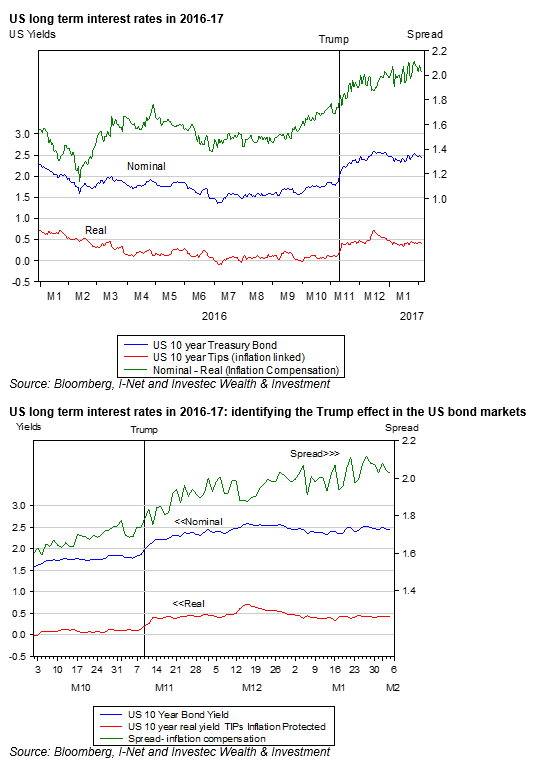
US 10 year yields, nominal and real, after declining to very low levels by mid-year 2016, then began to rise. The Trump election added further momentum but, as may be seen, long term interest rate levels in the US have largely stabilised at higher levels in 2017.


US Yields

Nominal rates are now about 100bp higher than they were in mid-2016 while real rates have gained about 50bp from approximately zero rates in mid-year. Accordingly the spread between the nominal and real yields that offer compensation for the inflation risks that holders of nominal fixed interest bonds assume, has widened. This indicated more inflation expected over the next 10 years, of the order of 2% p.a. The higher real rates indicate increased real costs of capital – a sign of faster growth expected and the increased demands for capital that come with faster growth. Thus the US bond market indicates that both more inflation and faster growth are now expected in the US. The rising US equity markets have regarded improved earnings growth prospects as more than adequate to off-set higher discount rates.

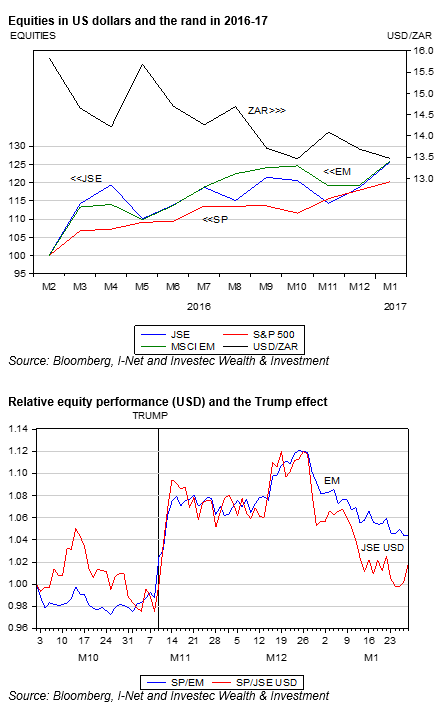
Equities

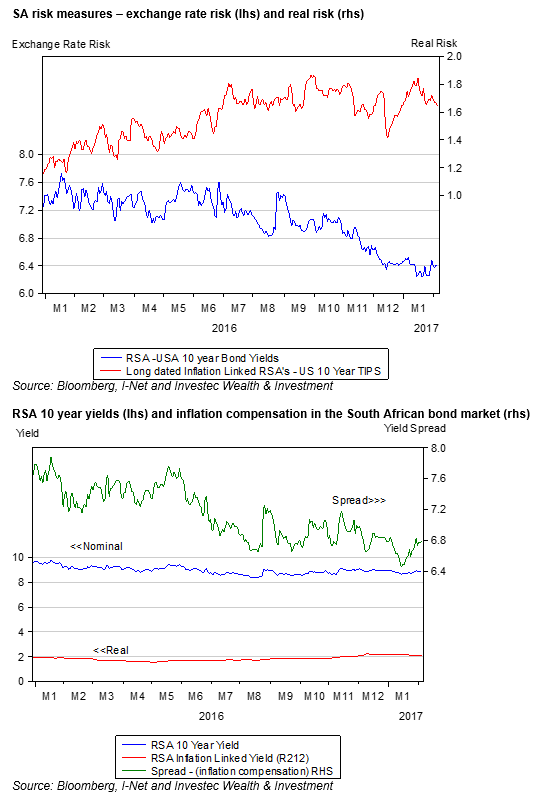
Long term interest rates in SA have taken a somewhat different course to those in the US. As may be seen below, RSA 10 year yields have edged lower while real yields have edged higher. The spread, indicating inflation expected over the following 10 years in the RSA bond market, has generally moved lower, from a very high near 8% in early 2016, to current levels of about 6.5% indicating still elevated inflationary expectations.

That longer term rates in the US have moved higher and equivalent rates in SA lower means that the spread between RSA and US rates have declined. This spread may be regarded as a SA risk premium, the extra yield required to compensate for the expected weakness of the rand, and equivalent to a forward exchange rate.

The difference in real yields may be regarded as the extra, after inflation yield required by foreign investors to compensate them for all the risks associated with investing in SA assets. As may be seen in the figures below, SA risk, that is the rate at which the rand is expected to depreciate against the US dollar, has declined as the rand strengthened, while the real risk premium offered to investors in SA has remained largely unchanged.

SA Risk

The faster the US and global economies are expected to grow the higher the expected rates in the US. But faster growth is helpful for commodity prices and emerging market currencies and equities and their profitability and reduces the risks associated with investing in emerging market economies.

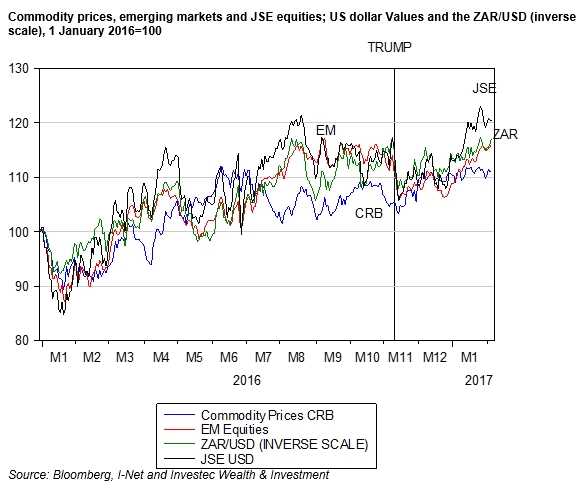
Commodity 2017-02-09_081722

Evidence of these helpful trends is clear enough, as may be seen in the figure above that graphs the similar responses of commodity prices, emerging market and JSE equities over the past year as interest rates have risen in the US.

What remains for the SA economy to benefit from improved outlook for the global economy is for the Reserve Bank to reduce its anxiety about the prospect of higher interest rates in the US and focus its attention on the downside risks to the real SA economy, rather than the upside risks to the rand and inflation, and to lower short term interest rates accordingly (President Zuma naturally permitting – and what he permits by way of his cabinet choices will be known this week).

*The views expressed in this column are those of the author and may not necessarily represent those of Investec Wealth & Investment

No Trump tantrum

Overcoming the Trump shocks and drawing its implications for SA and Reserve Bank action

The Trump shock has been working its way through the markets. Expectations for US growth under Trump were revised upwards, which benefited US equities generally. Emerging market (EM) equities by contrast have suffered both absolutely and relatively, with the JSE in US dollars performing as it usually does, in line with the average emerging market, with both losing about 6% of their pre-Trump US dollar values.

The market and central bank governors have long feared the impact of higher bond yields in the US on EM currencies, inflation and interest rates. Long term RSA bond yields rose immediately, in sympathy with higher US bond yields. But recent interest rate trends in the RSA bond market have proved much more encouraging. Yields have receded as the spread between RSA and US Treasury bond yields have narrowed, leaving rates little changed from their pre-Trump levels. These are helpful trends and indicate that a feared “Trump tantrum” in the RSA bond markets has not materialised.

A related and similarly favourable reaction can be observed in the currency market. The rand weakened against the US dollar, along with other EM currencies, with the Trump election. But more recently the rand has regained its pre-Trump US dollar value and has performed better than the average EM currency since. More important is that the trade weighted rand has gained significant strength as we also show below. The trade weighted rand is now as much as 24% stronger than it was in mid-January 2016. This strength translates directly into lower import and export prices and so less inflation and less inflation expected.

Not all the recent economic news has been encouraging. The latest GDP release for the third quarter indicates that SA growth trends have deteriorated. Spending by households and the government is barely increasing while capital expenditure by private businesses and public corporations declined significantly. The GDP growth rate of a mere 0.2% in the third quarter can be attributed to an extraordinary growth in investment in Inventories in the third quarter that was enough to offset a very poor reading on net exports. A better net export performance in the fourth quarter and beyond may help compensate for a likely decline in inventories.

The economy will have to grow at a minimal 2-3% rate to cause the rating agencies to sustain our credit rating. It will take meaningful growth enhancing structural reforms to raise growth rates permanently to higher levels. These appear unfortunately unlikely and would take time to achieve results.

A cyclical recovery is however distinctly possible and could take GDP growth up to a 2-3% pace. Such a cyclical recovery would have to be led, as it always has to be led, by a significant pick-up in household spending propensities. Households have to spend more to encourage firms to invest more in equipment and people to meet their extra demands. Lower short term interest rates are essential to the all-important purpose of a cyclical recovery.

Inflation in SA is now very likely to recede below the upper band of the inflation targets. There is always a risk that these recently favourable trends may reverse. But there is a much greater probability that the economy will continue to stagnate dangerously, leading to political and economic stability for want of a stimulus to spending. Inflation is no self-fulfilling process in SA. The relevance of so-called second round dangers to inflation that may accompany inflation expectations is a theory for which there is no good evidence. Inflation expected is much more likely to follow than lead inflation as the evidence does reveal.

The Reserve Bank focus, narrative and action should respond accordingly by addressing the downside risks to the economy and lowering interest rates. And by recognising an improved outlook for inflation, rather than to focus further on inflation risks, over which they have no predictable influence. 8 December 2016

Assessing markets after the US elections

The market reacts to a surprising US election. Is more growth expected in the US consistent with less growth in emerging economies? Perhaps not.

Donald Trump’s ascension to the White House surprised the financial markets. The bond markets have recorded the largest surprises. A heavy dose of shock and awe was registered in the Treasury bond market and the shock waves were also felt in emerging bond markets, including the market for RSA bonds. US 10 year Treasury yields ended last week over 30bps higher (as we write on Monday 14 November, the yield is 2.21% p.a). The RSA 10 year also ended the week higher at 9.11% p.a (now 9.17%) or 44bps higher, meaning a slightly wider SA risk spread of 6.95% p.a. – equivalent to the average rate the rand is expected to depreciate against the US dollar over the next 10 years.

The higher rates in the US were not confined to vanilla bonds. Inflation linked yields (TIPS) also moved higher on Wednesday 9 November, revealing that the Trump presidency was expected by market participants to not only bring more inflation but also faster growth; faster growth that was expected to increase the competition for capital, so making capital more expensive in real terms.

RSA yields indicated that more SA inflation came to be expected as real bond yields remained largely unchanged through the week. This indicated that little change in the SA growth outlook was expected. The wider spread between nominal and real RSA bond yields indicated more inflation expected that was consistent with the faster rate at which the rand was expected to weaken. More rand weakness, other things equal, means higher rates of inflation in SA (See figures 1-4 below).

Higher bond yields were also registered in Europe. German 10 year Bund yields that had been negative in October increased from 0.08% p. a. on the Monday to 0.235% by the Friday close, but not by enough to prevent the spread Vs US Treasuries from widening in favour of the US dollar, which made gains against the euro and much more significant gains vs emerging market currencies.

The rand was an underperformer within the world of weaker emerging market currencies. R13.35 bought a dollar on the Monday, but by Friday the USD/ZAR was R14.29, a decline of 6.8% (now R14.39) compared to our equally weighted basket of 11 other EM currencies that declined by a mere 3.8%. The currency market would appear to be pricing in additional SA-specific risks, perhaps associated with Zuma resilience revealed in the no-confidence in the President motion in the SA Parliament that failed on the Thursday.

Other signs that US growth assumptions were being revised upwards came from the market in high yield or junk bonds. These yields remained largely unchanged as the high risk spread narrowed even as Treasury yields rose. Faster growth reduces the risk of credit defaults and the market in high yield credit appeared to be drawing this conclusion.

Other signs of faster growth expected came from the metals market. While the gold and oil prices expressed in the stronger US dollar fell away, the CRB Index of Industrial Metals in US dollar increased by about 5% in the week while the weaker rand compensated to some extent for lower US dollar prices.

The stock markets also told the story of faster growth expected in the US and slower growth expected in emerging economies. The SA component of the emerging market equity benchmark lost over 6% in the week compared to the MSCI EM that ended the week 3.5% weaker. The large cap US S&P 500 Index gained 3.8% while the small cap index did significantly better, gaining over 7%. This move too could be regarded as supportive of faster growth that improves the prospects for riskier small companies.

The best performing sectors on the S&P 500 and the JSE in the week of 7 to 11 November proved to be the highly cyclical plays. Materials and resource companies did much better than the consumer-facing companies that had offered predictable dividend yields, yields and dividend growth that had compared well with what had been very low interest rates. The same direction could be seen on the JSE with the Global Consumer Plays, despite the weaker rand, proving distinct underperformers.

It is however not at all obvious why faster US growth should be associated with less growth expected fromemerging market economies; nor why strength in metal prices should be associated with a deteriorating outlook for emerging economies, including the SA economy. The opposite conclusion might have been drawn as appears to be the case for the Australian economy, which is highly dependent on metal exports.

The growth prospects for the SA economy would not have been improved by the changed outlook for short term interest rates. As we show below, the short term yield curve, as reflected in the Forward Rate Agreements (FRAs) offered by the banks, moved sharply higher last week. The money market, having much reduced the chances of higher short term rates earlier, has reversed course. The market is now expecting a further 75bp increase in the Reserve Bank repo rate. Such increases, where they to be imposed on the already hard-pressed SA economy, would eliminate almost any possibility of a recovery in household spending, a necessary condition for a cyclical recovery. The bond market is expecting more inflation to come and the weaker rand expected is consistent with such a view.

Yet the USD/ZAR, while now weaker, is stronger than it was in early 2016, indicating stable import prices. Furthermore the outlook for much lower food price inflation should see headline inflation and Reserve Bank forecasts of inflation recede well below the upper band of the inflation target in 2017. The case for higher policy-determined interest rates, given a further slowdown in the economy, is even weaker than it has been, even though the market may now believe otherwise of the Reserve Bank.

Lower inflation, should it materialise, will lead inflation expected in the same lower direction. The causation runs from inflation to inflation expected and not the other way round as the Reserve Bank has argued. Inflation takes its cue from the exchange rate and is much affected by the weather and the actions of the President. These are forces over which interest rates and the Reserve Bank have no predictable influence. The Reserve Bank should concentrate on what it can do to assist the growth prospects of the economy and that is to lower interest rates. Inflation is beyond its control; a fact of economic life in SA that is overdue official recognition but may yet receive it. 15 November 2016

The market is a lot less scared of Trump than the pundits

The punditry not only greatly underestimated the presidential chances of Donald Trump, they also misread the implications of the known election outcomes for the financial markets. Far from the predicted rush for safety in the US dollar, US Treasuries and defensive stocks, the market, when given the opportunity, pushed US bond yields higher, indicating that faster growth and more inflation was to be expected post Trump (the 10 year Treasury yield initially increased from 1.85% to 2.08%, though it closed at 2%).

Further evidence of positive expectations of faster growth came with the outperformance of resource companies, including those listed on the JSE. The performance of the 12 sectors that make up the S&P 500 is shown below. Financials and Healthcare (expected to benefit from less obtrusive regulation and executive action) as well as Materials ( to benefit from growth and investment in infrastructure) were outperformers while sectors that offered protection against a weaker economy, including Consumer Discretionary and Staples underperformed as did interest rate sensitive sectors of the New York stock market.


Emerging markets, a risk off trade, did come under initial pressure, led by the Mexican peso, a currency especially vulnerable to any protection provided for US manufacturers, lost 8.8% of its US dollar value on the day. The rand ended 1.8% weaker while the Brazilian real was 2% weaker. The 10 year RSA yield moved higher, from 8.64% to 8.78%, leaving the risk premium vs US bonds at an unchanged and recently improved 6.79%. The MSCI Emerging Market (EM) benchmark in US dollars ended 2.5% weaker on the day, compared to the JSE that was 1.3% weaker in US dollars and 0.5% up in rands.

These outcomes must be regarded as satisfactory for EM financial markets, including those measured in rands. The exchange value of the rand has held up more than well enough to sustain a forecast of lower inflation and interest rates to come- essential for faster growth in SA.

What the pundits missed is that while Hillary Clinton represented business as usual for the US and its allies, business as usual under Obama had become increasingly less friendly to business. US and global business have come under increasing suspicion and hostility from more ambitious and obstructive officials emboldened with ever greater executive powers. The Trump administration, with the aid of a friendly Congress, could achieve some quick wins for US business by annulling or at least amending financial and environmental legislation and practice, as Trump had promised to do. The grossly dysfunctional US corporate tax system is an obvious target for a complete restructuring in ways that would be helpful to the owners of business in general and to the economy at large – though these are not necessarily synonymous.

Free trade for example (against which Trump argued and which helped him bring in the vote on the rust belt) is very good for consumers and their standard of living. Cheaper and better air conditioners produced in China have made living in the US South a lot more comfortable, for example. But they have not been helpful to the owners of air conditioning factories in the US or to the employment benefits of their employees. Protection unfortunately can be good politics and good for business owners, but not necessarily for their customers. Though if free traders are seeking consolation they may find it in the prospect of freer trade in services, with a far larger role in the economy (including the SA economy) than manufacturers. Exchanges conducted not over the waters but over the internet and are much more difficult to tax.

The Trump triumph, it should be appreciated, represents a successful attack on the conventional wisdoms and actions that have guided social and economic policies in the US and Europe. How wise and fair this consensus actually is, is a matter of very divided opinion as the US election has demonstrated. Given the opportunity provided by the highly unorthodox Trump, large numbers of Americans voted in effect against the comforts of the ruling establishments inside and their supporters outside Washington DC. Their discomfort in recent events is understandable and clearly geo-political risks are enhanced. Perhaps even the risks to the environment have increased. But the risks to doing business in the US and its growth prospects have as clearly declined, as the market has told us. 10 November 2016

The markets after Brexit

Brexit is now seemingly a non-event for the global economy and its financial markets. A move to less quality in financial markets may be under way.

Brexit came as a large shock to the markets – but within two days of extra anxiety and an equity sell off – the Brexit effect came to be almost immediately reversed. Stock markets are now well ahead of where they ended on 24 June and are ahead of levels reached on 30 May. The benchmark MSCI Emerging Market Index on 14 July was 7.5% up on its 30 May level, fully accompanied by the JSE All Share that had lost over 12% per cent of its 30 May value (in US dollars) in the immediate aftermath of Brexit. The key S&P 500 Index has also recovered strongly. A feature of the equity markets in 2016 has been how unusually closely the developed and emerging stock market indexes have been correlated with each other when measured in US dollars (see figure 1 below).


The VIX Index that measures share price volatility on the S&P 500, simultaneously and consistently moved strongly in the opposite direction, while volatility on the JSE measured by the SAVI has remained elevated, consistent with the sideways move in the JSE when measured in rands rather than in US dollars. The volatility of the stronger USD/ZAR exchange rate has remained elevated as has, to a smaller degree, the realised volatility of the USD/EUR (see figures 2 and 3 below).
With renewed strength in emerging market equity and (especially) bond markets, emerging market currencies have shown strength against the US dollar, as we show below. We also show that the rand has performed better than the average emerging market currency, represented as an unweighted average of nine other emerging market currencies, excluding the rand and the Chinese yuan, as well as the Korean won and the Singapore dollar that enjoy a somewhat different status to the representative emerging market. The rand has gained about 10% against the US dollar and about 6% against the emerging market average since 30 May, as may be seen in figure 4.


A more risk-tolerant market place in the aftermath of Brexit has not only been helpful to emerging markets generally, but it has proved particularly helpful to the rand and the market in RSA bonds. As shown below, default risk spreads have receded for emerging market bonds, including RSA US dollar-denominated bonds. Judged by the spread between RSA yields and those of the high risk EM Bond Index, SA’s relative credit rating has improved recently as shown in figure 6.


A further important spread, that between RSA 10 year rand yields and US Treasury 10 year bond yields, has also narrowed as long term interest rates in developed markets and in emerging markets receded in the wake of Brexit. This spread represents the rate at which the rand is expected to weaken against the US dollar over the next 10 years (see figure 7 below).

The fact that most government long term bond yields declined further and immediately in the wake of Brexit – including gilt yields in the UK – indicated that Brexit was not regarded as a financial crisis, but rather as an indicator of slower global growth and less inflation to come. This conclusion was also evident in the decline in inflation-linked bond yields to very low levels.

This decline in the cost of funding government expenditure (especially in the form of negative costs of borrowing for up to 10 years for some governments) can be expected to encourage governments (not only the UK government) to borrow more to spend more and to attempt to reverse the austerity forced on them by the Global Financial Crisis of 2008 and the subsequent Euro bond crises, that were such a particularly expensive burden for European taxpayers. That burden of having to meet ever larger interest rate commitments has become something of a bonanza for European governments, faced as they are with a fractious electorate.

The sense that less austerity is now more firmly in prospect may have led investors to price in less risk when valuing equities. We have argued that a high equity risk premium is reflected in the value of the S&P 500 Index when valuation models that discount S&P earnings and especially dividends with prevailing very low interest rates. Still lower discount rates after Brexit may help explain the higher equity values. A search for yield in emerging bond markets, driving emerging market discount rates lower, may explain why more risky emerging market equities have also added value.

The very recent economic news moreover has been surprisingly good, rather than disappointing. The trends in the US economy have been particularly encouraging. The Citibank Economic Surprise Index for the US has moved significantly higher with the stronger S&P (revealing more data releases ahead of rather than behind consensus forecasts) (See figure 8 below).

The very recent news from China is that stimulus there has been working to stabilise GDP growth rates. Such more positive indicators of global growth will also have helped to modify what was already a high degree of global risk aversion before the UK referendum. Commodity prices, of particular importance for emerging economies and emerging equity markets, have recovered from depressed levels in January and have stabilised recently after Brexit (see figure 9 below).
This strength in emerging markets may be regarded as something of a reversal of the move to quality in equity markets that has so dominated equity market trends in recent years. A marked preference has been exercised for shares with bond-like qualities, revealed in the form of predictably defensive earnings flows, accompanied by relatively low share price volatility. These are qualities more easily found in developed markets but capable of adding to well above average price earnings multiples to favoured companies in emerging markets, including on the JSE. The JSE, by market value, has come to be dominated by relatively few companies with a global rather than a SA economy footprint. And the price-to-earnings ratios of these companies has risen markedly, dragging up the multiples for the JSE as a whole. We have described this class of shares that are well hedged against the rand and SA economy risks, as Global Consumer Plays.Chris Holdsworth in his Q3 Strategy Review for Investec Securities, published on 13 July has identified these trends – a preference for quality in response to lower interest rates that have left the average share price to earnings ratios well behind the elevated few (see figures from Investec Securities below).

Any further move away from quality will be very welcome to emerging market currencies, bonds and equities. It would be very helpful to the exchange value of the rand and the outlook for inflation and interest rates. It would be especially helpful to the SA economy plays that have so lagged the high quality Global Consumer Plays in recent years. Rand strength for global as well as SA-specific reasons could reverse such relative performance. Less quality may come to offer better value should global risk tolerance, even though justifiably elevated, continue to improve as it has done since Brexit.

Making sense of S&P 500 valuations – a dividend perspective

Is the best measure of past performance on the S&P 500 Index earnings or dividends per share? It can make a big difference

Our recent report on S&P 500 earnings per share indicated that, adjusted for very low interest rates, the S&P 500 Index at June month end could not be regarded as optimistically valued, even though earnings had been falling and the ratio of the Index level to trailing earnings was well above average. Since then, the Index has marched on to record levels (helped by still lower long-term interest rates) to support this proposition of a market that was not very optimistic about forward earnings.

The case for regarding the key US equity market as risk averse rather than risk tolerant would be enhanced, should S&P 500 dividends rather than S&P 500 earnings be regarded as a superior measure of how companies have performed for their shareholders in recent years. As we show below, S&P 500 dividends per share have continued to increase even as earnings per share have declined, while the growth in dividends declared has remained strongly positive even as the growth rate has declined (figures 1 and 2 below).

Clearly the average listed US large cap company has been paying out relatively more of the cash it has generated (and borrowed) in dividends – rather than adding to its plant and equipment. The pay-out ratio (that of earnings to dividends) has declined from the over three level in 2011 to less than two times earnings recently (see figure 3). This, presumably, is more of a problem for the economy than for shareholders, especially when interest income has come under such pressure.

When we run a regression model to explain the level of the S&P 500 Index using dividends discounted by long term interest rates, the Index appears as distinctly undervalued for reported dividends on 30 June 2016. This is more undervalued (some 30% undervalued) than in a model using Index earnings as the measure of corporate performance – as demonstrated in our report of Monday 11 July (see figure 4 below).

On the basis of the dividend model, the market has been pricing in a high degree of risk aversion. Or, equivalently, it has been demanding a large equity risk premium to compensate for the perceived risks to earnings and dividend flows (the larger the equity risk premium, the lower must be share prices – other things held the same, that is trailing earnings or dividends and interest rates – to compensate investors for the perceived risks to the market).

The equity risk premium can be defined directly as the difference between the earnings or dividend yield on the Index and long-term interest rates. The larger these differences in yields, the larger the equity risk premium and the lower share prices will be. An undervalued market, as indicated by the negative residual of the dividend model as shown above, where the predicted (fitted) by the model value of the Index is far above the prevailing level of the market, indicates a large equity risk premium. In figure 5 below, we compare the residual of the earnings and dividend models with this equity risk premium. As may be seen, they describe the same facts: a large equity risk premium accompanied by an undervalued market and vice versa.

These equity risk premiums or under-/overvalued markets – relative to past performance, adjusted with prevailing interest rates – may prove justified or unjustified by subsequent performance, reflected by future earnings and dividends declared. Disappointing or surprisingly good earnings and dividends may flow from listed companies. It would appear that despite the record level of the S&P 500 and record levels of dividends, shareholders are currently very cautious rather than optimistic about earnings and dividend prospects.

Their expectations of dividends and earnings to come have become somewhat easier to meet. There is perhaps more safety in the market at current levels than is generally recognised.