The future shape of the AI advanced labour market has become a known unknown.

November 4th 2025

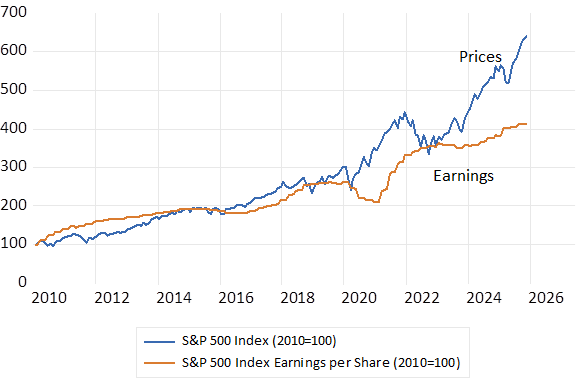
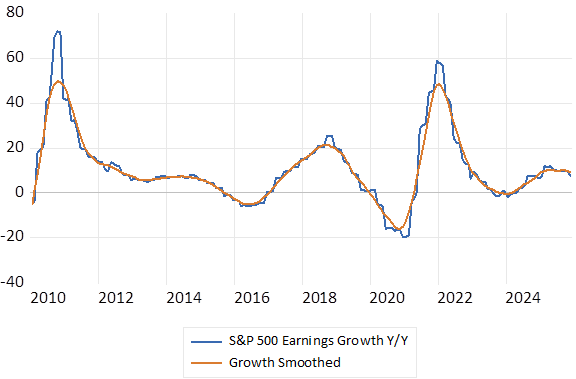
The US economy, judged by the flow of quarterly earnings reports from its leading companies is in very good shape. S&P 500 Index earnings have grown by about 8% over the past year. And the analysts are expecting further growth in earnings over the next twelve months- as much as an additional 14% by this time next year. Sales are growing and profit margins remain at highly elevated ratios. Fears of recession have proved greatly exaggerated.

And the prospect of further reductions in short term interest rates is still widely anticipated. Though several of the major employers, despite their impressive top and bottom lines have publicly revealed a deep reluctance to hire more workers. A wait and see approach to employing more workers and managers seems to be a widely adopted strategy by US business – understandably so. Waiting to see more clearly what the future of adopting AI means for their work forces seems an eminently sensible approach for all businesses everywhere, including South Africa to take.

And so the Fed – the US central bank – has a dilemma. And not only because the government shut- down has denied its policy makers the usual flow of updates on the state of the labour market. There may well be something much more fundamental at work that makes the conventional Fed play book much less useful.

              The Fed has a dual mandate- it is instructed to control inflation and to maximise employment with its interest rate and asset purchase settings. And while the prices of goods and services are still presumably subject to the usual somewhat predictable supply and demand forces – the labour market may not be – given the hard to predict pace of adoption of AI. The relationship between the state of the economy and the state of hiring and firing may be changing in a fundamental way- at least for now.  As may the link between wage rates, costs of production and prices charged may change. More (or less) demands for goods and services may not translate into coincident demands for workers. And so lowering interest rates to encourage demand for goods and services may be further good news for the revenue and profit lines of US business and lead to higher prices – without doing much to raise employment levels. If so, the case made now in the US for lowering interest rates is weaker.

That access to AI and AI empowered robotics will make workers of all kinds – those behind computers or assembly lines or down mine shafts more productive and safer is indisputable. As has been true of technological advances in the past made with the aid mostly of improved mechanics rather than computing power. Workers clearly produce more when complemented by more and better tools. But for additional profit margins, including covering the cost of the extra capital utilised, to translate into higher rewards for workers requires a relative shortage of workers. And competition for them. It is this competition for relatively scarce labour that has raised the rewards for work, enough for the average worker to consume more leisure – that is to work fewer hours. 

Or the adoption of AI might lead to an excess supply of potential workers enough to drive down the rewards of the average, insufficiently skilled worker. While the same forces help promote the exceptional incomes of a highly skilled and productive few. For example, the million dollar a year AI engineers now eing paid ever more handsomely to move from one AI firm to another.

Among the beneficiaries of more profitable, perhaps less labour-intensive technology, would include the owners of the more profitable firms- the employers of the AI and the computing power. Including include among the owners the many members of retirement and pension funds with valuable shares in the AI success stories.  Who may then be called upon to shield those unable to find decent jobs- to reduce inequality – as will be argued- with higher taxes.

One however can be optimistic about the impact of increased productivity on economic outcomes. Intense Competition to apply the technology and to scale up production for additional profit will mean more produced, lower prices and improved service. Lower prices and greater convenience greatly encouragers demand and demand for not only robots but also humans to supply a growing market. Think of Uber as an example. The convenience and price of E hailing has grown the market for a taxi service and the number of drivers. Another example might help.  If cutting the lawn or your hair took a third of the time and a sixth of the current cost, we would surely trim more frequently and spend more time in the gym.  The demand for AI advanced hair or lawn dressers who can share your woes, might well improve rather than decline. Hairdressing for boys does incidentally seem to be a growth story.

S&P 500 Index and Index Earnings per Share. (2010=100)
Source; Bloomberg and Investec Wealth & Investment

The S&P Earnings Cycle (2010 – October 2025)
Source; Bloomberg and Investec Wealth & Investment

Noble ideas.

The Nobel prize committee for economics has focused most helpfully on the causes of economic growth. In making its 2025 award it made the following observation.  

Over the last two centuries, for the first time in history, the world has seen sustained economic growth. This has lifted vast numbers of people out of poverty and laid the foundation of our prosperity. This year’s laureates in economic sciences, Joel Mokyr, Philippe Aghion and Peter Howitt, explain how innovation provides the impe­tus for further progress.

Technology advances rapidly and affects us all, with new products and production methods replacing old ones in a never-ending cycle. This is the basis for sustained economic growth, which results in a better standard of living, health and quality of life for people around the globe.

However, this was not always the case. Quite the opposite – stagnation was the norm throughout most of human history. Despite important discoveries now and again, which sometimes led to improved living conditions and higher incomes, growth always eventually levelled off.

The conditions for economic success in which innovation – changes in economic practice that makes humans more productive – should not be mysterious – given many past failures and some notable and recent successes all well documented including by our most recent laureates.

The recipe for success is for society to recognise and depend upon the essential nature of homo economicus- that is the powerful desire of individuals to improve their own economic circumstances, and to nurture their opportunities to do so without fear or favour. Too encourage the inventors, the innovators, the creative types more generally, those who challenge the economic status quo which is valuable to those who benefit from it. A highly competitive process long described as “creative destruction” must be tolerated if an economy is to grow. An acceptance that jobs lost or threatened by change are exchanged for better jobs gained. As the Competition Authorities in SA seem are unable to recognise. Protecting jobs – protecting businesses and the valued status quo -is a path to stagnation.

Free competition in all its forms through innovations and improved application of science and knowledge- technology can promote widely improved standards of living in all its guises, including improved hygiene and medical treatments.  More capital, more and better plant and equipment, combined with improved technical knowledge – makes labour more productive, hence relatively scarcer and capable of earning more.  As the hirers of labour compete for their services that become more valuable over time. There is no other known way to eliminate the scourge of poverty. Other than to rely on market forces in which all are welcome and encouraged to compete in, on their merits, as judged by the final arbiter of success, the spending decisions of households.

Important for society is to protect the wealth created through successfully challenging orthodoxy against expropriation or violent seizure or penal taxes and regulations. For society to be willing to vigorously protect rights to wealth (property) accumulated over time. Including protecting intellectual property that is such an important source of incomes and savings. And therefore, to accept degrees of income inequality as the inevitable consequence of economic progress. Recognising that unequal rewards for unequal efforts are necessary to the purpose of an improved standard of living for all.  

Innovation can be a costly, exercise planned by a business. Spending by firms on Research and Development and in training the workforce will be designed, as will be all spending on plant and equipment (capex) to enhance production and profit for its owners and managers. Helpful changes in practice may be forced on a firm in response to the initiatives taken by their competition. Or profitable changes in methods of production and distribution may best be initiated by the workers and managers of the firm itself. Innovations that gain sales and profits and the attention of the free to spend (after taxes) household. Continuous adaptation to change driven by the competition for economic gain by individuals is essential for the survival of any business in a free to compete economy.

The importance of best practice has become highly obvious given the revolutionary scale of recent developments in IT. Developments that are highly threatening to the established order of doing business. These developments now represent the most important form of the competition to anticipate how households will come to spend in the future. Wisdom would be to allow unfettered competition to determine these outcomes in the usual evolutionary way.

Creativity is vital for the survival of the fittest and not only when delivered in heroic proportions by rare start-up success. Careers in well-established businesses should be advanced by the successful application of good ideas that originate with valued, well trained motivated and appropriately rewarded employees. Innovation in human resource management is very important. The largest risk any potential business manager takes is the risk of undertaking a lifetime of work under the wrong leadership that fails to adapt to competition -the life blood of economic progress.