Some accidents are worse than others. Say thanks to the SA taxpayer.

The Road Accident Fund (RAF) has been much in the news, for the usual dispiriting reasons. The RAF is a very important, tax funded spender. It manages great complexity with over R50 billion of revenue and expenditure a year. A formidable amount that the Treasury expects to increase at an annual average rate of 19% p.a. over the next three years, from R53.1 billion in 24-5 to 89.7 billion in 2027/28.

The RAF, as a social service, and  its 50 plus billion bill  can be compared favourably, or is it unfavourably, with other kinds of tax funded expenditure. The old age grant now runs at 117bn, and the child support grant at R90.4b in a Social Development Budget of R422b. The RAF is estimated by the Treasury to have a negative asset value (liabilities over assets of R370b – rising to R423b by 27/28) Can South Africa afford such largesse? Could not other spending make a better claim? Or lower taxes be a better idea and win more votes than the RAF?

Fall off your bike or the mountainside, get bitten by a shark or a snake, drown in the sea river or lake and society commiserates and hopes your damages are covered by some insurance.  Society cannot hope to do much more for the victim given a lack of resources.  But, get unlucky on the road, have a car push you off your bicycle, or the pavement, and SA society comes to the rescue- very expensively.

The payments by the RAF are funded by a levy on the price for petrol and diesel, set at R2.18 rands per litre of unleaded petrol. That is now about ten per cent of the price paid at the pump.  A stealth tax paid for benefits the wider public surely does not recognise very well. How many drivers/taxpayers are aware of how much they are paying for the RAF when they fill up. And who, other than the successful claimants on the fund, are aware of the scale of the benefits provided? Bad luck is not expected. It sadly just happens

Compulsory third party insurance elsewhere is typically covered by private insurance companies and the premiums they raise from vehicle owners. As it was once long ago in South Africa until superseded by the RAF – mistakenly surely.

According to the report of the RAF for 2023- 04, there were 79,377 new claims registered that financial year, and 63,015 claims settled. The average claim on the Fund had grown by 9.5% to R287,000. 159,122 such claims were made in 23-24, a sharp decline from the 374,000 claims made in 2019.

Total outlays of the RAF were R45 600 million in 2023-04, of which payments made to compensate for incomes lost were R21.6b, or a chunky 47% of all payouts. The average claim for earnings lost was R1.2m, So called general damages paid amounted to R12.7b or 28% of total payments made.

The Fund, out of financial necessity, has succeeded recently in reducing the number of personal claims made and improving the rate at which claims are paid out. And in reducing legal fees incurred. The sums paid out have increased at a slower rate from R42b in 2019 to R45.6b in 2024.

Further slowing down the growth in payouts is essential. A first step would be to ensure that the loss of future income, inflation adjusted, was appropriately discounted by the high after realised inflation yields available from the RSA available to any beneficiary with a lump sum pay out. Somewhere close to a real and certain 5% p.a. for ten years.  

On a claim for the allowed maximum R350,000 of annual income lost, for say an agreed ten years, to which an agreed inflation rate of say 5% p.a. were added each year, the payout, equal to the present value of the future agreed income losses would be R3.4m  when applying an 8% discount rate (5% inflation + 3% real)  or close to R3m, R400,000 less when using a higher discount rate of 5 % p.a. above inflation.

Still much less would have to be paid out were the years of lost income more strictly limited, and the income inflation rate were assumed to be much lower. The accident victim could moreover be forced to buy a monthly annuity in exchange for the larger lump sums agreed. A regular source of income would be more socially desirable than a lump sum easily squandered. Insurance companies could compete for the lump sum provided by the RAF offering an annuity to be administered by them on behalf of the client. And collect the income tax due, as they do with any administered pension. A further way to reduce the net cost of the RAF.

The liability for the annuity offered would likely be matched by the insurer purchasing a government bond of similar duration. Hence helping to fund government debt, perhaps less expensively. Most important, vehicle owners could be encouraged to substitute private accident insurance for the RAF. It would need tax incentives to have them convert. The savings for the taxpayer of private third-party insurance could be immense. The RAF law would have to be amended to allow some of these changes essential for fiscal sustainability.  
A mid-year Report Card for the SA economy and its capital markets. Still a failing mark but some positive signs.

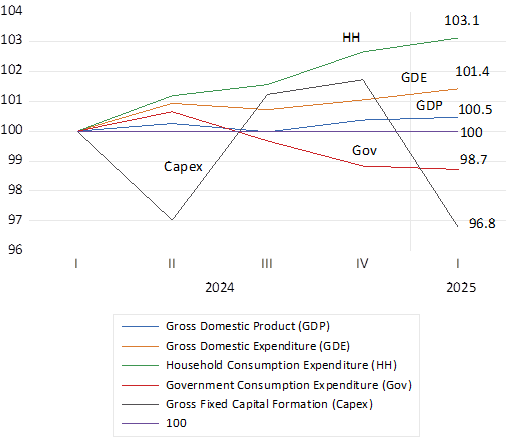
The real economy continues to make little progress, according to the latest National Income estimates for Q1 2025. Output (GDP) has stagnated, higher by a mere half of one per cent since Q1 2024.  The expenditure side of the economy (GDE) has consistently fared as poorly, up by 1.5% since then helped to a small degree by a 3.1 per cent increase in household consumption. Government consumption expenditure, that excludes the welfare grants in cash that find their way into household spending, has also been a drag on the economy. Down by 1.3%, while a bigger drag on growth has been capital expenditure by firms and the government that is now 3.2% lower than it was in early 2024. A baleful reality that seems to resonate everywhere except at the Reserve Bank.

South Africa; National Income Flows Quarterly Data 2024-2025 (2024=100)

Source; SA Reserve Bank,  Investec Wealth & Investment. (Quarterly seasonally adjusted data at constant prices)

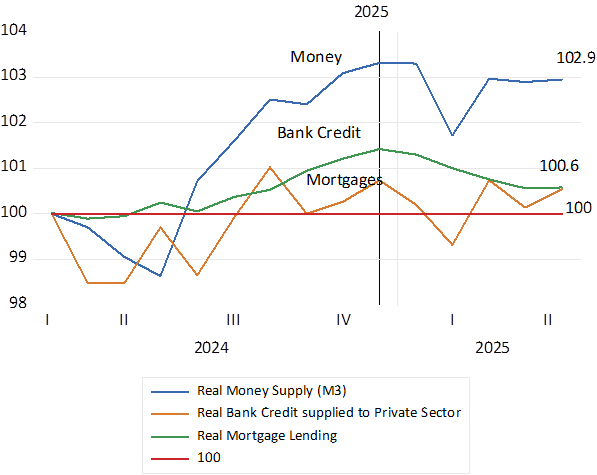
The lack of demand is easily explained by the money supply (bank deposits) and the credit supplied by the banking system. In 2025 the money supply and supplies of bank credit and mortgages, adjusted for inflation, have been in retreat and are barely above levels of early 2024. Clearly the lack of demand for money and credit  can be explained by their high real costs.

Money Supply and Bank Credit Adjusted for Inflation; Monthly Data (2024=100)

Source; SA Reserve Bank,  Investec Wealth & Investment.

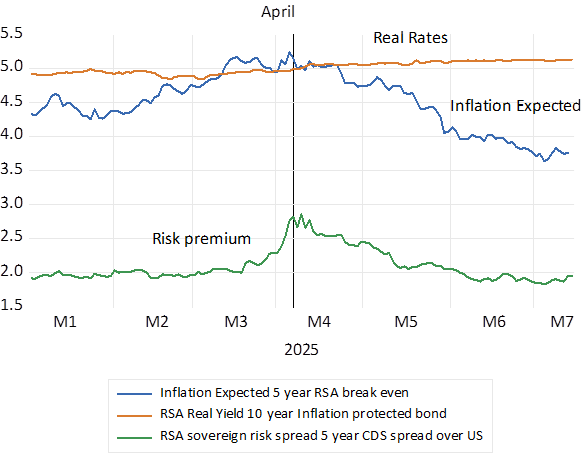
One notable improvement in financial conditions has been the decline in the inflation rate to below 3% p.a.  Perhaps even more worthy of notice is the decline in longer term interest rates since April, when the anxieties about the Budget and the survival of the GNU were at their most intense. The 10, 5 and 1 year bond yields are off by 128, 89 and 25 basis points respectively. Truly big moves at the long end. Largely because expectations of inflation in SA have been revised significantly lower.

Inflation expectations are implicit in the differences in the yield on an inflation exposed bond and its inflation protected equivalent. These differences in nominal and real yields for five-year RSA’s have declined impressively from 5.14% p.a. in April 2025 to 3.75% this week. Perhaps because the Reserve Bank has committed itself to a 3% inflation target. But more likely because inflation itself has receded so sharply. Inflation leads and inflation expected follows – not the other way round – as the Reserve Bank likes to contend.

However, the SA specific risks explicit in bond yields, while 50 bp lower than they were in April are still highly elevated, now just under 2%. For five year RSA’s. And the fully inflation protected RSA 10 year bond yield remains above a risk infused real 5% p.a. This implies a very high real cost of capital for SA business that suffocates capex spending, especially when demand for the goods and services they produce remains so depressed – and is expected to remain so. And when short term borrowing costs are not expected to decline by more than 25 bp over the next 12 months.

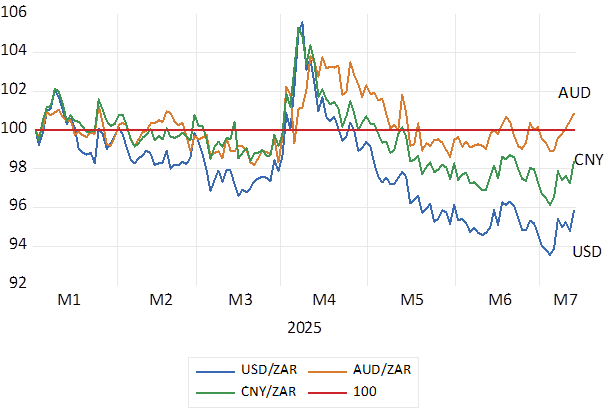
Inflation is down because demand for credit with which to buy is severely repressed. And because the rand has maintained its strength against most currencies. And in line with the bond market the ZAR has strengthened significantly since April 2025 for GNU related reasons. It is noticeable that the rand has weakened against the Chinese Yuan (our largest trading partner) at no more than an average about 1% p.a. rate since January 2021. One reason why Chinese motor cars are as cheap as they are. (despite Tariffs)

The ZAR Vs the USD, the Aussie and the Chines Yuan. (2025=100) Daily Data to 14th July 2025.

Source; Bloomberg, Investec Wealth & Investment

Real Rates, Inflation Expected and the RSA risk premium. Daily Data 2025

Source; Bloomberg, Investec Wealth & Investment

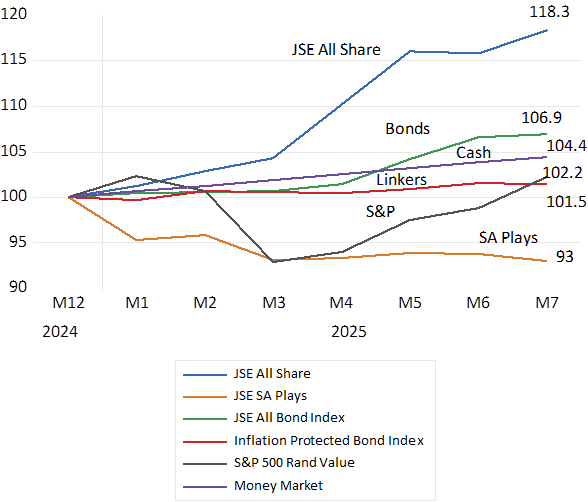
The stock market has nevertheless brought some welcome cheer. The JSE All Share Index has returned a whopping 18% this year. This run has everything to do with precious metals- platinum and gold in that order. Though the performance of the SA Economy Plays on the JSE reveals the dismal reality of a stagnant economy. The return on my constructed Index, market value weighted, of SA plays that includes the slow growth defying Clicks and Capitec, is down by seven per cent this year.

Growth can improve with governance and supply side reforms and less SA risk. Including reforms that can get more gold and other minerals legitimately out of the ground. Common cause surely.  But faster growth needs the essential accompaniment of a more sympathetic monetary policy. That would hence reduce SA risk, sustain a stronger rand and lead to less inflation. Three per cent inflation is possible without squeezing further life and growth out of the demand side of the economy.

Total returns from the different SA Asset Classes in 2025. Month end data. (January 2025=100)

Source; Bloomberg, Investec Wealth & Investment