Brian Kantor
January 2026.
The past 300 years have delivered an unprecedented improvement in the human condition. Full details of this extraordinary and mostly underappreciated human achievement can be asked of the chatbots. From which a few key statistics are worth repeating.
“In 1820, it is estimated that around 85% of the world’s population lived in extreme poverty (defined as living on less than $1.90 a day). In the 18th century, global life expectancy was around 30-40 years. By the 20th century, life expectancy had risen dramatically to about 60-65 years, and as of 2021, the global average life expectancy is estimated to be over 72 years. This increase reflects improvements in healthcare, nutrition, and living conditions. In the US Real GDP per Capita was approximately $2,000 (in 2018 dollars). By 2021, this figure had risen to around $70,000. The establishment of public health systems, advancements in medical technology, and the introduction of health insurance have greatly improved access to healthcare services, lowering infant mortality rates and addressing chronic illnesses”
Clearly the growth in incomes depended on the application of improved methods of production and increased competition for more productive workers. It depended on the successful application of science and technology by the owners, managers and employees of the essential agents of economic change. That is the privately owned business organisation. Progress through innovations as adopted by businesses. In response to households whose demands for goods and services largely determined which businesses succeeded and those that failed to survive the profit test of the market.
The growth advancing actions of businesses large and small that were left largely free and to challenge established economic interests. And were allowed to enjoy most of the fruits of their success. In the form of incomes and rewards that were unevenly distributed in proportion to the talent and perhaps even the luck of the agents of change. Who in turn were protected to a large degree against fraud or theft or violent expropriations by laws equally applied to all.
The founding fathers of the US constitution were keenly aware of the good they could do for a self-reliant citizenry, when left largely to their own devices. The perennial criticism of the market led economy, with so much proven potential, is that the economic outcomes and benefits are not equally shared. Even when the bottom twenty per cent of the income earners are much better off than they would otherwise be. And when the alternatives to a market led system – an economic system directed by governments – have consistently failed. Yet unequal rewards for unequal effort are the necessary incentives that drives successful innovation and risky ventures and economic growth.
But the very success of the market led economy has opened the opportunity to provide redress. One regular feature of all successful economies is the growth in the transfers of money and benefits in kind extracted from taxpayers and transferred by governments to the relatively poor. Transfers of revenue in cash and kind have become a growing burden on the incomes of the relatively successful. And continue to act as a powerful disincentive to work and to save and to invest in children for old age.
The politics of welfare will determine how much will be redistributed and what the trade-offs are – higher taxes for less growth and less tax revenue leading to more government borrowing and probably more inflation. Yet the beneficiaries of the welfare system and its protectors and promoters extend well beyond its direct recipients. The administrators of welfare clearly value their incomes and benefits and revel in their power to give to or refuse their supplicants. As do the many more NGO’s and researchers that compete to deliver the vast welfare budgets. The welfare – industrial complex is an influential, vast and growing one. Including in the US.
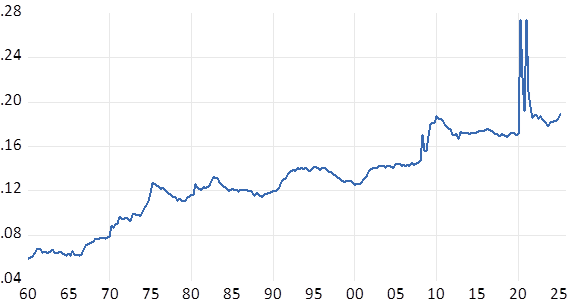
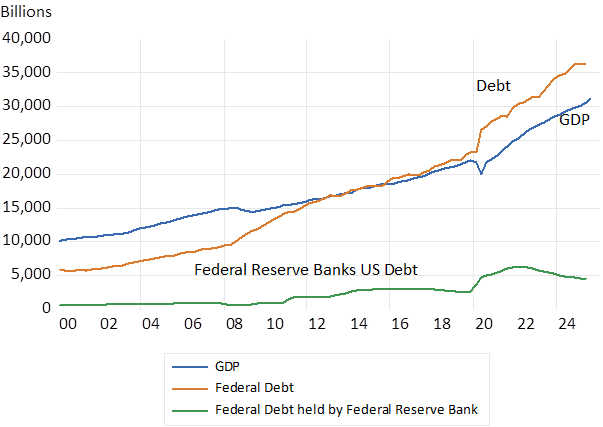
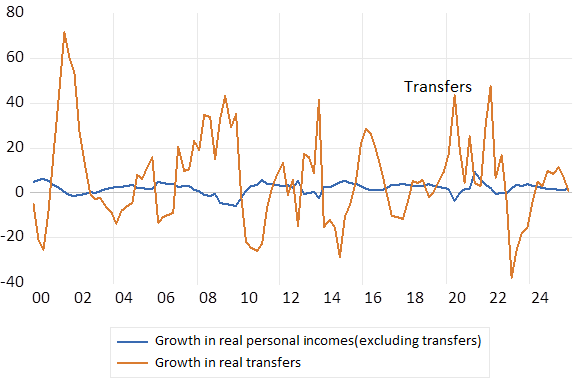
The share of all US personal incomes provided by transfers from governments has come to exceed 20% It was `12% in 2000 and 4% in 1960. The importance of personal income in the form of transfers from taxpayers received a huge boost from Covid. Real transfer spending is growing at double the rate (6% p.a. on average since 2000) of other sources of growth in personal incomes. (growing at about 2% p.a.) US Federal Debt is now over 120% of GDP – compared to a 60% ratio in 2010. And the Federal Reserve Bank funds (monetises) about 20% of this debt. Can economic growth and democracy survive a culture of increasing dependence on the US State?
Yet a burst in productivity thanks to AI and de-regulation and large infusions of venture capital so abundant in the US could still come to the rescue.
US; Share of Transfers in Personal Incomes. 1960-2025.
Source; Fred- Federal Reserve Bank of St.Louis and Investec Wealth & Investment.
US; GDP and Federal Debt (USD Billions) 2000-2025
Source; Fred- Federal Reserve Bank of St.Louis and Investec Wealth & Investment.
US Real Growth in Personal Incomes (excluding transfers) and Real Growth in Transfer Payments. 2000-2025. Quarterly
Source; Fred- Federal Reserve Bank of St.Louis and Investec Wealth & Investment.